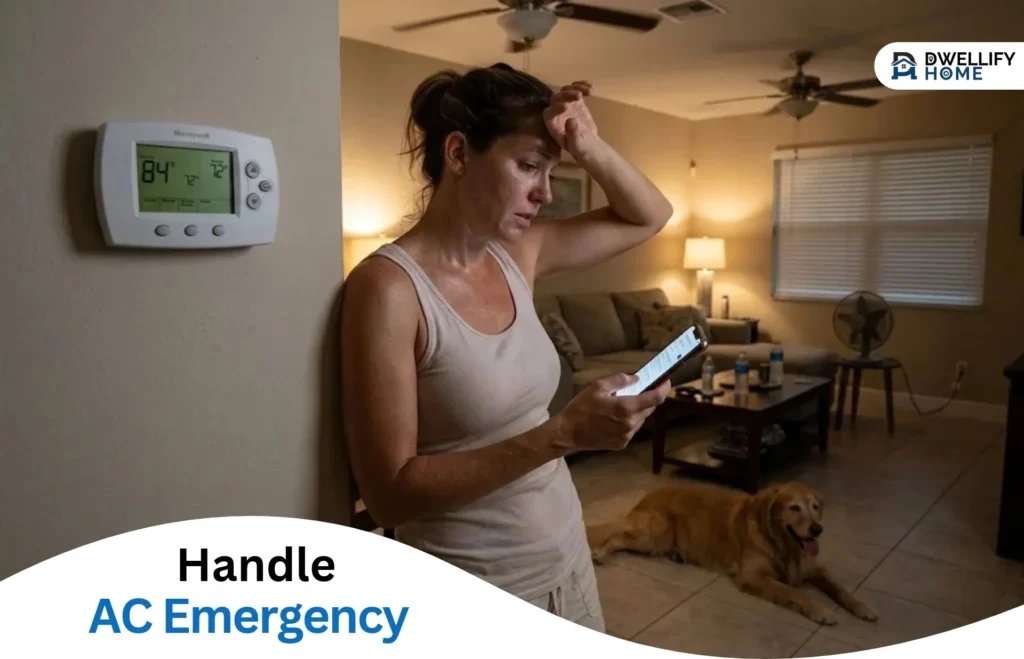
Your thermostat reads 84 degrees at 9 p.m. and the air coming out of the vents feels like nothing. That’s the moment most homeowners panic dial the first number they find, and that’s exactly how people overpay or wait two days for a fix. I’ve watched neighbors in Boca Raton do this three summers running. The house turns into a sauna, the dog gives up on the tile floor, and nobody has a plan.
Here’s the plan. A heat wave AC failure is a sequence, not a scramble: you confirm the problem is real, you protect the house, then you call with information that gets a tech moving faster. If you’ve already done the checks below and the system is still blowing warm, skip straight to hvac emergency repair boca raton, because a Saturday breakdown in July is not a DIY project.
Keep reading and you’ll know what to touch before you call, exactly what to say on the phone, and how to keep the house livable while you wait. None of it requires tools beyond a flashlight.
Why a dead AC in South Florida is a different kind of emergency
A broken furnace in Ohio in January is dangerous. A broken AC in Florida in August is slow and expensive. That’s the honest distinction, and it should shape how fast you act.
Indoor heat builds through the afternoon and peaks around 4 p.m. to 6 p.m., then lingers because your walls and furniture have absorbed it. A house that reads 82 at noon can read 92 by evening. According to the National Weather Service, heat is one of the leading weather-related causes of death in the United States, and prolonged indoor heat with no cooling is a real risk for older adults, infants, and pets.
So the clock matters, but not for the reason people think. You’re not racing a furnace. You’re racing heat soak, and heat soak gets harder to reverse the longer you wait. That’s why the homeowners who call at 3 p.m. on a Friday have a much better weekend than the ones who wait until Saturday morning to admit the system is dead.
The 3 a.m. triage script: six checks before you dial
Run this in order. It takes about four minutes and it saves you from paying an emergency rate for a tripped breaker or a thermostat in the wrong mode.
- Look at the thermostat mode. Confirm it says Cool, not Fan or Heat, and that the set point is below room temperature. I know how that sounds. I’ve also seen it twice.
- Check the breaker. Find the air handler breaker and the condenser breaker. Flip fully off, then on. A tripped breaker looks like it’s in the middle, not fully off.
- Open the thermostat and swap the battery if it takes one. A dying battery can blank the display or leave the system unresponsive.
- Look at the air filter. A filter matted with dust and pet hair chokes airflow and can freeze the coil. If it’s gray and fuzzy, that alone might be your problem.
- Listen at the outdoor unit. Fan spinning? Compressor humming? Fan dead but humming is a capacitor issue, and that’s one of the cheapest fixes in the trade.
- Put a thermometer in the return vent and let it sit five minutes. If supply air is within a few degrees of room temperature, the system is moving air without cooling it.
Write down what you found. “Outdoor fan not spinning, breaker fine, filter clean” tells a dispatcher more in one sentence than ten minutes of back and forth.
What to say when you call
The first two minutes of that call decide how fast you get help, so treat it like a handoff, not a conversation. Lead with three facts: your system is blowing warm air, you’ve already checked the breaker and filter, and your home has older adults or small children in it if that’s true.
Then ask two questions before you agree to anything. Ask whether the emergency rate applies and what the diagnostic fee covers. Ask for a window, not a day. A real dispatch gives you a narrower arrival range because they know roughly how long each job runs.
One more thing worth saying out loud: ask whether the tech carries common parts on the truck. Capacitors, contactors, and thermostats are routine. If the answer is no, expect a second visit and ask them to quote it that way.
Protecting the house while you wait
Your job between the phone call and the doorbell is to slow the heat climb. Close every window and blind on the sunny side. Run ceiling fans on high, but only in rooms you’re in, because fans cool people, not air. According to the Department of Energy, heating and cooling account for more than half of a typical home’s energy use, which is another way of saying your house leaks temperature fast from every gap it has.
Cook nothing. A pot of pasta on a dead-AC afternoon adds heat and humidity you’ll feel for hours. Take cool showers, drink water, and move to the lowest floor, which is always the coolest. If indoor temperature climbs past the mid 80s with no relief in sight, plan to spend the evening somewhere with working air rather than toughing it out.
| Symptom at the unit | Likely cause | What to tell dispatch
|
| Fan dead, compressor humming | Failed capacitor or fan motor | Outdoor fan not spinning |
| Ice on the indoor coil or line | Airflow restriction or low refrigerant | Coil is frozen, filter was dirty |
| Nothing at all, no sound | Breaker, thermostat, or control board | Complete no-power to system |
| Running constantly, warm air | Compressor or refrigerant charge | Blowing warm air, never cools |
Three decisions that save you real money
Do not let a tech add refrigerant without finding the leak. Topping off a system that leaks is a repeat bill, and refrigerant has gotten expensive. Ask where the leak is and how they found it.
Ask for a repair-or-replace opinion in writing. If the system is more than 12 years old and the repair is a compressor, get both numbers on paper before you decide. I’d lean toward replacement at that age in this climate, because South Florida runs its AC harder than almost anywhere else in the country.
Book the maintenance visit the same week you get cooling back. Every emergency I’ve seen in a Boca Raton home traces back to something a spring tune-up would have caught, usually a weak capacitor or a filter nobody changed. Preventative work is unglamorous and it is the cheapest thing you’ll ever do for your system.
The bottom line
A dead AC in July is a bad afternoon, not a catastrophe, as long as you run the checks, make the call early, and protect the house while you wait. The homeowners who come out of a heat wave with a small bill are the ones who confirmed the problem before dialing and asked about fees before agreeing to work.
You’ve got two options here. Either keep the number handy and hope, or open your phone right now, save the contact, and set a reminder to change that filter this weekend. Which one are you actually going to do?
A few links in this article may be associated with commercial partnerships, including affiliate referrals and sponsored placements. Any compensation received helps Dwellifyhome.com continue developing useful resources for its audience.