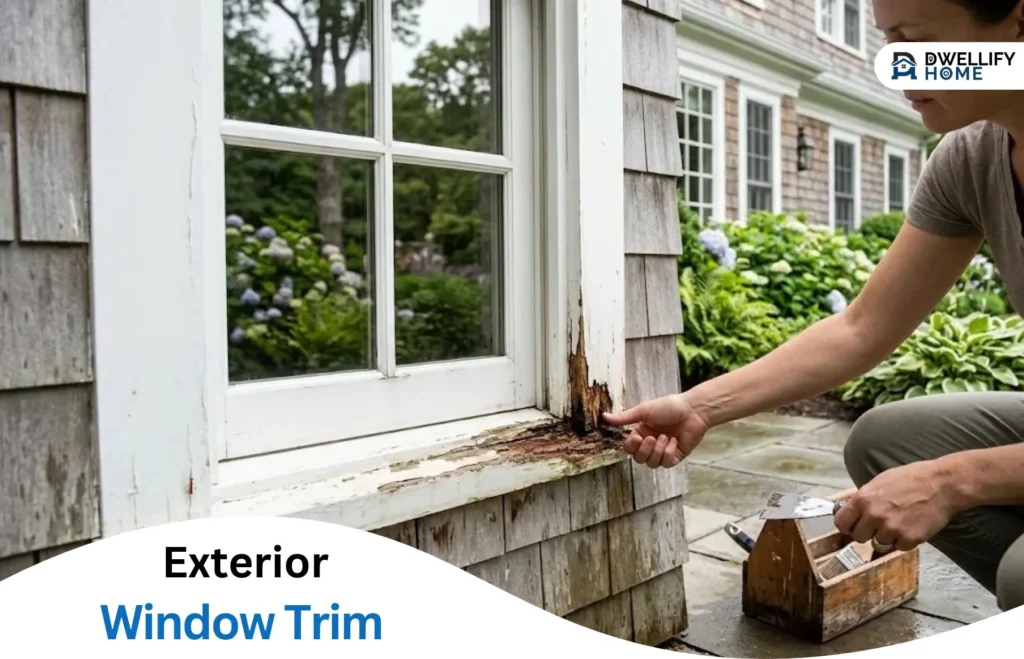
Two summers after the paint job, the southwest corners of my window trim had gone soft enough that my thumbnail sank in. That’s the normal lifespan of poorly detailed wood trim in a wet climate, and it costs most homeowners a weekend of scraping every few years. I’d rather solve it once.
So here’s the plan. You’ll learn why trim rots where it does, why paint is a maintenance schedule instead of a finish, and how window wrapping fits into a lasting answer. If you walk away with one idea, make it this: keep water out of the joints and off the end grain, and you’ve won most of the fight before you buy a single board.
Everything else here is detail, and the details are where trim jobs actually succeed or fail.
Why does trim rot at the corners and not the middle?
Water doesn’t attack a window frame evenly. It collects at the mitered corners, the bottom rail, and every place where a horizontal surface meets a vertical one. Those are the spots with a shelf. Rain lands, sits, and waits. The wood behind the paint soaks it up like a straw, and by the time the paint blisters, the fibers underneath are already gone.
End grain is the real villain. A board absorbs moisture through its cut ends dozens of times faster than through its face, which is why the bottom corners of a sill trim fail first while the flat middle still looks fine. If your trim has exposed end grain anywhere near the ground or under a drip edge, you’ve built a wick. The fix isn’t more caulk. The fix is keeping that end grain covered or shedding water away from it.
This is the detail that separates a trim job that lasts twenty years from one that lasts five, and almost nobody talks about it at the lumber yard.
Paint protects, but it doesn’t seal
Paint is a sacrificial layer. It takes the sun and the rain so the wood underneath doesn’t have to, and when it fails, it fails on purpose. The problem is that every coat you add to keep up with it eventually traps moisture instead of keeping it out, and the whole assembly begins to hold water against the substrate.
There’s a reason old painted trim gets gummy and peels in sheets rather than flaking. You’re not looking at a coating failure. You’re looking at wood that has been wet for years and is finally pushing the paint off from underneath.
Our climate-control habits matter here too. According to the Department of Energy, moisture management inside a home directly affects how the building envelope performs over time, which is another way of saying that wet trim and a wet wall are the same conversation.
What window wrapping actually does
Wrapping, sometimes called capping, covers the wood trim with a formed metal shell, usually aluminum, bent to match the profile of the existing frame. It’s not a decoration. It’s a raincoat with corners.
Here’s what makes it work: the aluminum is folded, not glued. Each piece gets a hemmed edge that kicks water away from the wall, and the joints are lapped in the direction the water runs. That lap direction matters more than the material itself. A skilled wrapper gets asked to fix failures that came from a lap running uphill, and yes, that happens more than you’d think.
You’ll want to know what you’re getting before anyone bends metal on your house. Ask your installer three things. Is the coil stock painted aluminum or bare steel? Where does the lap direction run on the head casing versus the jambs? And is the sill piece pitched, or flat? A flat sill cap is a bathtub with extra steps.
Aluminum coil versus composite versus PVC
You have three real options if you want to stop repainting, and they behave differently in the field.
| Option | Best for | Weak spot
|
| Aluminum wrap | Existing wood trim you want to keep without resurfacing | Dents on lower corners and garage-adjacent frames |
| PVC trim board | New builds and full replacement jobs | Expands and contracts noticeably in direct sun |
| Engineered composite | Period homes that need a wood look | Cost, and it still needs repainting on a schedule |
My pick for most occupied homes is aluminum wrap over existing sound wood. It keeps the original profile, it’s fast, and it ends the repaint cycle. If the wood underneath is already soft, though, wrapping it is like putting a raincoat on a sponge. Replace first, then wrap.
One more thing on the metal: colorfastness varies wildly by coil supplier, and a cheap coil will chalk within a few seasons. Feel the sample. If the paint film feels thin and slick, it probably is.
The prep checklist before any wrap goes on
This is where the job is won. Run through it with your installer, and don’t accept a shrug as an answer.
- Probe the trim with an awl or screwdriver. Any spot that gives should be cut out and replaced, not filled.
- Confirm the backer is sound and fastened. Aluminum bends with the substrate, so a loose board shows through.
- Check that the sill has slope. Water needs somewhere to go besides your siding.
- Ask how the wrap terminates against the siding and whether a sealant joint is being used there.
- Look at the coil stock before it’s cut. Bare steel edges rust from the cut side out.
If you’re replacing the windows at the same time, the sequence changes. New construction and full-frame replacements mean the wrap becomes part of the flashing assembly, and the Census Bureau tracks how much of the housing stock is aging into that kind of retrofit work, which tells you retrofit crews have gotten very good at it.
What it costs and what to expect
Wrapping is a labor-driven trade, so pricing swings by region, access, and how many inside corners a crew has to fold. Two-story homes take longer than ranchers, and porch columns take longer than anything. Don’t expect a flat national number. Expect a quote that reflects how much cutting and bending your specific house requires.
What you can expect is a drop in maintenance. A properly wrapped frame doesn’t need scraping, caulking, or a fresh coat every few years, and that’s the real return. Factor your own time into the math. Most homeowners underestimate how much a repaint cycle costs once they’re paying someone else to climb a ladder.
And if you’re selling in the next year or two, sound trim is one of the few exterior details a buyer actually inspects, usually with a fingernail, right at the corner I mentioned earlier.
Where wrapping is the wrong call
Not every frame should be wrapped, and I’d rather say so plainly than sell it to you. If your home has deep, ornate trim with real architectural detail, aluminum will flatten it. Restoration work on older homes often calls for repair and a proper paint system instead.
Also skip the wrap if the underlying rot runs into the wall sheathing. Metal over structural damage hides a problem you’ll pay for later, and no finish is worth that. Fix the wall first, then decide.
The whole thing comes down to one shift in how you think about a window frame: it’s not a decorative border, it’s a drainage assembly. Once you treat it that way, the corner rot stops being a mystery and starts being a design problem with known answers. Walk outside today and press a screwdriver into the bottom corner of your least favorite window. Whatever that tool tells you should set your next move, whether it’s a wrap, a repair, or a full replacement.
We occasionally feature links from businesses and affiliate partners in our articles. When these links result in qualifying purchases or involve sponsored arrangements, Dwellifyhome.com may receive compensation.