Smart, reversible changes that reshape a compact bedroom without a single paintbrush.
Small bedrooms put pressure on every square foot. Paint is the usual first move, yet it is rarely the most effective one. Rental agreements, tight budgets and children who change their favorite color every few months all argue against it. The good news is that most of what makes a room feel different has little to do with the walls themselves. Layout, light, texture and storage do far more of the work, and each can be changed in an afternoon.
1. Use Removable Wallpaper and Decals on a Single Wall
Peel-and-stick wallpaper has improved considerably in the past several years. Current versions use repositionable adhesive that lifts cleanly from most smooth, primed surfaces, and the patterns, including those in dedicated kids room wallpaper ranges, run from soft botanical prints to bold geometric designs. Designers generally recommend limiting it to one wall, typically the one behind the bed or desk. That keeps the room from feeling closed in, which matters when floor space is already limited.
Decals offer a lighter commitment. Oversized shapes, maps and silhouettes can be rearranged as a child grows, and they leave nothing behind. Testing a small patch in an inconspicuous corner is sensible before applying either product across a larger area, since textured walls and recent paint jobs can behave unpredictably.
2. Build Upward Instead of Outward
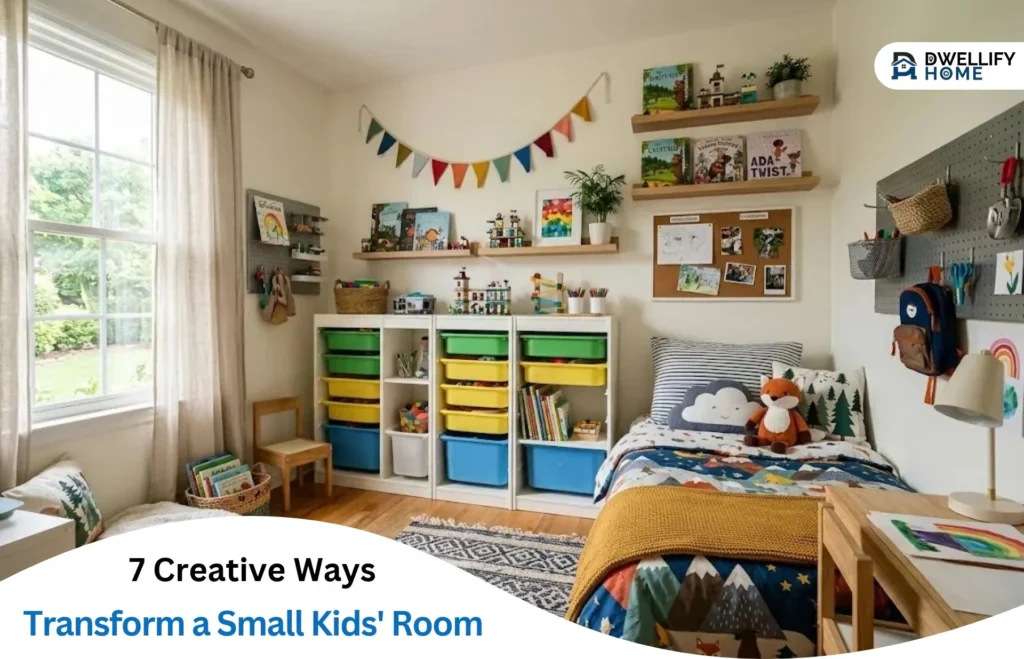
When the floor is crowded, the vertical plane is the obvious place to look. Tall, narrow bookcases anchored to the wall, shelves mounted above the door frame and hanging organizers behind the door all create storage without taking up play space. A loft or raised bed goes further. Positioned correctly, it frees the area below for a desk, a reading corner or a small wardrobe.
Safety deserves attention here. Furniture should be fastened to wall studs, and raised beds suit older children better than toddlers. Most manufacturers publish minimum age guidance, and ceiling height needs to leave enough clearance for a child sitting upright.
3. Layer the Lighting
A single overhead fixture tends to flatten a small room. Layering sources produces a very different result. A ceiling light handles general brightness, a clip-on or wall-mounted reading lamp covers the bed, and a low-wattage nightlight or string of warm LEDs gives the room a calmer evening mood.
Plug-in wall sconces are especially useful in rooms where wiring cannot be changed. They also keep lamps off the nightstand, which clears surface space. Warm white bulbs, generally in the 2700K range, suit sleeping areas, while cooler light works better over a homework desk.
4. Let Textiles Do the Heavy Lifting
Soft furnishings change the character of a room faster than almost any other category. A patterned rug introduces color and pattern underfoot. Curtains hung close to the ceiling rather than at the window frame make walls look taller. Bedding, cushions and a throw can be swapped seasonally, so the room stays fresh without new furniture.
Fabric also absorbs sound, a practical benefit in small spaces where noise bounces. Washable materials such as cotton, linen blends and low-pile synthetics hold up best, given how much use children’s rooms see.
5. Divide the Room Into Zones
Even a ten-by-ten bedroom can serve three purposes: sleeping, playing and studying. Treating them as separate zones brings order to the space. A rug marks the play area. A bookcase set at an angle, or a low shelf unit placed perpendicular to the wall, partly separates the sleeping corner. A narrow desk by the window defines the place for homework.
The boundaries need not be solid. Open shelving lets light pass through while still signaling that one activity ends and another begins. Children tend to respond well to this clarity, and tidying becomes easier when every object has a home.
6. Create a Display System for Art and Collections
Blank walls become useful when they hold something. Picture ledges let artwork be changed without new nail holes. Corkboard panels, magnetic boards and pegboards support a child’s drawings, certificates and favorite objects, and pegboard in particular can be reconfigured with hooks, baskets and small shelves as needs shift.
Hanging a row of framed prints at a child’s eye level gives the room a gallery feel, while a string of clips and twine does the same job for a fraction of the cost. Giving children control over what goes up also makes the room feel like theirs, which no coat of paint can guarantee.
7. Reflect Light and Reduce Visual Clutter
A large mirror, positioned opposite a window, bounces daylight deeper into the room and makes the dimensions feel more generous. Shatterproof acrylic versions are available for younger children, and low-mounted mirrors can double as a dressing area.
Clutter works in the opposite direction. A room full of visible objects reads as smaller than it is. Lidded bins, under-bed drawers and a rotating toy system, in which only a portion of belongings are out at one time, keep surfaces clear. Closed storage in a consistent color range also quiets the room visually, so the textiles and wall treatments chosen earlier can stand out properly.
Making the Changes Work Together
None of these ideas requires a full renovation, and none locks a family into a long-term decision. They work best in combination. A removable accent wall, a layered lighting plan and a sensible storage strategy together can shift a cramped bedroom into something that feels purposeful and spacious. Starting with the biggest daily frustration, whether that is clutter, poor light or a lack of play space, usually points to the most useful first change. Everything else can follow gradually, at whatever pace the household prefers.
Some links mentioned in this article may connect readers with affiliate partners or sponsored businesses. Dwellifyhome.com may receive compensation through qualifying purchases or agreed promotional collaborations.