Mid century modern outdoor furniture works when you follow the era’s own discipline: clean lines, tapered legs, honest materials — above all solid teak — and one accent color, because a substantial solid teak slab table silvers naturally over 12 months and lasts 15 years or more, while a mixed set of teak, steel, and Adirondack chairs just reads as eclectic, according to the mid-century outdoor guide at Houex. A quality five-piece teak set starts around $700 and runs $1,400 for FSC-certified teak with Sunbrella cushions, and this guide shows you the four decisions that make the look real, the materials that survive outside, and the mistakes that turn it into a theme party.
One mistake in the style section below ruins more mid-century patios than any other, and it costs nothing to fix — it is a decision, not a purchase. Most buyers make it in the first hour of shopping, before they have bought a single chair. Before that, you need to know what the style actually is, because half the furniture sold under this name has nothing to do with it.
What Is Mid Century Modern Outdoor Furniture?
Mid century modern outdoor furniture is patio furniture built on the design language of 1950s and 1960s Scandinavian and American modernism: clean lines, tapered legs, organic curves, low-slung silhouettes, and minimalist profiles, made from honest materials such as teak, powder-coated aluminum, and solution-dyed acrylic fabric. The style is not a color or a pattern — it is a discipline about proportion and material.
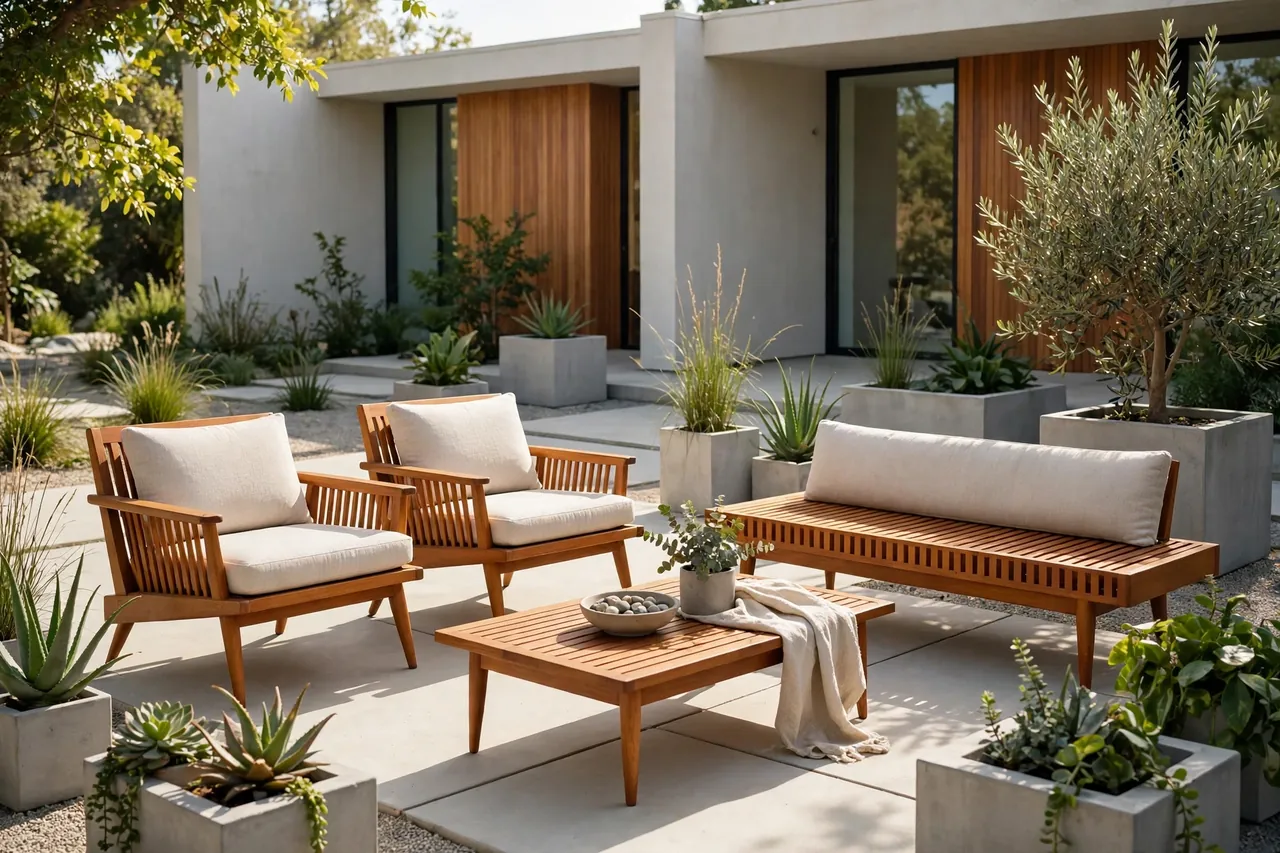
The look comes from a few clear marks. Low, wide lounge chairs with gently tapered legs and slatted surfaces show off the wood grain instead of hiding it. Dining tables are substantial slab or trestle designs, 84 to 108 inches long for a real mid-century dining setup, in solid teak that ages from honey to silver. Chairs match each other — six Bertoia wire chairs or six Eames outdoor variants, one model, not a mixed set — because matched seating reads deliberate and mixed chairs read eclectic, as Houex explains. One saturated accent, such as a single pair of mustard cushions, does the color work; everything else stays warm cream, charcoal, olive, or natural teak.
The style also carries a philosophy worth knowing: form follows function, materials stay honest, and you buy once and buy well. Teak earned its place because Danish designers such as Finn Juhl admired it for fine joinery, and because its natural oils and dense grain let it resist moisture, insects, and decay while aging into a refined silver patina, as Luxus Home and Garden describes. That philosophy is why this style has never really left us — and why cheap copies fail so visibly. The next section is the four-decision test that separates the real thing from the Pinterest version.
Mid-century is a discipline, not a theme. One accent, matched chairs, honest materials.
The Four Decisions That Make It Look Real
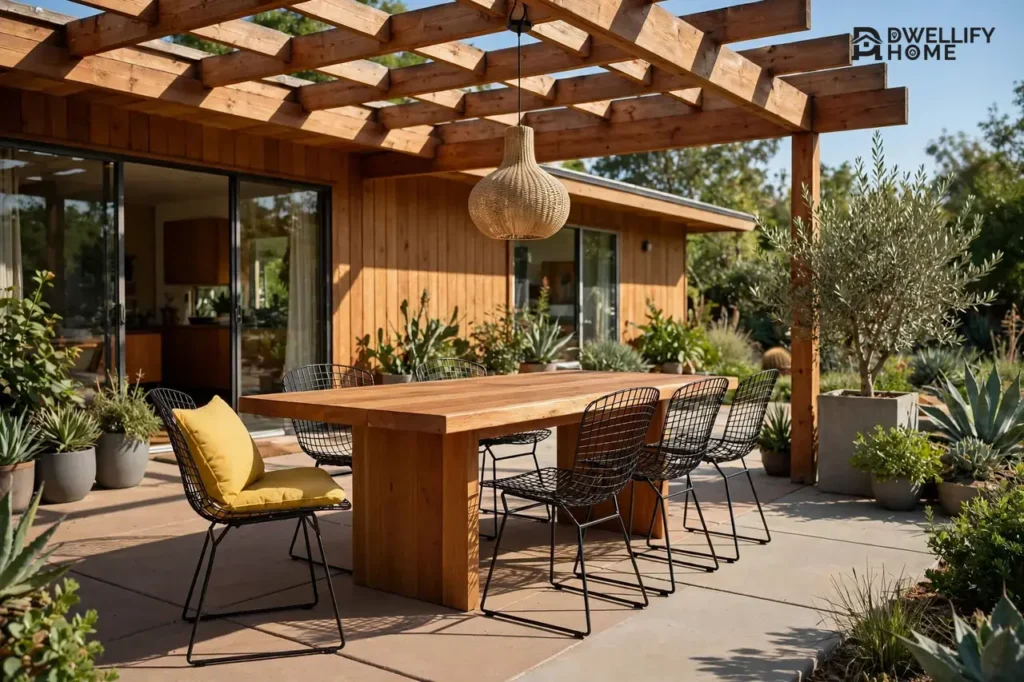
A mid-century outdoor setup looks real when you make four decisions together: a substantial solid teak slab table, six matched chairs in one model, a single sculptural pendant or light, and one accent textile only, because skipping any one of them makes the setup read as mixed-eclectic or themed-outdoor instead of 1962 ranch, according to Houex. Get all four right and the patio reads as a deliberate room; miss one and it reads as a collection of nice things.
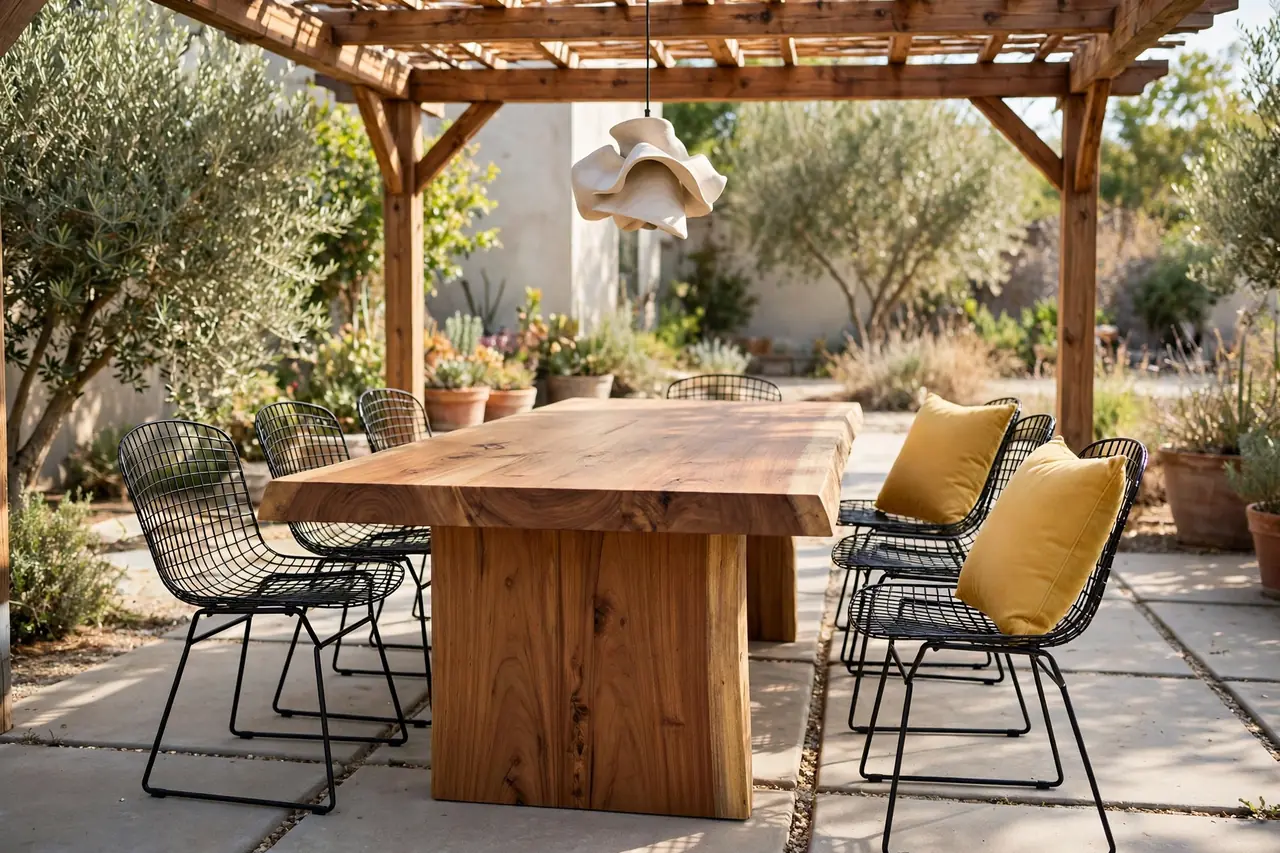
First, the table. A solid teak slab on a simple trestle or four-leg base, 84 to 108 inches long, allowed to silver naturally over 12 months from honey teak to silvered grey. What does not work: round pedestal tables, which read traditional; faux-wicker tables, which read cheap; glass tops, which read 1990s contemporary; and reclaimed barn wood, which reads farmhouse. A quality solid teak slab table costs $2,500 to $8,000, per Houex, and it is the anchor the whole patio hangs on — buy the table first and the chairs second.
Second, matched seating. Six Bertoia wire chairs or six Eames outdoor variants, one chair model, in raw steel with powder coat or in teak. The matched-seating discipline is what produces the 1962 California ranch outdoor dining moment, and mixing chair styles is the fastest way to lose it. Third, a single sculptural light: one sputnik-influenced outdoor pendant or one Nelson saucer pendant hung from a pergola beam, never three Edison string lights crossed festoon-style. Fourth, one accent application: a single pair of mustard cushions or one burnt-orange textile, and nothing else competing with it.
Here is the discipline in one place.
The four decisions at a glance
| Decision | Do this | Not this |
|---|---|---|
| Table | Solid teak slab, 84–108 in | Round pedestal, glass top |
| Chairs | Six matched, one model | Mixed styles, Adirondack mix |
| Light | One sputnik or saucer pendant | Crossed festoon string lights |
| Accent | One mustard or burnt-orange textile | Tropical prints, sunburst clocks |
That last row is the mistake from the introduction: most buyers add a second and third accent — patterned pillows, a themed clock, a bright rug — because each one looks fun on its own. Together they cancel the discipline that makes the style work. One accent is the rule, and the restraint is the style. The materials below decide whether the look survives its first winter.
Teak, Aluminum, or Acacia: Which Material Survives Outside?
Teak survives outside best, because its natural oils and high silica content resist water, rot, and insects without any coating, and it has been used in shipbuilding for centuries for exactly that reason, as the Homary buying guide explains. Acacia and eucalyptus give you much of that durability at a lower price if you oil them, and powder-coated aluminum gives you the clean lines with zero wood care at all.
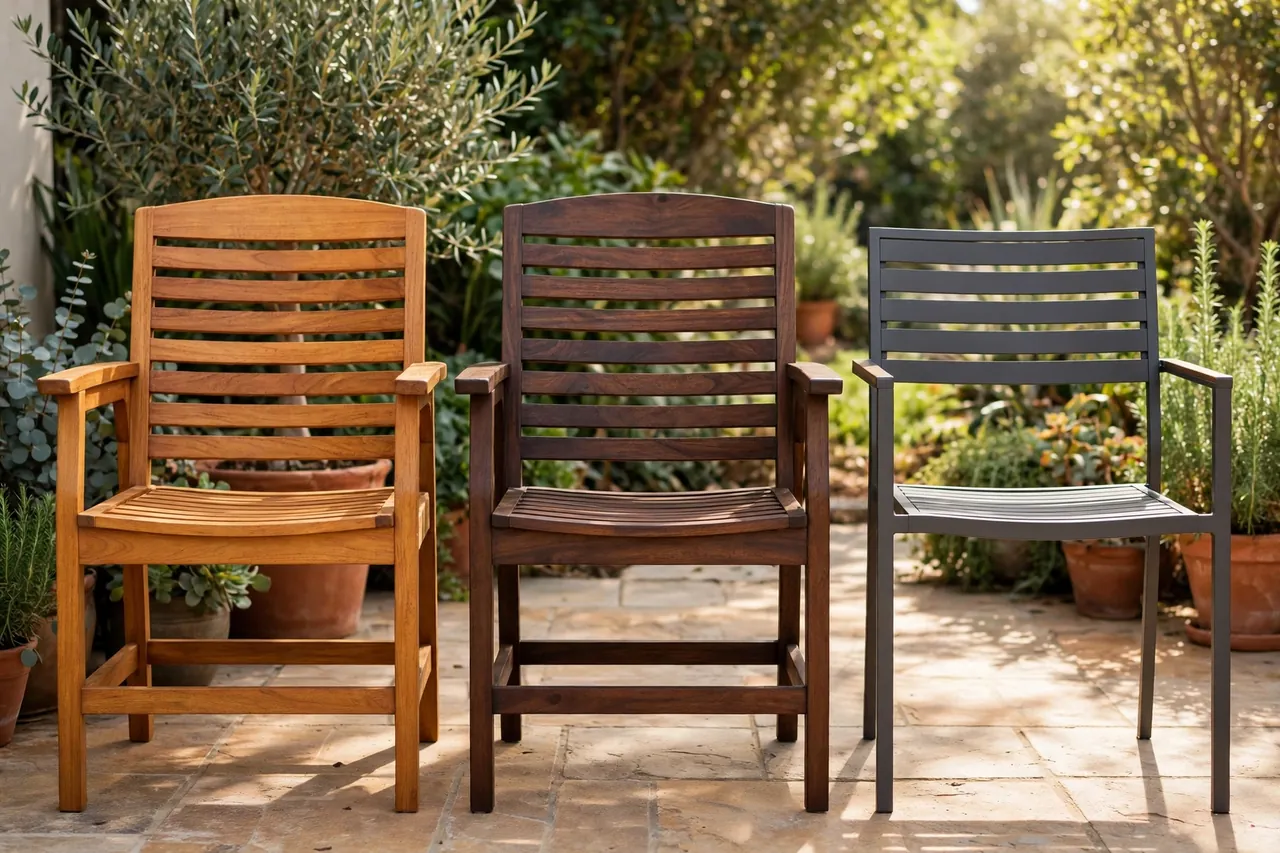
Teak is the benchmark everyone measures against. It resists rot and insects better than any other outdoor wood, holds its shape with far less movement than most woods when it dries, and weathers to a silver-gray patina that most owners love. Grade A teak heartwood lasts decades, while lower grades can rot within two years, so check the grade, not just the word “teak.” FSC-certified teak sets with Sunbrella cushions average around $1,400 for five pieces and last 15 years or more, while quality five-piece sets start around $700. Our teak outdoor dining table guide covers teak tables in depth, and our outdoor wooden bench guide compares teak with cedar, acacia, and eucalyptus side by side.
Acacia is the budget-friendly alternative that does not compromise too much: dense, hard, naturally water-resistant, with a rich variegated grain, at a much lower price than teak. The catch is care — acacia needs oiling every 6 to 12 months, and skipping it leads to surface cracking. Eucalyptus sits between acacia and teak on almost every axis. Our acacia wood furniture guide shows the care routine that keeps it looking good. Aluminum is the third path: powder-coated aluminum frames with teak or stone tops give you tapered legs and sculptural bases with no oiling at all, and they suit the Danish modern sensibility of warm teak paired with Arctic White, Champagne, or Graphite frames, as Lumens describes in its mid-century dining collection.
Cushion fabric is the quiet decision. Solution-dyed acrylic such as Sunbrella outperforms polyester in fade and mildew resistance, and it is the fabric to ask for by name. Kiln-dried wood resists warping better than air-dried wood, and FSC certification tells you the teak was sustainably harvested. Three material rules, one sentence each: buy Grade A teak or FSC-certified acacia, ask for Sunbrella by name, and never buy a wood set that does not name its species. The palette below is where the style becomes a room.
Teak is the benchmark; acacia is the value; aluminum is the zero-care path. All three can be mid-century — the species name is what matters.
How Much Does Mid Century Modern Outdoor Furniture Cost?
Mid century modern outdoor furniture costs about $700 for a quality five-piece set, around $1,400 for an FSC-certified teak five-piece set with Sunbrella cushions, and $2,500 to $8,000 for a quality solid teak slab dining table alone, based on prices published by the mid-century dining guide and Houex in 2026. Authentic wood builds run $800 to $2,500 for a five-piece set, and the honest total for a complete patio — table, six chairs, two loungers, and one pendant — lands between $3,000 and $10,000.
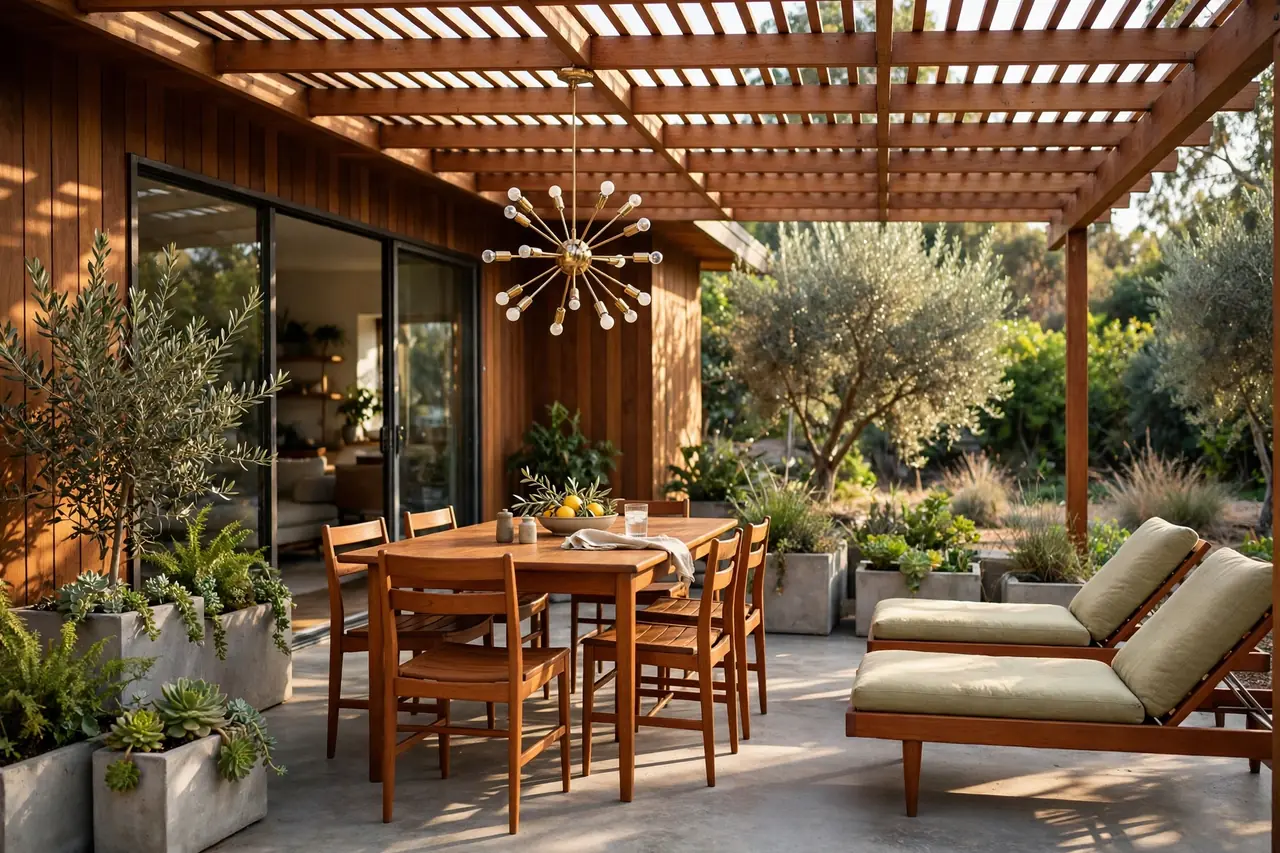
Price is mostly a material story. Teak costs the most upfront and the least over time: a $1,400 FSC teak set lasting 15 years costs about $28 per year in the Alibaba guide’s cost-per-year math, while a $500 set that lasts three years costs $167 per year and looks tired after the first summer. Houex prices a full mid-range mid-century outdoor dining setup — teak slab table, six Bertoia wire chairs, cushions, pendant, and pergola — at $7,600 to $23,100, with an honest mid-range project budget of $15,800 for a 14-by-18-foot patio. The cheapest way to buy this style is to buy it once.
Here is the honest budget map.
What mid-century outdoor furniture costs in 2026
| Piece | Budget tier | Quality tier |
|---|---|---|
| 5-piece dining set | $500–$700 | $1,400 teak, Sunbrella |
| Solid teak slab table | $800–$1,500 | $2,500–$8,000 |
| Teak lounge chair | $200–$400 | $600–$1,200 |
| Accent cushions (pair) | $40–$80 | $120–$200 Sunbrella |
Two warnings save real money. First, avoid sub-$500 five-piece sets unless durability is verified, because thin frames and untreated wood fail first and cannot be fixed. Second, remember the total: the table is the anchor, and a $700 set with a $200 table is not a $700 mid-century patio — it is a $700 set of chairs. Buy the table first, the chairs second, and the accent last. Bertoia wire chairs run $400 to $900 each as quality reproductions, $800 to $1,500 each for Knoll authentic, and a single sputnik or Nelson saucer pendant runs $400 to $1,500, per Houex. The layout section below shows how to place them.
How to Style a Mid Century Patio Without Overdoing It
A mid-century patio works when you anchor it with one sculptural teak piece, keep the palette to warm cream, charcoal, olive, and natural teak, let clean-lined geometry shape the layout, and add linen cushions, ceramics, or concrete planters without overwhelming the simplicity, because the style is restraint, and every extra object argues with it. Luxus Home and Garden’s recipe is exactly this: sculptural teak, grounded modernist tones, geometry-led layout, minimal textures, and indoor-outdoor continuity.
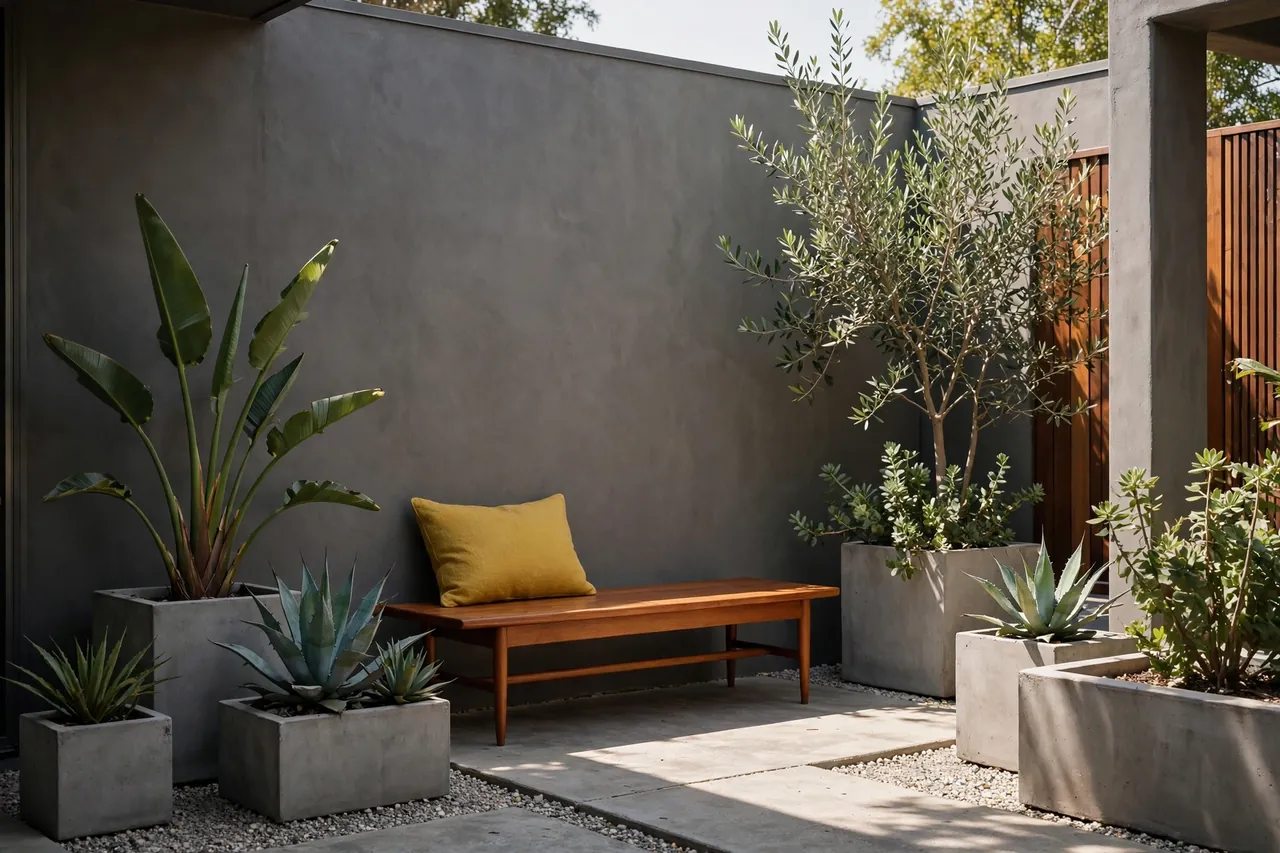
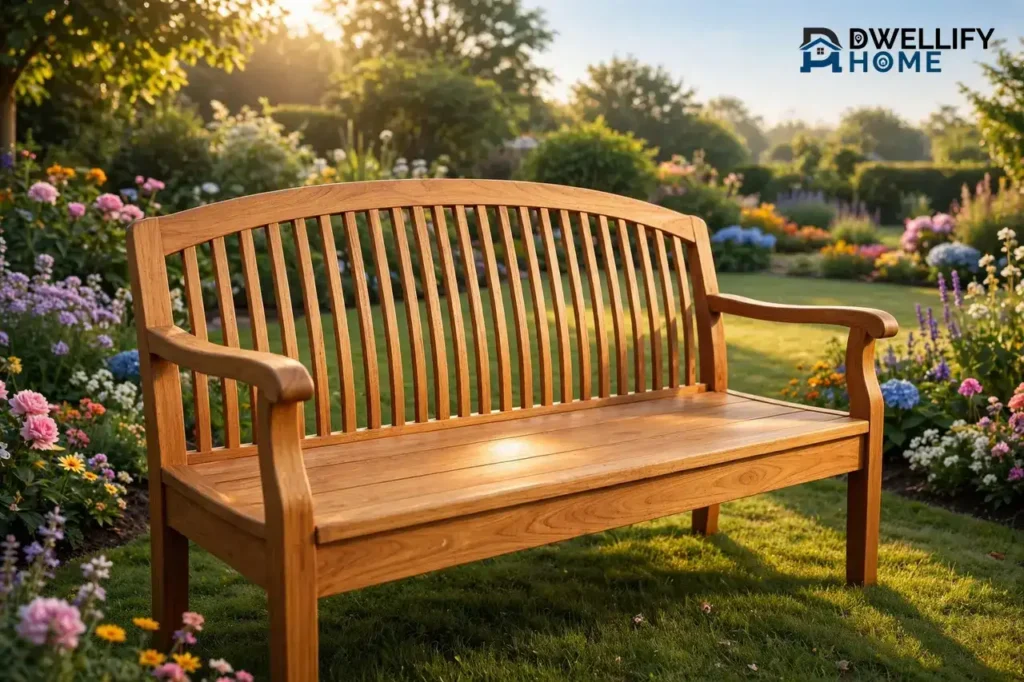
Start with the anchor. One statement piece — an outdoor teak bench, a low teak lounger, or the slab table — introduces the strong mid-century lines, and everything else supports it. Then set the palette: charcoal, olive, white, and natural teak create a calm, cohesive canvas, with a single mustard or burnt-orange accent doing the color work. Repeat similar materials inside and outside for indoor-outdoor continuity, so the patio reads as a room of the house rather than a separate yard.
Layout follows geometry. Clean-lined teak tables and chairs echo mid-century proportions, and the furniture sits in straight lines and right angles, not scattered clusters. Low, wide loungers with tapered legs suit poolside spots, where their slatted surfaces show the grain and the low profile keeps the horizon open. A dining set under a streamlined pergola, with one pendant above it, makes the most of a covered patio. In a walled courtyard, teak grounds a canvas of concrete and greenery, and a concrete planter or two is enough decoration.
What to leave out matters as much as what to include. No mixed teak, steel, and Adirondack chairs. No tropical-print pillows. No themed sunburst clock on the pergola. Our how to arrange outdoor furniture guide covers spacing rules for any patio, and our modern outdoor chairs guide shows how modern and mid-century chairs differ. The care section below is what keeps the look from aging into a regret.
One anchor, one accent, straight lines. Everything else is support.
How to Care for Teak and Keep the Silver or the Gold
Teak asks almost nothing of you, and the one real decision is whether you want it silver or gold: leave it alone and it turns a uniform silver-gray within a year or two, or apply teak oil every 2 to 6 months to keep the honey-gold tone, because the gray is only the oxidized surface layer and the wood underneath stays sound. Teak oil lasts 3 to 4 months per coat, while a teak sealer lasts 12 to 18 months, so the sealer is the lower-effort way to hold color.
Cleaning is simple. Hose the pieces down, scrub with mild soap and a soft brush, and let them dry in the sun. Never use a pressure washer close up, because it raises the grain and leaves a fuzzy surface. Keep pieces out of standing water — feet on pavers, not in a puddle — and bring cushions inside over winter. Our how to care for outdoor furniture guide covers the seasonal routine for teak and every other material, and our outdoor covers for furniture guide shows which covers breathe instead of trapping damp.
The most common teak mistake is buying “teak oil” and expecting it to protect the wood. Most teak oil bottles are tung or linseed oil blends, and they feed the color, not the protection — teak protects itself with its own oils, and the bottle only decides the shade. The second mistake is oiling a dirty surface: oil seals in the dirt, so clean first, dry fully, then oil. If your teak has already silvered and you want the gold back, a light sanding and one oil coat restore it in an afternoon. The misconception below is the last trap, and it is about the word “vintage.”
What Most People Get Wrong About Mid-Century Style
Most people get mid-century style wrong by treating it as a vintage theme, when it is really a design discipline: the original designers were not decorating in retro style, they were solving problems with new materials and honest construction, and a patio full of sunburst clocks and atomic patterns is a costume, not a mid-century room. The second wrong belief is that any tapered leg makes a piece mid-century — it does not, because proportion, material, and restraint have to arrive together.
The third wrong belief is that mid-century furniture is fragile because it looks light. The opposite is true: teak’s strength supports slim, architectural silhouettes without compromising durability, and a well-built teak lounger outlasts a heavy-looking softwood set by a decade. Judge the species and the joinery, not the visual weight. The fix is the four-decision test from the second section: if your patio passes all four, it is mid-century; if it fails one, fix that one before buying anything else.
Related Guides
Mid-century style touches every piece on the patio. These guides go deeper into the pieces and materials around it.
- Modern outdoor chairs — how modern chairs differ from mid-century ones, and which suits your patio.
- Teak outdoor dining table — the anchor piece, in depth: sizes, grades, and prices.
- Acacia wood furniture — the budget hardwood, its care routine, and its limits.
- Outdoor wooden bench — teak, cedar, acacia, eucalyptus, and pine compared for outdoor use.
- Outdoor furniture wood — the full wood guide: every species, lifespan, and yearly care.
- Aluminum outdoor furniture — the zero-care frame material for clean mid-century lines.
- How to arrange outdoor furniture — spacing rules and layout plans for any patio.
- Rope chair — woven rope chairs, the softer mid-century seating option.
- Luxury outdoor furniture — when premium materials and construction are worth the price.
- Patio dining set — the patio-side guide to dining sets and their sizing.
- Wicker outdoor furniture — woven texture as the contrast to teak’s clean lines.
Frequently Asked Questions
What is mid century modern furniture?
Mid-century modern outdoor furniture is patio furniture built on 1950s and 1960s Scandinavian and American modernism: clean lines, tapered legs, organic curves, low-slung silhouettes, and honest materials such as teak and powder-coated aluminum. It is a design discipline about proportion and material, not a color, pattern, or vintage theme.
How do I stop teak furniture going grey?
Apply teak oil every 2 to 6 months or a teak sealer every 12 to 18 months to hold the honey-gold tone, and clean the wood before you oil it so you do not seal in dirt. Left alone, teak turns a uniform silver-gray within a year or two, which is only the oxidized surface layer — a light sanding and one oil coat restore the gold.
Is mid-century furniture expensive?
A quality five-piece set starts around $700, an FSC-certified teak five-piece set with Sunbrella cushions runs about $1,400, and a solid teak slab table costs $2,500 to $8,000. Teak costs the most upfront and the least per year, at roughly $28 per year over 15 years, while a cheap set that lasts three years costs far more per year.
Can garden furniture be left outside?
Yes, if it is made from outdoor-rated materials: teak and powder-coated aluminum handle rain and sun all year, and Sunbrella cushions resist fading and mildew. Bring cushions inside over winter, keep feet out of standing water, and use a breathable cover in harsh climates so freeze-thaw cycles cannot work water into joints.
Buy the table first, match the chairs, hang one pendant, and stop at one accent. A teak mid-century patio built on those four decisions looks deliberate in year one and better in year ten — and the next step is the wood guide or the teak table guide above, which turns the style into a shopping list.