A fire pit table is a patio table with a gas burner built into the top, and the one that actually warms a group puts out 50,000 BTU or more, runs on a standard 20-pound propane tank hidden inside the base, and lights with a push-button igniter in seconds. A 50,000 BTU table keeps four to six adults comfortable within 6 feet on a 55°F evening, and most good tables cost $250 to $500, checked November 16, 2026. This guide covers gas versus wood, BTU sizing, safety clearances, real prices, and the care routine that keeps a fire table safe for years.
One safety rule decides whether a fire pit table belongs on your patio at all, and it has nothing to do with the BTU number on the box. It sits in the safety section below, and it is the question patio owners ask most. Get that answer first, then shop.
What Is a Fire Pit Table?
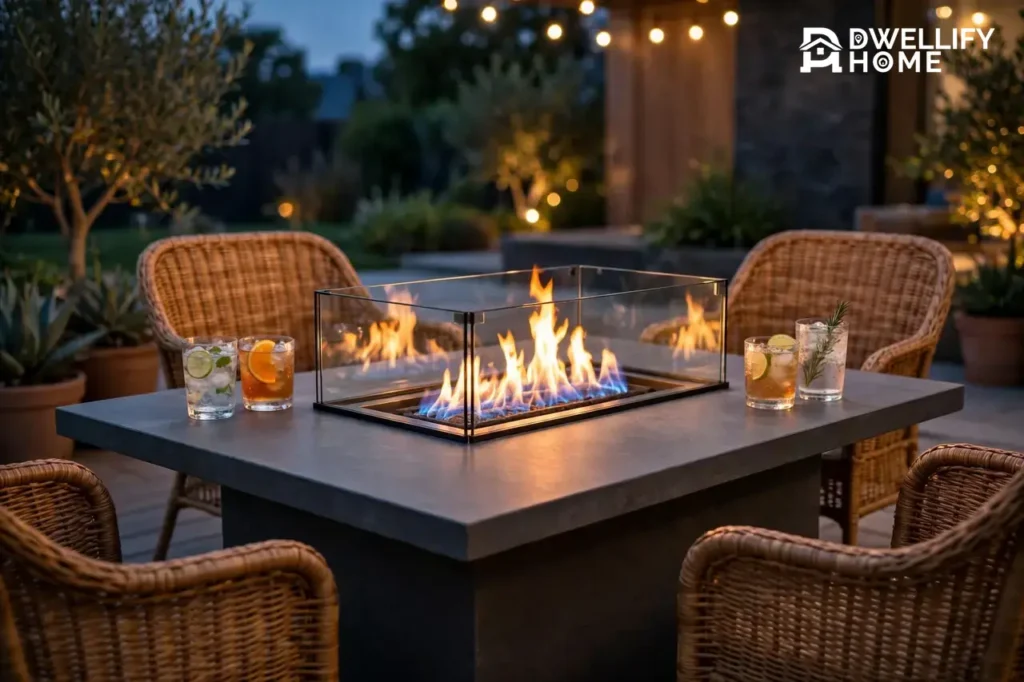
A fire pit table is an outdoor table with a fire burner set into the center of the tabletop, so it works as a normal patio table during the day and as a heat source at night, with a lid that covers the burner bowl and turns the whole top back into a flat table. Most run on propane from a 20-pound tank stored inside the base, and a few connect to a home natural gas line.
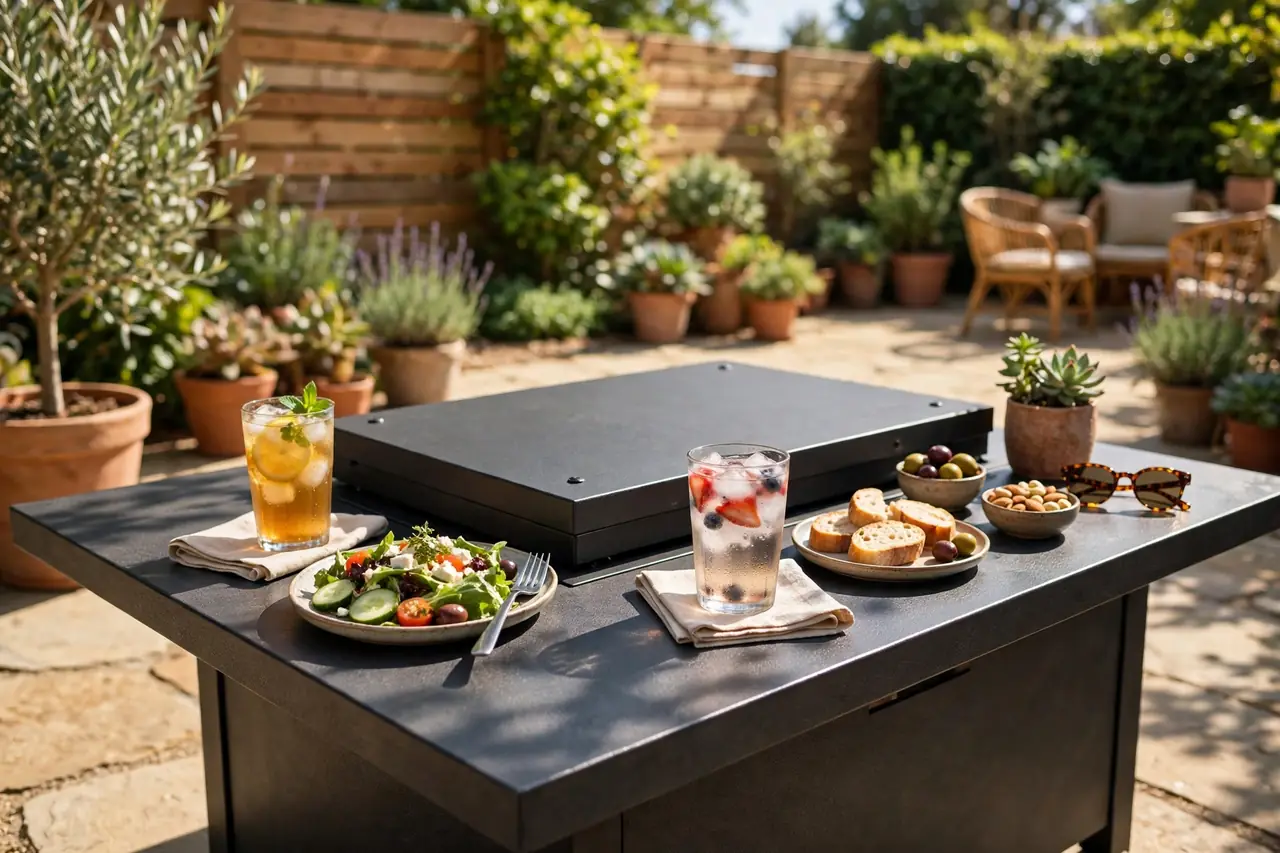
The design is simple on purpose. The burner sits in a shallow bowl in the middle, ringed by a tabletop ledge wide enough for plates, glasses, and elbows. Fire glass or lava rock fills the bowl, the flame dances through it, and a metal lid drops over the bowl when the fire is out. At 42 inches across, a round fire pit table seats four people with drinks and snacks in reach; at 53 inches rectangular, it seats six.
Fire pit tables are not fire pits. A fire pit is an open bowl for burning wood, usually set away from seating. A fire pit table is furniture first: it lives in the middle of the seating circle, it holds your coffee, and its flame is controlled by a knob, not by feeding logs. That difference matters for safety, for smoke, and for how often you will actually use it.
A fire pit table is a table that happens to burn, not a fire pit with a lid. Buy it for the seating circle, not the flame show.
Gas, Propane, or Wood: Which Fire Pit Table Fuel Is Best?
Propane is the best fuel for most fire pit tables, because it lights with a push button, burns clean with no smoke or ash, needs no gas line, and a standard 20-pound tank gives roughly 8 to 10 hours of burn time at medium flame. Natural gas never runs out but needs a professional to run a line and turns the table into a permanent fixture, and wood gives real crackle but makes smoke, ash, and embers.
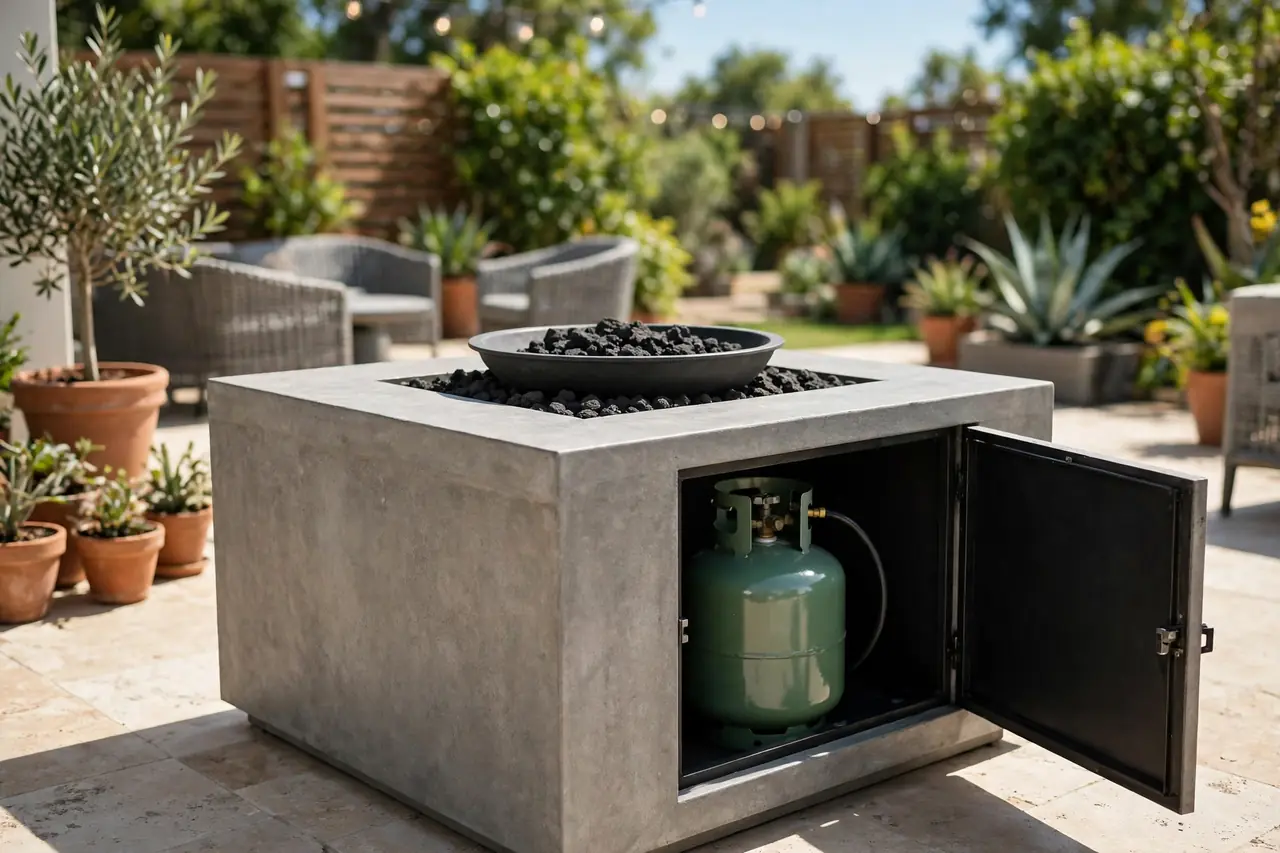
Propane wins on convenience. You swap the tank at any grocery or hardware store, the table stays portable, and you can move it when the party moves. The tank hides inside the base, so the table looks like furniture, not a grill. The trade-off is the tank itself: it runs out mid-evening if you forget to check it, and a full 20-pound tank weighs about 37 pounds to carry.
Natural gas wins on never running out. If your patio already has a gas line, a natural gas table connects once and burns forever, with no tank swaps and slightly lower fuel cost per hour. The catch is installation: a licensed pro must run the line, the table cannot move, and the upfront cost is higher. Wood wins on atmosphere alone. A wood-burning fire table gives real flame, real crackle, and real smoke, which is exactly why many neighborhoods and many covered patios ban it.
Propane for most patios, natural gas for a permanent setup, wood only where smoke is welcome. The fuel decides the freedom.
How Many BTU Does a Fire Pit Table Need?
A fire pit table needs 50,000 BTU to warm four to six people on a cool evening, because 50,000 BTU is the output of a standard patio heater, and anything below it buys ambience rather than heat. A 60,000 BTU burner handles six to ten people and pushes the comfortable radius further out, while a 40,000 BTU table suits two or three people sitting close.
BTU stands for British Thermal Unit, and for fire tables it measures how much heat the burner produces per hour. The roundups that tested these tables in 2026 put the useful range at 50,000 to 60,000 BTU, and they all applied the same filter: nothing under 50,000 BTU made the list, because owners of lower-output tables report the same complaint every time — pretty flame, cold knees. Read the full BTU test at Who Is McAfee’s best propane fire pit tables for patios.
Higher BTU also means faster propane use. A 60,000 BTU burner at full flame empties a 20-pound tank in roughly 4 to 5 hours, while at medium flame the same tank lasts 8 to 10 hours regardless of the BTU rating. That is why the knob matters more than the number: a 60,000 BTU table run at half flame outlasts a 40,000 BTU table run flat out, and it warms you better while it does it.
Guess which number matters more: the BTU on the box, or the wind on your patio? A 50,000 BTU table in still air warms six people. The same table in a stiff breeze warms two, because wind strips the heat sideways. A glass wind guard, which most good tables include or sell as an add-on, is the cheapest BTU upgrade you can buy.
50,000 BTU is the floor, not the goal. Below it, you bought a candle with a table attached.
How Much Does a Fire Pit Table Cost?
A fire pit table costs $180 to $1,200, checked November 16, 2026, with most good 50,000 BTU propane tables landing between $250 and $500. Small 28-to-32-inch tables run $180 to $350, mid-size 42-to-44-inch tables run $350 to $550, and large concrete or stone tables run $700 to $1,200 and more.
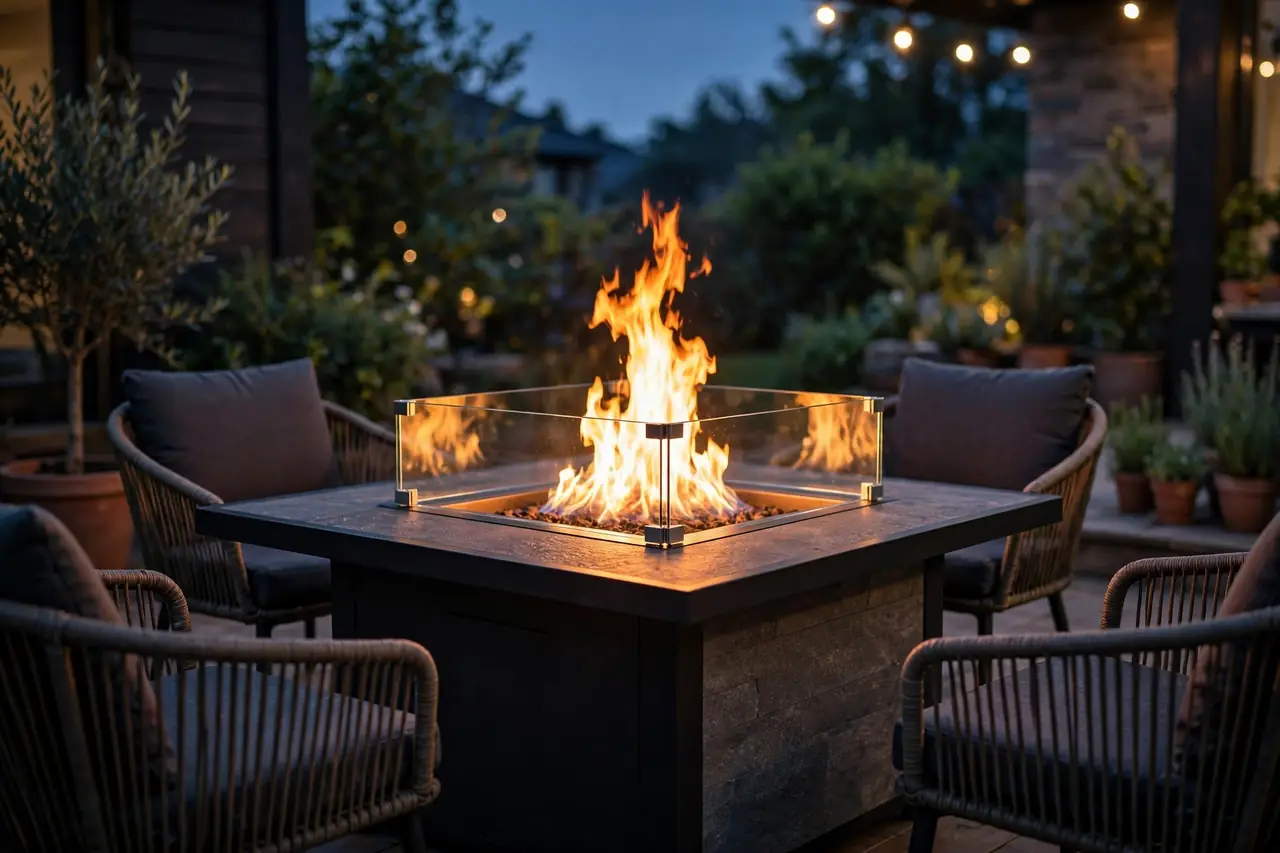
Real retailer prices show the spread. At Wayfair, a 50,000 BTU rectangular rattan fire pit table with lid and hidden tank storage lists at $253.99, a 42-inch round 50,000 BTU table at $389.99, and a 51-inch rectangular table with glass wind guard at $379.99. At Target, a 32-inch rectangular 50,000 BTU table with ceramic tile top and wicker base lists at $347.99. Concrete tables cost more: a 36-inch round concrete table lists at $699.99 at Wayfair, and premium stone tables pass $1,000.
Three things push the price up. Size adds cost fast, because a bigger table needs a bigger burner and a heavier base. Material adds cost too: concrete, stone, and powder-coated aluminum outlast plain steel, which can pit and rust after two seasons. And certification adds cost: a CSA-certified burner costs more to build, and it is the one feature you should never skip to save money.
Do not forget the running cost. A 20-pound propane tank refill runs about $20 to $25, and at medium flame that buys 8 to 10 hours of evenings. Two evenings a week through a six-month season is roughly $200 to $300 of propane a year, which is the real price of the fire, not the table.
Budget $350 to $500 for the table, then $20 a tank for the fire. The cheap table is the one that rusts in two seasons.
Fire Pit Table Prices and Heat at a Glance
The best-value fire pit table is a 42-to-44-inch, 50,000 BTU propane table at $350 to $500, because it warms four to six people, fits a normal patio, hides a full-size tank, and costs half what a concrete table costs while lasting just as long under a cover. Go smaller only if your patio is under 100 square feet, and go concrete only if the table never moves.
| Table size | BTU | Seats | Typical price |
|---|---|---|---|
| 28–32 in square | 40,000–50,000 | 2–4 people | $180–$350 |
| 36 in round | 50,000 | 4 people | $350–$570 |
| 42–44 in round/rect. | 50,000–60,000 | 4–6 people | $350–$550 |
| 51–53 in rectangular | 50,000–60,000 | 6 people | $470–$700 |
| Concrete/stone 36–42 in | 50,000–60,000 | 4–6 people | $700–$1,200+ |
Prices are Wayfair and Target listings checked November 16, 2026. The table’s lesson is that the mid-size 50,000 BTU table is the sweet spot for almost every patio, and the money saved over concrete buys two years of propane. But a table that fits the budget and fails the safety check is a table you cannot use, and the next section is the one that decides that.
Is a Fire Pit Table Safe on a Patio or Under a Cover?
A gas fire pit table is safe on an open patio when the burner is CSA-certified, the table sits on a non-combustible surface or a fireproof mat, and you keep 36 inches of clearance from walls and 8 feet of clearance to any ceiling. It is not safe under a low roof, inside a screened porch, or on a wooden deck without checking the manufacturer’s clearances first, and a wood-burning fire table is never safe under any cover.
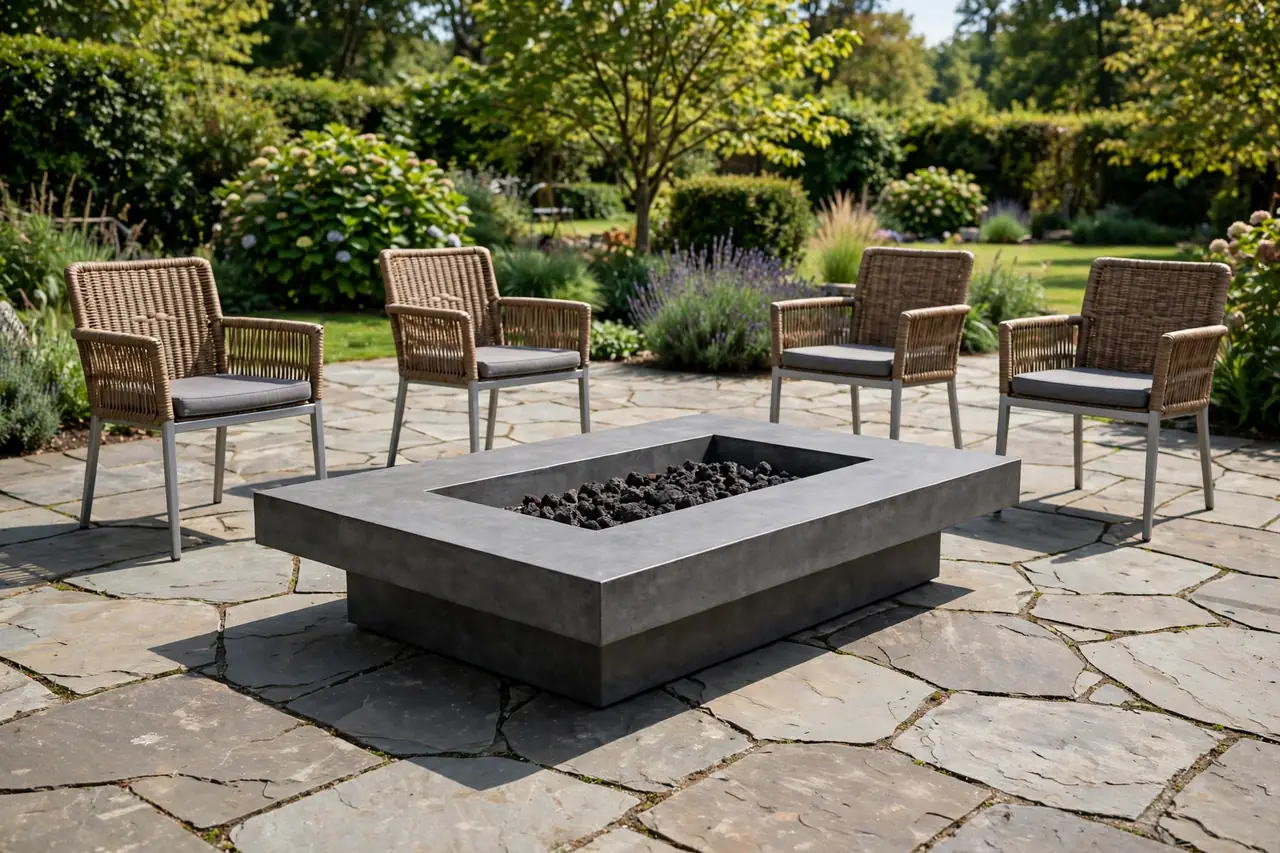
This is the safety rule from the intro, and it is the most repeated question patio owners ask. Gas tables are outdoor heat sources with an open flame, and the certification is what makes them usable near a house. CSA certification means a third-party lab tested the burner, the gas connections, and the shut-off, and every table in the 2026 roundups that earned a recommendation carried it. A table without it is a gamble, not a bargain. See the full safety breakdown at Who Is McAfee’s 10 best fire pit tables, tested and ranked.
Clearances are not suggestions. Keep 36 inches from any side wall, 8 feet to the ceiling above, and never place a fire table under a pergola with a fabric top or a low porch roof. Put it on stone, concrete, or pavers, or on a fireproof mat over a wood or composite deck, because the base gets hot and embers from a wood table can scorch decking. Keep the propane tank upright inside its compartment, check the hose for cracks each season, and test connections with soapy water: bubbles mean a leak, and a leaking connection never gets lit.
Children and pets change the rules. A wind guard does more than block wind: it keeps small hands and paws away from the flame, and it keeps the fire glass inside the bowl. Never leave a lit table unattended, never move a lit table, and always close the tank valve when the evening ends, not just the control knob.
CSA-certified, 36 inches from walls, 8 feet to the ceiling. Miss any one of those and the table stays in the store.
What Most People Get Wrong About Fire Pit Tables
Most people get fire pit tables wrong in the same three ways: they buy BTU instead of buying a wind guard, they believe the lid makes the table a normal table, and they forget the tank until it runs out mid-party. All three mistakes are cheap to avoid and expensive to learn.
BTU is not warmth. A 60,000 BTU burner in a breeze warms fewer people than a 50,000 BTU burner behind a glass wind guard, because wind steals heat faster than any burner makes it. The guard costs $40 to $80 and does more for comfort than 10,000 extra BTU ever will. Buy the guard before you buy the bigger burner.
The lid is not a tabletop. Yes, the lid covers the burner bowl and gives you a flat surface, but it is thin metal over a fire bowl, and it is not rated for a hot pan, a heavy planter, or a child standing on it. Use it for drinks and plates, not for storage, and never put the lid on while the burner is still hot.
And the tank is the part everyone forgets. A 20-pound tank at medium flame lasts 8 to 10 hours, which is about four evenings, and then it dies without warning in the middle of the best conversation of the night. Keep a spare tank full and a tank gauge on the one in use. A $15 gauge ends the mid-party flame-out forever.
Wind guard first, BTU second, spare tank always. The accessories decide the evenings, not the box.
How to Care for a Fire Pit Table
Care for a fire pit table with a 20-minute routine each season: check the gas hose and connections for cracks and leaks, clean the burner ports with a soft brush, wash the fire glass or lava rock, and cover the table with a breathable cover when it is not in use. A covered table lasts years longer than one left open to rain, because water in the burner bowl rusts the ports from the inside.
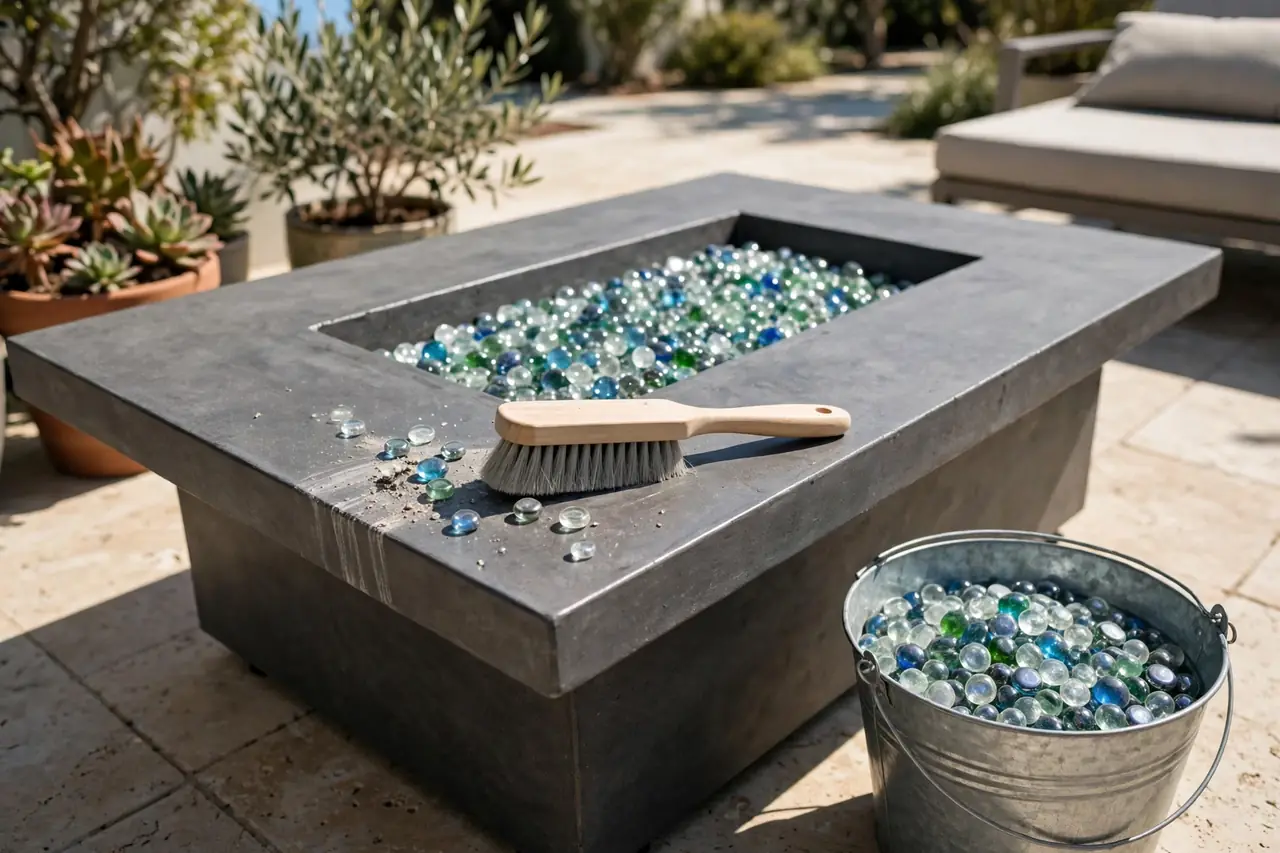
Start each season with the leak test. Brush soapy water over every connection, open the tank valve slowly, and watch for bubbles. No bubbles means no leak. Then light the burner and watch the flame: it should burn blue with yellow tips, evenly around the ring. A flame that sputters or burns on one side only means a clogged port, and a soft brush or a toothpick clears it. Never poke a burner port with a metal pin while the gas is on.
Clean the fire glass twice a season. Lift it out, rinse it, and let it dry fully before it goes back, because wet glass steams and pops when the burner lights. Lava rock needs the same treatment, and it breaks down over time, so replace the top layer every year or two. Keep the lid on between uses, and keep a breathable cover over the whole table in winter. Our how to store outdoor furniture guide covers the full winter routine for everything on the patio.
Pair the table with the right seating and the right light. A deep sectional around a fire table turns a patio into a living room, and our outdoor sectional couch guide shows how to size one to the table. For heat on nights when the fire stays off, our propane patio heater and electric patio heater guides cover the alternatives, and our patio string lights ideas guide finishes the evening glow.
Leak test, clean ports, cover it up. Twenty minutes a season is the whole job.
Related Guides
If you are planning the whole outdoor living space, these guides pick up where this one leaves off:
- Outdoor Sectional Couch — deep seating for the circle around your fire table.
- Propane Patio Heater — heat for nights when the fire table stays off.
- Electric Patio Heater — plug-in warmth with no tank to swap.
- Paved Patio Ideas — the stone or paver base a fire table deserves.
- Patio String Lights Ideas — finish the evening glow around the fire.
- Enclosed Patio Ideas — how to use a covered patio safely with heat sources.
- How to Store Outdoor Furniture — keep it clean, dry, and ready for spring.
- Concrete Patio Design Ideas — a fireproof base that looks good too.
Frequently Asked Questions
What to look for when buying a fire pit table?
Focus on five factors: CSA certification for safety, BTU output between 50,000 and 60,000 for typical patios, materials suited to your climate, size that fits your space, and included accessories like a cover and lid. Propane is the most practical fuel for residential use.
Are fire pit tables worth it?
Yes, if you entertain outdoors regularly. They extend your patio season by two to three months in most climates, double as functional table space when not lit, and give you an ambience a standalone fire pit cannot match. With proper care, five or more years of use is common.
Do fire pit tables give off heat?
Yes. Fire pit tables produce real radiant heat, but most of the warmth radiates upward rather than outward. At 50,000 to 60,000 BTU, you feel comfortable warmth within 4 to 6 feet of the burner on cool nights, though they are not designed to heat large areas like a patio heater.
How long does a propane tank last in a fire pit table?
A standard 20-pound propane tank lasts 8 to 10 hours at medium flame on a 50,000 to 60,000 BTU fire pit table. At full flame, expect 4 to 5 hours, and at low flame for ambience you can stretch a single tank to 12 or more hours. Wind and outdoor temperature affect consumption.
Can you use a fire pit table on a deck?
Yes, but place a heat-resistant fire pit pad under the table to protect the deck surface from radiant heat. Most manufacturers and local codes recommend a pad rated for at least the BTU output of your fire pit table, and wooden decks need this protection more than concrete patios.
How far should a fire pit table be from the house?
Most local regulations require at least 10 feet between any fire feature and a structure, and some areas require 15 to 20 feet. Always maintain clearance from overhangs, eaves, and overhanging branches, and check your city or county code for the exact distance before the first lighting.
Disclaimer: This guide gives general advice about outdoor fire features, not professional gas or fire-safety instructions. Follow the manufacturer’s manual and your local fire code, check gas connections for leaks before every season, keep children and pets away from the flame, and hire a licensed professional for any natural gas line work. Never use a fire pit table indoors, in a garage, or under a low cover.
Buy the 50,000 BTU table, add the wind guard, keep a spare tank, and put it on stone with 36 inches of air on every side. Do that, and the fire table becomes the seat everyone fights for on a cool evening — and the table everyone eats at the rest of the time.