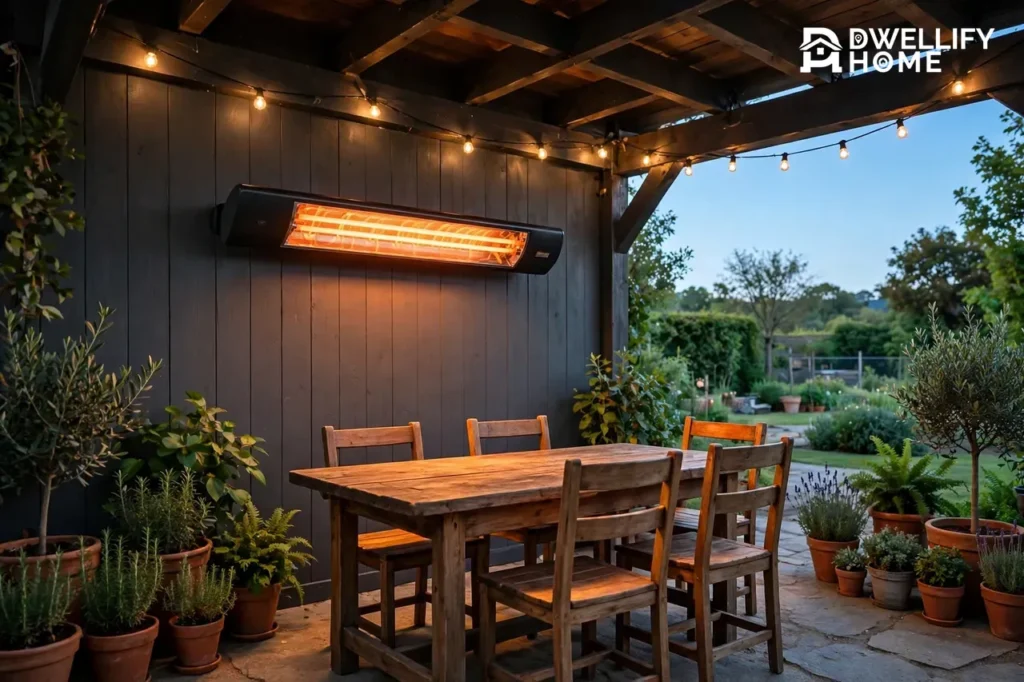
An electric patio heater is the simplest way to keep using your patio after sunset, and a standard 1,500-watt infrared model warms one or two people for about 27 cents an hour at the U.S. average residential electricity rate of 18.16 cents per kilowatt-hour (EIA, August 2026). It plugs into a normal outdoor outlet, makes no fumes and no flame, and works under a roof where a gas heater cannot go. This guide covers how electric heat works outdoors, the five types worth buying, real 2026 prices, and the safety rules that keep it worry-free.
Shoppers get confused because every heater promises the same thing: warmth. The real differences are how the heat reaches you, how much space one unit covers, and where you can safely put it. A wall-mounted infrared bar under a covered patio and a freestanding tower on an open patio solve different problems, and buying the wrong one is the most common regret. Below you will learn which type fits your patio, what it costs to buy and run, and the outlet and clearance checks to make before you order.
How Does an Electric Patio Heater Work?
Most electric patio heaters use infrared heat, which works like sunshine. Instead of warming the air, the heating element sends out infrared rays that warm people, chairs, and tables directly. The air between the heater and your skin stays cool, so a breeze steals far less warmth than it would from a heater that blows hot air. That is why an outdoor electric patio heater still feels warm on a breezy evening when a fan heater would be useless.
A few electric heaters use a fan and a ceramic element instead. Fan heaters warm the air around them, which works indoors but outdoors the warm air rises and drifts away in seconds. For a patio, infrared is the better pick almost every time. If a listing does not say infrared, radiant, or quartz, assume it heats air and skip it for outdoor use.
Infrared heat also starts instantly. There is no warm-up wait and no flame to light. You switch it on, and the glow and the warmth arrive together. Most models offer two or three heat levels, a remote, and a timer, so you can run it on low for a mild evening and turn it up when the temperature drops. Electric outdoor heaters are nearly silent, need no fuel tank, and produce no exhaust, which is why they are the only heater type that belongs under a solid roof or on a small balcony.
Infrared warms people, not air, so wind steals far less of its heat. That single fact decides most electric heater purchases.
The 5 Types of Electric Patio Heaters Compared
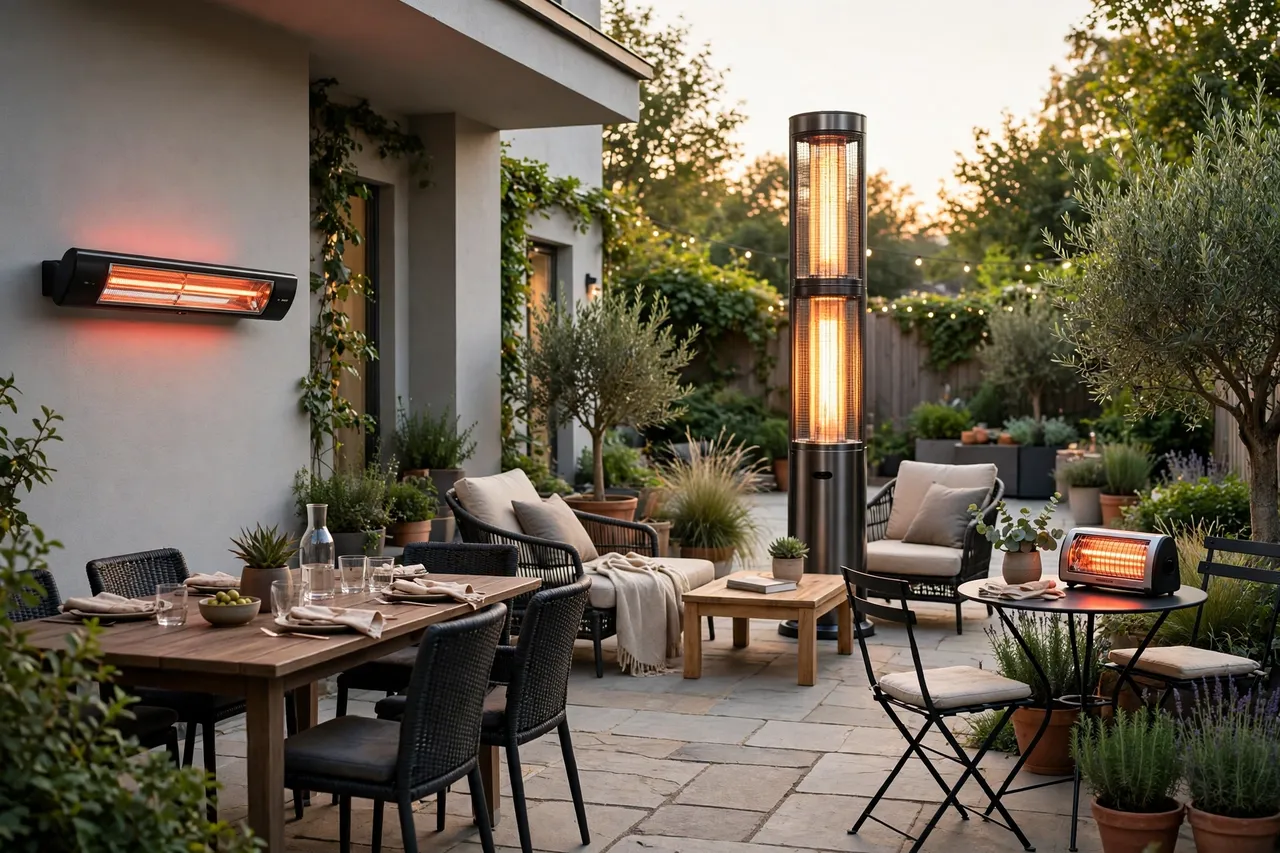
Every electric patio heater falls into one of five types. The table gives the short version, then each type gets a closer look so you can match one to your patio and your outlet.
Electric patio heater types at a glance
| Type | Best for | Typical price | Power |
|---|---|---|---|
| Wall or ceiling bar | Covered patios, pergolas | $110 to $250 | 1,500 W, 120 V plug-in |
| Freestanding tower | Open patios, renters | $110 to $200 | 1,500 W, 120 V plug-in |
| Tabletop or mini | Small tables, balconies | $45 to $170 | 750 to 1,500 W |
| Hanging heater | Gazebos, covered seating | $90 to $250 | 1,500 W, 120 V plug-in |
| Hardwired overhead | Large patios, permanent install | $800 to $1,200+ | 3,000 to 6,000 W, 240 V |
Prices in this table come from retailer and guide checks in November 2026 and cover plug-in models at the low end and hardwired commercial-grade fixtures at the high end. A hardwired unit also needs an electrician, which adds to the real cost.
Wall or ceiling bar: the covered-patio standard
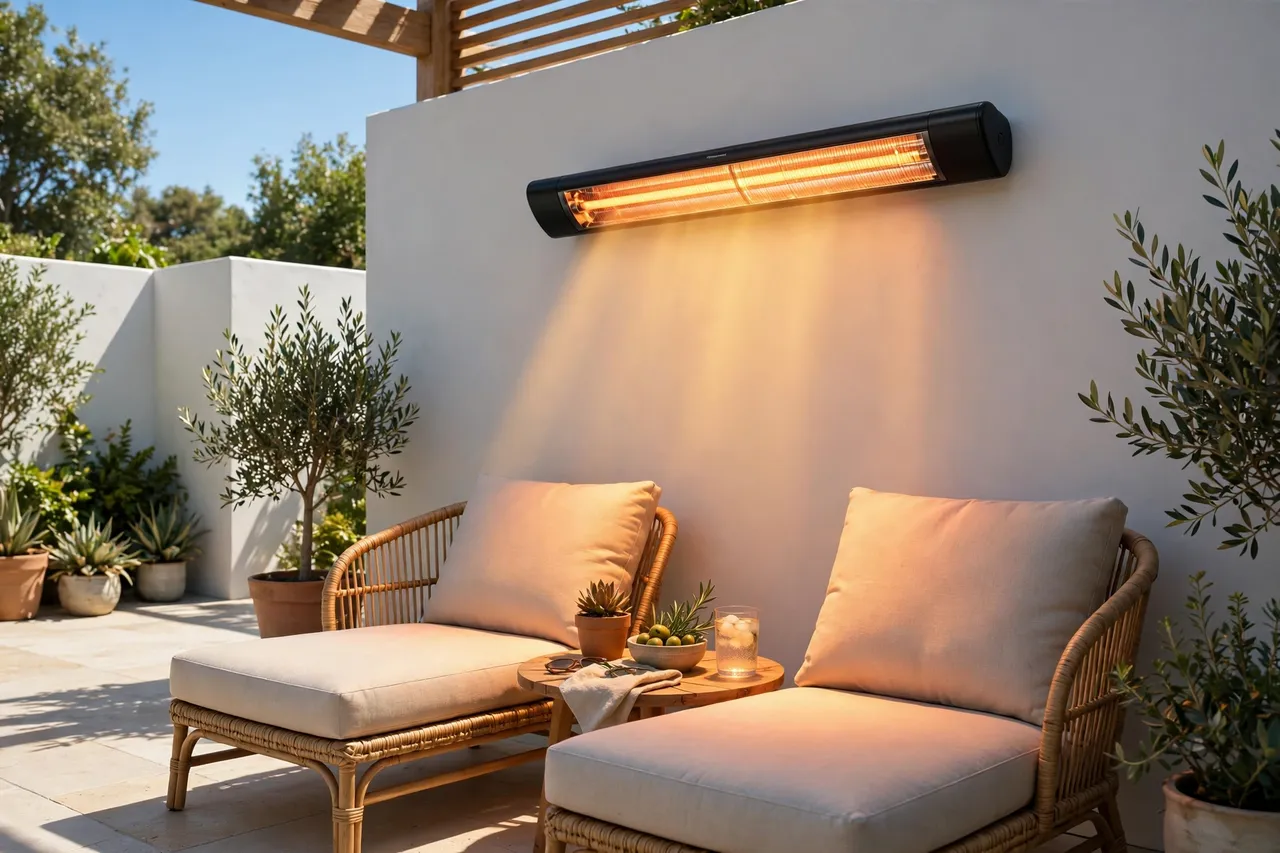
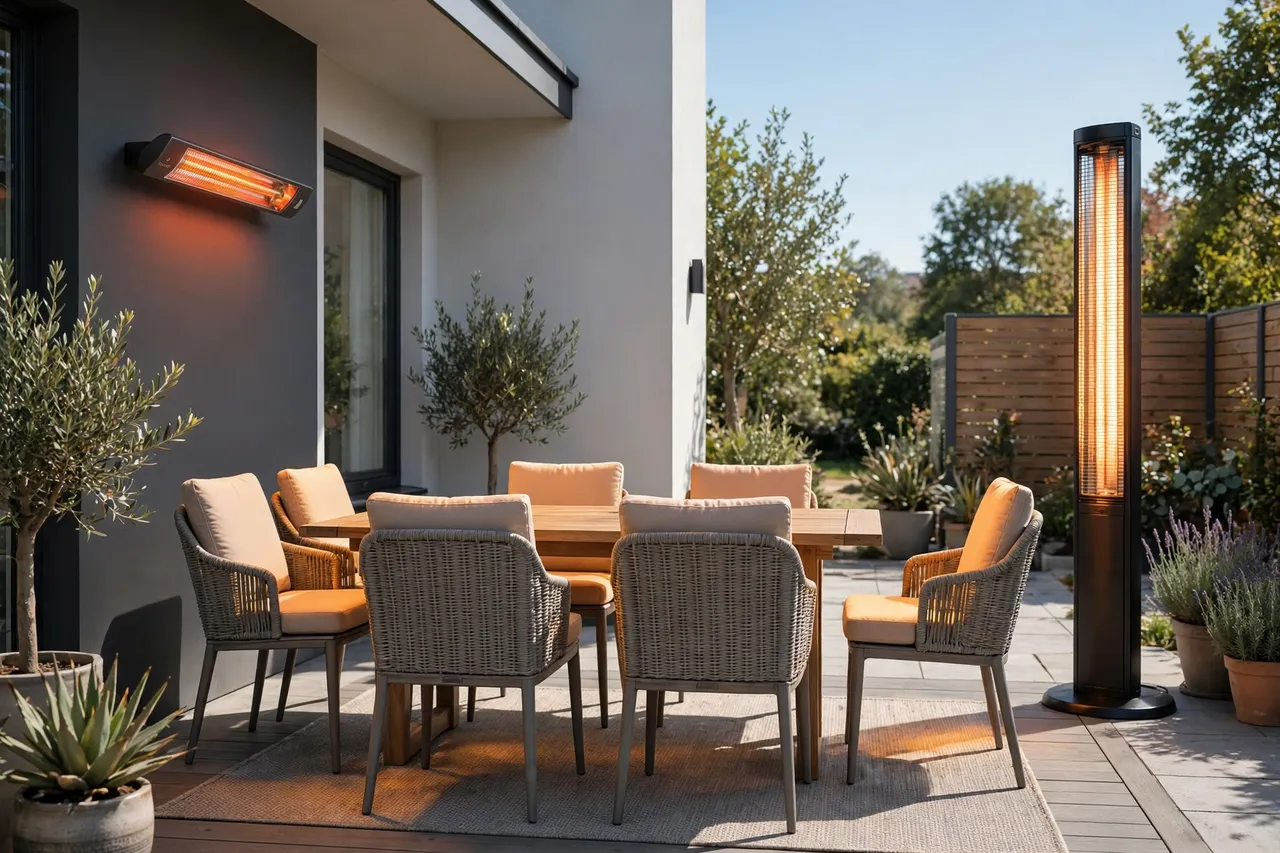
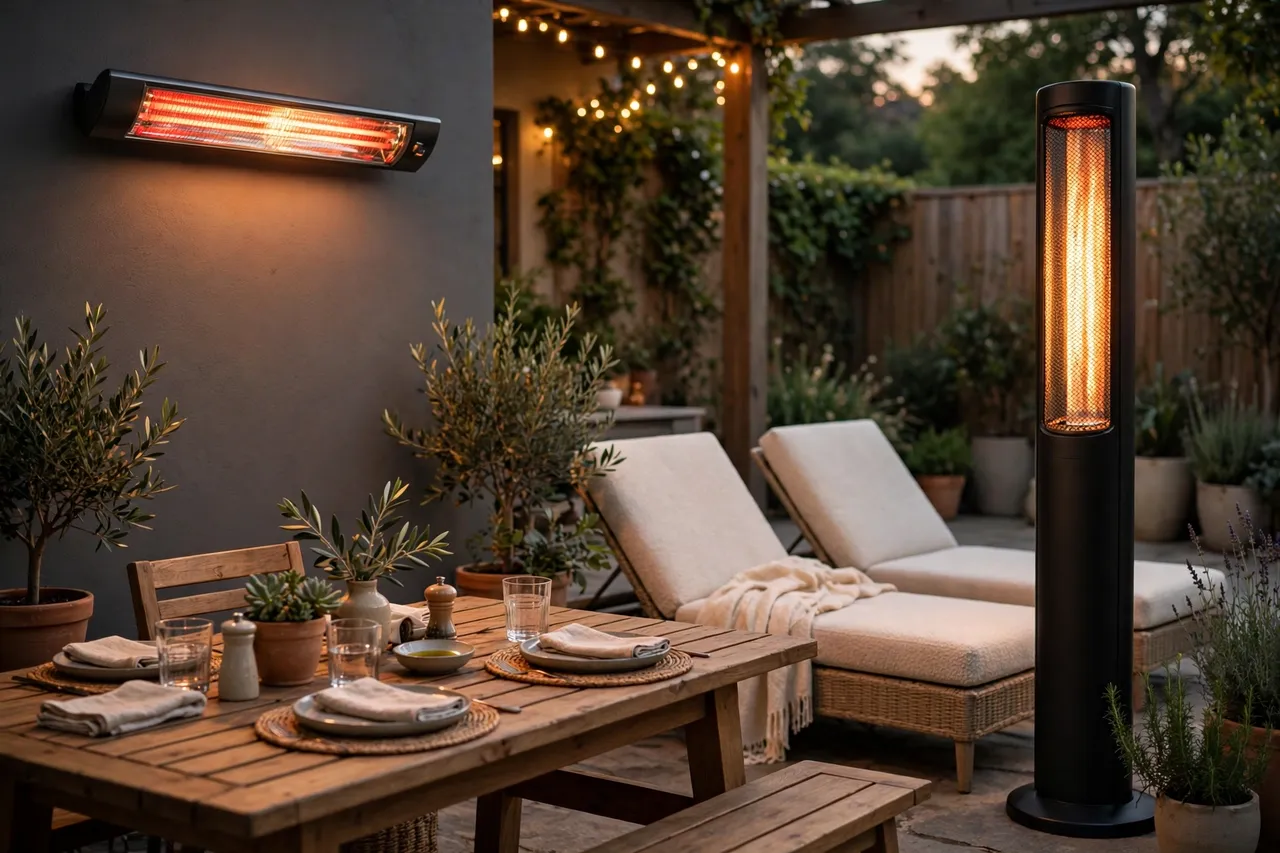
A wall or ceiling bar heater is a slim infrared tube mounted above head height, aimed down at the seating area. It is the most popular electric patio heater for a covered patio because it takes up no floor space, keeps the hot element far from hands and cushions, and aims the heat exactly where people sit. The best-known model, the Dr. Infrared DR-238, is a 1,500-watt carbon infrared bar with three heat levels, a remote, and an IP55 weather rating, and it was listed at about $126 on Amazon in an October 2026 price check. Mount it at least 6 feet above the floor and keep 3 feet clear of anything that can burn, per the maker’s guidance.
Freestanding tower: heat you can move
A freestanding patio heater, often called a patio tower heater or standing patio heater, stands on the floor like a slim column and warms the people around it. It suits open patios and renters best, because it needs no drilling and moves wherever the chairs go. Most towers run 1,500 watts on a standard outlet, stand about 3 feet tall, and cost $110 to $200. Look for a weighted base, a tip-over switch that cuts power if it falls, and an IPX5 rating if it will sit in the rain. A tower warms one or two people at close range, not a whole patio, so place it beside the seating, not in a corner.
Tabletop or mini: small heat for small spaces
A table top patio heater or mini outdoor patio heater sits on the table itself and warms the hands and faces around it. It is the right pick for a small balcony, a two-person bistro set, or a screened porch where a full-size heater would crowd everyone out. Mini models run 750 to 1,500 watts, and some are simple heat lamps for outside use: a glowing bulb in a small shade that throws heat down onto the table. They cost the least and cover the least, so treat them as a personal warmer, not a patio heater. Never set a tabletop heater on a soft surface or near paper napkins, and keep the cord off the table edge where it can be pulled.
Hanging heater: warmth from above, nothing on the floor
A hanging patio heater hangs from a beam, a gazebo frame, or a sturdy hook by a chain or a short mount, with the heat lamp pointing down at the table. It works well under a gazebo or a pergola where wall space is short but a beam runs overhead. Most hanging models are 1,500-watt infrared units, and the manual sets the clearances: the Westinghouse hanging heater manual, for example, calls for at least 1.5 feet of space above the unit, about 9 inches from a side wall, and 5 feet below it to the floor. Hang it only from a solid attachment point that can hold its weight, never from a light fixture or a thin branch.
Hardwired overhead: the permanent answer for big patios
A hardwired overhead heater is a commercial-grade infrared fixture, usually 3,000 to 6,000 watts on a 240-volt circuit, mounted under a roof or a pergola beam. Brands like Bromic lead this class: the Bromic Tungsten 6000W was listed at $1,161 on Amazon in November 2026, and the 3000W model at $958. These units heat a large area from overhead and look like part of the patio, not an appliance. They need a licensed electrician, a dedicated 240-volt circuit, and the maker’s clearances, so they suit homeowners building a permanent outdoor room, not renters or first-time buyers.
Buy the type that fits your roof and your outlet, not the one with the brightest photo. A wall bar needs a wall and a roof, while a tower needs only floor space and an outlet.
How Much Heat Do You Need? Sizing by Watts
Electric patio heaters are rated in watts, not BTUs, and the number tells you how much heat you get. A 1,500-watt heater makes about 5,100 BTUs of heat, which warms one or two people sitting within a few feet of it. That is the standard size for a normal 120-volt outdoor outlet, and it is enough for a dining table or a pair of lounge chairs. Two people sharing a small table need one 1,500-watt unit; a six-person dining set needs two, placed on opposite sides.
For bigger spaces, the math is simple but strict. A 1,500-watt heater draws 12.5 amps on a 120-volt circuit. The National Electrical Code limits a continuous load to 80% of a circuit’s rating, which is 12 amps on a 15-amp circuit, so one full-power heater nearly fills a standard 15-amp outdoor circuit on its own. A dedicated 20-amp circuit supports a 1,920-watt continuous load and comfortably runs one 1,500-watt heater with room to spare. Never run two 1,500-watt heaters on one 15-amp circuit, and never share the heater’s circuit with string lights or a holiday display, or the breaker will trip the moment the heater peaks.
If one 1,500-watt unit is not enough, the next step is a 240-volt hardwired heater, not a bigger plug-in. A 3,000-watt unit covers a small seating group from overhead, and a 6,000-watt unit covers a large patio. Both need a licensed electrician and a dedicated circuit, and both cost far more than a plug-in. For most homes, two well-placed 1,500-watt plug-in heaters on separate circuits beat one expensive hardwired unit.
Wind changes the answer more than wattage does. Infrared heat travels in a beam, and a strong wind scatters it before it reaches you. On a windy patio, mount the heater closer and lower, add a windbreak like a screen or a hedge, and sit inside the beam, not beside it. Our covered patio ideas show roofed layouts where a roof and side walls hold the warmth in, which is where electric heat works best.
One 1,500-watt heater warms one or two people, not a whole patio. Size by people and seating, never by the size of the slab.
What Does an Electric Patio Heater Cost?
An electric patio heater costs $45 to $250 for a plug-in model and $800 to $1,200 or more for a hardwired fixture, and the running cost is where electric wins. A 1,500-watt heater uses 1.5 kilowatt-hours per hour, which costs about 27 cents an hour at the U.S. average residential rate of 18.16 cents per kilowatt-hour reported by the EIA for August 2026. Three hours a night, four nights a week, for four months costs roughly $52 in electricity. Compare that with propane, covered below, and the gap is hard to ignore.
Electric patio heater prices, checked November 2026
| Model or type | Power | Price checked |
|---|---|---|
| Hykolity 38.5 in standing heater | 1,500 W | $109.99 (Nov 12, 2026) |
| Dr. Infrared DR-238 wall/ceiling bar | 1,500 W | $125.99 (Oct 10, 2026) |
| SereneLife 1,500 W infrared heater | 1,500 W | $162.06 (Oct 21, 2026) |
| Haimmy 42 in infrared tower | 1,500 W | $159.99 (Oct 10, 2026) |
| Paraheeter 1500 W, tripod/wall | 1,500 W | $169.98 (Oct 10, 2026) |
| Bromic Tungsten 3000 W, hardwired | 3,000 W | $958 (Nov 12, 2026) |
| Bromic Tungsten 6000 W, hardwired | 6,000 W | $1,161 (Nov 12, 2026) |
Your own running cost depends on your local rate, which varies widely: Nevada averaged 12.72 cents per kilowatt-hour in August 2026 while Hawaii averaged 47.18 cents, per the same EIA data. At the national average, a 1,500-watt heater costs about 27 cents an hour; in Hawaii it would cost about 71 cents, and in Nevada about 19 cents. Check your own bill for your rate, then multiply by 1.5 to get your hourly cost for a 1,500-watt heater. The U.S. average rate and the state spread come from the EIA figures compiled at Price of Electricity’s EIA rate table.
Budget for the extras too. A wall bar needs mounting brackets (usually included) and an outdoor outlet within reach. A tower needs nothing extra, but a good outdoor-rated extension cord costs $25 to $40 if the outlet is far away, and only a heavy 12-gauge outdoor cord is safe for a 1,500-watt load. A hardwired heater needs an electrician, which typically adds several hundred dollars to the job. None of these extras is large, but a heater with no safe way to plug it in is money wasted.
The running cost is about 27 cents an hour at the national average rate. The purchase price is a one-time cost, while the hourly cost decides whether you actually use it.
Electric vs Propane: Which One Wins for Your Patio?
Electric and propane heaters solve the same problem in opposite ways, and the right one depends on your patio, not on which is newer. Electric infrared heat warms people directly, makes no fumes, and costs about 27 cents an hour to run. Propane heat warms a wide circle of air, puts out far more total heat, and costs about $2 to $2.50 an hour in fuel: a standard 20-pound tank holds about 4.7 gallons, costs roughly $20 to $25 to refill, and lasts about 10 hours on a 40,000-BTU heater at full power.
Choose electric when your patio has a roof, a wall, or a nearby outlet. Electric is the only safe choice for a covered patio, a screened porch, or a small balcony, because it produces no carbon monoxide and no open flame. It is also the quiet choice, the low-maintenance choice, and the cheapest to run per hour. If your seating sits under a pergola or a patio roof, electric wins outright.
Choose propane when your patio is wide open with no roof and no outlet nearby. A freestanding propane tower puts out roughly 40,000 BTUs, about eight times the heat of a 1,500-watt electric unit, and warms a large circle of people at once. It needs no cord and no circuit, so it works anywhere on the lawn. The trade-offs are real: you buy and store fuel, you pay about ten times more per hour to run it, and you must keep it in open air, away from roofs and walls.
The two types also differ in how they handle wind. Electric infrared loses less heat to a breeze because it warms people, not air, but a strong wind still scatters the beam. Propane warms air, so wind steals more of it, but its sheer output can overpower a light breeze. On a calm evening under a roof, electric feels warmer per dollar. On a windy open patio, propane’s brute force wins, at a much higher running cost.
Roof and outlet nearby means electric; wide-open patio with no power means propane. Most homes with a covered patio should start electric.
How to Use an Electric Patio Heater Safely
An electric patio heater is safer than any fuel-burning heater, but it still draws serious power outdoors, so the safety rules matter. The U.S. Consumer Product Safety Commission reports that portable heaters were involved in an average of 1,600 house fires a year from 2019 to 2021, and the same safety habits apply outdoors. Follow these rules every time you switch the heater on.
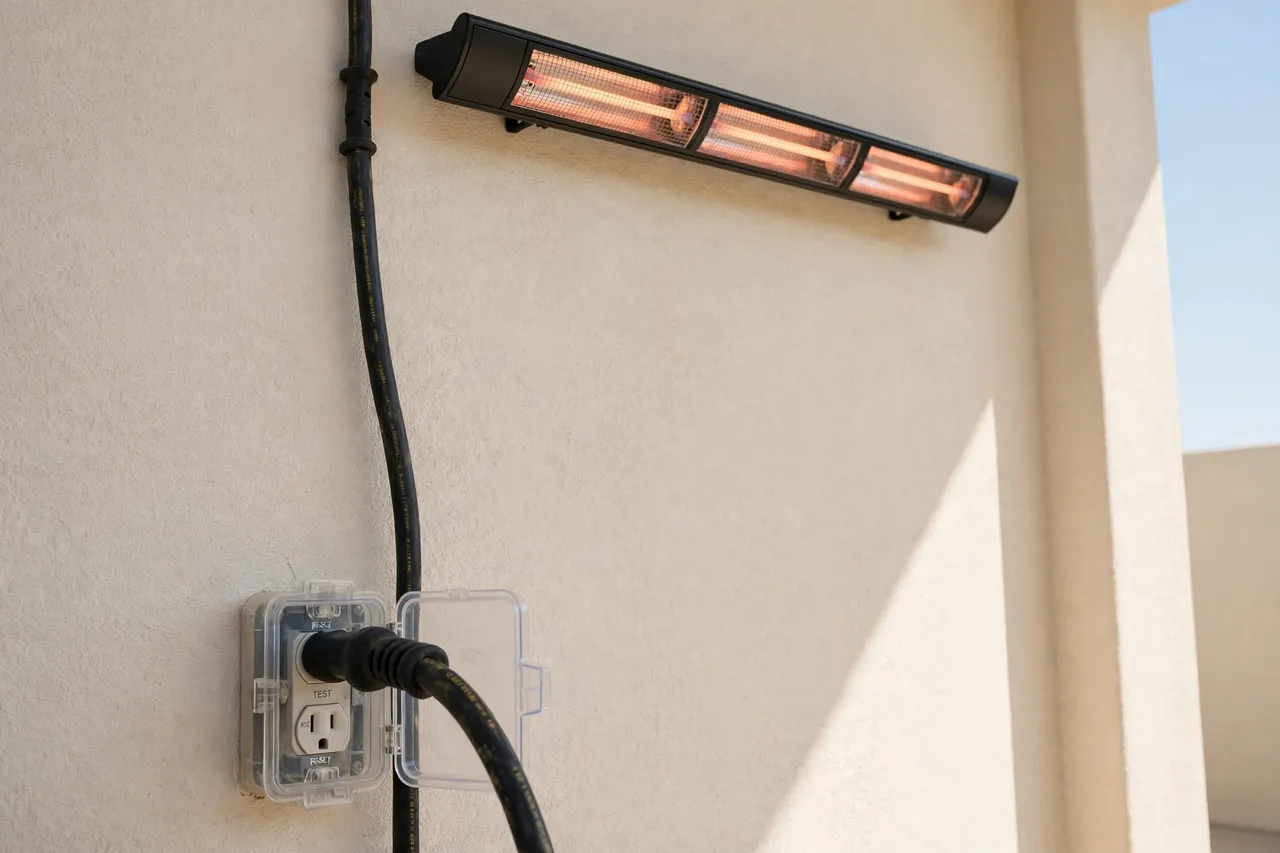
Plug it straight into a GFCI outlet. A ground fault circuit interrupter outlet cuts power in a fraction of a second if current leaks through water or a damaged cord, and outdoor outlets should already be GFCI-protected. If your outdoor outlet has no test and reset buttons, ask an electrician to fit one before you use the heater. Never plug a 1,500-watt heater into an indoor extension cord, a power strip, or a light-duty cord. If you must use an extension cord, use a heavy-duty outdoor-rated 12-gauge cord, keep the connection off the ground and out of puddles, and never run it under a rug, where it can overheat.
Keep 3 feet of clear space around the heater. Consumer Reports, citing CPSC and fire-safety guidance, advises keeping anything that can burn at least 3 feet from a heater, and the same rule applies on a patio: cushions, curtains, dry leaves, and paper decorations stay outside that circle. Read the full safety guidance at Consumer Reports’ space heater safety tips. Set a freestanding heater on a hard, level surface, never on a rug or a table, and keep it out of walkways where it can be knocked over.
Buy a certified heater and check its weather rating. Look for a UL, ETL, or CSA mark, which means an independent lab tested it to a North American safety standard. Check the IP rating too: IPX4 means it tolerates splashing water, IP55 means it handles rain and dust, and IP65 means it stands up to water jets from any direction. A splash-rated heater belongs under a roof; only an IP65 unit belongs fully exposed to rain. Never use a heater with a cracked housing, a frayed cord, or a plug that feels hot, and never leave a heater running when you go inside or go to bed.
Keep water and electricity apart. Turn the heater off before you water plants nearby, move it only after the element has cooled, and store a portable heater indoors or under a cover when the season ends. If a GFCI trips while the heater runs, do not just reset it and carry on: a repeated trip means moisture or a fault, and the heater should be checked before it is used again.
GFCI outlet, heavy outdoor cord, and 3 feet of clear space. Those three habits prevent almost every electric heater accident.
Where to Put It: Placement and Mounting Heights
Placement matters more than wattage, because infrared heat travels in a straight beam. A heater aimed at an empty corner warms nothing, while the same heater aimed at the chairs warms everyone. Mount a wall or ceiling bar 6 to 8 feet above the floor, angled down toward the seating, and sit inside the beam, not beside it. The maker’s manual sets the exact clearances: Bromic asks for 3 feet from anything that can burn, and Eurofase heaters mount at least 72 inches above the floor, 18 inches from an adjacent wall, and 12 inches below the ceiling when wall-mounted, or 6 inches when ceiling-mounted. A licensed installer in San Diego who fits these heaters explains the full clearance rules at Specialty Electric’s electric patio heater installation guide.
For a dining table, mount the heater above the table’s long side so the beam covers every seat, or hang one above the table center. For lounge chairs, mount it on the wall behind the chairs and aim it forward, or place a tower beside the chairs at arm’s length. For a small balcony, a tabletop heater on the table or a short tower in the corner is usually enough, and a wall bar works only if the balcony wall can take the mount and the clearances fit. Check your lease and local fire rules before you mount anything on a rented balcony: many leases and fire codes ban open-flame heaters on balconies, which is one more reason electric wins there, but a mounted heater still needs the building’s permission.
Think about the outlet before you think about the mount. The heater needs a GFCI outlet within its own cord length, ideally without any extension cord at all. If the nearest outlet is across the patio, move the seating, not the heater: a long cord across a walkway is a trip hazard and a shock risk. For a hardwired heater, the electrician runs the circuit to the mount, so the outlet problem disappears and the placement decision becomes purely about where people sit.
Aim the beam at the chairs, not at the patio. A well-placed 1,500-watt heater beats a badly placed 3,000-watt one.
5 Mistakes to Avoid With an Electric Patio Heater
Most electric heater regret comes from five avoidable mistakes. Check your plan against this list before you order.
- Buying a fan heater for outdoors. Fan heaters warm air, and the air blows away. Buy infrared for a patio, every time.
- Running two heaters on one circuit. Two 1,500-watt heaters draw 25 amps and will trip a 15-amp breaker. Give each heater its own circuit, or use a dedicated 20-amp circuit for one.
- Using a light indoor extension cord. A 16-gauge indoor cord can overheat under a 1,500-watt load. Use a 12-gauge outdoor-rated cord, or plug straight into the wall.
- Ignoring the IP rating. A splash-rated heater left in open rain will fail early and may void its warranty. Match the rating to the exposure: IPX4 under a roof, IP65 in the open.
- Mounting it too high or aiming it wrong. Heat falls in a beam, so a heater mounted 10 feet up over an empty corner warms the floor, not the people. Mount 6 to 8 feet high and aim at the seating.
The heater is only as good as its circuit, its cord, and its aim. Get those three right and the heater itself is the easy part.
Related Guides
If you are planning the whole patio for cool evenings, these guides pick up where this one leaves off:
- Covered Patio Ideas — roofed patios where electric heat works best.
- Home Heating — how to heat the whole home, inside and out.
- How to Winterize a House — get the house and the patio ready for cold weather.
- Patio Ideas — layouts, styles, and features for every size of patio.
- Small Patio Designs — seven layouts that make a tiny patio feel bigger.
- Patio Lighting Ideas — lights that pair with evening heat after dark.
- Outdoor String Lights — string lights that make a heated patio glow.
- Indoor Outdoor Rugs — rugs that keep feet warm under the heater.
- Paver Patio Renovation Cost — what the patio floor underneath costs, line by line.
- Patio Shade Ideas — shade by day, heat by evening, on the same patio.
- Outdoor Awnings for Patio — an awning roof over the seating area, where a wall-bar heater shines.
- Small Patio Decorating Ideas — decorating the heated seating area.
- Outdoor Furniture for Small Spaces — furniture that sits under the heater.
- Outdoor Patio Tiles — the floor under the heater.
Frequently Asked Questions
Are electric patio heaters safe?
Yes, used correctly. Electric heaters make no flame, no fumes, and no carbon monoxide, so they are the safest heater type for a covered patio or balcony. Plug into a GFCI outlet, keep 3 feet clear of anything that can burn, use a heavy outdoor-rated cord if you must extend, and buy a UL, ETL, or CSA certified model.
How much does it cost to run an electric patio heater?
A standard 1,500-watt heater uses 1.5 kilowatt-hours per hour, which costs about 27 cents an hour at the U.S. average residential rate of 18.16 cents per kilowatt-hour (EIA, August 2026). Three hours a night, four nights a week, for four months costs roughly $52. Your rate may be higher or lower, so check your own bill.
Can you use an electric patio heater under a covered patio?
Yes. Electric infrared heaters are made for covered patios and are the only heater type that belongs under a solid roof, because they produce no fumes. Honor the clearances in the manual, at least 6 feet above the floor and 3 feet from anything that can burn, and mount to solid framing or masonry, never to a thin ceiling panel.
Do electric patio heaters work in wind?
They work better in wind than any heater that warms air, because infrared rays warm people directly instead of heating air that blows away. A strong wind still scatters the beam, so mount the heater closer and lower, sit inside the beam, and add a windbreak like a screen or hedge on the windward side.
What size electric patio heater do I need?
A 1,500-watt heater suits one or two people at a small table or a pair of chairs. A six-person dining set needs two 1,500-watt units on separate circuits, one on each side. For a large patio, step up to a hardwired 3,000- or 6,000-watt overhead heater on a 240-volt circuit, fitted by a licensed electrician.
Are electric patio heaters cheaper to run than propane?
Yes, per hour. A 1,500-watt electric heater costs about 27 cents an hour at the national average electricity rate, while a 40,000-BTU propane heater costs about $2 to $2.50 an hour in fuel. Propane heats a much larger area for that money, so it wins on open patios, but electric wins on running cost for a covered seating area.
Disclaimer: This guide gives general advice, not electrical or safety instructions. Outdoor wiring, new circuits, and hardwired heaters need a licensed electrician, and local electrical and fire codes apply. Never use a heater with a damaged cord or housing, never run a heater while you sleep, and always follow the product maker’s manual and your local rules. If you are unsure about your outlet, your circuit, or your clearances, ask a qualified electrician before you switch the heater on.
The best electric patio heater is the one that fits your roof, your outlet, and your seating. Pick infrared, size it by people, plug it into a GFCI outlet, and aim the beam at the chairs. Do that, and the patio stays open long after the sun goes down, for less than the cost of a cup of coffee a night.