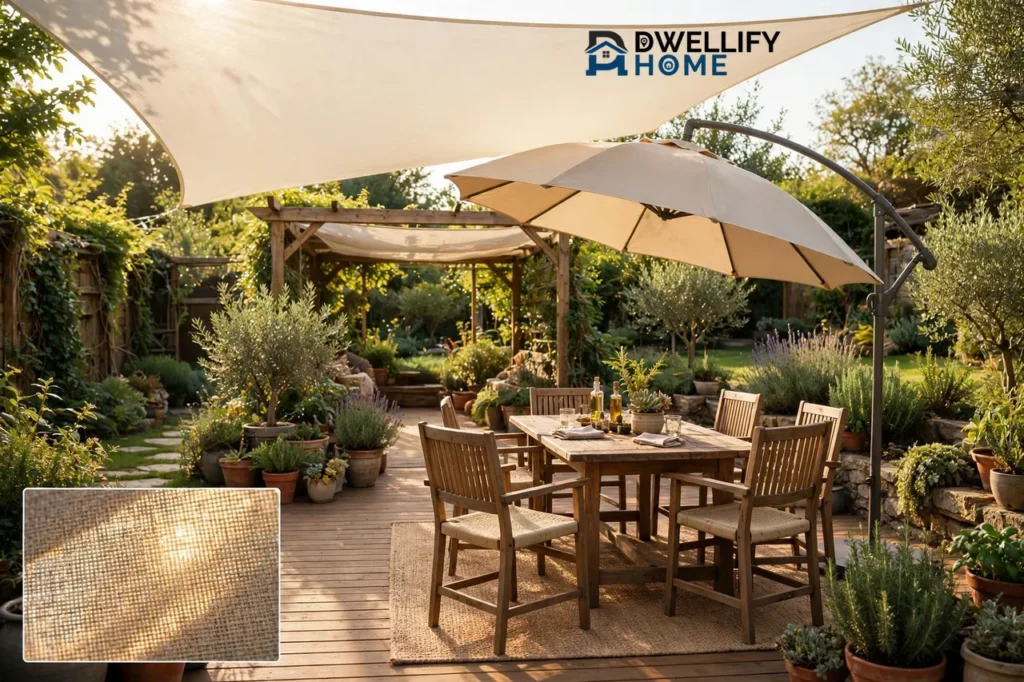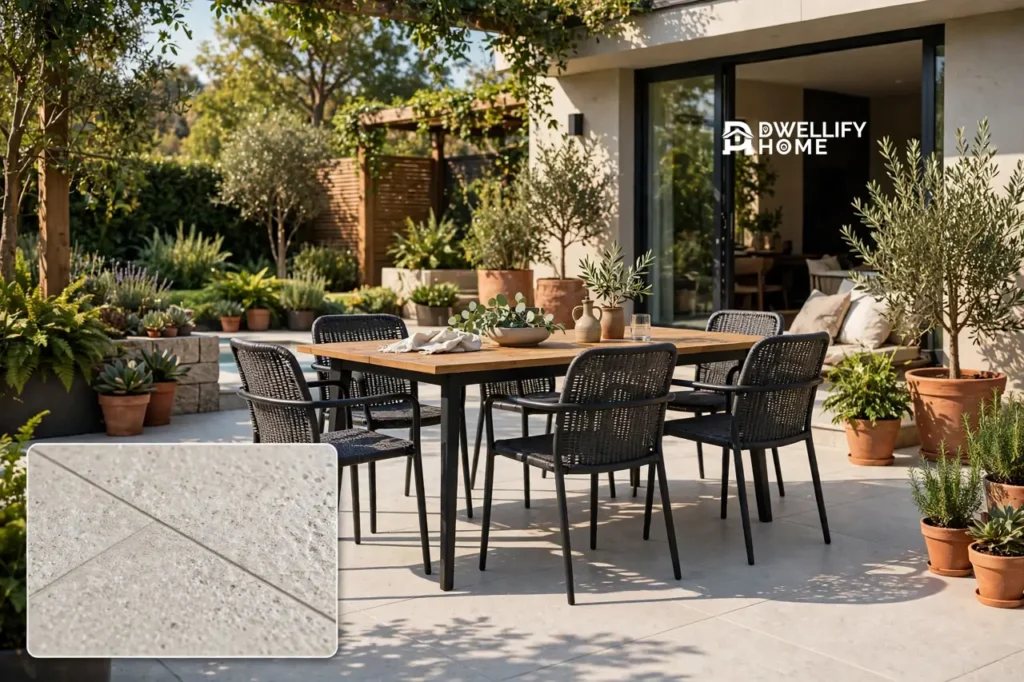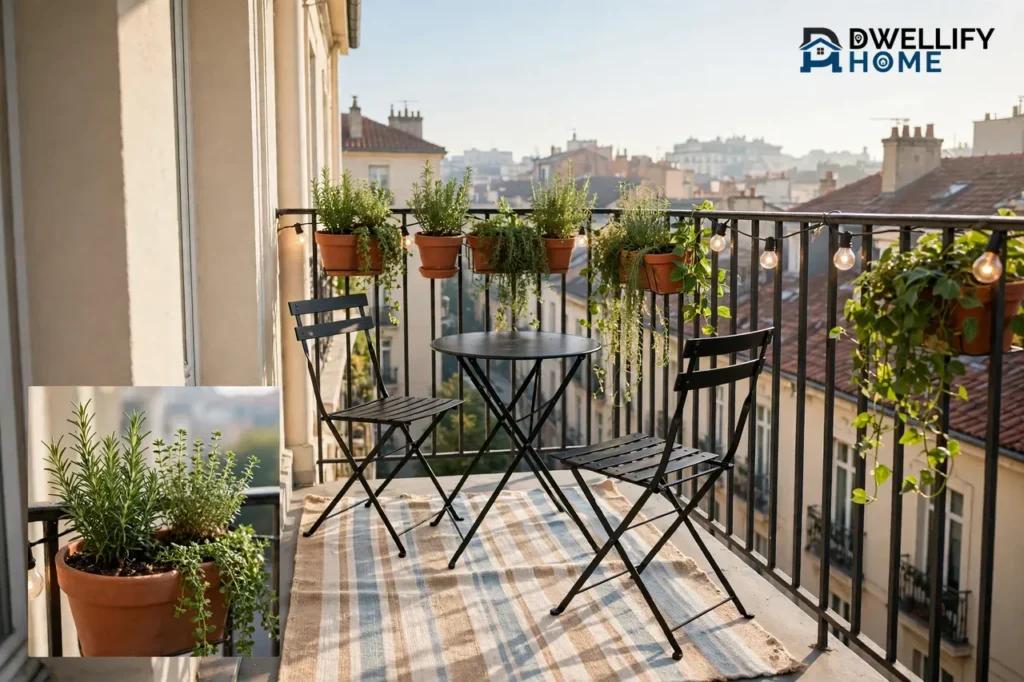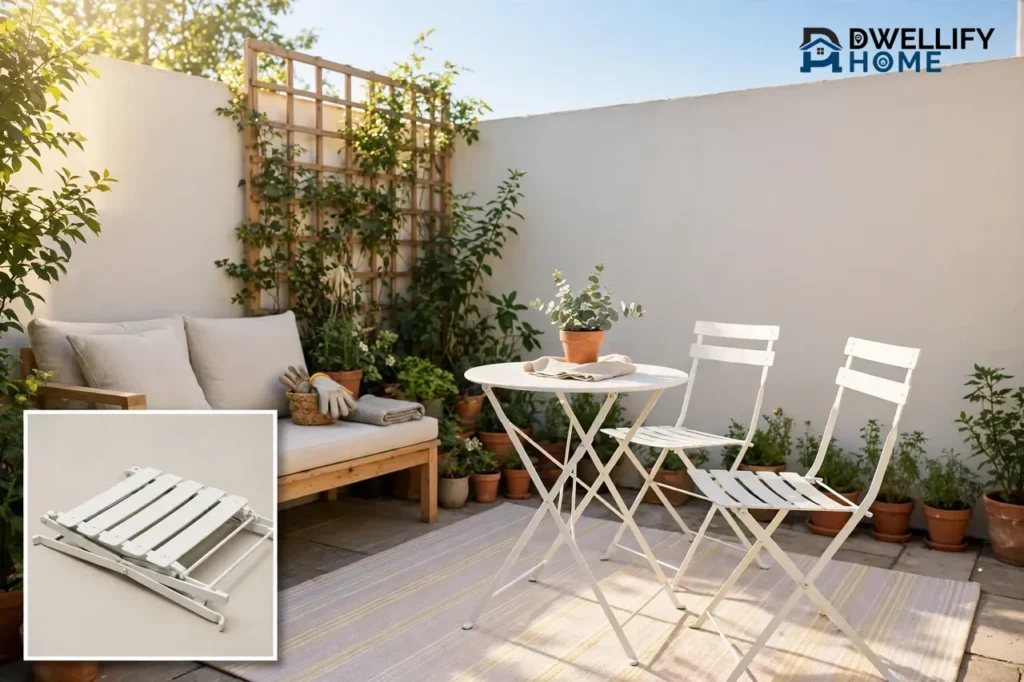
Outdoor furniture for small spaces works when you measure first and buy second: a 24-inch round bistro table with two slim chairs fits most apartment balconies, and a standard 3-piece bistro set needs about 5 by 5 feet of floor space once the chairs are pulled out. Keep 24 to 30 inches of clear walking space to the door and the railing, pick pieces that fold, stack, or store things, and your small patio stops feeling cramped and starts feeling like a room.
This guide shows you the exact numbers to measure, the seven pieces that earn their floor space, layouts for balconies and patios of every size, and the materials that survive sun and rain without constant care. You will also learn the mistakes that make small patios unusable, so you buy once and enjoy the space all season.
Outdoor Furniture for Small Spaces at a Glance
A small patio goes wrong in one of two ways: furniture too bulky for the footprint, or so little furniture that nobody ever sits outside. The fix is not a matching set. It is two or three slim pieces that fit the way you actually use the space, whether that is morning coffee, dinner for two, or an evening with a book.
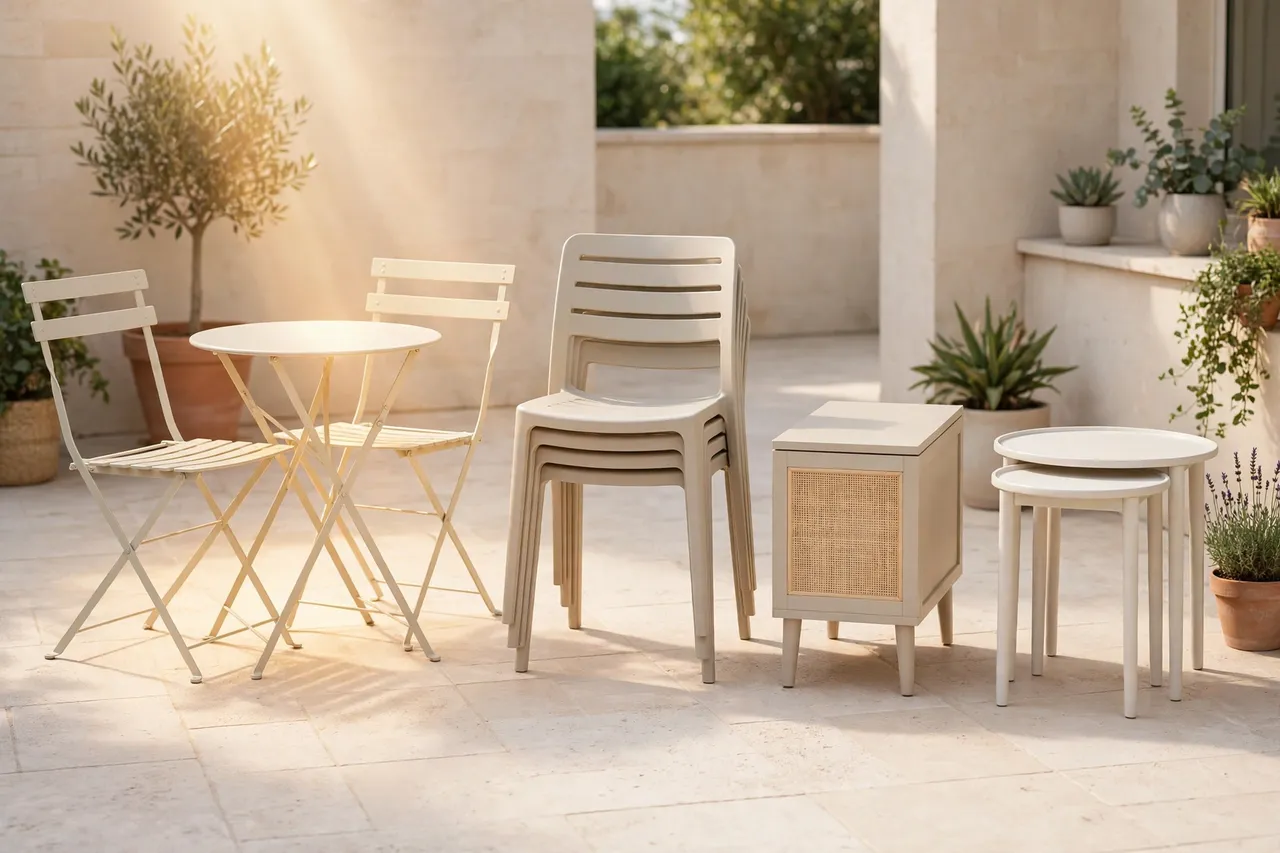
The table below sums up the best options. A bistro set is the safest first buy, a storage bench is the smartest second piece, and everything else earns its place only if it folds, stacks, or does two jobs at once.
Best outdoor furniture for small spaces compared
| Piece | Best for | Typical footprint | Watch for |
|---|---|---|---|
| Folding bistro set | Coffee and meals for two | About 5 by 5 ft in use | Narrow seats, light frames |
| Stackable chairs | Extra guests, flexible seating | Stack vertically when stored | Chairs without stack bumpers scratch |
| Compact loveseat | Relaxing with a partner | 48 to 60 in wide | Deep cushions crowd the walkway |
| Storage bench | Seating plus storage | About 44 in wide, 16 to 18 in deep | Lid clearance, weather resistance |
| Nesting side tables | Drinks, books, flexible surfaces | Small table slides under the large one | Very light tables blow over |
| Wall-mounted drop-leaf table | Very narrow balconies | Folds flat against the wall | Railing fit and wall fixings |
| Bar-height railing set | Views over the railing | Uses vertical space | Stability in wind, stool access |
A bistro set is the safest first buy for most small patios and balconies, because it gives you a real place to sit and eat without filling the floor. If you only buy one thing, buy that, then add a second piece only when you know how the first one lives in the space.
Measure First: The 5 Numbers That Decide What Fits
Before you open a single product page, measure the space you actually have. The listing’s square footage means nothing here, because doors, railings, planters, and a grill all eat floor space you cannot use for furniture.
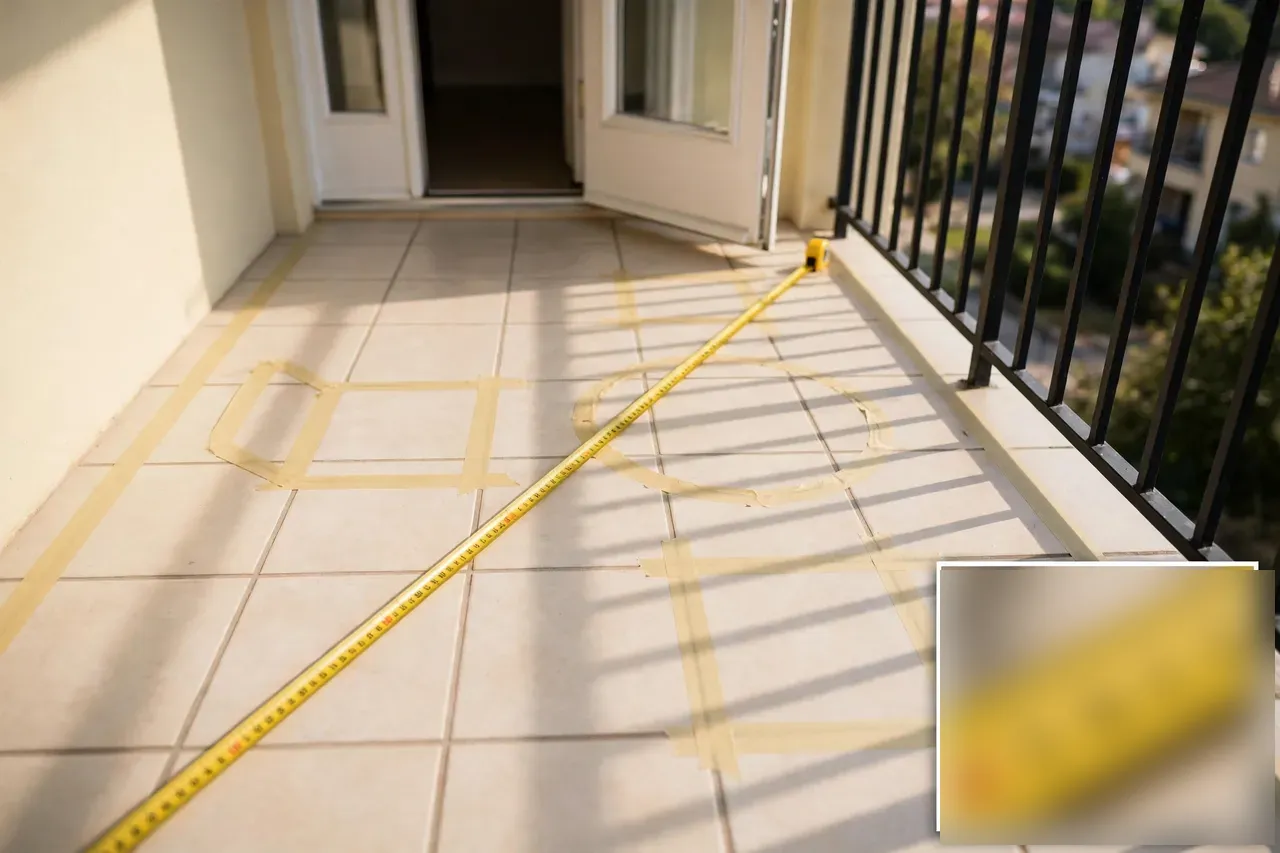
1. Usable floor area
Measure wall to wall, then subtract everything fixed: the door swing, the grill, planters, drains, and air-conditioning units. What is left is your real furniture budget. On a typical apartment balcony, 5 feet deep by 10 feet wide, that usually leaves about 5 by 6 feet of working space.
2. Walking path
Leave a clear route of 24 to 30 inches wherever people need to pass, to the door and to the railing. In a very tight space, 20 to 22 inches works for one person at a time, but anything narrower forces you to turn sideways every time you cross the patio. If you cannot leave at least 24 inches, drop a piece of furniture instead of squeezing the path.
3. Door swing
A door that swings onto the patio eats 30 to 36 inches of floor. Measure the full arc and keep it clear, or you will move a chair every time someone steps outside. A sliding door is kinder, but still needs a clear path in front of it.
4. Chair pull-out room
A chair needs about 30 inches of depth at a table: roughly 18 inches for the seat and 12 more for your legs when you stand up. Product photos never show this, so check the listed depth and add the pull-out room yourself. A chair that looks slim in a photo can still block the whole walkway once someone sits in it.
5. Railing and building rules
Before you buy, check your building’s rules. Many apartment buildings allow only small folding tables and chairs on balconies and ban heavy furniture, flammable items, and barbecues. Keep furniture clear of the railing, never hang anything over it, and keep the path to it open so nobody has to climb past a chair to reach the edge.
Measure the usable floor, not the listing, and write the numbers on your phone before you shop. A tape outline on the floor works even better: mark each piece with painter’s tape, walk the path, open the door, and pull out an imaginary chair. If it feels tight with tape, it will feel worse with real furniture.
The 7 Best Pieces for Small Patios and Balconies
Every piece below earns its floor space by doing more than one job, or by disappearing when you do not need it. Buy in this order, and stop when the space feels full, not when the catalog runs out.
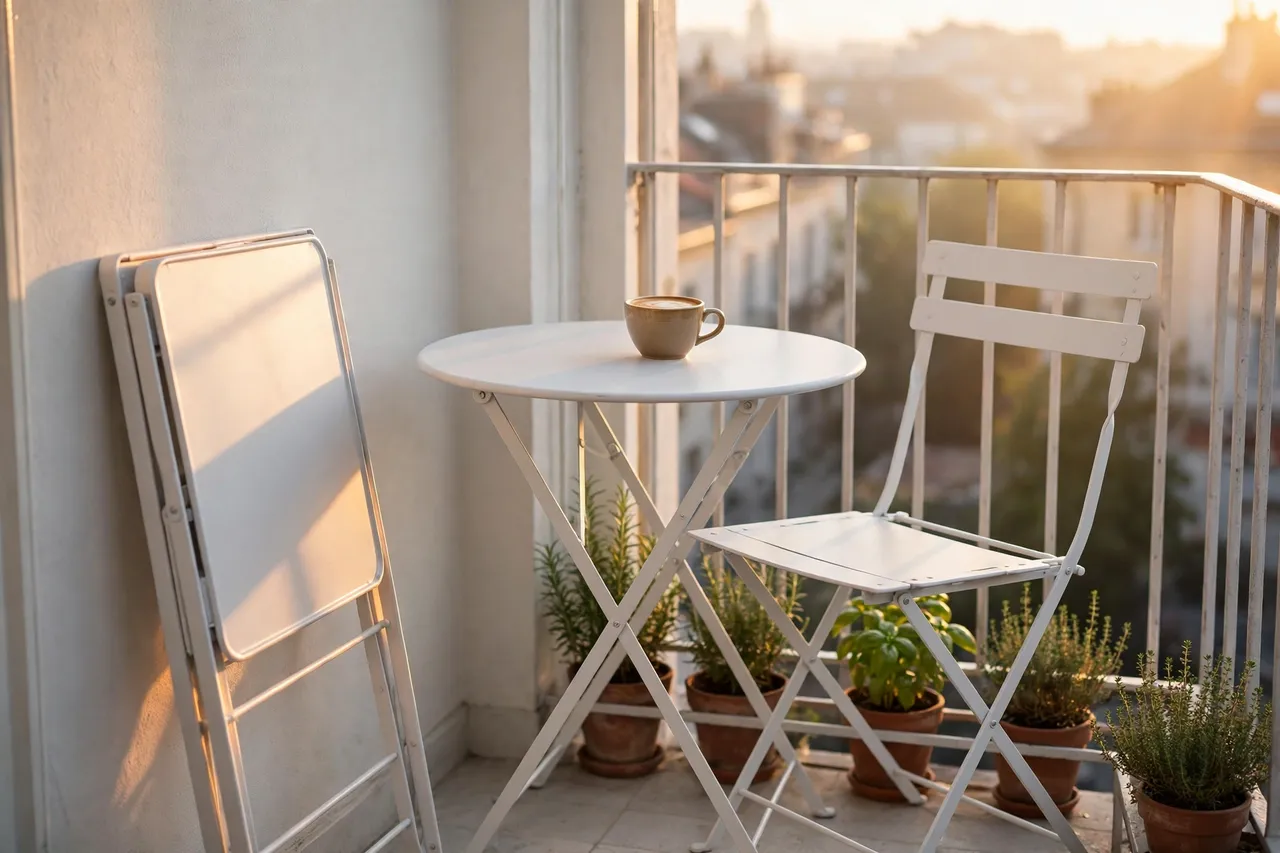
1. Folding bistro set
A folding bistro set is the most versatile choice for a small patio or balcony. A round table about 24 to 30 inches across seats two people for coffee or a full meal, and the chairs fold flat against a wall when you want the floor back. Powder-coated steel, aluminum, acacia, and eucalyptus versions all work, so pick by weight and weather: aluminum is lightest to carry, wood is warmest to look at. A 24-inch table is the practical minimum for dining with two real dinner plates; a 21-inch table fits drinks and a small plate but feels tight at mealtime.
2. Stackable chairs
Stackable chairs make entertaining realistic on a small patio. Keep two out for daily use and stack two more in a corner or by the door for guests. Resin, polypropylene, and aluminum designs are light enough to move with one hand and tough enough for daily use. Look for chairs with protective stack bumpers, or the frames will scratch each other over a season. Chairs about 17 to 20 inches wide and 18 to 22 inches deep are the right scale; wider chairs eat the walkway.
3. Compact loveseat
A loveseat turns a patio into a lounge, but only if the depth allows it. A two-seat loveseat about 48 to 60 inches wide fits a 5 by 8 foot or 6 by 8 foot space, with a small side table beside it. Skip deep lounge cushions on a small patio: they look comfortable in a photo and block the path in real life. A seat height of about 17 to 19 inches and a seat depth of about 16 to 20 inches keeps the piece compact and easy to get in and out of.
4. Storage bench
A storage bench is the hardest-working piece on a small patio because it seats two people and hides cushions, covers, and garden tools inside. A bench about 44 inches wide and 16 to 18 inches deep fits along a wall or railing without stealing the middle of the floor. Check the lid clearance before you buy: the lid needs room to open fully, and a bench pressed against a wall may not open at all. Weather-resistant construction matters more than looks, because a bench that leaks ruins the cushions it is meant to protect.
5. Nesting side tables
Nesting tables give you a surface exactly when you need one. The small table slides under the large one, so two tables take the floor space of one until a guest arrives. They are perfect beside a loveseat or a lounge chair for a book and a drink. Pick a weight that will not blow over in the first strong wind, and avoid glass tops on a windy balcony.
6. Wall-mounted drop-leaf table
On a balcony under 4 feet deep, a wall-mounted drop-leaf table is often the only dining option that works. It folds down when you eat and folds flat against the wall when you are done, leaving the whole floor clear. Mount it at dining height, about 28 to 30 inches, and pair it with two folding chairs that hang on the wall beside it. Check the wall fixings and the railing fit before you order, because not every balcony wall takes screws.
7. Bar-height railing set
A bar-height set uses vertical space instead of floor space, which is why it suits balconies with a good view. A narrow counter-height table or a railing-mounted bar lets you sit above the railing line and see out, while stools tuck underneath when you are done. Make sure the set is stable in wind and the stools are easy to climb onto in a tight space, or the view is not worth the daily hassle.
Buy the set that folds flat before you buy the set that looks best in a photo. A storage bench earns its floor space twice, once as a seat and once as the shed your small patio does not have.
Layouts That Work: What Fits Each Space Size
Small patios are not all the same shape, and the layout that works on a square patio fails on a narrow balcony. Match the layout to your measurements, not to a photo of a bigger space.
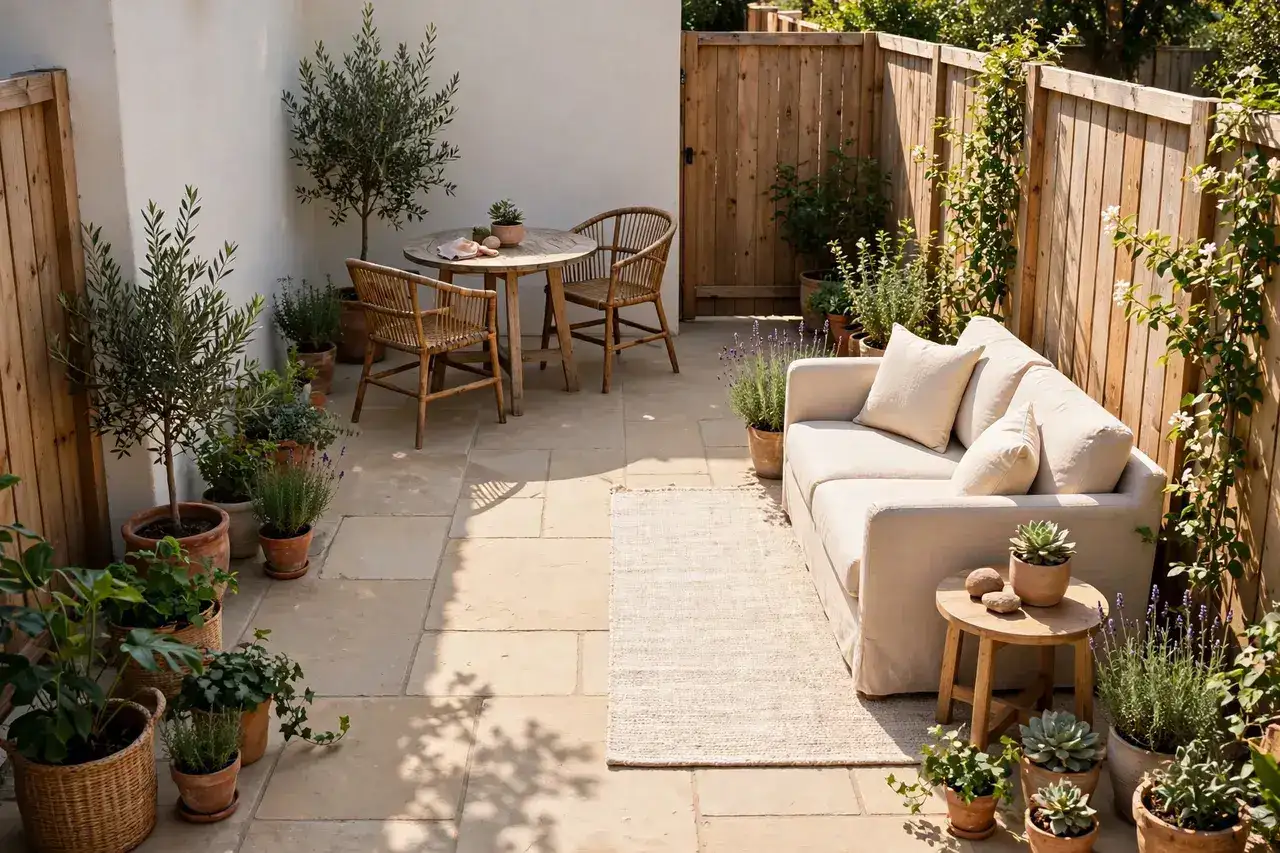
Layouts by space size
| Space | What fits well | Walking space left |
|---|---|---|
| Narrow balcony, 3 to 4 ft deep | Two slim folding chairs and a small side table, or a wall-mounted drop-leaf table with two stools | Full depth stays clear when folded |
| Small square balcony, about 6 by 6 ft | Bistro set for two, or a loveseat with a small side table | About 24 in path to the railing |
| Small patio, about 5 by 8 ft | Bistro set plus a slim storage bench, or two chairs and a side table against the wall | About 24 in, tight but workable |
| Small patio, about 8 by 10 ft | Loveseat plus one chair and a coffee table, or a compact dining set for four | 30 to 36 in path with careful placement |
Narrow balconies: go vertical
On a balcony under 4 feet deep, the floor is for walking, not for furniture. Use the walls and the railing: a drop-leaf table, folding chairs that hang on the wall, and planters on the railing instead of pots on the floor. Keep one clear path from the door to the railing at all times, and resist the urge to add “just one more” chair.
Square balconies: one zone, done well
A 6 by 6 foot balcony fits one good zone: coffee for two or a small lounge, not both. Put the bistro set or loveseat in the far corner so the door side stays open, and use a single side table instead of a coffee table. If you want plants, grow them up the wall or on the railing, not in floor pots that shrink the seating area.
Small patios: two zones, loosely divided
An 8 by 10 foot patio can hold two zones: dining at one end and lounging at the other. Divide them with a rug, not with furniture, because a rug marks the lounge zone without blocking the path. Leave the middle open as the walking route, and keep the grill at the far end with 36 inches of clear space in front of its lid. For more ideas on shaping the whole space, browse small patio designs and patio ideas to see how furniture, planting, and layout work together.
One zone per use, and a clear path between them. A patio with one good seating spot and room to walk beats a patio crammed with three half-usable ones.
Materials Compared: What Survives Outside
Material decides whether your furniture lasts three years or fifteen, and whether you spend weekends maintaining it or enjoying it. In a small space the choice matters more, because you cannot move a heavy teak set out of the rain the way you can fold up an aluminum bistro set.
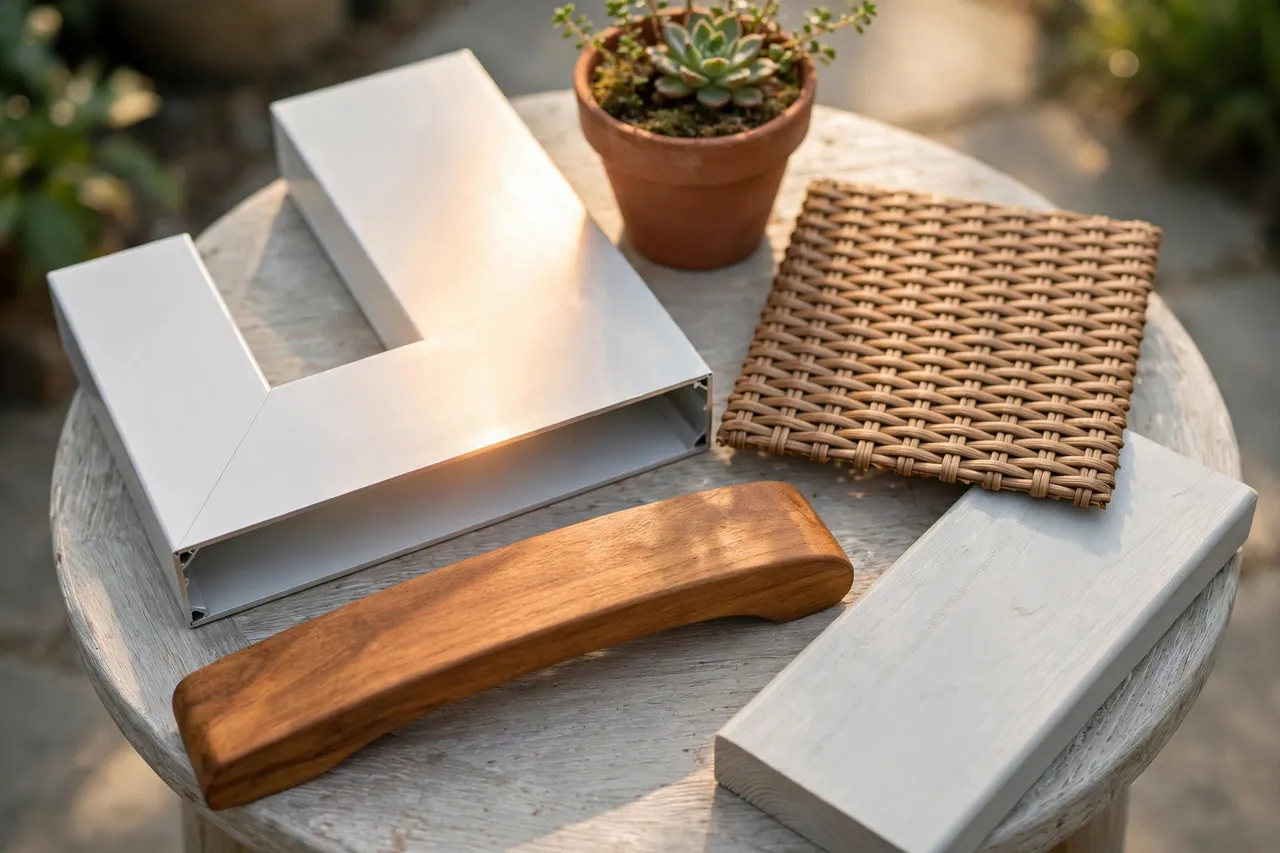
Outdoor furniture materials compared
| Material | Best for | Upkeep | Watch for |
|---|---|---|---|
| Powder-coated aluminum | Most small spaces, wet climates | Very low, wipe clean | Light pieces shift in wind; dark frames get hot in sun |
| Resin wicker (HDPE) | Covered or partly covered patios | Low, brush the weave clean | Cheap weaves crack in full sun |
| Teak | Warm look, all climates | Low to medium, oil optional | Heavy; weathers silver-gray if unoiled |
| Acacia and eucalyptus | Warm wood look on a budget | Medium, seal or oil yearly | Needs protection from standing water |
| HDPE lumber | Coastal homes, heavy daily use | Very low, wash with soap and water | Heavy; hard to move on a small patio |
| Steel | Windy spots, sturdy feel | Medium, watch for rust at joints | Heavy and can rust if the coating chips |
Castlery’s materials guide explains that powder-coated aluminum resists rust and UV damage while staying light enough to move, that teak’s natural oils help it stand up to years of sun and rain, and that resin wicker does not absorb water easily, which lowers the risk of warping and mildew. Read their full comparison at Castlery’s guide to the most durable outdoor furniture materials before you choose.
Aluminum is the best default for a small patio: light, rust-proof, and slim, so the furniture never dominates the space. Resin wicker looks softer and more comfortable, but buy HDPE resin, not cheaper PE, and keep it out of full sun when you can. Teak is the long-life pick if you love real wood and do not mind the weight, and leaving it unoiled is fine: it turns silver-gray over 6 to 12 months and keeps its strength.
Powder-coated aluminum is the low-care default for small spaces, because you can carry it, clean it, and forget it. Never buy natural rattan for uncovered outdoor use: it absorbs moisture, weakens, and grows mold, and no amount of sealing makes it a real outdoor material.
Furniture That Does Double Duty: Storage Without a Shed
Small patios rarely have room for a shed, so furniture that stores things is worth more than furniture that only seats people. The goal is simple: everything you need outside should live outside, hidden inside something you sit on.
A storage bench is the obvious start, but it is not the only double-duty piece. An ottoman works as a footrest, an extra seat, and a side table, and a hollow one hides throws and citronella candles. A deck box doubles as a coffee table when you put a tray on top, and a dining table with a lower shelf keeps placemats and lanterns out of the house. Even a side table with a lift-off lid can hold the cushions for two chairs.
Keep the storage weather-tight and easy to reach. Cushions stored in a damp bench come out smelling worse than they went in, so look for a bench with a raised floor inside and a lid that seals. Store the softest things, cushions and throws, in the driest spot, and keep the hard things, tools and pots, in the spot you reach least. If your home is short on storage inside too, our guide to how to organize a small apartment has the same small-space thinking for indoors.
Every piece should hide something or fold away. If a piece only sits there, it is costing you floor space without paying rent.
Make It Feel Bigger: 6 Tricks That Cost Almost Nothing
Furniture picks the size of your patio, but styling picks how big it feels. Six cheap tricks make the same furniture read as open and calm instead of crowded.
First, pick light colors. Pale cushions, light wood, and white or silver frames bounce light around and make the space feel airy, while dark furniture reads heavy and shrinks the eye. Second, choose slim legs and open frames. Furniture you can see through and under feels lighter than solid blocky pieces, even at the same size. Third, use one rug to mark the seating zone, and keep it big enough that the front legs of every seat sit on it: a too-small rug chops the space up. Our guide to indoor outdoor rugs covers sizes, materials, and care.
Fourth, grow plants up, not out. A railing planter, a wall-mounted planter, or a slim tiered stand adds green without taking floor space, and plants soften hard edges so the patio feels like a garden instead of a box. For compact picks that stay small, see best plants for small gardens. Fifth, keep one color palette across furniture, cushions, and pots, because a single calm palette reads as one bigger space while mixed colors break it into pieces. Sixth, hang string lights or a single lantern overhead: light at eye level and above draws the eye up and makes the ceiling of the space feel higher.
Light colors, slim legs, and plants grown up the wall do more for a small patio than any new piece of furniture. Style the space you have before you buy more for it.
Care and Storage: Make It Last
Small-space furniture works hard, so a little care goes a long way. Wash frames with warm water and mild soap, rinse well, and let them dry in the sun before you cover or store them. Brush dirt out of wicker weave before it gets trapped, because a soft brush reaches between the strands where a cloth cannot.
Cushion fabric needs the most attention. Sunbrella’s official care guide says to hose fabrics off monthly with clean water, clean with mild soap and cold to lukewarm water, rinse thoroughly, and air dry only, never with heat. For stubborn mildew stains, the guide gives a mix of 1 cup of bleach and 1/4 cup mild soap per gallon of clean water. See the full instructions in Sunbrella’s care and cleaning guide.
Store furniture right and it lasts years longer. In winter, clean everything, let it dry fully, then stack chairs, fold tables, and bring cushions indoors. If the furniture must stay outside, cover it with a breathable cover that does not trap water underneath, and lift the cover now and then so air moves. On a covered patio, furniture can stay out all year with a monthly wash, but check the manufacturer’s guidance for your material first. For layout ideas that keep furniture dry, see covered patio ideas.
Clean it, dry it fully, then store it. Furniture put away wet is furniture that comes back moldy in spring.
7 Mistakes to Avoid With Small-Space Outdoor Furniture
Most small patios fail for the same short list of reasons. Check your plan against it before you order anything.
- Buying before measuring. A set that looks small online can fill a whole balcony once the chairs pull out.
- Choosing one oversized sectional. It dominates the patio no matter how good it looks in the catalog, and two smaller pieces usually feel larger.
- Blocking the door or the railing. If you have to move a chair to step outside, the layout is wrong.
- Picking deep lounge chairs. They are comfortable for ten minutes and in the way for the other ten hours.
- Buying natural rattan for outdoors. It weakens and molds in rain, and it belongs inside or under a roof.
- Forgetting the wind. Very light furniture slides, tips, and blows over on an exposed balcony, so weigh pieces down or pick heavier frames.
- Ignoring building rules. A set that breaks your building’s balcony rules has to come back inside, whatever it cost.
The cheapest set is the one you buy once. A slightly better bistro set that fits, folds, and survives the weather costs less over five years than a cheap set replaced twice.
Related Guides
If you are planning the whole patio, these guides pick up where this one leaves off:
- Small Patio Designs — seven layouts that make a tiny patio feel bigger.
- Patio Ideas — layouts, styles, and features for every size of patio.
- Covered Patio Ideas — roofed patios where furniture stays dry longer.
- Indoor Outdoor Rugs — sizes, materials, and care for rugs that define a seating zone.
- Best Plants for Small Gardens — compact picks that stay small and suit a tiny patio.
- How to Organize a Small Apartment — the same small-space thinking for indoors.
- Small Patio Decorating Ideas — rugs, planters, and lights that finish the furnished patio
- Outdoor Storage Bin — extra storage beyond a storage bench
- Small Balcony Design Ideas — the whole-balcony design around the furniture
- Patio String Lights Ideas — lighting ideas for the furnished patio
Frequently Asked Questions
What is the best patio furniture for a small patio?
A 2-person bistro set is the best patio furniture for most small patios, because it seats two people for coffee or meals and folds away when you need the floor back. Add stackable chairs for guests, a storage bench for seating plus storage, or a compact loveseat if you mainly want to lounge.
What size bistro set fits a typical apartment balcony?
Most apartment balconies run 4 to 6 feet deep by 6 to 10 feet wide, and a standard 3-piece bistro set needs about 5 by 5 feet when the chairs are pulled out for seated use. A 24-inch round table is the practical minimum for dining for two, and the chairs should tuck under the table when not in use.
How much walking space should I leave on a balcony?
Plan on 24 to 36 inches of clear walking space between furniture and any door, railing, or wall. Anything tighter forces you to turn sideways to pass, which gets old fast. If you cannot leave at least 24 inches, drop a piece of furniture rather than squeezing the path.
Can I have a dining area in a small outdoor space?
Yes, you can have a dining area by using a small bistro set or a foldable table and chairs. On a very narrow balcony, a wall-mounted drop-leaf table that folds down when needed saves the most space, and two folding chairs that hang on the wall complete the setup.
What materials are best for small outdoor furniture?
Powder-coated aluminum, resin wicker, and treated wood are the best materials for small outdoor furniture because they are durable and weather-resistant. Aluminum is the lightest and lowest-care pick, HDPE resin wicker suits covered patios, and teak lasts longest if you accept its weight and upkeep.
How can I make a small outdoor space look bigger?
Use light colors for furniture and cushions, choose slim-legged pieces you can see through and under, and keep one calm color palette across the whole space. Grow plants up the wall or on the railing instead of in floor pots, mark the seating zone with one rug, and hang lights overhead to draw the eye up.
A small patio does not need less furniture. It needs the right furniture, measured to fit and chosen to fold, stack, or store. Start with the tape measure, buy the bistro set, and add one piece at a time until the space feels full. Then stop, sit down, and enjoy the room you just made outside.