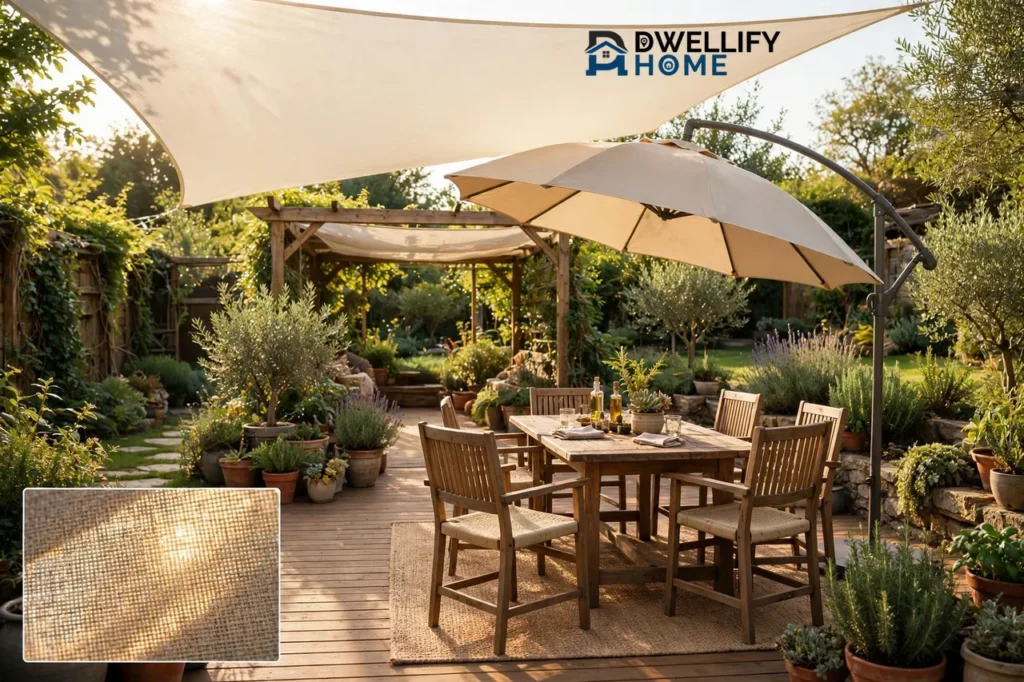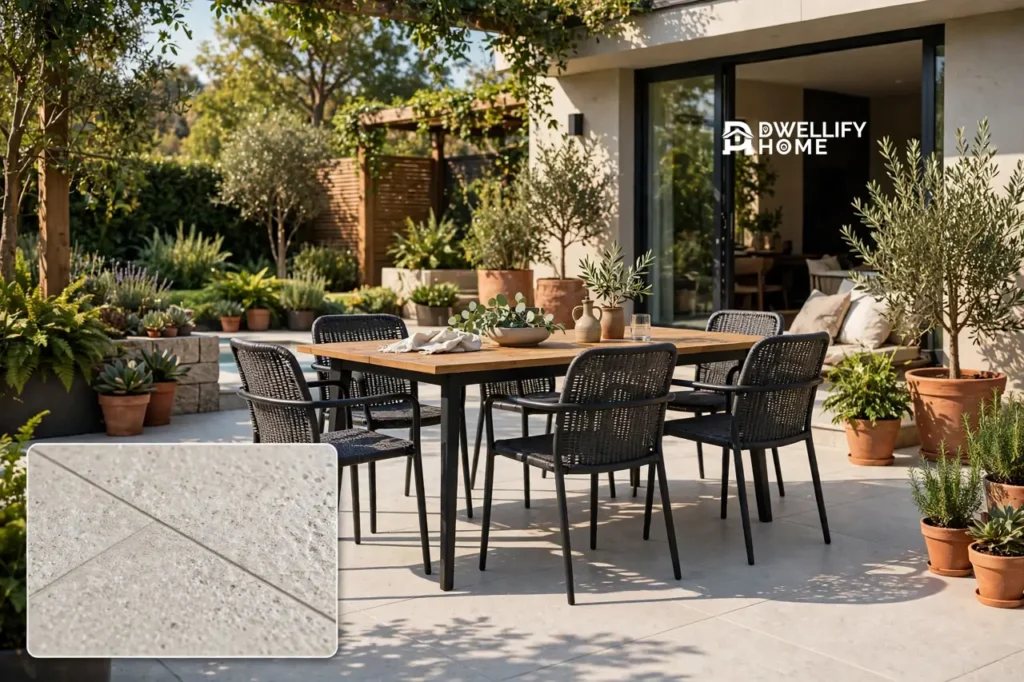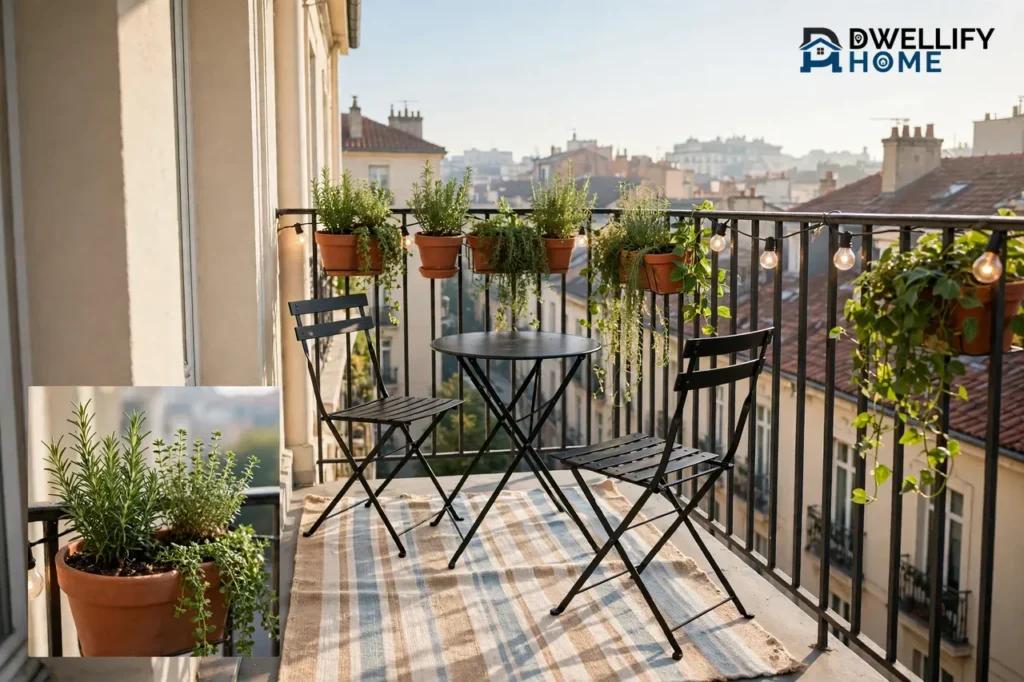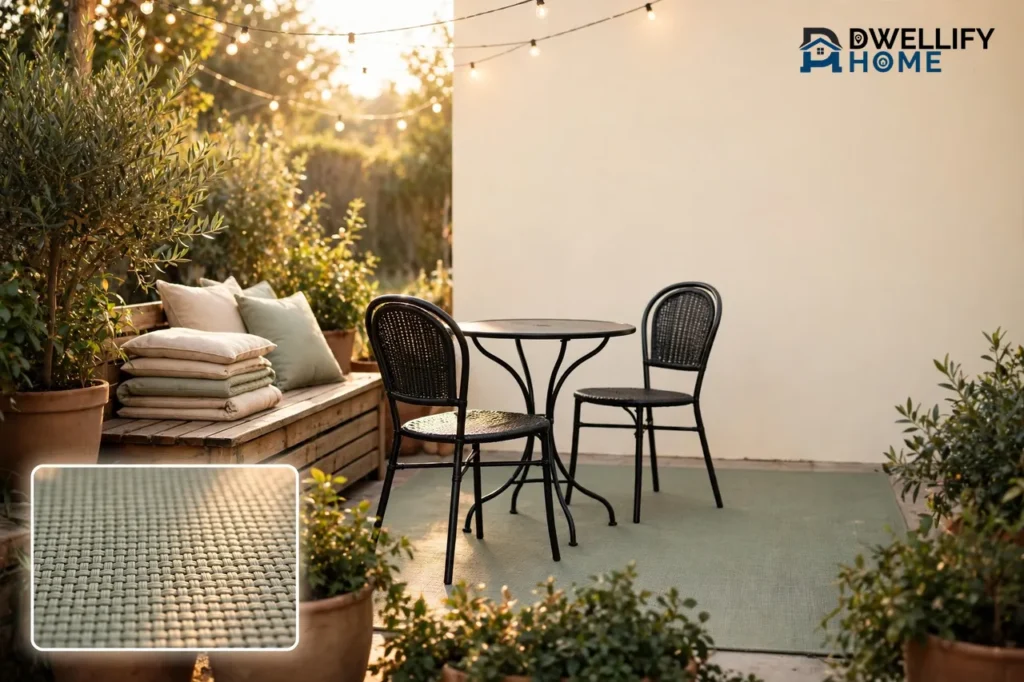
Small patio decorating works when you pick one job for the space, scale the furniture to it, and leave 24 to 30 inches of clear walking space between pieces. That one measurement is what keeps a tiny patio from feeling crowded. Start with a rug on the floor, plants or privacy on the walls, and warm light overhead, and a patio as small as 6 by 8 feet can feel like a real outdoor room.
This guide walks you through the whole makeover in order: measuring first, choosing furniture that fits, fixing the floor, growing plants upward, adding privacy, and lighting the space for evenings. You will also find real budget tiers, the mistakes that shrink a small patio, and answers to the questions people ask most.
Small Patio Decorating Ideas at a Glance
A small patio feels finished when it has three layers: the floor, the walls, and the sky above. The floor is a rug or a tile cover that defines the seating area. The walls are plants, a screen, or a curtain that give privacy. The sky is warm light overhead that makes the space usable after dark. Decorate in that order, floor first, and each layer makes the next one easier.
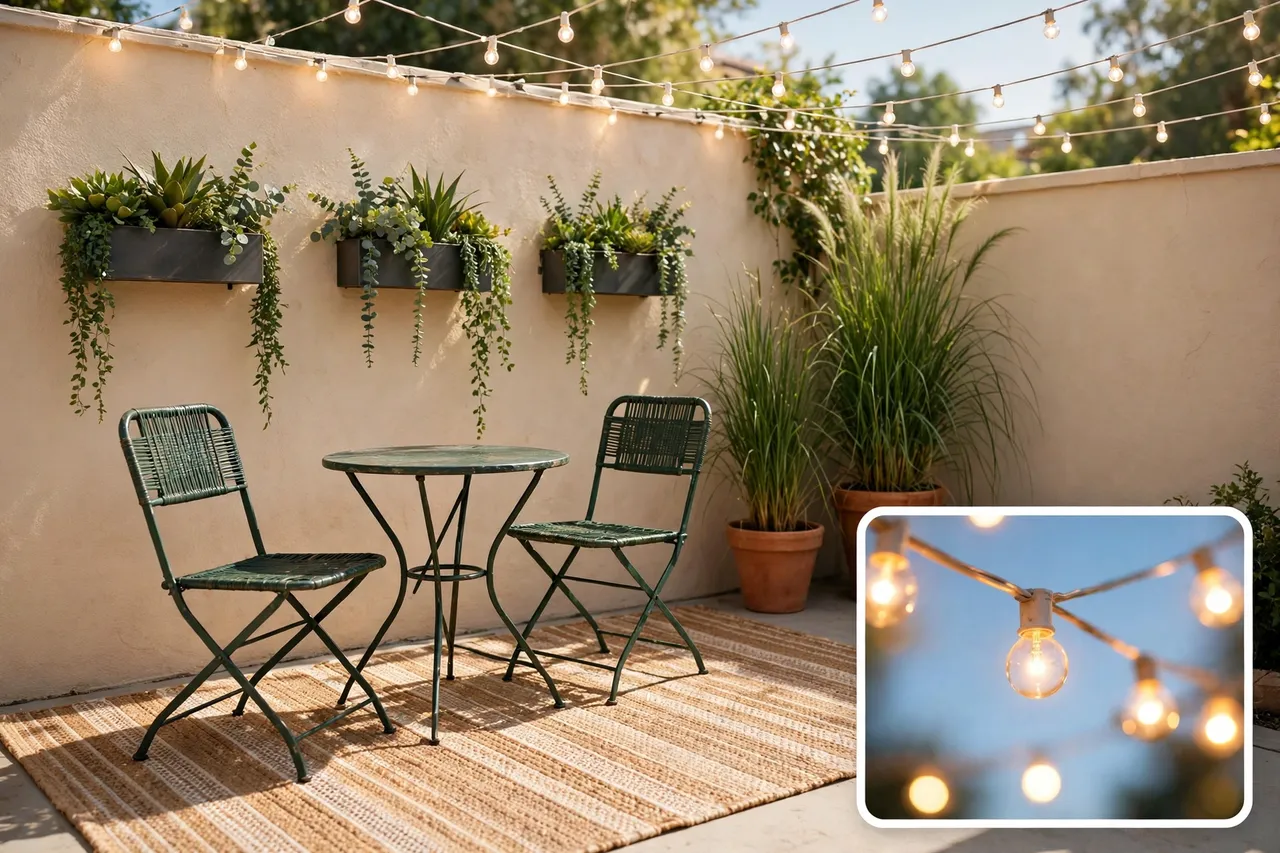
The table below sums up the method. Every idea in this guide fits one of these three layers, so nothing you buy ends up fighting for the same square foot.
The three layers of a small patio
| Layer | What it does | Start with |
|---|---|---|
| Floor | Defines the room and hides tired concrete | Outdoor rug, 5 by 7 feet or larger |
| Walls | Adds privacy, color, and life | Tall planters, railing planters, or a curtain |
| Sky | Extends use into the evening | Warm white string lights, 7 to 8 feet high |
Decorate the floor first, the walls second, and the light last. A rug and a light change the feel of the space more than any chair or cushion, and they cost the least.
Start With One Job for the Patio
A small patio cannot be a dining room, a lounge, and a garden at the same time. Pick one main job, and let the second job visit only now and then. If you eat outside most nights, the patio is a dining spot with a bistro table. If you read with morning coffee, it is a lounge with one good chair. If you love growing things, the plants are the main event and the seat is a perch for watering and pruning.
Measure before you buy anything. Write down three numbers: the floor area, the longest wall, and the hours of sun the patio gets at noon. A tape measure and a piece of chalk beat a shopping cart every time. Mark the outline of each big piece on the floor with painter’s tape, then walk the path to the door. If you have to shuffle sideways past a chair, the piece is too big.
Leave 24 to 30 inches of clear walking space between furniture pieces, and about 36 inches behind a dining chair so someone can push back and stand. The door swing counts too: a chair parked in the door’s arc will get moved every single day, and a patio you have to rearrange is a patio you stop using. If you want more layout ideas, our guide to small patio designs shows seven layouts that make a tiny patio feel bigger.
One job, one anchor seat, one clear path to the door. That is the whole plan, and everything else in this guide hangs on it.
Pick Furniture That Fits, Not Furniture You Wish Fit
Small patio furniture should be scaled down from normal indoor sizes. A bistro set, two slim chairs and a round table, is the easiest anchor for most small patios. It seats two for coffee or dinner without filling the floor. A compact loveseat works when you want to lounge, because one shared seat creates one clear focal point instead of chairs scattered everywhere.
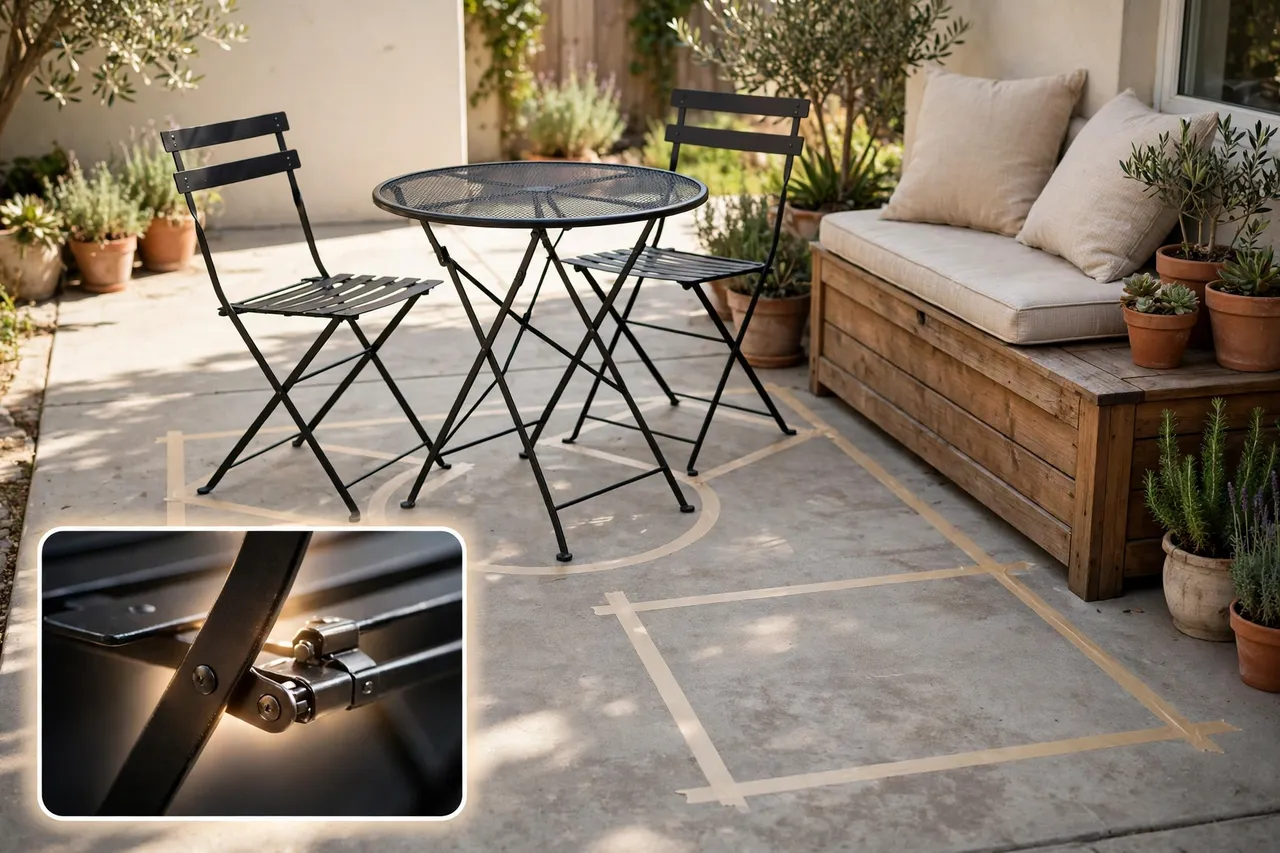
Choose pieces that do two jobs. A storage bench holds cushions and throws and gives you a seat. A side table with a shelf holds a book and a drink. Folding chairs and stackable chairs store flat against the wall when no one needs them, and a pouf works as a third seat, a footrest, or a side table. HGTV’s guide to small patios makes the same point: fold-away seating and furniture with built-in storage are the ideas that actually get used on a tiny patio. See their full list at HGTV’s 20 small patio decorating ideas.
Watch the arms and the bulk. Slim arms and open frames let you see the floor through the furniture, and that open sight line makes the patio feel larger. A deep, wide lounge chair with thick arms eats the same floor space as a bistro set and seats one person. If a piece looks big in the store, it will look bigger on your patio.
Buy weather-ready materials. Metal, resin wicker, and treated wood handle rain and sun, and outdoor cushions dry fast after a shower. Indoor cushions soak up water, grow mildew, and fade in a month. If you already own chairs you like, a can of exterior spray paint and new outdoor cushions can make them look new for the price of a takeout dinner.
One larger piece beats several small ones. A single loveseat or one bistro set calms a small patio, while four mismatched chairs make it look like a storage corner.
Lay Down a Rug and Fix the Floor
A tired concrete slab is what makes most small patios feel like a service yard, and the floor is the fastest thing to change. An outdoor rug defines the seating area the same way a rug defines a living room, and it hides worn concrete for very little money. Put the rug down first, then arrange the furniture on top of it.
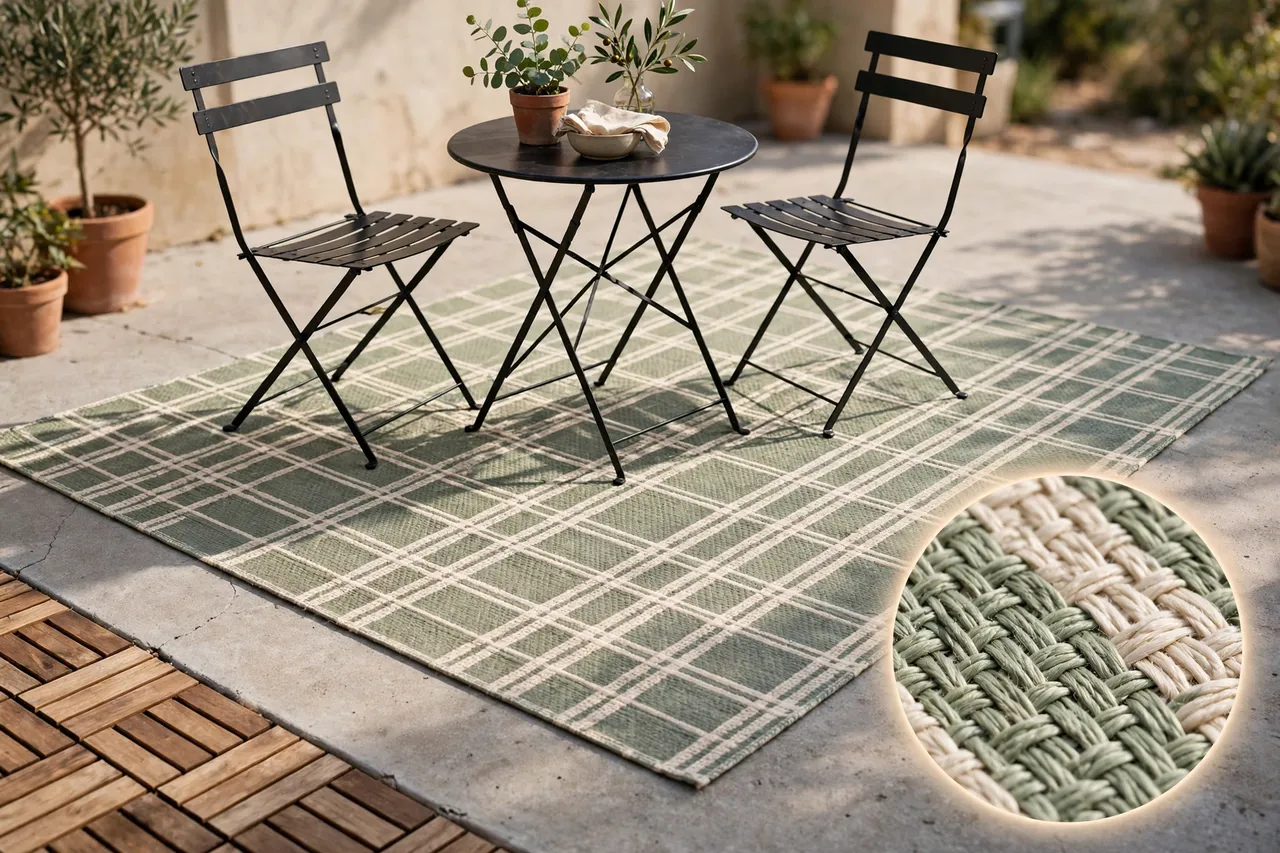
Size the rug to the furniture, not to the patio. The rug should sit under at least the front legs of every seat, and under a dining table it should extend 24 to 36 inches beyond the table on all sides so chairs stay on the rug when you pull them out. Rugs Direct’s outdoor rug size guide gives the same rule and lists 5 by 8 feet as the fit for a small balcony or bistro setup, with 5 by 7 or 6 by 9 feet for a compact seating area. Read the full chart at Rugs Direct’s outdoor rug size guide.
Outdoor rug sizes for small patios
| Patio setup | Rug size | Why it works |
|---|---|---|
| Bistro set for two | 3 by 5 or 5 by 7 feet | Covers the table and both chairs |
| Compact seating, loveseat plus table | 5 by 8 or 6 by 9 feet | Front legs stay on the rug |
| Dining table for four | 8 by 8 or 8 by 10 feet | Chairs stay on the rug when pulled out |
Pick a flatweave or low-loop rug in polypropylene or a similar all-weather fiber. Deep pile traps moisture and grows mildew, and a rug without UV protection fades in full sun within months. Leave 12 to 18 inches of bare floor showing around the rug’s edges when you can, so the rug reads as a defined room instead of a wall-to-wall carpet.
If the floor itself needs more than a rug, interlocking deck tiles clip together over flat concrete with no glue and no tools, and you can lift them out when you move. They are the best renter-friendly floor fix. For a permanent change, our guide to paver patio renovation cost breaks down what a new patio floor really costs, line by line. And if you want the full picture of patio layouts and features, browse patio ideas for styles that work at every size.
If you buy only one thing, buy the rug. It anchors the seating, hides the worst of the concrete, and sets the color palette for everything else.
Grow Up, Not Out: Plants That Fit a Tiny Patio
Plants soften hard edges and make a small patio feel alive, but pots on the floor eat the space you just saved. Grow upward instead. Wall-mounted pots, a vertical planter, railing planters, and hanging baskets put greenery at eye level and leave the floor clear. A shelf of herbs by the kitchen door gives you something to cook with and something green to look at.
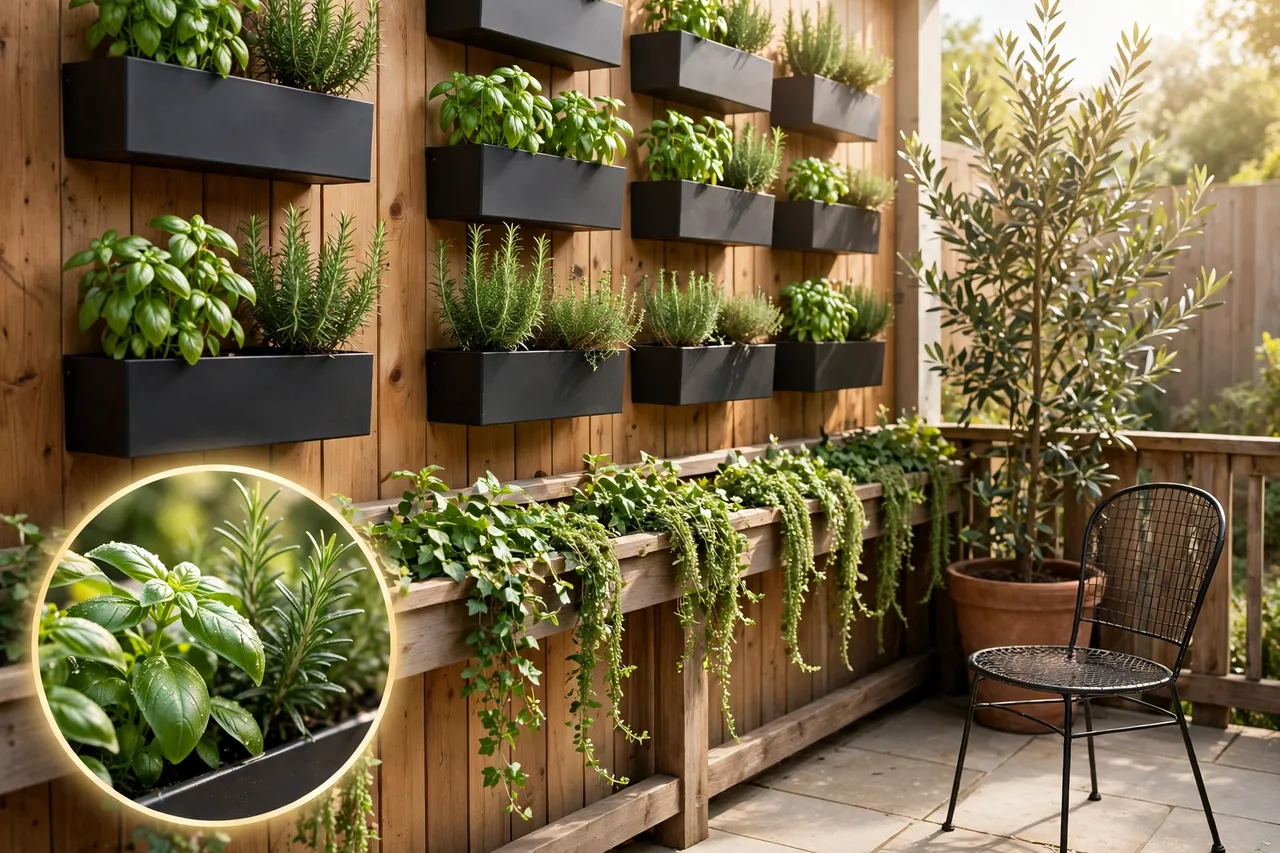
Group plants in odd numbers and at different heights. Three pots, one tall, one medium, one low, look designed; six pots in a straight row look like a garden center shelf. Put the biggest pots at the edges and corners, never in the path to the door. One large plant in a big pot makes a stronger statement than five small pots scattered around, and it is easier to water too.
Choose plants that suit your sun. Herbs, succulents, and dwarf shrubs handle pots well, and climbing vines on a trellis turn a bare wall into a green screen. NC State Extension’s guide to gardening in small spaces explains that container gardens are the best strategy when space is limited, that drainage holes are essential, and that vertical gardening on a fence or trellis grows a lot of food in a small footprint. Read it at NC State Extension’s vegetable gardening in small spaces guide. For plant picks that stay compact, see best plants for small gardens.
Watering matters more in pots than in the ground. Containers dry out fast in sun and wind, so check them daily in hot weather. Use potting soil, not garden dirt, because garden dirt brings weeds and pests into a pot. And always use a pot with a drainage hole, or drill one, because roots sitting in water rot fast.
One big pot at the edge beats five small pots in the walkway. Height and grouping do the decorating work, not the number of plants.
Add Privacy Without Building a Wall
A small patio feels exposed when neighbors can watch you eat breakfast. The fix is to break the sight line at seated height, not to build a wall. A row of tall planters along the overlooked edge, a freestanding trellis with a climber, or an outdoor curtain on a tension rod all do the job, and every one of them comes down or moves when you do.
Tall grasses, bamboo in a container, or a small multi-stem tree in a large pot make a living screen that moves in the wind and needs no permission. A slatted screen or lattice panel is permeable, so it does not create a wind tunnel, and it takes climbing plants like jasmine or clematis over time. Outdoor curtains are the fastest fix of all: they cover exactly one side, slide open when you want the view back, and wash easily at the end of the season.
Think about what you are blocking. A neighbor’s window needs height at one edge. A path or a shared boundary needs a screen along the side people walk past. A balcony above needs something overhead, like a shade sail or a retractable awning, rather than a taller fence. Fix the real sight line and you use half the material.
Renters can do all of this. Planters, freestanding screens, tension-rod curtains, and railing planters need no drilling and no landlord approval in most rentals. Check your lease and your building rules before you hang anything heavy from a railing or a wall, and keep planters light enough to move. If your patio is covered and you want shade ideas that pair with a screen, see covered patio ideas.
Block the sight line at seated height. Privacy you can see over while standing still feels open, and privacy that blocks the seated view is all you actually need.
Light It So You Use It After Dark
A patio without light gets used on summer afternoons and at no other time. Lighting is what turns a small patio into a space you step out into on a cool evening. Several low light sources beat one bright one: string lights overhead, two or three lanterns near the seats, and a small rechargeable light on the table read as a room, while a single security floodlight reads as a parking lot.
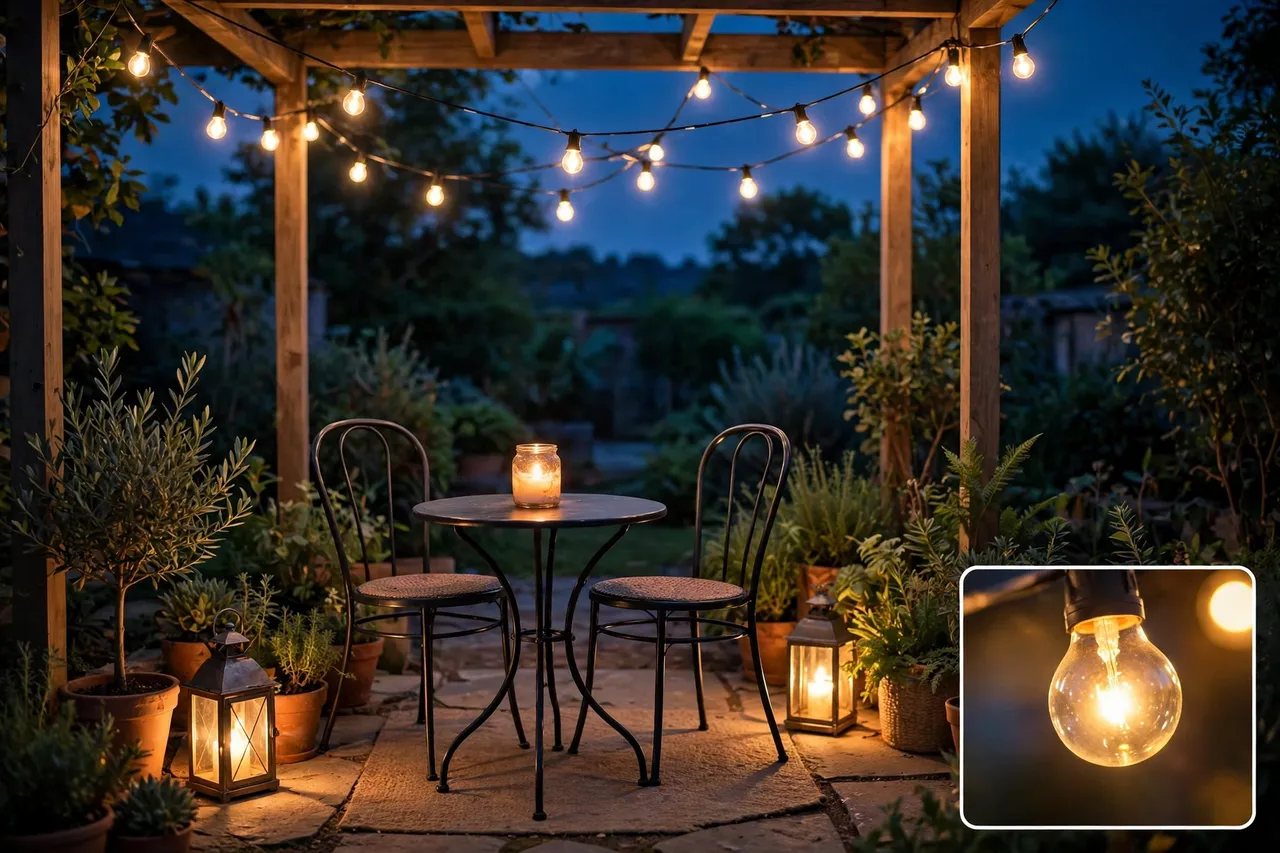
Hang warm white string lights about 7 to 8 feet above the ground, high enough to walk under and low enough to feel cozy. Drape them along a fence, a wall, or a pergola beam, and keep the run short so the lights do not sag. Solar string lights need no outlet and no wiring, which makes them the easiest pick for renters. Plug-in lights give steadier brightness on cloudy weeks, so pick the type that matches how often you sit outside after dark.
Use only lights and cords rated for outdoor use, and follow the maker’s mounting and power instructions. Indoor extension cords crack and fail outside, and a string light meant for a bedroom has no place in the rain. Keep cords off walkways where feet catch them, and use a covered outdoor outlet or a weatherproof box for any plug that stays outside.
Lanterns do the close work. A lantern beside the seat gives enough light to read a menu or a book, and a candle in a glass jar on the table adds a warm flicker that string lights cannot copy. Keep open flames away from cushions and curtains, and never leave a candle burning when you go inside.
Warm, low, and several beats bright, high, and one. Three small lights make a small patio glow, while one floodlight flattens it.
Small Patio Decorating on a Budget
You do not need a big budget to finish a small patio. In fact, a small patio is the cheapest outdoor space to decorate, because every piece is small and the floor is tiny. Spend first on the two things that change the feel the most: the rug and the lights. Then add plants, then cushions, then the extras.
A simple makeover can cost under $100 if you already own chairs: an outdoor rug, two or three outdoor pillows, and a set of warm solar lights. House Decor Ideas priced three full makeovers in November 2026, and their numbers show the same ladder: under $75 for a soft refresh with a rug and pillows, under $150 adding solar string lights and a can of spray paint for tired chairs, and under $250 starting from an empty patio with a folding bistro set, a rug, and lights. See the priced breakdowns at House Decor Ideas’ patio decor ideas with real prices.
Small patio budget ladder
| Budget | What it buys | Best for |
|---|---|---|
| Under $75 | Outdoor rug plus two or three pillows | A patio that already has chairs |
| Under $150 | Rug, pillows, solar string lights, spray paint | Patios you use after dark |
| Under $250 | Folding bistro set, rug, solar lights | A bare patio or first home |
Thrift stores and secondhand listings are your best friends for small patios. Metal chairs, small tables, and terracotta pots show up cheap, and a can of exterior spray paint makes a $7 table look new. Shop for cushions and outdoor textiles at the end of summer, when stores clear seasonal stock. And before you buy anything new, look at what you already own: a stool from the kitchen becomes a plant stand, and a tray from the cupboard becomes a tabletop.
Keep the color palette simple and it will look expensive. Two main colors, one accent, and lots of green from the plants is the easiest palette that works. Repeat the accent in the pillows, one pot, and the rug, and the whole patio looks planned instead of collected. If you want more small-space planting inspiration, our guide to small backyard garden ideas covers beds and borders that suit tight spaces.
Spend on the rug and the lights first. They do most of the work, and everything after them is decoration, not repair.
7 Mistakes That Make a Small Patio Feel Crowded
Most small patios fail for the same short list of reasons. Check your plan against this list before you spend anything.
- Buying furniture before measuring. A chair that fits the store rarely fits a 6 by 8 foot patio.
- Filling the floor with pots. Plants belong on walls, railings, and edges, not in the walkway.
- Using too many small pieces. Four tiny chairs look busier than one loveseat.
- Skipping the rug. Without it, the chairs float on bare concrete and the space never reads as a room.
- Mixing five colors. A small space needs two main colors and one accent, not a rainbow.
- Blocking the door path. A chair in the door swing gets moved daily, and the patio stops getting used.
- One harsh light. A single floodlight kills the mood that three small warm lights create.
Every mistake on this list is free to avoid and expensive to fix later. Measure, tape the outlines, and buy last.
Related Guides
If you are planning the whole patio, these guides pick up where this one leaves off:
- Patio Ideas — layouts, styles, and features for every size of patio.
- Small Patio Designs — seven layouts that make a tiny patio feel bigger.
- Covered Patio Ideas — roofed patios where furniture and decor stay dry.
- Indoor Outdoor Rugs — sizes, materials, and care for rugs on a patio.
- Paver Patio Renovation Cost — what a new patio floor really costs, line by line.
- Best Plants for Small Gardens — compact plants that suit tight spaces.
- Small Backyard Garden — garden beds and borders for small yards.
- Apartment Patio Ideas — apartment patios, decorated the renter-friendly way.
- Balcony Decor Ideas — the same decorating method on a balcony.
- Small Balcony Design Ideas — the same method, at balcony scale.
- Outdoor Storage Bin — cushion and clutter storage for a small patio.
Frequently Asked Questions
How do I make a small patio feel less crowded?
Choose seating that leaves a clear walking path, then move plants and lighting to the walls instead of filling the floor. Pick one main seat, keep 24 to 30 inches of space between pieces, and use one larger piece rather than several small ones. A rug under the seats and a simple two-color palette make the space feel calm, not cramped.
What can a renter change on a small patio?
Renters can change almost everything that matters: movable planters, an outdoor rug, folding furniture, and lights that need no permanent wiring. Interlocking deck tiles clip over concrete and lift out when you move. Check your lease before hanging anything heavy from a railing or wall, and keep everything portable.
How do I decorate a small patio on a budget?
Start with an outdoor rug and string lights, which make the biggest difference for the least money. Add a few plants in budget pots and two or three outdoor pillows. A simple makeover can cost under $100 if you already own chairs, and under $250 buys a folding bistro set, a rug, and lights for a bare patio.
How do I make my small patio look bigger?
Use light, neutral colors, keep furniture low and slim, and leave the floor visible around the rug’s edges. A large-format rug with few patterns, one big plant instead of many small pots, and a mirror or light-colored wall all stretch the space. Diagonal paver patterns and pale flooring help too, because the eye reads fewer breaks as more room.
What size furniture works best for a small patio?
Look for furniture scaled down from standard indoor sizes: bistro sets, slim-arm chairs, and folding tables. A bistro set suits two people, and a compact loveseat suits lounging. Always leave at least 24 to 30 inches of walking clearance between pieces, and tape the outline on the floor before you buy.
How do I make a small patio feel cozy?
Add warm string lights, a rug, and plants at different heights, and use the floor-wall-sky method: rug on the floor, plants and privacy on the walls, light overhead. Layer a cushion and a throw on the seat, keep the palette to two colors plus green, and add one lantern or candle on the table for a warm glow.
Start with the tape measure, not the shopping cart. Pick one job for the patio, lay down a rug, grow the plants upward, and hang warm light overhead. A small patio decorated that way stops being the slab you walk past and becomes the room you step out into every evening.