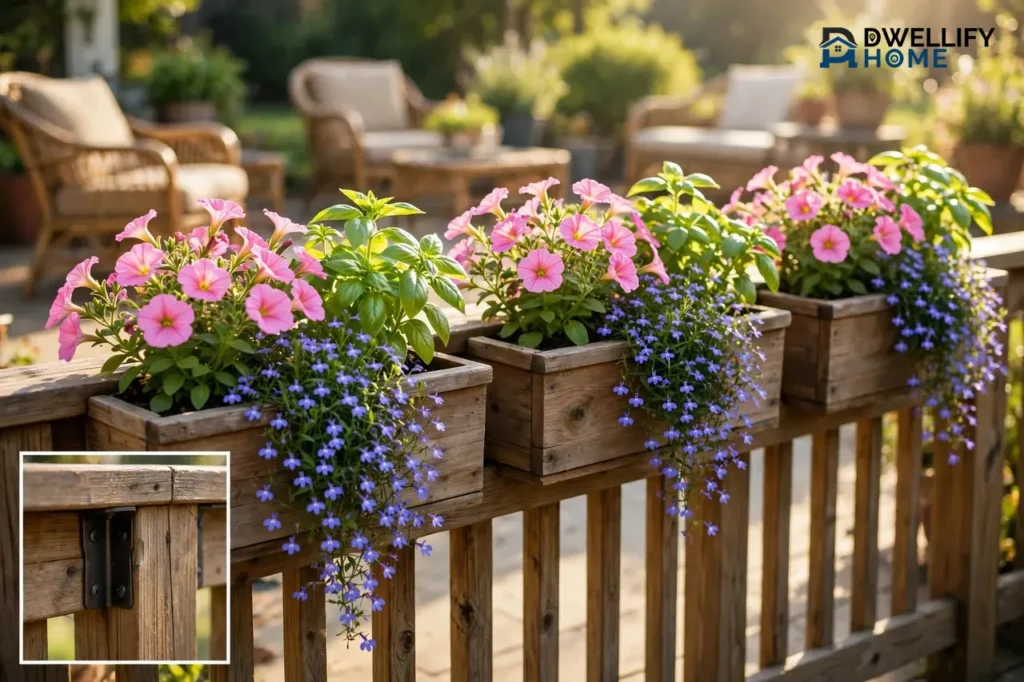
A handrail planter is a box or pot that hangs on your deck, porch, or balcony railing so you can grow flowers, herbs, and small vegetables without using any floor space. A typical 24-inch box filled with wet soil weighs 15 to 25 pounds, so it fits most sound railings — but only if the bracket matches your rail width and the railing itself is solid. Measure first, hang second, and you get a garden that stays put all season.
This guide covers every type of railing planter, how to match one to your railing, how much weight is safe, what to plant, what it costs, and how to keep the plants alive. You will also learn the mistakes that send planters crashing down, so yours is not one of them.
Handrail Planters at a Glance
Handrail planters go by many names — railing planter boxes, over-the-rail planters, saddle planters, and deck rail planters — but they all do the same job. They turn the railing you already have into growing space, which matters most on small balconies and narrow decks where every square foot counts.
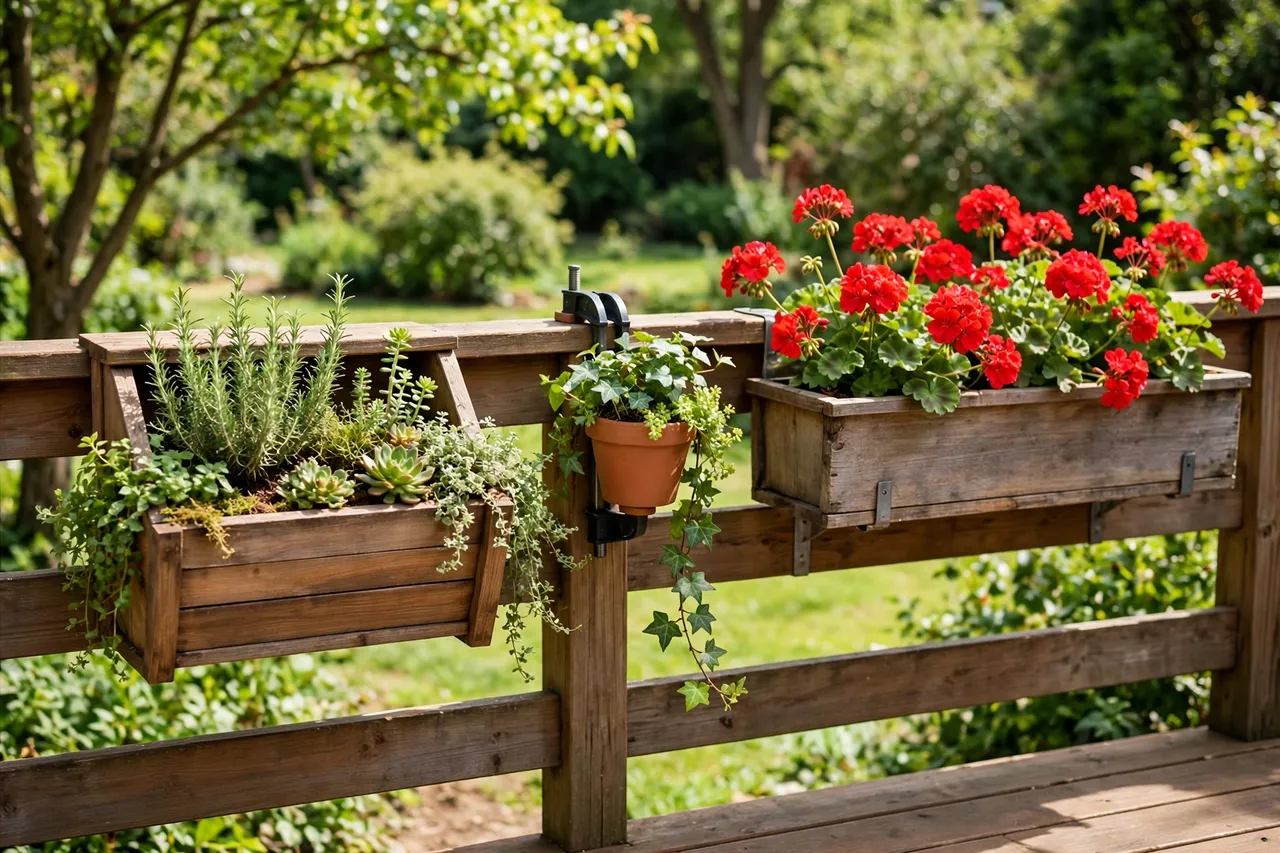
The table below sums up the five main styles. Saddle and clamp-on styles suit most renters, because they need no drilling. Bracket-mounted boxes suit owners who want a long, full flower display.
Handrail planter styles compared
| Style | How it attaches | Best for | Filled weight |
|---|---|---|---|
| Saddle / straddle box | Sits over the top rail | Flat wood or composite rails | 15–25 lb |
| Clamp-on planter | Clamp grips the rail | Renters, metal rails | 8–15 lb |
| Bracket-mounted box | Brackets screw to rail or posts | Long flower displays | 25–40 lb |
| Hanging pots and hooks | Hooks hang over the rail | Single plants, herbs | 10–15 lb |
| Window box on railing | Brackets hold a long box | Porch rails, window ledges | 25–40 lb |
Start with the saddle or clamp-on style if this is your first railing planter. Both go up in minutes, come down just as fast, and let you test the spot before you commit to screws.
What Is a Handrail Planter?
A handrail planter is a container made to attach to a railing instead of sitting on the floor. Most are long, narrow boxes that run along the top rail, but the family also includes round hanging pots, half-round saddle pots that straddle the rail, and window boxes fitted with railing brackets. The shared idea is simple: the railing holds the planter, and the planter holds the soil and plants.
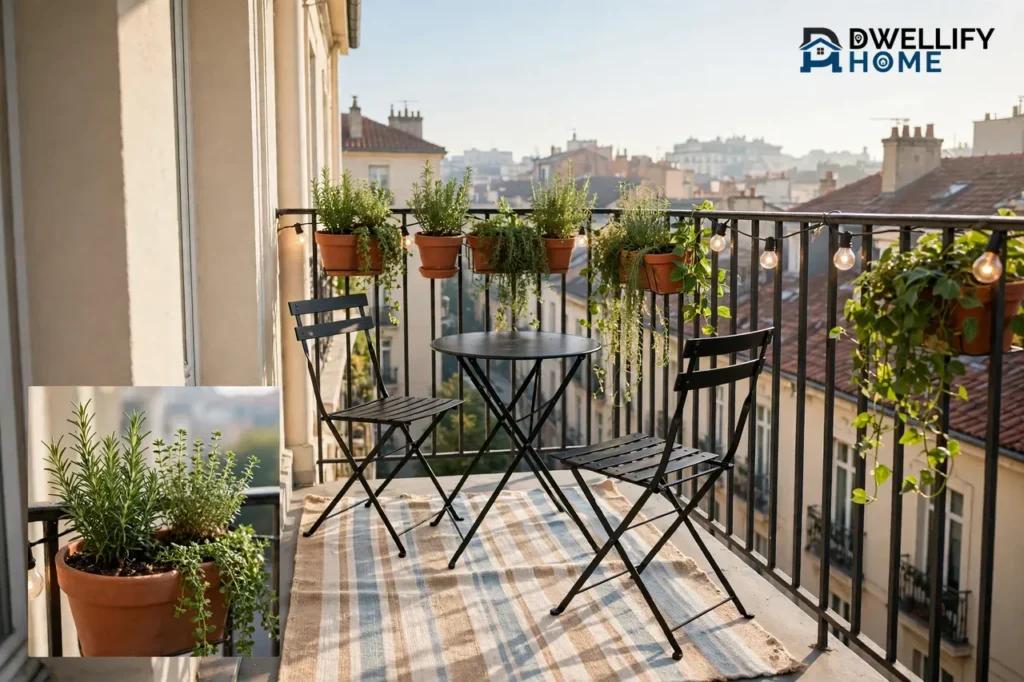
That design solves the biggest problem of small outdoor spaces. A balcony that fits two chairs and nothing else can still hold a row of petunias, a pot of basil, and a trail of lobelia — all at eye level, where you can see and water them without bending down. For a small patio, a railing garden adds color at the edge of the space instead of eating the middle of it. If your patio is short on floor room, these small patio designs show how to use every edge and corner.
Railing planters work on decks, porches, balconies, and even stair rails. They also work as window boxes, because the same brackets that grip a railing often fit a window ledge. Just remember that a planter on a railing lives a harder life than a pot on the ground: it catches more wind, dries out faster, and hangs over the edge — so fit and weight matter more here than anywhere else in the garden.
Will a Handrail Planter Fit Your Railing?
Fit comes first, because a planter that does not match your rail will wobble, slip, or fall. Grab a tape measure and check three things before you buy: the width of your top rail, the shape of the rail, and what the rail is made of.
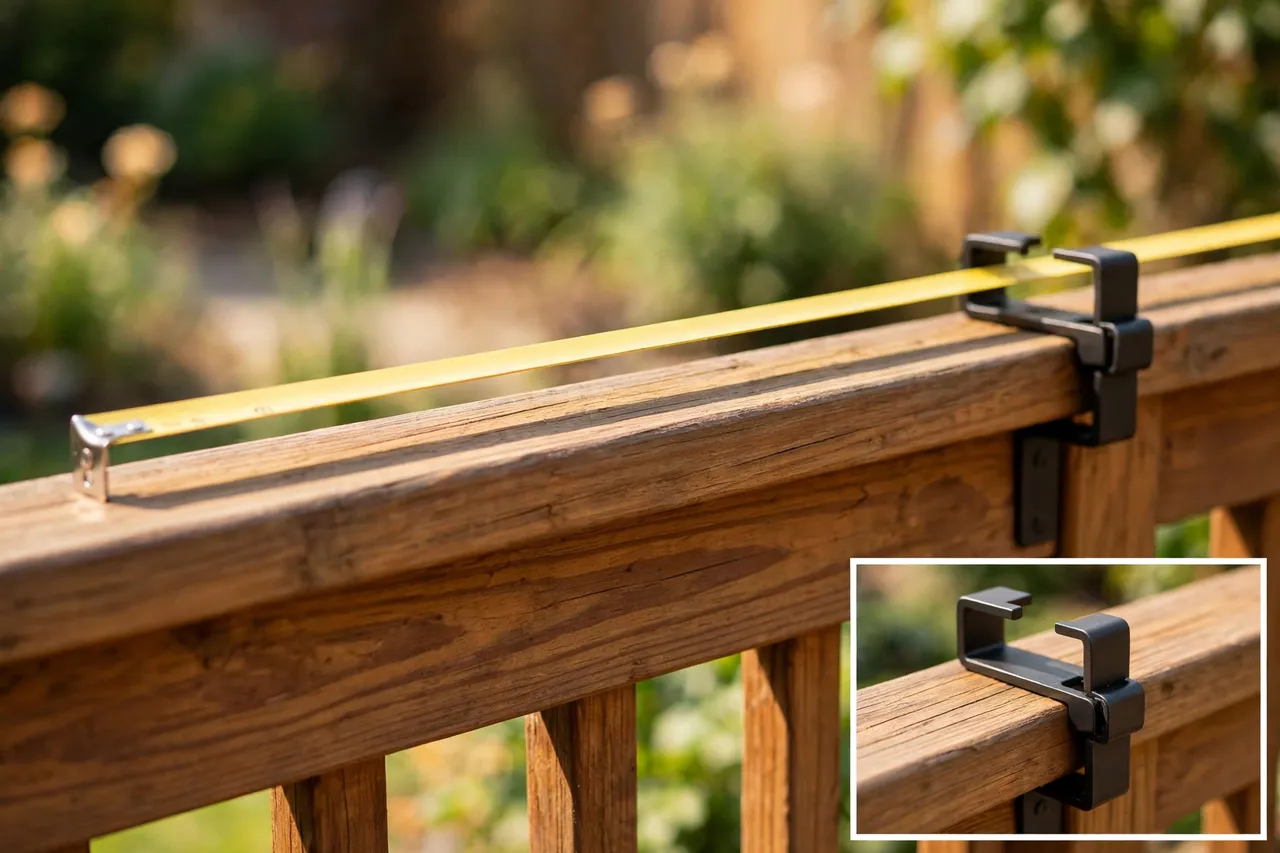
Most clamp-on and saddle planters fit rails between 1.5 and 3.5 inches wide, which covers most wood and composite deck rails. Adjustable brackets stretch a little further, and some fit rails up to 4 inches wide. Measure the widest point of your rail, including any cap or trim, and compare it with the bracket range printed on the box. A bracket that is even half an inch too narrow will not seat, and one that is far too wide will rock in the wind.
Rail shape matters as much as width. A flat-topped wood rail takes a saddle box happily. A round metal rail needs a clamp or hook made for round bars, because a flat saddle will slide sideways. A wide composite cap rail may need an adjustable bracket with a rubber pad so it grips without scratching the cap.
The rail material sets the rules too. Wood and solid metal rails hold brackets well. Vinyl rails can crack under clamp pressure, so use wide, rubber-padded brackets that spread the load, or mount a wood board through the posts instead. Never drill into vinyl — it weakens the rail. Glass railings need suction or rubber-clamp mounts made for glass, and many apartment buildings ban them outright, so check your building rules first.
Measure the rail before you order anything. A planter that fits your rail width, shape, and material hangs straight and stays put; one bought on a guess is the one that tips over in the first storm.
How Much Weight Can Your Railing Hold?
Weight is the safety question, and it has a real answer. A single 10-inch planter with wet soil can weigh about 18 pounds, and a full 24-inch box usually lands between 15 and 25 pounds. Wet soil adds 30 to 50 percent to the dry weight, so always count the wet number, not the dry one.
Most sound residential railings handle that load without trouble. The International Residential Code (IRC) requires a guardrail top rail to resist a 200-pound concentrated load applied in any direction, and this explainer of the IRC deck railing rules sets out the 36-inch height and 200-pound strength requirements that most US homes follow. That 200-pound figure is the railing’s strength, not a planter allowance — it tells you a healthy railing is far stronger than one planter box. Still, the planter hangs on one short stretch of rail, so spread the load: space boxes along the rail, use a bracket at each end, and never stack several heavy boxes on one weak section.
Check the railing itself before you hang anything. Grab the top rail and push it firmly. If it wobbles, if the wood is soft or rotted, if metal shows rust at the joints, or if posts feel loose, fix the railing first or skip the planter. A planter is only as safe as the rail it hangs on.
Renters and apartment dwellers have one more check: the building. Many apartment complexes set their own weight limits for balcony rails, often around 15 kilograms per planter, and some require written permission before you hang anything. Ask the building manager first — a short question now beats a fine or a falling planter later. A privacy screen changes the wind on a balcony too, so if you screen the rail, read these privacy screen ideas for a balcony before you add planters beside it.
Types of Handrail Planters Compared
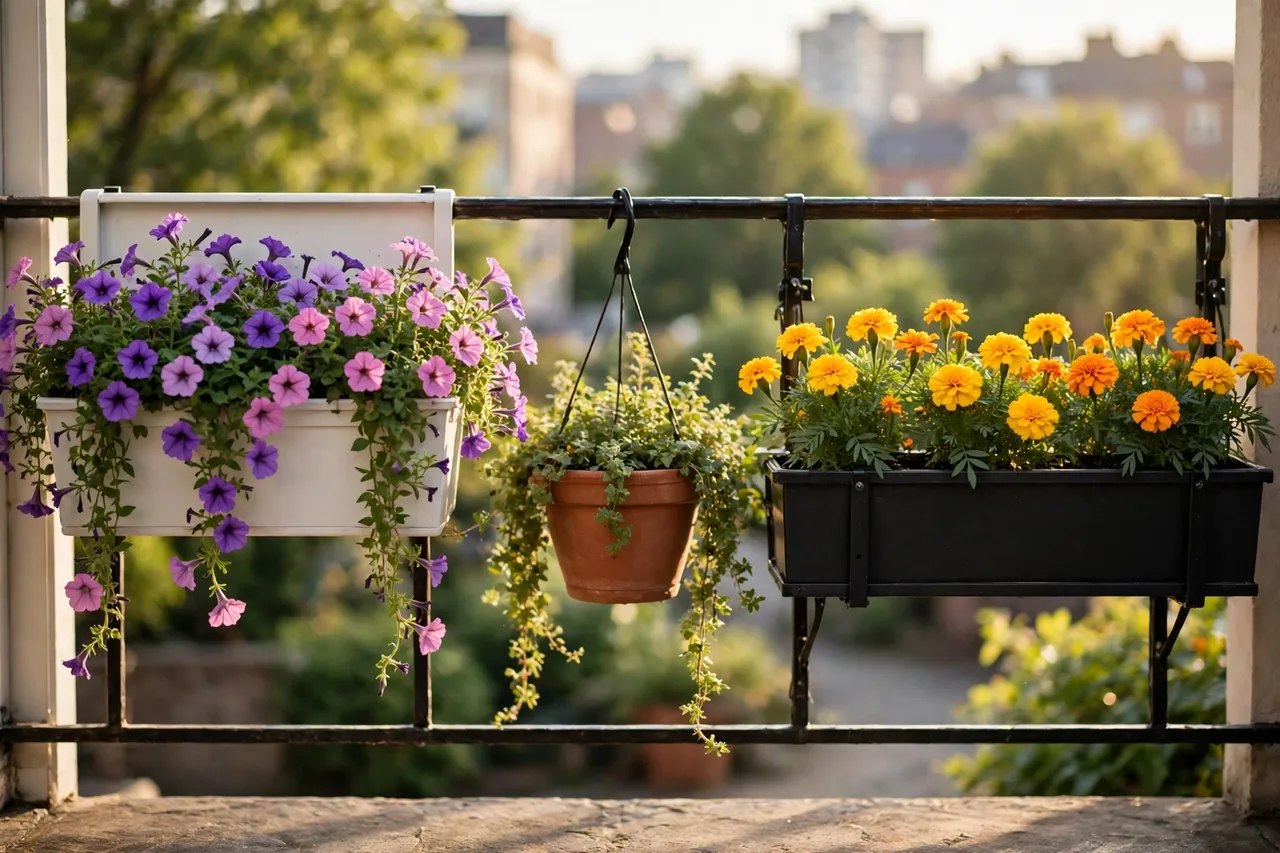
Five styles cover nearly every railing, and each one fits a different home. Pick by your rail, your lease, and how much garden you want.
Saddle and Straddle Boxes
A saddle box has a deep groove in the middle that drops over the top rail, so the soil weight splits evenly on both sides. It needs no tools and no screws, and it lifts off in seconds for cleaning or winter storage. It suits flat wood and composite rails best, and it is the easiest style for a first try. Its weak spot is wind: a tall, top-heavy saddle box can rock on a narrow rail, so keep it low and wide.
Clamp-On Planters
Clamp-on planters grip the rail with an adjustable clamp, often with a rubber pad to protect the finish. They suit renters and metal rails, and they install in two to five minutes. They hold less weight than a saddle box — usually 8 to 15 pounds — so they suit single herbs, small flowers, and trailing plants. Tighten the clamp by hand, then give the planter a firm tug to test it before you add soil.
Bracket-Mounted Boxes
Bracket-mounted boxes are the classic long flower box, held by metal brackets that screw into the rail or the posts. They hold the most weight, 25 to 40 pounds, and they give the longest, fullest flower display. They suit owners who want a permanent look. The trade is commitment: screws leave holes, so this style is a poor pick for a rented balcony or a new composite rail you do not want to mark.
Hanging Pots and Rail Hooks
Hooks and hangers hold single pots over the rail, one plant at a time. They are cheap, flexible, and easy to move around as the sun shifts. They suit herbs by the kitchen door and trailing flowers at the corners. Their limit is size: each hook holds 10 to 15 pounds, so keep the pots small and the soil light.
Window Boxes Used as Railing Planters
A window box with railing brackets does double duty. The same long box that dresses a window can dress a porch rail, and the brackets let you move it between the two. Window boxes run 24 to 36 inches long and hold the most soil, so they grow the fullest rows of flowers. Just watch the total weight — a 36-inch box full of wet soil is the heaviest planter in this guide.
Match the style to your rail and your lease, not to the prettiest photo. A clamp-on pot that fits your rail beats a screwed-in showpiece that your landlord makes you take down.
Best Materials: Wood, Metal, Plastic, and Resin
The material decides how heavy the planter is, how long it lasts, and how it looks after a year outside. Each one has a clear trade-off.
Wood looks warm and natural, and cedar and redwood resist rot without paint. A wood box is easy to build yourself and easy to repair. It is also the heaviest empty box, and it needs sealing or lining or the soil moisture will rot it from the inside. Line a wood box with landscape fabric or a plastic insert, and reseal it once a year.
Metal looks sharp and modern, and powder-coated steel or aluminum lasts for years. Metal is strong for its weight, so a thin metal box holds a lot of soil. Its weak spot is rust: any scratch that breaks the coating lets water in, and in humid or coastal air that rust spreads fast. Pick powder-coated metal, and touch up scratches as soon as you see them.
Plastic and resin are the lightest choices, and that lightness is gold on a railing. A plastic box weighs one or two pounds empty, so nearly all of your weight budget goes to soil and plants. Resin copies the look of wood, stone, or metal, shrugs off rain and sun, and never rusts or rots. Its trade is feel: cheap thin plastic can look flimsy and may fade or crack after a few hard winters, so pick a thick-walled resin box with UV protection.
Terracotta and ceramic look beautiful, but they are the worst pick for a railing. A terracotta box is heavy before you add soil, it cracks in a freeze, and a fall from a railing shatters it. Save terracotta for the ground, and keep the railing light.
How to Hang a Railing Planter in 5 Steps
Hanging a railing planter takes about fifteen minutes once you have the right box. Follow the steps in order, and test before you plant.
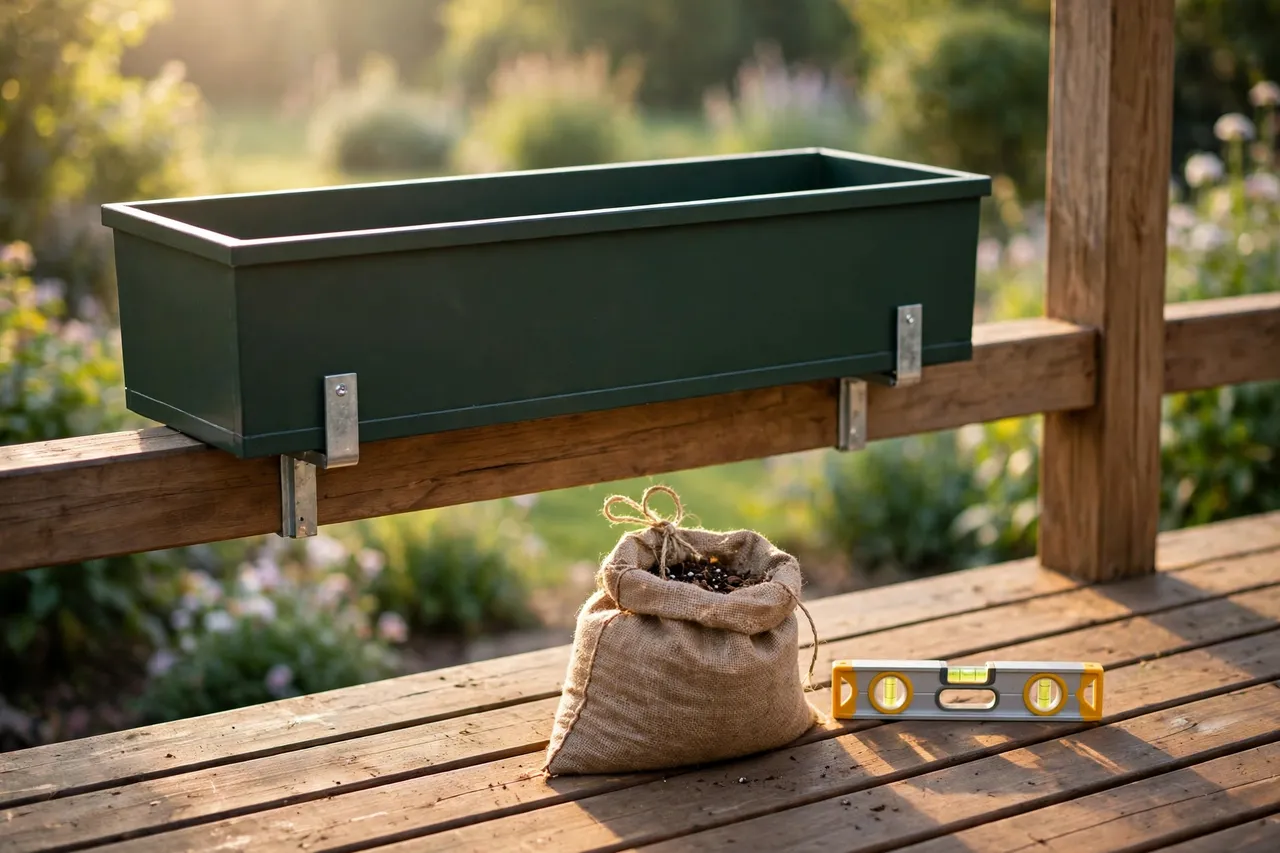
- Measure the rail. Measure the top rail width, check its shape, and note the material. Compare the numbers with the bracket range on the box.
- Pick the spot. Choose a straight stretch of rail with solid posts at both ends. Leave at least 6 inches between boxes so plants get air and you can reach each one to water it.
- Fit the brackets dry. Set the empty planter on the rail and check that it sits level and does not rock. Tighten clamps or screws, then tug the planter hard. If it moves, refit it now, not after it holds soil.
- Add drainage and soil. Check that the box has drainage holes. If it does not, drill three or four half-inch holes in the bottom. Add a thin layer of gravel or a drainage insert, then fill with lightweight potting mix — never heavy garden soil, which adds weight and holds too much water.
- Plant, water, and check again. Set the plants in, water until it runs from the holes, and tug the planter once more. Check it again after the first rain, when the soil is at its heaviest.
If you would rather build the box yourself, Decks.com’s guide to building a deck railing planter box walks through materials, cuts, and the screw-or-bracket choice for a wood rail, and it is a solid starting point for a first DIY box. Read it before you buy lumber, because its bracket advice saves a trip back to the store.
A drip tray under the box is a small add-on that earns its keep. It catches the water that would otherwise drip on the deck, the siding, or the neighbor’s balcony below. Angle the tray slightly outward so overflow runs away from the building, not toward it.
What to Plant in Handrail Planters
Railing planters grow best what is shallow-rooted, light, and compact. Deep-rooted vegetables and big shrubs belong in the ground. The winners are herbs, leafy greens, and trailing flowers that stay under 12 inches tall.
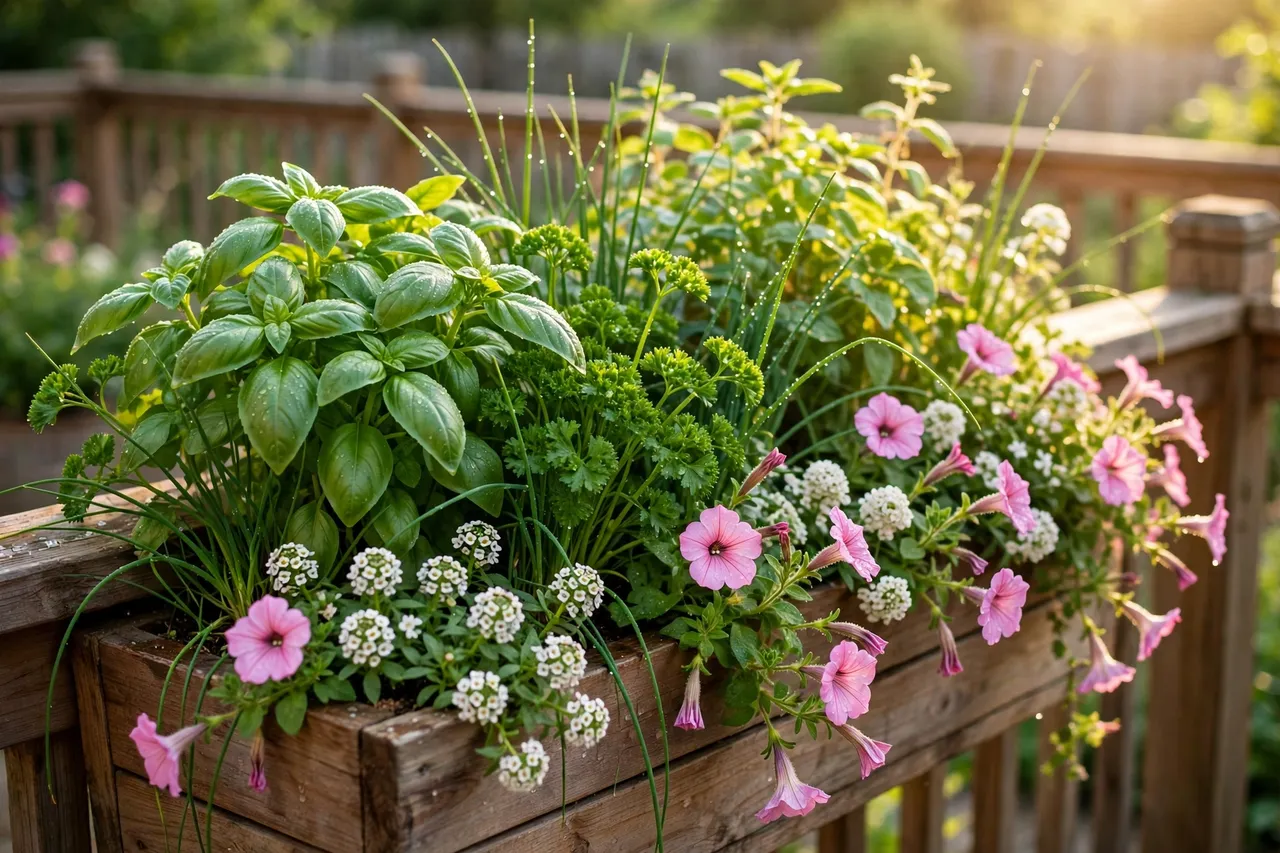
For sun, pick heat-tolerant plants. Petunias, geraniums, marigolds, and lantana give color all summer. Rosemary, thyme, and oregano are herbs that love sun and forgive a missed watering. Sedum and portulaca handle heat and drought, which helps because a railing box dries out 25 to 40 percent faster than a pot on the ground.
For part shade, pick begonias, impatiens, fuchsia, coleus, and ferns. Mint, chives, and parsley grow well with morning sun. Lettuce, spinach, and kale bolt less in part shade than in full sun, so they last longer in a railing box.
For a kitchen garden, keep it simple. Basil, parsley, and chives sit close to the door and get used daily. Strawberries trail over the edge and look as good as they taste. Cherry tomatoes can work, but only dwarf types like Tiny Tim, and only in a deep box with a strong bracket — a full-size tomato plant is too heavy and too tall for a railing.
Match plants by water needs. Never mix succulents with ferns in one box: one wants dry soil and the other wants wet soil, and one of them will always lose. Group the thirsty plants together and the drought-tolerant ones together, and water the thirsty box more often.
Grow shallow, light, and compact. Herbs, leafy greens, and trailing flowers thrive on a railing; carrots, full-size tomatoes, and shrubs do not.
How Much Do Handrail Planters Cost?
Handrail planters are one of the cheapest ways to start a garden. Prices vary by size and material, and the ranges below come from Target’s railing window box listings, checked November 13, 2026.
A basic 24-inch plastic railing box costs about $35 to $60. The HC Companies 24-inch deck railing box lists at $37.99, and the Emsco 24-inch railing planter lists at $40.99 to $56.99. A 2-pack of 24-inch hanging planters with adjustable brackets runs about $40. Premium 36-inch resin boxes cost more: the Veradek Demi Series 36-inch railing planter lists at $89.99 to $149.99, and a Veradek Pure Series 36-inch 2-pack lists at $129.99. A self-watering 36-inch Mayne Fairfield window box lists near $130. So a fair budget is $20 to $60 for a single basic box, $90 to $180 for a premium 36-inch box, and $30 to $120 for a wood or metal box, before soil and plants.
Soil and plants add to the bill. A bag of lightweight potting mix costs a few dollars, and a box takes about half a bag. Six small bedding plants cost roughly $15 to $30, depending on the nursery. A full starter setup — one 24-inch box, soil, and plants — usually lands between $60 and $100.
DIY saves money if you have the tools. A simple cedar box from one board costs about $15 to $25 in lumber, plus a few dollars for screws and brackets. Decks.com notes the same job takes under four hours for a beginner. If you build your own, budget for a liner too, because bare wood rots fast against wet soil.
Watering, Drainage, and Care
A railing planter dries out faster than any pot on the ground. Wind hits it from both sides, sun hits the thin walls, and the small soil volume holds little water. In summer, check the soil every day: push a finger an inch deep, and water when it feels dry.
Drainage holes are not optional. Without them, rain fills the box, roots sit in water, and the plants rot. If your box has no holes, drill them. If it has plugs, pull them out for outdoor use. A drainage insert or a thin gravel layer helps, but the holes do the real work.
Water slowly, until it runs from the holes. Fast watering runs off the top and leaves the middle dry. In hot weather, water in the morning so the plants face the day full, and water again in the evening if the soil is dry. A self-watering box with a reservoir buys you a day or two of grace, which helps on a weekend away.
Feed lightly. A small box runs out of nutrients fast, so add liquid fertilizer at half strength every two weeks in the growing season. Too much fertilizer burns the roots in a small volume of soil, so half strength is the safe dose.
At the end of the season, clean the box. Pull dead plants, dump the old soil, scrub the inside, and store the box upside down or indoors. A box left full of wet soil over winter cracks, warps, or grows mold. If you keep the box out all winter, empty it and tip it so rain runs off.
Care for the railing too. Lift each box once a month and look at the rail beneath it. Trapped water rots wood and rusts metal, so wipe the rail dry and let it air before you set the box back. A rubber pad between the bracket and the rail stops scratches and gives water a path to escape.
Common Mistakes That Kill Plants or Drop Planters
Most railing planter failures come from the mount, not the box. The fix is usually a five-minute check that never happened.
- Skipping the weight math. A box that feels light empty turns heavy with wet soil. Count the wet weight, and keep each filled box inside its bracket rating.
- Using garden soil. Garden soil is heavy, compacts, and holds too much water in a small box. Lightweight potting mix weighs about 30 percent less and drains better.
- Forgetting drainage. A box with no holes drowns the roots in the first heavy rain. Drill the holes before you plant, not after the plants wilt.
- Overcrowding. Six plants in a 24-inch box looks full on day one and starved by July. Space plants by the tag, and let them grow into the box.
- Ignoring wind. A high balcony funnels wind, and a tall plant acts like a sail. On windy rails, pick low, compact plants and add a second bracket.
- Mixing water needs. Succulents and ferns in one box means one of them dies. Group plants that drink the same amount.
- Blocking the rail. A planter that covers the handrail leaves nothing to grip on the stairs. Keep stair rails clear, and put planters on the deck and balcony rails instead.
A railing garden should make a small outdoor space feel bigger and greener. If you want more ideas for that space, these patio ideas pair planters with furniture and shade, and these patio lighting ideas keep the garden glowing after dark.
Safety Note: Keep the Railing a Railing
A railing planter must never weaken the railing it hangs on. Do not drill into a vinyl rail, do not overload a rotted or rusty rail, and do not hang planters on a stair handrail that people grip for balance. If the rail wobbles, if the building bans planters, or if the balcony sits high above a walkway, skip the planter or use a freestanding pot on the floor instead. A falling planter can hurt someone below, so when in doubt, ask a professional or your building manager before you hang anything heavy. This is general guidance, not a structural check: your rail, your building rules, and your local code have the final say.
Frequently Asked Questions
How much weight can a railing planter hold?
Most railing planters hold 15 to 25 pounds when filled, and clamp-on styles hold less, usually 8 to 15 pounds. The railing itself is stronger than the planter: the IRC requires a guardrail top rail to resist a 200-pound load. Always check the bracket rating and the railing’s condition first, and count the wet-soil weight.
What plants grow best in railing planters?
Shallow-rooted, lightweight plants grow best: herbs like basil, thyme, and mint, leafy greens like lettuce and spinach, and compact flowers like petunias, pansies, and marigolds. Pick varieties that stay under 12 inches tall. Avoid deep-rooted vegetables like carrots and heavy plants like full-size tomatoes.
How do you attach a planter to a handrail?
Use the mount that fits your rail. A saddle box drops over a flat top rail, a clamp-on planter grips the rail with a rubber-padded clamp, and a bracket box screws into the rail or posts. For a wood rail, one screw at each end often holds a box, and a bracket works when you do not want to drill.
Do railing planters need drainage holes?
Yes. Every outdoor railing planter needs drainage holes so rain and extra water can escape. Without holes, roots sit in water and rot, and the box gets heavier with every rain. Drill three or four half-inch holes in the bottom, and use a drip tray to catch the runoff.
Are railing planters safe on a balcony?
Yes, when the railing is solid, the bracket fits, and the filled weight stays inside the rating. Skip them on a rotted, rusty, or wobbly rail, on vinyl rails under clamp pressure, and above the third floor in a windy high-rise. Check your building rules first, because many apartments require written permission.
What size railing planter do I need?
Match the box to your rail width first, then to your space. Most planters fit rails 1.5 to 3.5 inches wide. A 24-inch box suits most decks and balconies, and a 36-inch box suits a long porch rail. Measure the rail, then pick the longest box that fits without blocking the handrail grip.
A handrail planter is a small project with a big payoff: color at eye level, herbs by the door, and a garden that costs no floor space at all. Measure your rail, pick a light box that fits it, plant shallow and compact, and check the mount after the first rain. Then enjoy the view — and if your patio still needs a plan, start with these small patio designs and add a railing garden to the edge. For a shady corner, these covered patio ideas show how shade and planters work together, and a small backyard garden gives the same ideas room to spread.