A patio heater propane unit is a tall freestanding gas heater that burns propane from a standard 20-pound tank, and the most common size — 40,000 to 50,000 BTU — warms a circle about 15 to 20 feet across, roughly 150 to 200 square feet, for about 8 to 10 hours on one full tank at high heat. It needs no wiring and no install: roll it out, connect the tank, and light it. It is also strictly an outdoor heater — never use one indoors, in a garage, or in an enclosed porch, because burning propane makes carbon monoxide, a gas you cannot see or smell.
Shoppers get stuck on the same three questions: which type to buy, how much heat their patio really needs, and what the tank will cost over a season. This guide answers all three with real 2026 prices and running costs, so you can pick the right heater once and enjoy the patio deep into fall.
What Is a Propane Patio Heater?
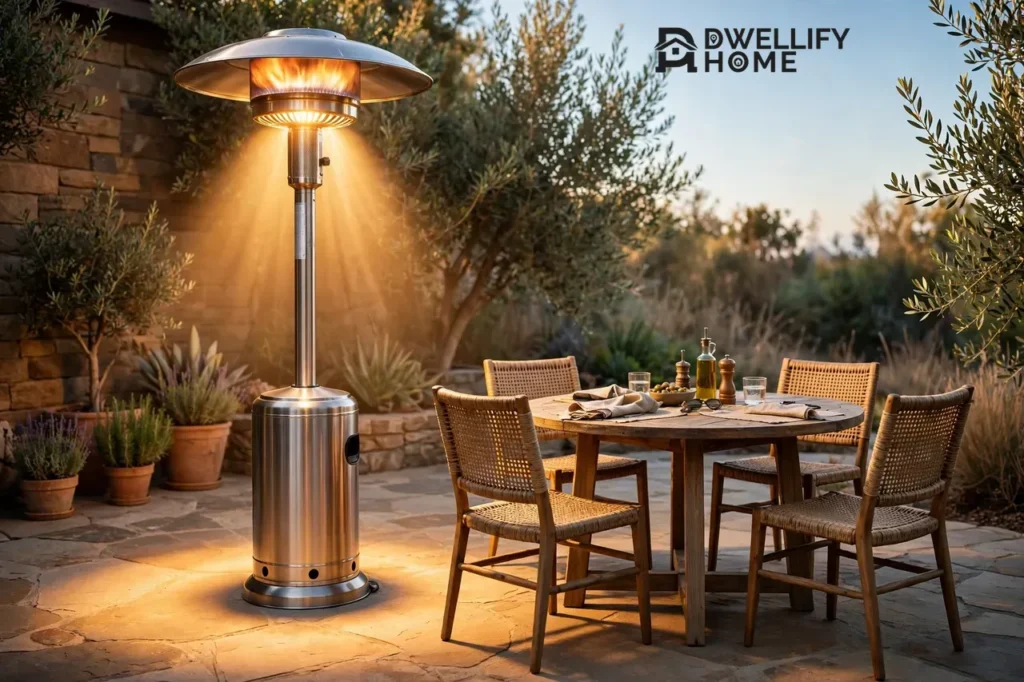
A propane patio heater is an outdoor heater that burns liquid propane gas to make radiant heat — the same kind of warmth you feel from the sun or a campfire. It warms people and furniture directly instead of heating the air, which is why it works outside, where warm air would just blow away. Most models hide a standard 20-pound propane tank inside the base, the same tank a gas grill uses, and light with a push-button igniter.
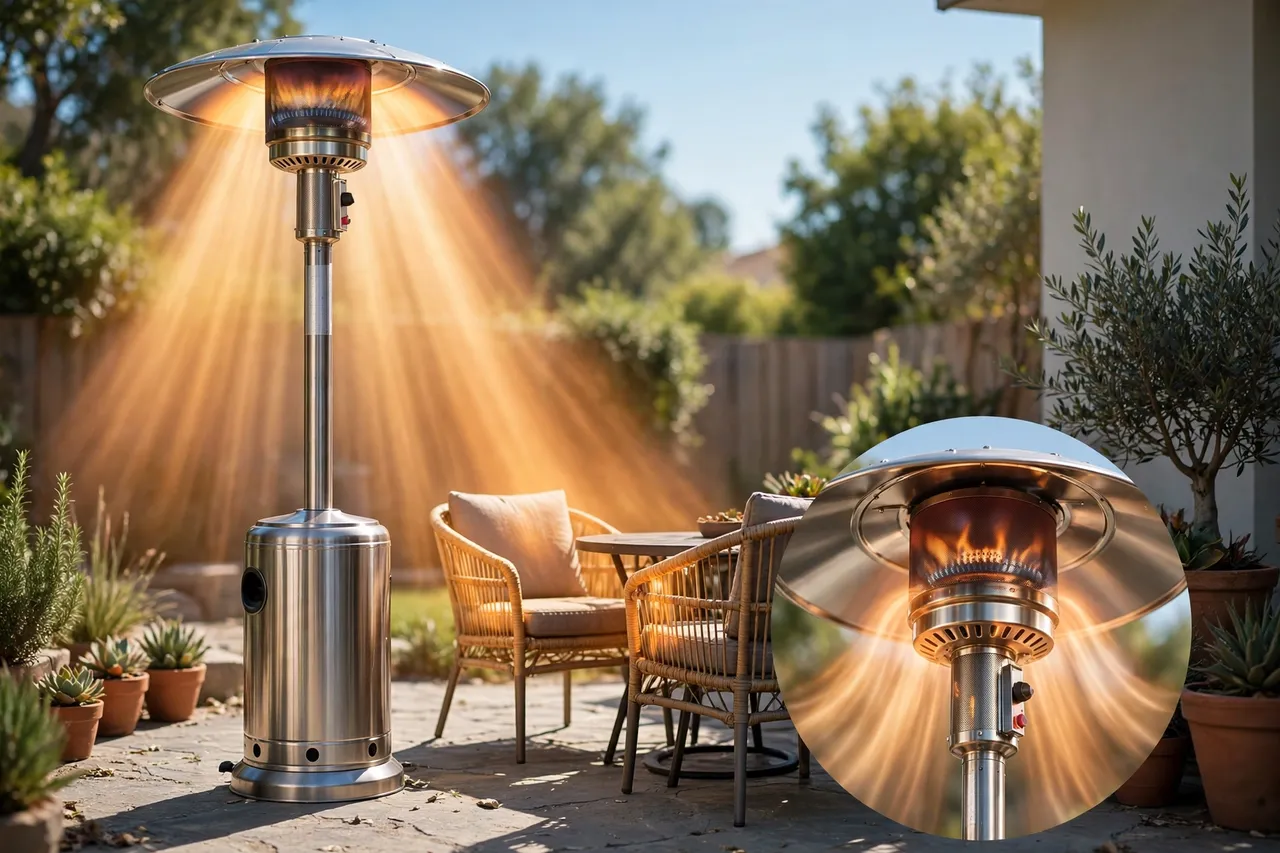
The heat comes from a burner under a wide metal reflector, often called a mushroom cap, that pushes the warmth down and out in a circle. Some models show the flame inside a tall glass tube instead, which looks like a fireplace and throws light as well as heat. Either way, the warmth is strongest within a few feet of the heater and fades as you move away, so where you place it matters as much as how big it is.
People also call these heaters propane heaters for the patio, gas patio heaters, or outdoor gas heaters, and the names all mean the same thing: a portable gas heater built for open air. A small propane patio heater that sits on a table works the same way at about 11,000 BTU, warming the people around one table instead of a whole seating area.
Radiant heat warms people, not air, so place the heater close to the chairs. A heater standing ten feet from the seating warms nobody, no matter how high its BTU number is.
Can You Use a Propane Patio Heater Indoors?
No. Never use a propane patio heater indoors — not in a house, a garage, a basement, a tent, or an enclosed porch, even with a door or window open. Patio heaters are built and labeled for outdoor use only, and the U.S. Consumer Product Safety Commission warns that portable propane heaters used in enclosed spaces have caused fatal carbon monoxide poisoning. Read the agency’s findings at the CPSC report on carbon monoxide from portable propane heaters.
The danger is carbon monoxide, not just the open flame. Burning propane gives off carbon monoxide, a gas with no color and no smell. Outdoors, it drifts away in the open air. In a closed room it has nowhere to go, and it builds up quietly while the heater looks like it is working fine. Headache, dizziness, nausea, and confusion are the early signs, and the CDC lists them on its carbon monoxide information page, which also notes that more than 400 Americans die each year from unintentional carbon monoxide poisoning not linked to fires.
Opening a window does not make it safe. An indoor-rated portable heater is a different product: it carries an oxygen depletion sensor that shuts the gas off when oxygen drops. A patio heater has no such sensor, because it was never meant to run where fresh air is limited. If the manual does not clearly say the heater is approved for indoor use, treat it as outdoor-only.
For a covered patio, the rule is the same unless the space is genuinely open on the sides. A roof with open sides and moving air is still outdoor use, but a screened porch with vinyl panels clipped over the screens or a glassed-in room is enclosed enough to trap exhaust. When in doubt, switch to an electric infrared heater for that space — it makes no exhaust at all. Our covered patio ideas show which roofed layouts stay open enough for outdoor heating and which ones do not.
If the space has walls and a roof that close it in, the propane heater stays outside. No cracked window changes that rule.
The 4 Types of Propane Patio Heaters Compared
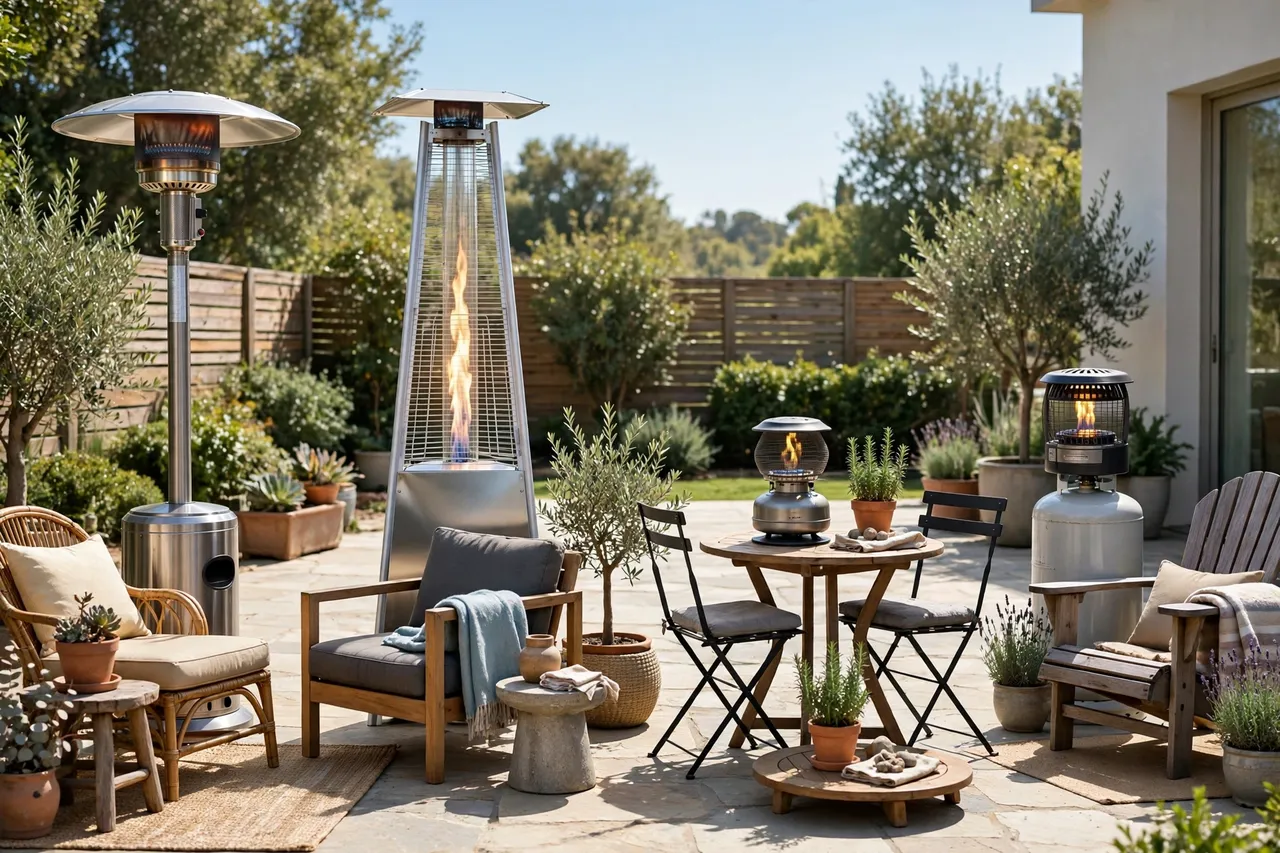
Every propane patio heater falls into one of four types — here is the short version, then a closer look at each.
Propane patio heater types at a glance
| Type | Heat output | Best for | Typical price |
|---|---|---|---|
| Mushroom tower | 40,000 to 50,000 BTU | Open patios, 4 to 6 guests | $130 to $250 |
| Pyramid glass tube | 40,000 to 42,000 BTU | Style plus heat, visible flame | $200 to $300 |
| Tabletop | About 11,000 BTU | One table, 2 to 4 people | $90 to $150 |
| Tank-top | About 15,000 to 30,000 BTU | One side of a table, camping | $60 to $120 |
Prices in this table are typical US retail prices checked November 13, 2026, for the heater itself. The tank, a cover, and the first fill are extra.
Mushroom tower: the standard patio heater
The mushroom tower is the tall standing heater most people picture: about 7 feet high, with a wide round reflector on top and a 20-pound tank hidden in the base. It puts out 40,000 to 50,000 BTU and warms a circle roughly 15 to 20 feet across on a calm evening. Wheels let you roll it where the chairs are, and most models have tip-over protection that shuts the gas off if the heater falls. This is the right pick for most open patios, because it gives the most heat per dollar and needs no install.
Pyramid glass tube: heat you can see
A pyramid heater shows the flame rising inside a tall tempered-glass tube, so it works as a light feature as well as a heater. Output is similar to a mushroom tower, about 40,000 to 42,000 BTU, but the glass tube is fragile and the heater is heavier and harder to move. Buy one when the look matters as much as the warmth, and keep in mind that a cracked tube is the most common repair.
Tabletop: small heat for a small space
A tabletop propane heater sits on the table and runs on a small 1-pound propane canister, putting out about 11,000 BTU. It warms the people sitting right around the table, roughly a 30-square-foot bubble, and it suits a balcony or a bistro set where a full tower would crowd the space. A 1-pound canister lasts about 1.5 to 2 hours on high, so keep spares on hand.
Tank-top: the budget single-side heater
A tank-top heater screws directly onto a 20-pound propane tank through a regulator, with no stand and no base. It throws heat in one direction, which suits a workbench, one side of a table, or a camping setup, but it is a poor pick for a seating area, because only the people facing it feel warm. It is also the least stable type, since the tank itself is the base.
For most patios, the mushroom tower wins on heat per dollar. Buy the pyramid for the flame show, the tabletop for a balcony, and the tank-top only for one-sided heat.
How Much Heat Do You Need? BTU and Sizing
BTU, short for British Thermal Unit, is the number that tells you how much heat a heater makes in an hour. A 40,000 to 50,000 BTU standing heater is the standard answer for a normal patio, and it warms a circle about 15 to 20 feet across — enough for four to six seated guests on a calm 45-degree evening. A tabletop at 11,000 BTU warms about 30 square feet, enough for two people at one small table.
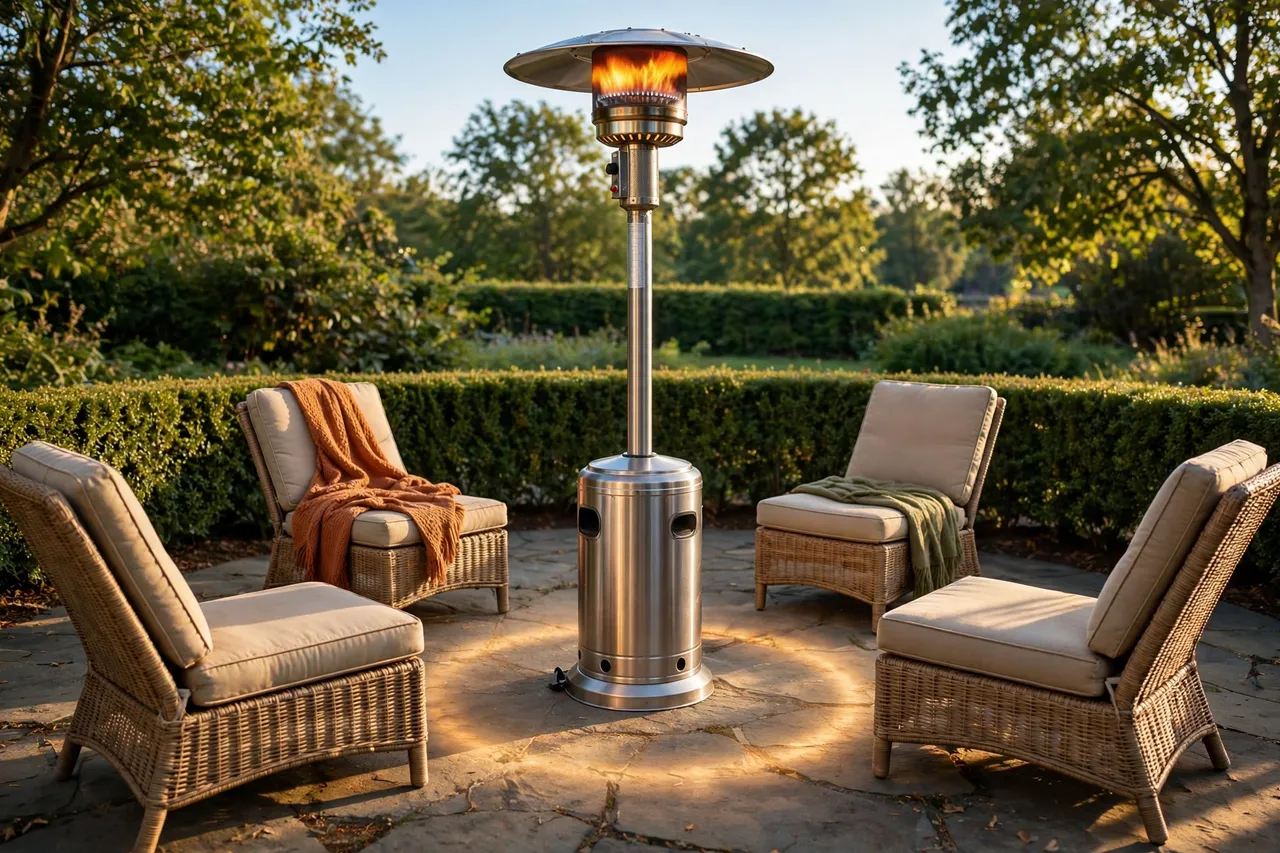
Size the heater to the seating, not to the patio. Measure the circle where people actually sit, then match it to the table below.
Patio heater sizing at a glance
| Seating area | Heater to buy | What it warms |
|---|---|---|
| One small table, 2 people | Tabletop, 11,000 BTU | About 30 sq ft |
| Compact patio, 2 to 4 guests | Standing, 40,000 BTU | About 8-foot radius |
| Standard patio, 4 to 6 guests | Standing, 46,000 to 48,000 BTU | About 9-foot radius |
| Large deck, 6 or more guests | Standing, 50,000 BTU, or two heaters | About 10-foot radius each |
Wind is the biggest variable in the whole calculation. At 10 miles per hour, even a 50,000 BTU heater loses 20 to 30 percent of its effective range, because the warm air is blown away before it reaches the chairs. A windbreak — a fence, a hedge, or a screen on the windy side — does more for comfort than a bigger heater. Put the heater on the upwind side of the seating so the breeze carries the warmth toward people, and keep it out of the main walkway so nobody bumps it.
Cold matters too. On a mild 50-degree evening, a 46,000 BTU heater feels generous. Near freezing, the same heater only takes the edge off, and guests will still want a jacket. If you plan to use the patio below 40 degrees, add a second heater rather than expecting one tower to do the work of two. For layout ideas that put the heater, the chairs, and a windbreak in the right places, browse patio ideas and our small patio designs for tight spaces.
Wind steals more heat than cold does, so block the wind before you buy a bigger heater. A screen on the windy side is cheaper than a second tank of propane every weekend.
How Long Does a Patio Heater Propane Tank Last?
A full 20-pound tank lasts about 8 to 10 hours on a 40,000 to 48,000 BTU heater on high, and 12 to 15 hours on medium, because fuel use drops almost in step with the flame. The math is simple: a full 20-pound tank holds about 430,000 BTU of energy, so divide 430,000 by your heater’s BTU rating to get the hours on high.
That number comes with one catch. A tank you swap at a grocery-store exchange cage usually holds only 15 pounds of propane, not 20, even though the cylinder is the same size. Blue Rhino and AmeriGas both state that their exchange cylinders contain 15 pounds. That 15-pound tank runs a 40,000 BTU heater for about 8 hours on high instead of nearly 11, while a refill station fills your own tank to the full 20 pounds.
Cold weather cuts runtime further. Propane has to boil from liquid into gas inside the tank, and that boiling slows down as the tank gets cold. On a near-freezing night, a tank can frost up and the flame can weaken even when fuel is left inside. Keep the tank out of the wind, never heat it with anything, and swap in a fresh tank when the flame starts to sputter.
To check how much propane is left before guests arrive, weigh the tank. Every cylinder has its empty weight stamped on the collar as TW, usually 17 to 18 pounds. Weigh the tank on a bathroom or luggage scale, subtract the TW number, and the rest is propane in pounds. Multiply those pounds by 21,600 and divide by your heater’s BTU rating for the hours left. Skip screw-on pressure gauges: propane vapor pressure depends on temperature, not on how much fuel is left.
A swapped exchange tank holds 15 pounds, not 20, so a refill buys you about 25 percent more heat per tank. Weigh the tank before the party, not during it.
How Much Does a Propane Patio Heater Cost?
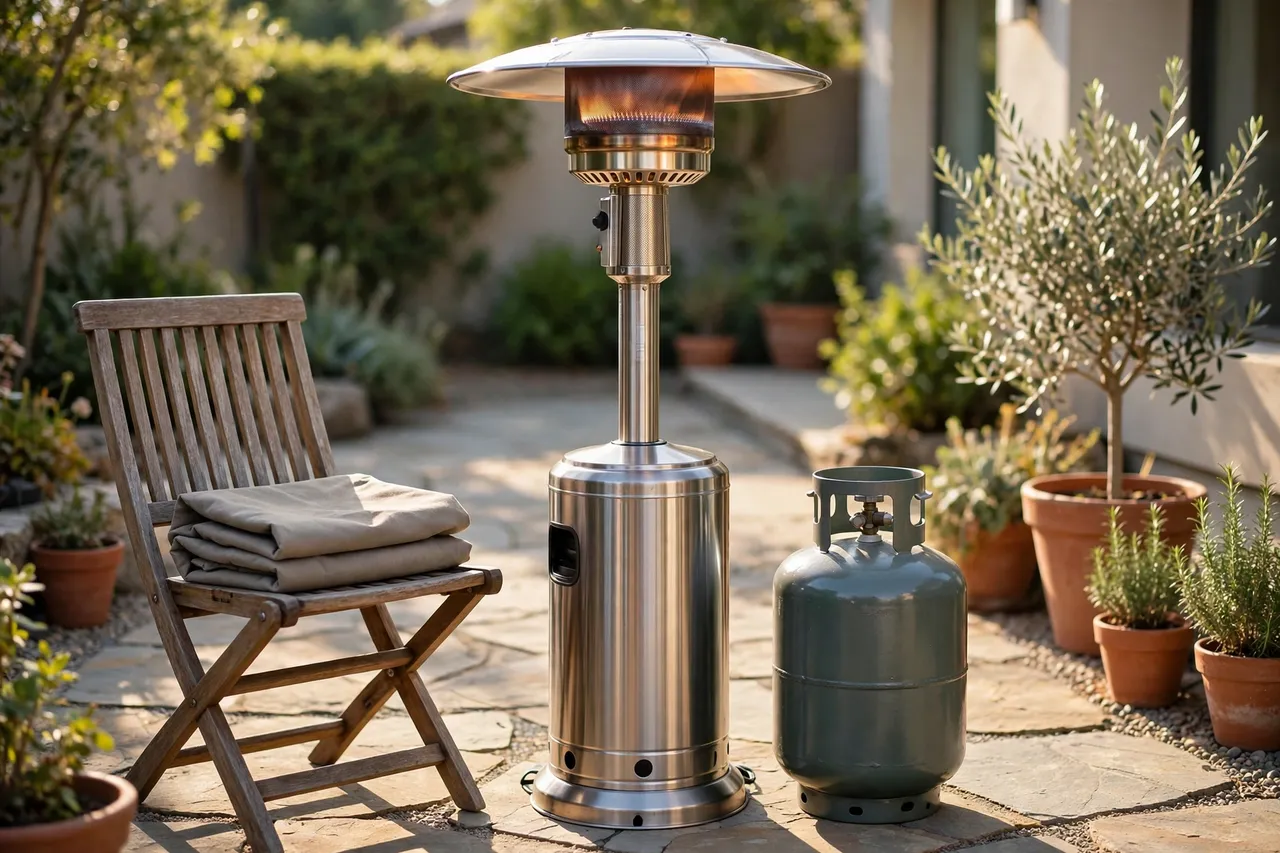
A propane patio heater costs $90 to $300 for the heater itself, depending on type, and the fuel runs about $1.50 to $2.00 per hour on high. The table below shows real US prices checked November 13, 2026, with the running cost beside them.
Propane patio heater costs, November 2026
| Heater | Price checked | Fuel cost per hour on high |
|---|---|---|
| Amazon Basics 46,000 BTU tower | About $135 (Amazon, Oct 2026) | About $1.70 |
| Mainstays 48,000 BTU tower | About $147 at Walmart (Nov 12, 2026) | About $1.80 |
| Mr. Heater 48,000 BTU tower | $219.99 (Dick’s Sporting Goods) | About $1.80 |
| EAST OAK 50,000 BTU tower | About $250 (Amazon, Oct 2026) | About $1.90 |
| Cuisinart tabletop, 11,000 BTU | $149.99 (Amazon, Oct 10, 2026) | About $0.40 per 1-lb canister hour |
The tank is the running cost. A 20-pound refill costs about $14 to $20 at most US refill stations in 2026 — Costco runs about $13 to $15, U-Haul about $14 to $19 — while an exchange costs about $22 to $25 and gives you only 15 pounds. The US Energy Information Administration’s residential propane benchmark was $2.674 per gallon for the week of March 30, 2026, the last weekly figure of the heating season, and retail refill stations typically charge $3.00 to $4.50 per gallon. See the EIA’s weekly propane prices at the EIA propane price page.
At about $1.70 an hour on high, that is roughly $400 of propane for the season. Running on medium most nights cuts that bill nearly in half.
Budget in this order: the heater, a cover, and two tanks. A cover costs $20 to $40 and keeps rain off the burner, which is the part that rusts first. A second tank means the evening never ends early because the first one ran dry — keep it full and stored upright outdoors. A rug under the seating area makes the warmed space feel finished, and our indoor outdoor rugs guide covers sizes and materials for rugs that live outside.
Refill, do not exchange, and the fuel bill drops by a third. A $20 exchange buys 15 pounds, while a $14 to $20 refill buys the full 20.
Propane vs Natural Gas vs Electric: Which Fuel Wins?
Propane wins on portability, natural gas wins on running cost, and electric wins on safety in covered spaces.
Propane needs no install: the tank travels with the heater, so you can roll it anywhere on the patio or take it to a friend’s house. The trade-off is the tank itself — refills, storage, and about $1.50 to $2.00 an hour on high. It is the best pick for renters, for patios with no gas line, and for anyone who wants heat this weekend without a project.
Natural gas is a different hookup, not just a different tank. A natural gas patio heater connects to a fixed gas line, so it never runs out and costs roughly $0.40 to $0.80 an hour to run — less than half the cost of propane. But it needs a plumber to run the line, it cannot move, and it only makes sense if your house already has a gas line near the patio. If you do not, the install cost wipes out years of fuel savings.
Electric infrared heaters make no flame and no exhaust, so they are the only safe pick for a covered or semi-enclosed patio. A 1,500-watt plug-in unit costs about 20 to 25 cents an hour to run and warms one or two people at close range, while a 6,000-watt hardwired unit needs a dedicated 240-volt circuit and an electrician. Electric is the cheapest per hour, but it cannot match a 50,000 BTU propane tower for warming a whole seating area on a cold night.
Propane for the open patio, electric for the covered one, natural gas only if the line is already there. The fuel follows the space, not the other way around.
How to Set Up and Use a Propane Patio Heater Safely
A propane patio heater is safe when you set it up right and stay consistent about the rules. Most accidents come from the same few shortcuts: a heater too close to something that burns, a loose gas connection, or a heater moved while it is lit. Work through the steps below the first time, and the routine takes five minutes after that.
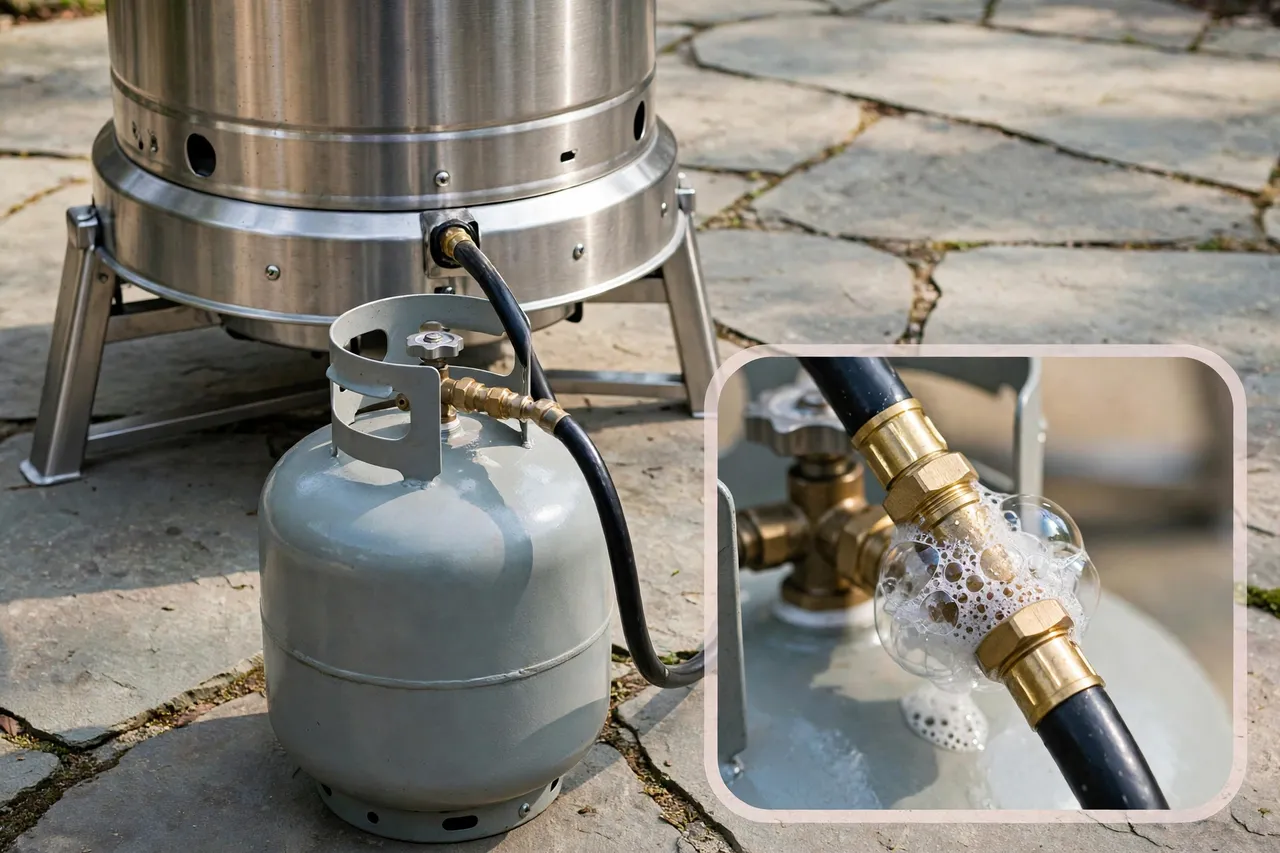
Step 1: Pick a flat, open spot
Set the heater on flat, level ground, outdoors, away from the house wall, the fence, and anything overhead. Keep at least 36 inches clear on the sides and 24 to 36 inches above the top of the heater, and check your own manual, because some models ask for more. Never set a heater on a slope, on an uneven paver, or near the edge of a raised deck, where a bump can tip it. Keep children and pets away from the hot reflector while it runs.
Step 2: Connect the tank and test for leaks
Connect the regulator by hand and tighten it firmly, then brush soapy water over the connection and open the tank valve slowly. Bubbles mean gas is leaking: close the valve, tighten the connection, and test again. If bubbles keep coming, do not light the heater. Never test a connection with a flame, and keep the tank upright inside the base, never on its side.
Step 3: Light it and let it warm up
Follow the maker’s lighting instructions exactly: most models need you to hold the igniter button while the pilot catches, then turn the knob up slowly. The reflector takes a few minutes to get hot, so give it time before you judge the warmth. If the flame goes out, turn the gas off, wait five minutes for any gas to clear, and light it again. Never relight a heater the moment it blows out.
Step 4: Run it, watch it, and shut it down right
Never leave a lit patio heater unattended, and never move it while it is lit or still hot. Turn the tank valve off first when you are done, then let the burner flame die before you switch the heater off — that burns the gas out of the line instead of leaving it sitting in the hose. Let the heater cool fully before you put the cover on or wheel it into storage, and store spare tanks upright outdoors, never in the house, the garage, or a shed.
Soapy water finds a leak; a flame finds a fire. Test every new connection before the first light, and every spring after storage.
Care, Storage, and Making It Last
A propane patio heater lasts years longer with simple care, and the burner is the part that decides its life. Brush the burner and the reflector clean once a month during the season, and wipe off any soot before it bakes on. Spiders love to nest in the burner tube over summer, and a blocked tube is the most common reason a heater will not stay lit — a quick pass with a soft brush or compressed air before the first fall light fixes it.
Cover the heater whenever it is not in use. Rain on a hot burner causes rust, and rust on the reflector cuts the heat it throws down. A fitted cover costs $20 to $40 and pays for itself the first winter. If your model has a glass tube, clean it with glass cleaner only, never an abrasive pad, and check it for chips before you light the heater.
Store the heater upright in a dry shed or garage for winter in cold climates, with the tank removed and stored outdoors. Just clean it, cover it, and check the hose and regulator in spring for cracks, stiffness, or chew marks. Replace a cracked hose before you light the heater, not after you smell gas — a hose is a $15 part, and a leak is not a repair you postpone.
Clean the burner before the first fall light, and cover the heater every night it is not running. Rust and spider nests end more heaters than cold weather does.
5 Mistakes to Avoid With a Propane Patio Heater
Most patio heater regret comes from five avoidable mistakes. Check your plan against this list before you order.
- Using it indoors or in an enclosed porch. Burning propane makes carbon monoxide, and no open window makes an enclosed space safe.
- Buying too little heat. A tabletop warms one table, not a seating area, so match the BTU to the circle where people sit.
- Paying exchange prices for 15 pounds. Refill your own tank to the full 20 pounds and the fuel bill drops by about a third.
- Skipping the leak test. A loose connection is silent and invisible, and soapy water is the only check that finds it.
- Leaving it uncovered in rain. A rusted burner and reflector throw less heat every season until the heater is not worth lighting.
A heater you have to fight is a heater you will stop using. Pick the type that fits your patio, test the connection every time, and keep a spare tank full.
Related Guides
If you are planning the whole patio for cold evenings, these guides pick up where this one leaves off:
- Patio Ideas — layouts, styles, and features for every size of patio.
- Covered Patio Ideas — roofed patios where a heater needs open sides and real clearance.
- Patio Lighting Ideas — string lights and fixtures that work beside a heater after dark.
- Outdoor String Lights — the classic evening glow for a heated patio.
- Small Patio Designs — seven layouts that make a tiny patio feel bigger.
- Covered Patios Attached to the House — roofed patios where a heater needs open sides and real clearance.
- Home Heating — the systems that warm the inside when outdoor heat is not enough.
- How to Improve Home Insulation — keep the heat you pay for inside the house all winter.
- 3-Season Room Designs — the enclosed-space alternative where propane heat does not belong.
- Patio Shade Ideas — shade for the same patio by day; heat for the evening.
- Outdoor Patio Tiles — the floor under the heater.
- Outdoor Sectional Couch — the seating circle the heater warms.
- Small Patio Decorating Ideas — decorating the heated seating area.
- Patio String Lights Ideas — lights beside the heater after dark.
Frequently Asked Questions
Can you use a propane patio heater indoors?
No, never. A propane patio heater is built for outdoor use only, and burning propane indoors makes carbon monoxide, a gas you cannot see or smell. The CPSC warns that portable propane heaters used in enclosed spaces have caused fatal carbon monoxide poisoning. Use an electric infrared heater indoors or in an enclosed porch instead.
How long does a patio heater propane tank last?
A full 20-pound tank lasts about 8 to 10 hours on a 40,000 to 48,000 BTU heater on high, and 12 to 15 hours on medium. An exchange-cage tank usually holds only 15 pounds, so it runs about 8 hours on high. Divide 430,000 by your heater’s BTU rating for the hours on high.
How much does a propane patio heater cost?
A propane patio heater costs $90 to $300 for the heater itself: about $135 for the Amazon Basics 46,000 BTU tower, about $147 for the Mainstays 48,000 BTU tower at Walmart, and about $250 for the EAST OAK 50,000 BTU tower, based on prices checked November 13, 2026. Fuel runs about $1.50 to $2.00 per hour on high.
How many square feet will a propane patio heater heat?
A 40,000 to 50,000 BTU standing heater warms a circle about 15 to 20 feet across, roughly 150 to 200 square feet, on a calm evening — enough for four to six seated guests. A tabletop at 11,000 BTU warms about 30 square feet. Wind shrinks the warm circle by 20 to 30 percent at 10 miles per hour.
Are propane patio heaters safe?
Yes, outdoors, when you follow the rules: flat ground, 36 inches of clearance on the sides, a soapy-water leak test on every new connection, and never leave it lit unattended. The risk is carbon monoxide, so never use one indoors, in a garage, or in an enclosed porch, and store spare tanks upright outdoors, never inside the house.
Is a propane or natural gas patio heater better?
Propane is better when you want a heater that moves and needs no install, at about $1.50 to $2.00 an hour in fuel. Natural gas is better when a gas line already reaches the patio, because it never runs out and costs roughly $0.40 to $0.80 an hour. Without a gas line, the install cost wipes out fuel savings.
Disclaimer: Propane is flammable, and burning it makes carbon monoxide, which you cannot see or smell. This guide gives general advice only, not safety or installation instructions. Never use a propane patio heater indoors, in a garage, or in any enclosed space; keep it clear of anything that burns; test every gas connection with soapy water; and always follow your heater maker’s instructions and your local fire rules. If you smell gas, close the tank valve, do not light the heater, and call your gas supplier or fire department.
The best propane patio heater is the one that fits your seating, your wind, and your habits. Measure the circle where people sit, buy the BTU that warms it, refill the tank instead of exchanging it, and keep the heater outdoors where it belongs. Do that, and the patio stays the place everyone gathers long after summer ends.