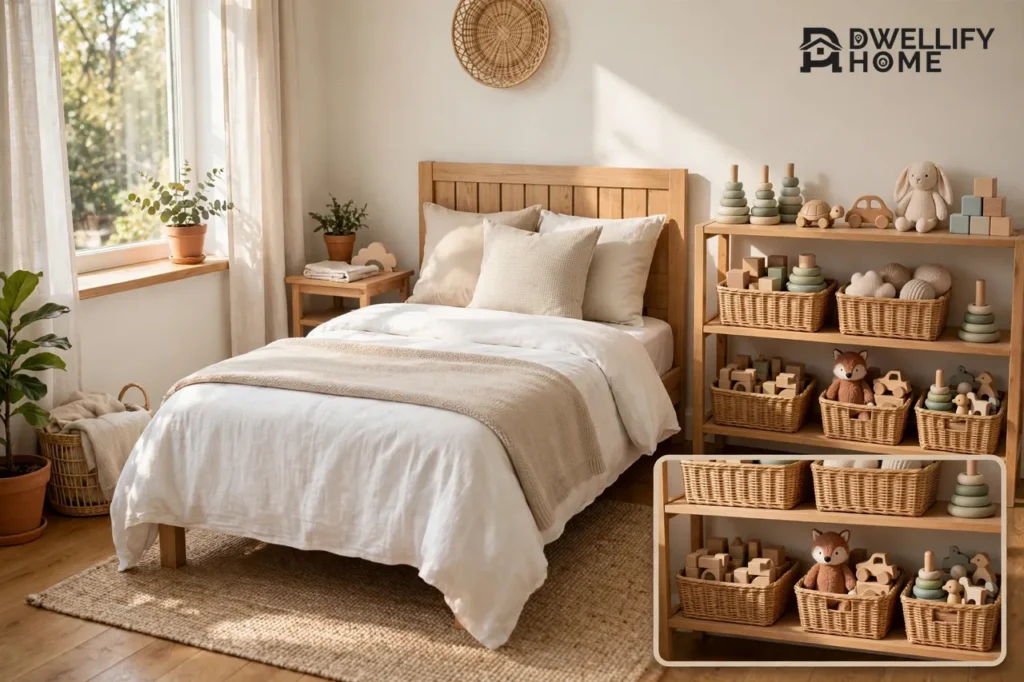
To declutter children’s rooms, sort toys with your child into keep, rotate, and donate piles, keep favorites out, store the rest in rotation, and give every toy a home your child can reach. In a 2018 University of Toledo study, toddlers played longer and more deeply with four toys in the room than with sixteen. Fewer toys out at once usually means longer, deeper play — not more boredom. When you declutter toys with your child instead of around them, the room stays tidy and play gets better.
Kids’ rooms fill up faster than any room in the house. Birthdays, holidays, and well-meaning gifts add up until the floor disappears under toys, and then nobody can play at all. The fix is not a bigger room or stricter rules. It is fewer toys out at once, each with a home your child can reach and put back. This guide walks through the whole reset, from the toy sort to the rotation system that keeps it working. For the whole-house plan, start with our full decluttering guide, then use this page for the kids’ rooms.
Start With Your Child, Not Without Them
Decluttering a child’s room works best with the child, not around them. For toddlers, do most of the sorting yourself, then let them pick favorites from small groups. For preschoolers and older kids, invite them in with a clear, kind goal: “Let’s make room for the toys you love most.” Then offer limited choices, such as “Pick your top three cars,” rather than “What do you want to get rid of?”
Never secretly throw away a child’s favorite toy. If a child discovers a beloved toy gone without warning, it can hurt trust, and the next declutter becomes a battle. Rotation is a gentler way to remove items you are unsure about: the toy is resting in a box, not gone forever, and it can come back. The limited-choice rule is simple: small choices, kind words, and no surprise purges.
Pick a time when your child is rested and fed, and set a time limit. One room in one or two hours is realistic. Doing the whole house in one go usually stalls halfway with every toy on the floor. If the whole house feels too big to face, our guide on how to start decluttering when overwhelmed breaks any room into the same small steps.
The Toy Sort: Keep, Rotate, Donate
Gather every toy in one place before you sort. Pull toys from the bedroom, the living room, the car, and under the furniture into a single pile. Seeing it all at once is often enough to make the decisions easier — and it shows you the duplicates you never knew you had.
Sort what is left into three piles: keep out, rest in rotation, and donate. Toss what is broken first: anything cracked, missing key pieces, with sharp edges, or with electronics that no longer work. Then pull out the outgrown: baby rattles for a four-year-old go in donate. Then find the duplicates — group toys by type and you will probably find five toy phones or twenty cars. Keep the best one or two of each and donate the others, unless your child plays with them as a set.
For each toy left, ask whether your child has played with it in the last few months. A toy that has not been played with does not have to go. Toys that sit unused on a crowded shelf often get played with once they are one of eight on a clear shelf. Pack the rest pile into three or four bins, one per rotation, and store them out of sight.
The Four-Box Method for Kids
The four-box method turns hard decisions into quick ones.
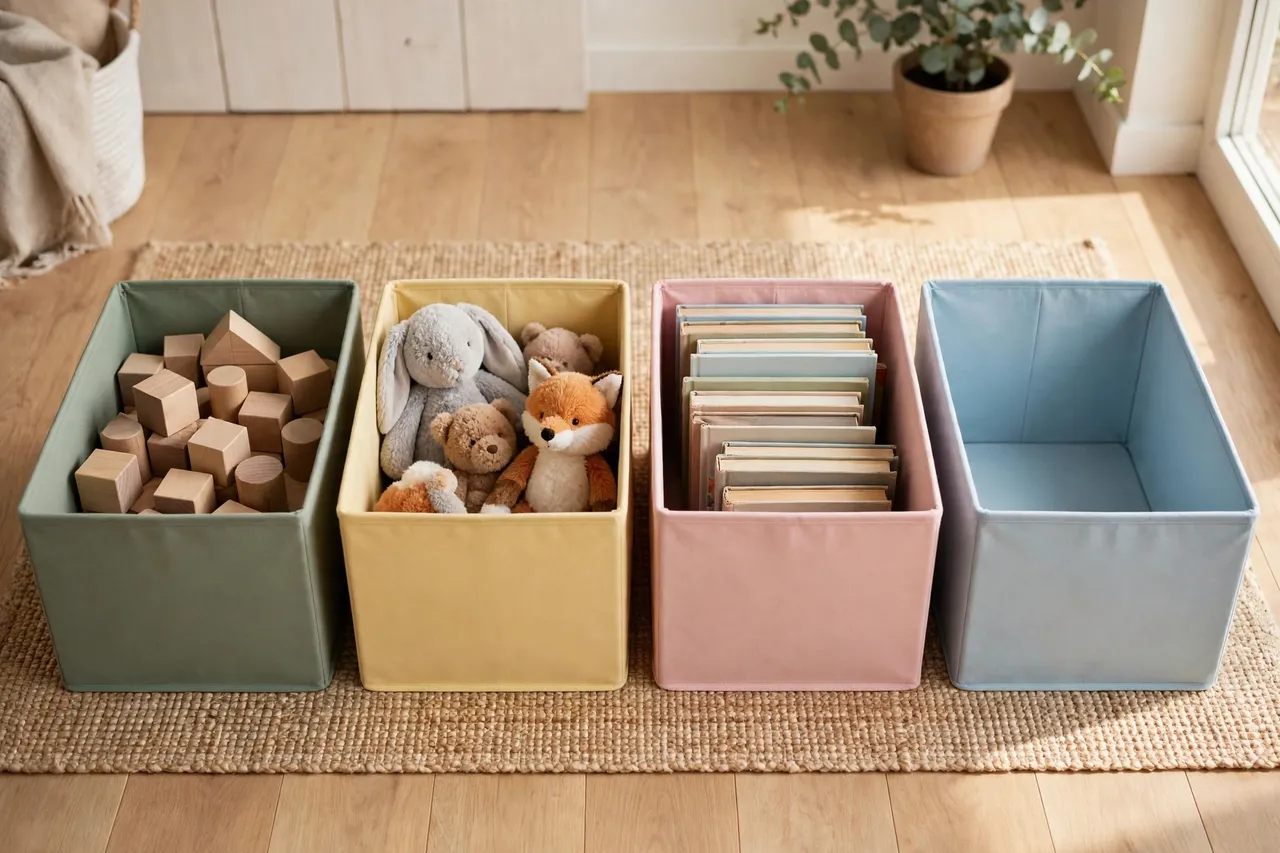
Set up four boxes, bags, or laundry baskets and label them keep, rotate, donate, and recycle. Every toy gets an obvious next stop, so sorting goes much faster and the decisions stop feeling endless.
| Box | What goes in | What happens next |
|---|---|---|
| Keep | Favorites, open-ended toys, age-right items | Back on the shelf with a clear home |
| Rotate | Good toys not in use right now | Stored away, swapped back in later |
| Donate | Outgrown or duplicate toys in good shape | Given to a younger child or a toy drive |
| Recycle | Broken toys and missing-piece sets | Recycled or thrown away |
The rotate box is the secret weapon. Whenever you are unsure, put it there. No guilt, no arguments, and you can decide later with fresh eyes. Toys that sit in rotation for a few months and still never get played with can be donated next time, with much more confidence. For donating, give older children a smaller job: choose three toys to give to a younger child or a toy drive.
Keep the boxes visible while you sort, and let your child help label them. A child who helped sort is a child who knows where things live — and a child who knows where things live can put them back. If clutter has spread to the rest of the house, our declutter your home guide uses the same one-zone method.
Clothes: The Six-Month Rule
Clothes pile up just as fast as toys. Pull everything out of the closet and drawers, and check each piece. Outgrown clothes go in donate. Stained or worn-out pieces go in the rag pile or the bin. Clothes your child has not worn in six months — and is not saving for a season — can go too.
Organize what stays by size and type, and keep it where your child can reach it.
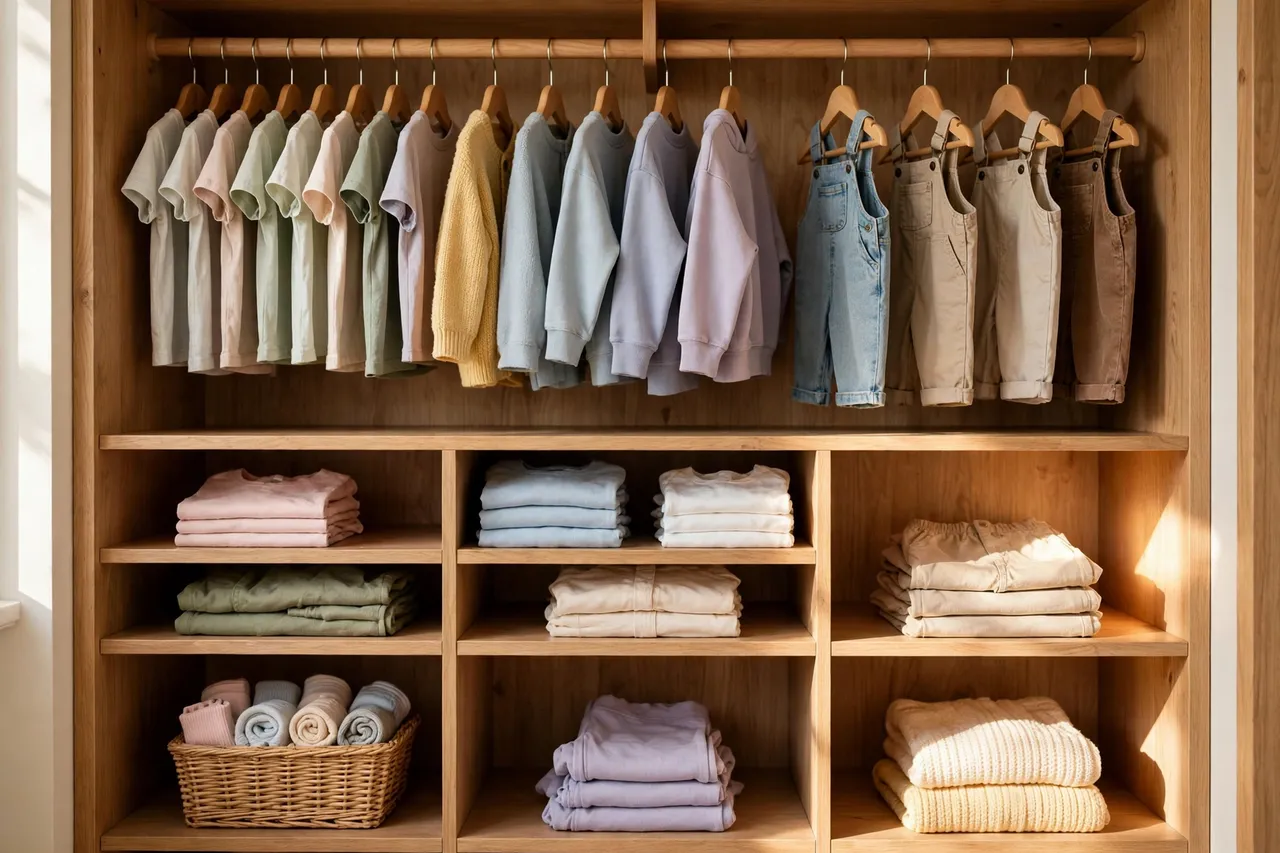
Low hangers, folded cubbies, and small baskets for socks and underwear let kids dress themselves, which is the whole point of a tidy kids’ room. Keep the next size up in a separate bin at the top of the closet, not mixed in with today’s clothes.
Do a clothes check every season, when the weather changes. That is when outgrown clothes are easiest to spot, and when the next size up is needed anyway. A seasonal check takes twenty minutes and stops the closet from filling up again between birthdays.
Books, Art, and School Papers
Books deserve their own sort.
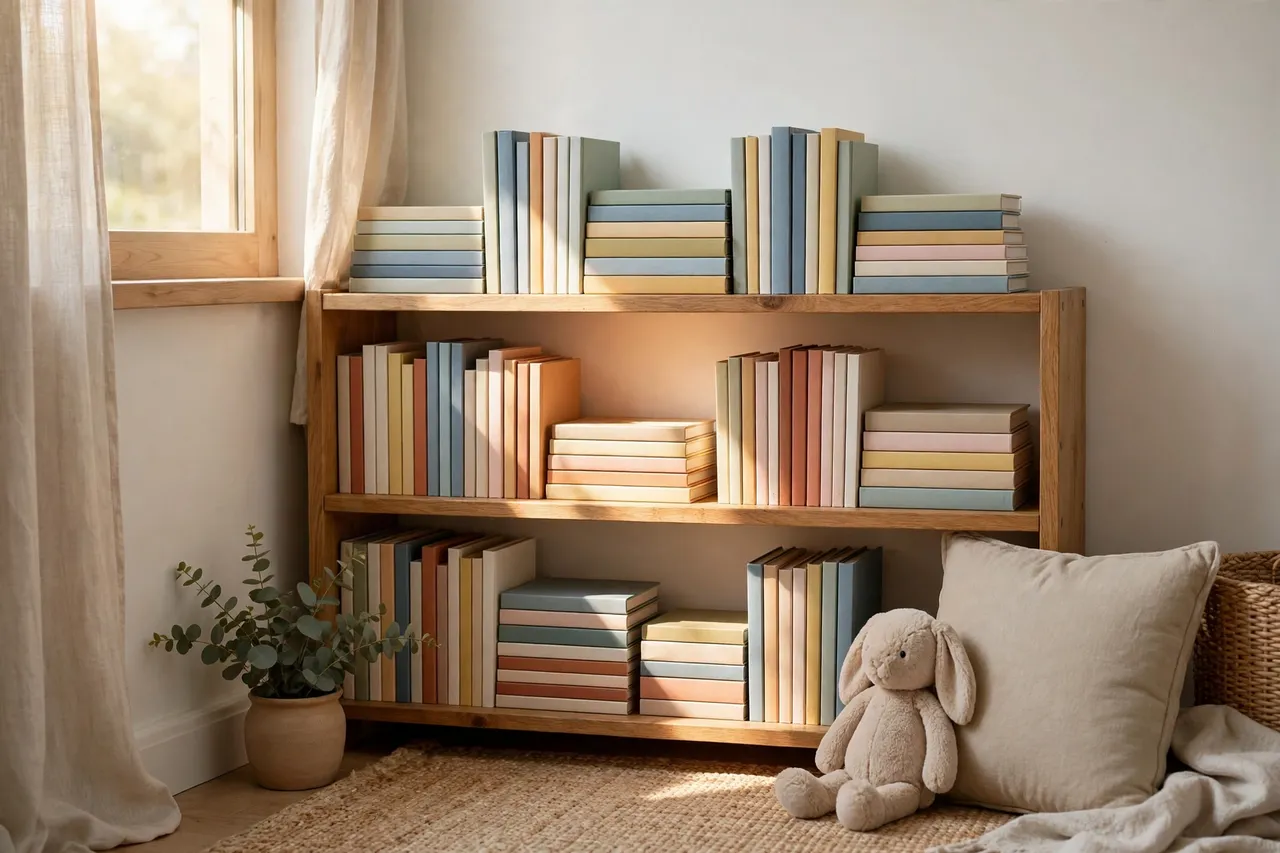
Keep the favorites your child reads again and again, and rotate the rest like toys — four to six titles per cycle instead of the whole shelf at once. A low bookshelf with books facing out lets small children choose for themselves, and a small cushion beside it turns the shelf into a reading nook.
Art and school papers need a limit, or they take over the room. Keep a single display spot — one wall, one string, or one shelf — and rotate what is shown. Photograph the rest before it goes, and keep only the pieces your child is proudest of in a single keepsake box. A box with a lid and a clear limit beats a drawer that never closes.
Craft supplies go in one place, not five. A single bin for crayons, paper, and glue, kept where your child can reach it, is enough for daily creativity. Broken crayons, dried markers, and half-used sticker sheets go. If the living room has become the craft room too, our declutter living room guide puts it back in order.
Storage Kids Can Actually Use
Storage only works if your child can use it.
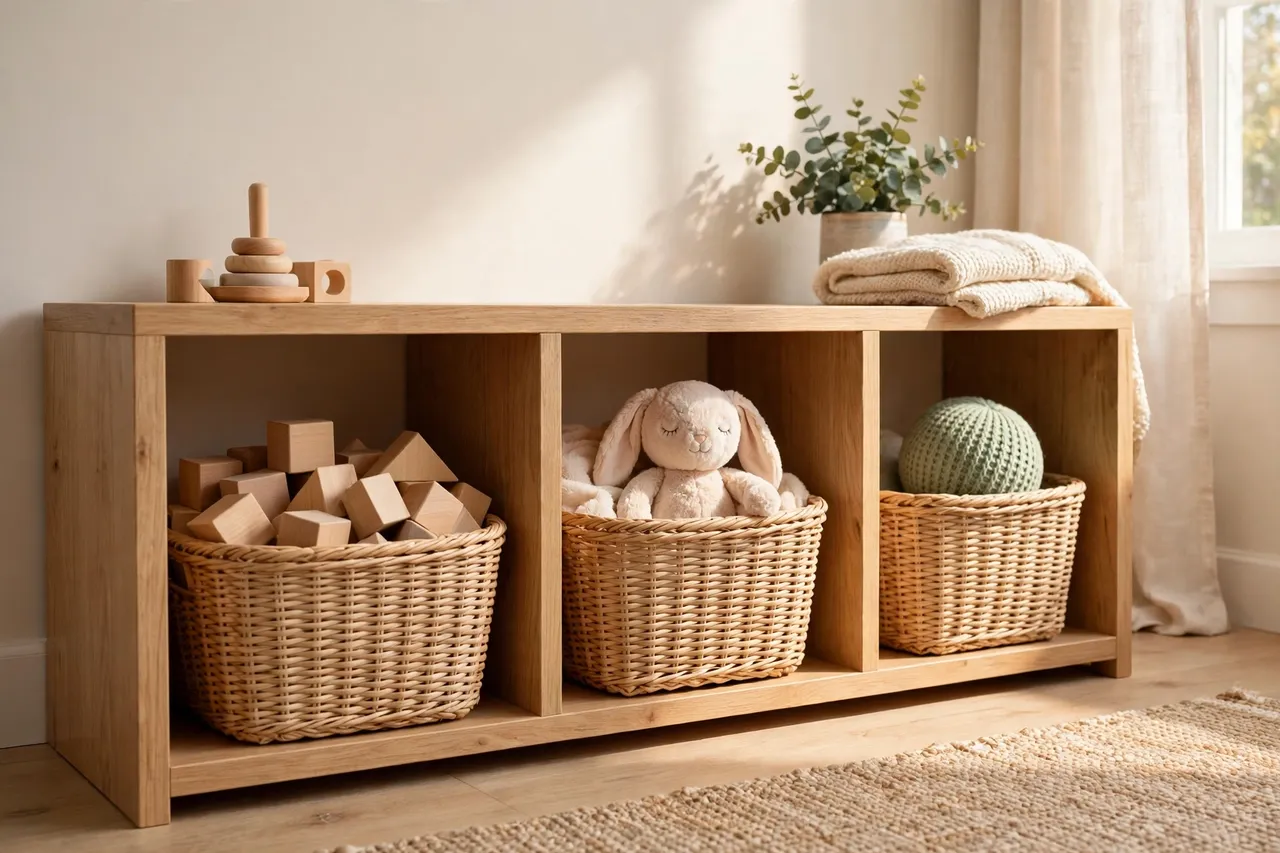
Low open shelves, woven baskets, and labeled bins at child height beat tall cabinets every time. Give every toy a simple home with a picture label — a photo of blocks on the block bin, a photo of cars on the car bin — so even a child who cannot read can put things back.
Use open shelves or low bins for the toys that are out, and labeled, lidded bins on a high shelf or in a closet for the rest. Keep the toys that are out to a number your child can tidy alone: most families settle on eight to twelve toys or activities in the play space at once. If cleanup takes longer than five minutes or consistently overwhelms your child, pull a few items back into storage.
Do not buy storage until you know what is left to store. Declutter first, see what remains, and then buy one basket or shelf that solves a real problem. A room with fewer toys and one good basket beats a room with twenty organizers and the same mess. For the storage system that ties the whole house together, see our organization systems for home.
The Toy Rotation System
A toy rotation system keeps most of your child’s toys in storage and puts out a small set, then swaps them on a schedule. Sort toys by type, put a few from each type on open shelves, store the rest in labeled lidded bins out of sight, and swap every week or two.
Start by gathering every toy in one place, sorting by type, removing what is broken or outgrown, and dividing the rest into “out” and “storage”. Split the storage toys into two or three smaller boxes, each with a mix of toy types, and store them out of sight. On rotation day, put away the toys that have been out, bring out the next set, and let your child help — a short, predictable routine works best.
Pick a rhythm you can keep, such as every week or two, and watch your child to adjust. Most families rotate every one to two weeks for younger toddlers and stretch to two to four weeks for preschoolers who engage more deeply with each set. Monthly rotations work once children reach school age. The right schedule is the one that gets done — and if a toy sits untouched for days, swap it out early. If your child asks for something in storage, bring it back even if the rotation window has not closed yet.
Keep It Tidy: The Nightly Reset
The nightly reset is what makes the whole system last.
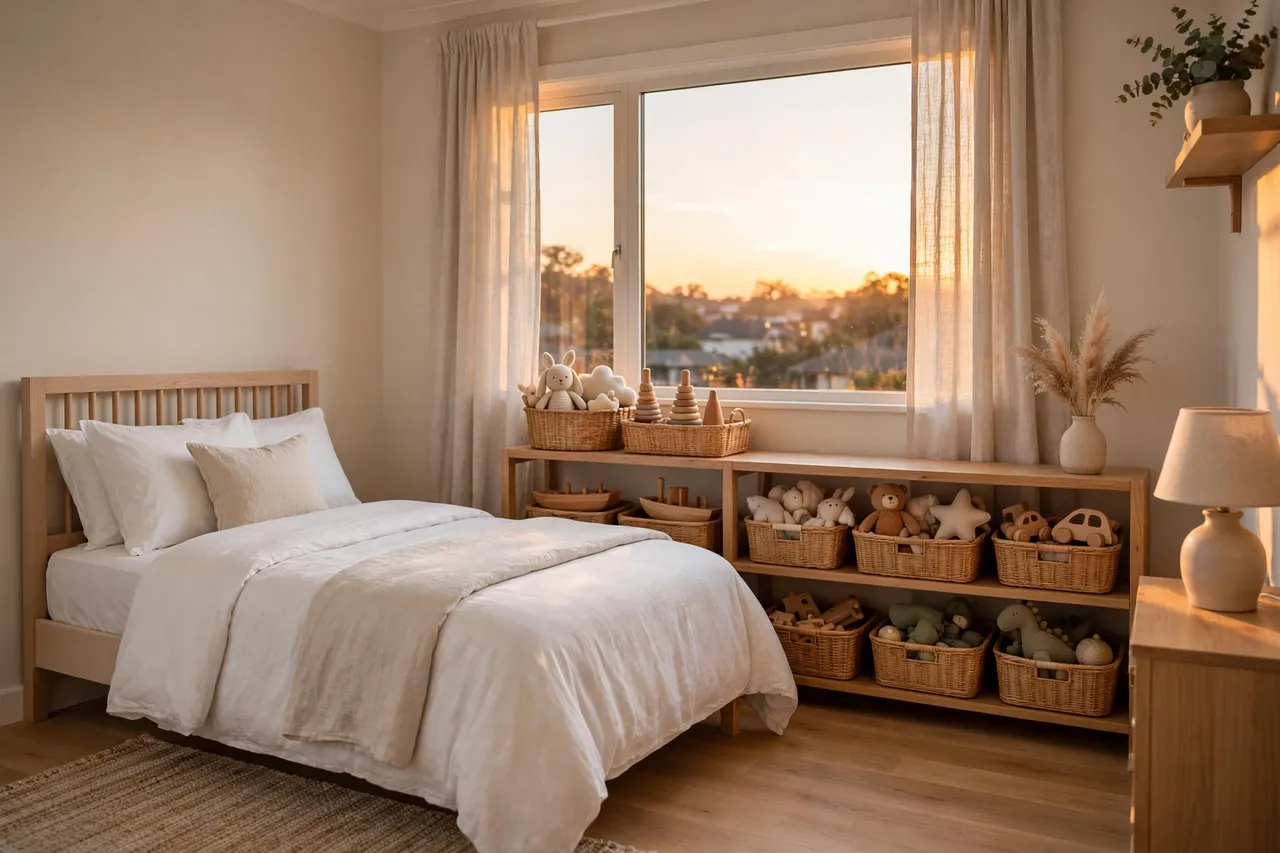
Five minutes before bed, toys go back to their labeled homes, books go back on the shelf, and the floor clears. A child who can tidy the play area mostly alone has the right number of toys out — and a child who cannot is telling you the room still has too much.
Use one in, one out for birthdays and holidays. When a new toy arrives, an old one leaves or goes into rotation. It is the simplest rule in the house, and it stops the slow refill that undoes most declutters within a month. Teach your child the rule early, and they will start applying it themselves.
Do a ten-minute check every week: look at one shelf, check for anything broken or outgrown, and swap the rotation box if the week calls for it. Fifteen minutes a day is enough for the whole house — see our guide on how to declutter your home in 15 minutes a day. The kids’ room was the busiest room. Keep it calm, and play gets better from here.
Related Guides
Keep going with these room-by-room guides from the same series:
Frequently Asked Questions
How do I declutter my kid’s toys?
Set up four boxes: keep, rotate, donate, and recycle. Sort one shelf or zone at a time. Keep favorites and open-ended toys that suit your child’s age, put “maybe” toys in a rotation box, and pass on or recycle the rest. Give every toy a simple home with picture labels.
How do you start a toy rotation system?
Gather every toy in one place, sort by type, remove what is broken or outgrown, and divide the rest into “out” and “storage.” Put a few toys from each type on open shelves, store the rest in labeled lidded bins out of sight, and swap every week or two.
How do you choose a rotation schedule?
Pick a rhythm you can keep, such as every week or two, and watch your child to adjust. Most families rotate every one to two weeks for toddlers and two to four weeks for preschoolers. The right schedule is the one that gets done.
How often should I rotate toys?
Most families rotate every one to two weeks for younger toddlers and stretch to two to four weeks for preschoolers who engage more deeply with each set. Monthly rotations work once children reach school age. If a toy sits untouched for days, swap it out early.
Your child’s room does not need to look perfect. It needs to let your child play without tripping over piles, find what they love in seconds, and put everything away without help. Clear it once, rotate the toys, reset it nightly, and let the calm room do its quiet work for you.