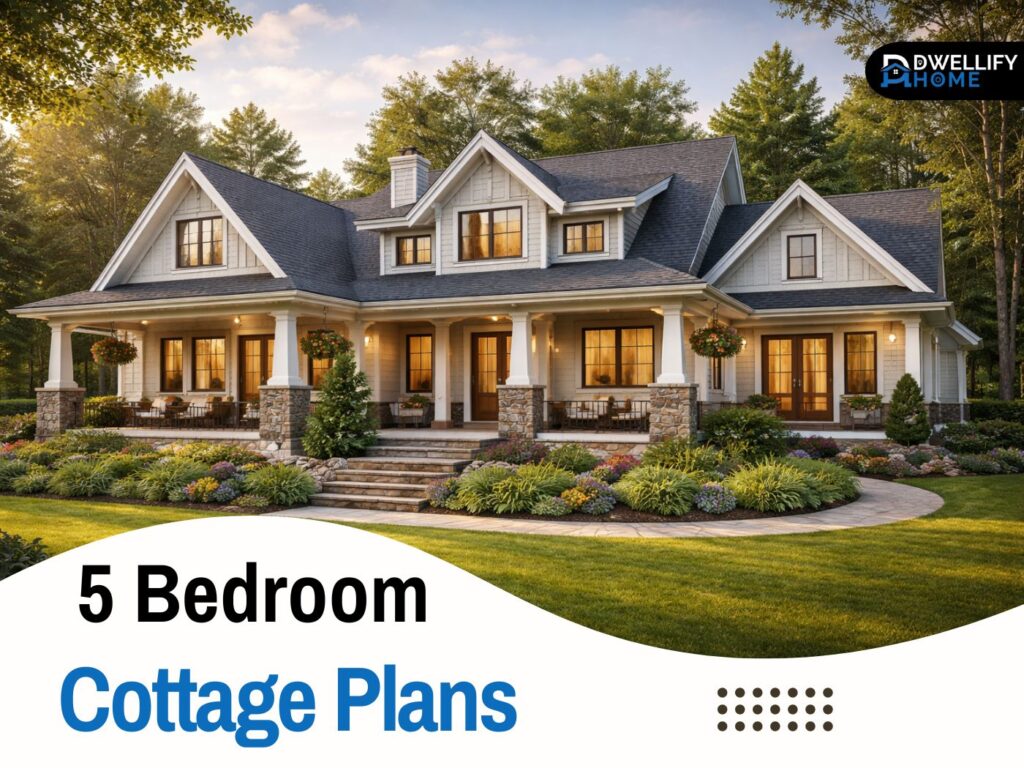
If you’re considering 5 bedroom cottage plans, you’re probably trying to solve a real-life puzzle. You need enough bedrooms for kids, guests, maybe a home office, but you still want that cozy cottage feeling. Not a giant, cold box that just happens to have five rooms with beds in them.
Here’s the thing, a cottage-style home isn’t about being tiny. It’s about feeling warm, welcoming, and livable. With the right layout choices, five bedrooms can fit beautifully without the house feeling complicated or overwhelming.
In this guide, I’m going to walk you through what works, what doesn’t, and the small planning decisions that make a big difference. I’m speaking from hands-on design experience, the same way I would during a planning meeting at the kitchen table.
Snippet-ready definition:
5 bedroom cottage plans are cozy-looking home designs with five bedrooms, flexible layouts, and practical family features like open living areas, porches, mudrooms, and optional basements, sized to feel warm without wasting space.
Mission Statement:
Dwellify Home helps homeowners plan spaces that truly work, with clear, experience-based guidance on layouts, sizing, comfort, and smart home decisions you can trust.
Quick Guide Comparison Table
| Option | Best for | Typical trade-off | Smart tip |
| Single-story (1 level) | Long-term easy living, fewer stairs | Needs a wider lot, often higher roof and foundation cost | Avoid long hallways by using two bedroom “wings” |
| 1.5-story | Main-floor living plus extra bedrooms/bonus upstairs | Some stairs, roof complexity can rise | Put the primary suite and laundry on the main floor |
| 2-story | Smaller lots, budget-friendly bedroom count | More stairs, upstairs noise can travel | Keep kids’ bedrooms together and add a quiet zone downstairs |
| Basement or walk-out | Extra space without bigger footprint | Moisture control, ceiling height planning | Use it for a guest zone, rec room, or office with daylight if possible |
Step-by-step plan shortlist (simple and practical)
- Pick your layout type first (single-story, 1.5-story, or 2-story).
- Decide what the 5th bedroom really is (office, guest suite, hobby room, teen room).
- Check the bed-to-bath ratio (most families feel best at 3+ baths).
- Confirm flow: entry to kitchen, kitchen to pantry, kitchen to outdoor space.
- Do a storage check: mudroom drop zone, pantry, linen, garage storage.
- Verify lot fit: width, depth, setbacks, driveway approach, slope.
- Then buy the PDF plan set and budget for local adjustments if needed.
What 5-bedroom cottage layouts usually include (and why families love them)
Most 5-bedroom cottage house plans follow a similar “family-first” recipe. You’ll usually see a comfortable great room, a practical kitchen, and bedrooms arranged in a way that supports privacy and everyday flow.
The best part is that five bedrooms give you options. One family might use the fifth bedroom as a quiet office. Another uses it as a guest suite for grandparents. Someone else turns it into a craft room or a teen hangout. That flexibility is the real value, not just the number five.
In many designs, you’ll also notice a few features that keep showing up because they genuinely work:
- Open living space that connects the kitchen, dining, and family room
- A mudroom or drop zone near the main entry
- A pantry that can handle a big household
- Covered outdoor living like a porch, screened porch, or rear terrace
On top of that, cottage-style homes tend to feel more “human” inside. The rooms often have better proportions, warmer sightlines, and little nooks that make the home feel personal instead of cookie-cutter.
How big should a 5-bedroom cottage be?
This is where many homeowners get stuck. They assume five bedrooms automatically means an enormous house. In reality, the size depends on how efficient the layout is and how you plan to use each bedroom.
In my projects, most comfortable 5-bedroom cottage layouts land somewhere around 2,400 to 3,400 square feet. You can go smaller if bedrooms are modest and shared spaces are designed efficiently. You can go larger if you add a basement suite, extra living rooms, or oversized secondary bedrooms.
A practical way to decide is to start with how your household actually lives:
- Do you need one big shared living space, or do you need two smaller ones?
- Do you host guests often, or only a few weekends a year?
- Do you want a dedicated office that stays quiet during the day?
Now let’s talk bathrooms, because this matters more than people expect. For five bedrooms, I usually advise families to aim for at least 3 bathrooms, especially if kids are involved. If you have teens, guests, or multigenerational living, 3.5 to 4 bathrooms makes mornings smoother and reduces daily friction.
Cottage styles to consider (pick the look first, then the layout)
Cottage style can mean a few different things, and you don’t have to lock yourself into one label. What matters is choosing a style that fits your lot, climate, and the feeling you want when you pull into the driveway.
Modern farmhouse cottage styles usually focus on simple gables, clean lines, and a strong porch presence. These often pair well with modern 5 bedroom cottage plans because the interiors are open, bright, and easy to build.
Craftsman cottage designs tend to feel warmer and more detailed. You’ll see thicker trim, tapered columns, and cozy rooflines. Inside, craftsman layouts often include defined spaces that still connect nicely.
Country or lake cottage plans lean into outdoor living and relaxed flow. These are great if your property has views, trees, or water, because the porch and deck spaces become part of the home’s daily life.
Modern cottage is a simpler, cleaner take. Less ornament, more glass, and often a slightly more contemporary interior. If you want a cottage feel without heavy rustic details, this can be a great middle ground.
Best layout types for 5-bedroom cottage homes
The layout type is a bigger decision than most people realize. It affects cost, privacy, stairs, and how the home feels day-to-day.
2-story cottage plans
Two-story layouts are often the best value for space. You get more bedrooms without stretching the footprint too wide. That’s helpful if your lot is narrow or your buildable area is limited.
A common and very livable setup is three bedrooms upstairs and two downstairs. The upstairs becomes the kids’ zone, and the main level stays functional for guests, work, and everyday living.
1.5-story cottage plans
A 1.5-story plan is one of my favorites for families who want “mostly main-level living” but still need extra bedrooms. You’ll typically have the primary suite, main living areas, and one additional bedroom downstairs. Then you’ll have two or three bedrooms and maybe a bonus room upstairs.
Guess what, this layout often feels more cottage-like because the rooflines and dormers match the interior story-and-a-half feel. It’s also a smart compromise if stairs are okay, but you don’t want the whole household living across two full floors.
5 bedroom house plans single story
Single-story layouts are comfortable, accessible, and great for long-term living. But they need a wider footprint, which can be tough on smaller lots. They also tend to cost more per square foot because the roof and foundation are larger.
If you’re looking at 5 bedroom house plans single story, pay close attention to hallway length. A long, hotel-like hallway is one of the biggest reasons single-story homes lose charm.
Duplex or split-living layouts
Some families want separation. Maybe adult kids need privacy, or a parent lives with the family. In those cases, a split-living or semi-duplex style can work well while still feeling like one home.
The key is to keep shared spaces welcoming, not awkward. A shared kitchen and great room with separated bedroom wings often works better than two fully separate sides that feel disconnected.
Core living spaces that make a big cottage feel comfortable (not crowded)
A cottage should feel cozy, even when it’s larger. That comes down to proportions, circulation, and how you enter the main living space.
Open concept cottage floor plans can work beautifully, but the trick is to “zone” the space. I often do that by using ceiling changes, furniture groupings, or a partial wall that creates definition without closing the room off.
Dining placement also matters more than you’d think. If the dining table blocks the path between the kitchen and living room, the home will feel annoying every single day. One of my simple design rules is to protect the main walkways first, then place furniture.
And don’t forget a quiet corner. A small reading nook, a window seat, or a compact den can make a five-bedroom home feel calmer, especially when the main space is busy.
Kitchen planning for a 5-bedroom household
In a large household, the kitchen isn’t just a cooking space. It’s the command center. That’s why most well-designed cottage plans include an island, pantry storage, and a layout that handles traffic.
For kitchen island seating, clearances matter. If people can’t open the dishwasher while someone is sitting at the island, that becomes a daily frustration. A little extra circulation space keeps mornings smoother.
Walk-in pantry versus cabinet pantry is another common decision. If you cook often or buy in bulk, a walk-in pantry usually wins. If your household is smaller but still needs five bedrooms for flexibility, a well-designed cabinet pantry can be enough and saves space.
Here’s a real-world tip from design meetings: plan a landing zone near the kitchen. It can be a counter, a small desk nook, or a cabinet section for backpacks and mail. That one detail reduces clutter instantly.
Bedroom strategy that supports real life
Five bedrooms sounds simple until you start placing them. Bedroom placement strategy is one of the biggest differences between a plan that feels peaceful and one that feels chaotic.
A split-bedroom layout is often a winner. That means the primary suite is on one side of the home, and the other bedrooms are grouped elsewhere. It helps with quiet, privacy, and sleep schedules.
It’s also smart to decide early how you’ll use the fifth bedroom. If it’s an office, place it away from noisy living areas and consider a door that seals well. If it’s a guest room, make sure it’s near a bathroom and not in the middle of kids’ bedrooms.
I’ve had families tell me later that the best decision they made was designing one bedroom to flex. A simple closet and a good window let that room shift from nursery to office to guest room over the years.
Main-floor primary suite vs upstairs primary suite
A main floor primary suite is popular for a reason. It supports long-term living, reduces stair dependency, and often creates a calm retreat away from upstairs activity.
If you plan to stay in the home for a long time, I usually recommend the primary on the main floor if the layout allows it. You don’t have to worry about carrying laundry up and down later in life.
An upstairs primary can still work well, especially if you want all bedrooms on the same level for young kids. In that case, privacy comes from smart spacing. Keep the primary away from the stair landing and avoid placing it directly above the noisy great room if possible.
Bathrooms, laundry, and the mudroom effect
In a five-bedroom home, the “back of house” spaces often make or break the experience. Bathrooms, laundry, and mudrooms aren’t glamorous, but they’re what keep the home functioning.
Jack and Jill bathrooms are great when two bedrooms share a bath without needing separate hall access. The key is to add privacy locks and make sure there’s enough counter and storage space for real use.
Powder room placement matters too. You want guests to find it easily, but you don’t want it opening right into the dining area. A small hallway or tucked corner is ideal.
Mudroom with laundry is one of the most practical combinations in family homes. Shoes, backpacks, coats, and messy gear all need a home. If the mudroom connects to laundry, it becomes a real-life reset zone. That’s especially helpful in cottage homes where you want the main spaces to stay cozy and clutter-free.
Basement, walk-out, or bonus level (adding space without changing the footprint)
Basements are a common way to make a 5-bedroom cottage plan more flexible. A finished lower level can add a rec room, extra bedroom, office, or guest zone without making the house wider.
Walk-out basement and daylight basement layouts are especially valuable if your lot slopes. They bring in natural light and make the basement feel like a true living level, not a cave.
Here’s the thing, basements have “watch-outs.” Moisture control, insulation, and ceiling height expectations should be addressed early. I’ve seen families assume the basement will feel like the main floor, then get disappointed when ductwork drops ceilings too low. Planning solves that.
A bonus room over the garage is another great option. It can serve as a playroom, media room, or office without impacting bedroom count.
Outdoor living that fits the cottage vibe
Outdoor living is part of cottage culture. It’s where the home feels relaxed and welcoming.
A covered front porch creates a friendly “hello” moment. A wraparound porch adds charm and practical shade. A screened porch is a game-changer in buggy climates, because you’ll actually use it.
For rear patios and terraces, plan the layout like an outdoor room. Leave space for a table, walking paths, and a grill zone that won’t smoke into the house. Small planning details make outdoor spaces feel effortless instead of cramped.
Garage and storage options that don’t ruin cottage charm
Garages can easily overpower a cottage design if they’re too front-facing. Side-entry garage options often preserve charm better, especially on wider lots.
Detached garages can look beautiful with cottage style, and they add flexibility. You can connect with a breezeway or keep it separate if you want a more traditional cottage property feel.
Storage planning should cover real items, not imaginary ones. Bikes, strollers, sports gear, tools, holiday bins, and outdoor cushions all need a home. A small storage room off the garage or a deep closet near the entry can save the whole house from clutter.
Simple 5 bedroom cottage plans that still feel high-end
Simple doesn’t mean boring. In fact, simple 5 bedroom cottage plans are often the smartest builds because they reduce complexity while keeping comfort.
The “simple-build” formula looks like this:
- Cleaner rooflines with fewer valleys
- Stacked plumbing locations for bathrooms and laundry
- More rectangular footprints with fewer bump-outs
- Repeated window sizes to reduce custom costs
Where to spend depends on your lifestyle. I often tell families to invest in insulation, good windows, and a comfortable kitchen layout. You’ll feel those upgrades every day.
Where to save is usually in fancy roof shapes, overly complex exterior changes, and oversized rooms that don’t get used.
5 bedroom cottage plans with pictures: how to judge plans correctly
Pictures are helpful, but they can be misleading. Renderings often make rooms look larger than they are. Furniture might be scaled down. Window placement may look great outside but feel awkward inside.
A quick way to judge a plan is to check real measurements. Look at the great room width, kitchen clearances, and bedroom sizes. Also check closet depth and where doors swing.
Here’s a simple picture-to-floor-plan checklist:
- Can the dining table fit without blocking walkways?
- Is there a clear path from entry to kitchen?
- Do bedrooms have real closet space, not tiny reach-ins?
- Is there storage near where life happens?
This is especially useful when comparing simple 5 bedroom house plans with pictures, because the layouts can look similar until you check the details.
5 bedroom cottage plans PDF: what’s included, what’s not, and what to verify
A 5 bedroom cottage plans PDF often includes floor plans, elevations, and basic structural details. Some plan sets include foundation options like crawl space or basement. Many include window and door schedules.
But not every set includes everything needed for your local build. Some items may require local professionals, especially mechanical, electrical, and plumbing plans.
Also, plan customization is common. People often adjust:
- Primary suite layout
- Kitchen island size
- Window placements for better light
- Adding a mudroom bench or pantry storage
- Converting a bedroom into a dedicated office
One practical tip: if you’re buying simple 5 bedroom house plans PDF files, ask what’s included before purchase so you can budget properly for local engineering or adjustments.
Lot and code checks before you buy any plan (avoid expensive surprises)
This is where experienced planning saves real money. Before committing to any plan, make sure it fits your lot and local rules.
Setbacks determine how close you can build to property lines. Lot width and depth affect whether a wide single-story plan will even fit. Driveway approach and garage orientation can also create design limitations.
If you’re on a slope, a daylight basement house plan might be perfect. If your lot is narrow, a two-story plan may fit better. If you need septic, you’ll want to check layout and reserve area early, because it can affect where the house sits.
A quick check with your local building department or a local designer can prevent expensive redesigns later.
Quick decision checklist (choose your best plan faster)
When you’re narrowing down options, keep it simple. A plan that looks pretty but fights your daily life won’t feel good long-term.
Use this quick checklist:
- Does the layout match how your household actually functions?
- Are bedrooms placed for privacy and sleep schedules?
- Is there enough storage near entry, kitchen, and bedrooms?
- Do bathroom counts and placement support busy mornings?
- Does the plan fit your lot and future needs without stretching the budget?
If you’re torn between options, pick the plan with better circulation and storage. Those two things are what make a home feel easy to live in.
Conclusion
Choosing a five-bedroom cottage-style home isn’t about chasing the biggest square footage or the fanciest rendering. It’s about finding a layout that supports your family’s real routines while keeping that warm, welcoming cottage feel.
If you take one practical step today, do this: write down how each bedroom will be used right now, and how it might change in five years. Then match that list to a plan that offers privacy, storage, and smart circulation. That’s how you end up with a home that feels comfortable on day one and still works years down the road.
When you’re ready, share whether you want a single-story, 1.5-story, or two-story layout, plus whether your lot is flat or sloped. I can help you narrow the best plan direction based on that, just like a real planning consult.
Disclaimer:
This article is for general planning guidance only. House plans must be checked and adapted for your lot, local building codes, and structural requirements. Always work with a qualified local designer, architect, or engineer before building.