If you’ve ever stood under your recessed lights and thought, “Why does this look a little harsh” or “Why does this area feel dim,” you’re not alone. I’ve been in plenty of homes where the fixture is fine, the wiring is fine, but the bulb choice is doing the damage.
When it comes to BR bulbs, the decision usually comes down to fit and coverage. Pick the right one and the room feels balanced. Pick the wrong one and you’ll notice glare, dark edges, or that odd spotlight effect you didn’t want.
Snippet-ready definition:
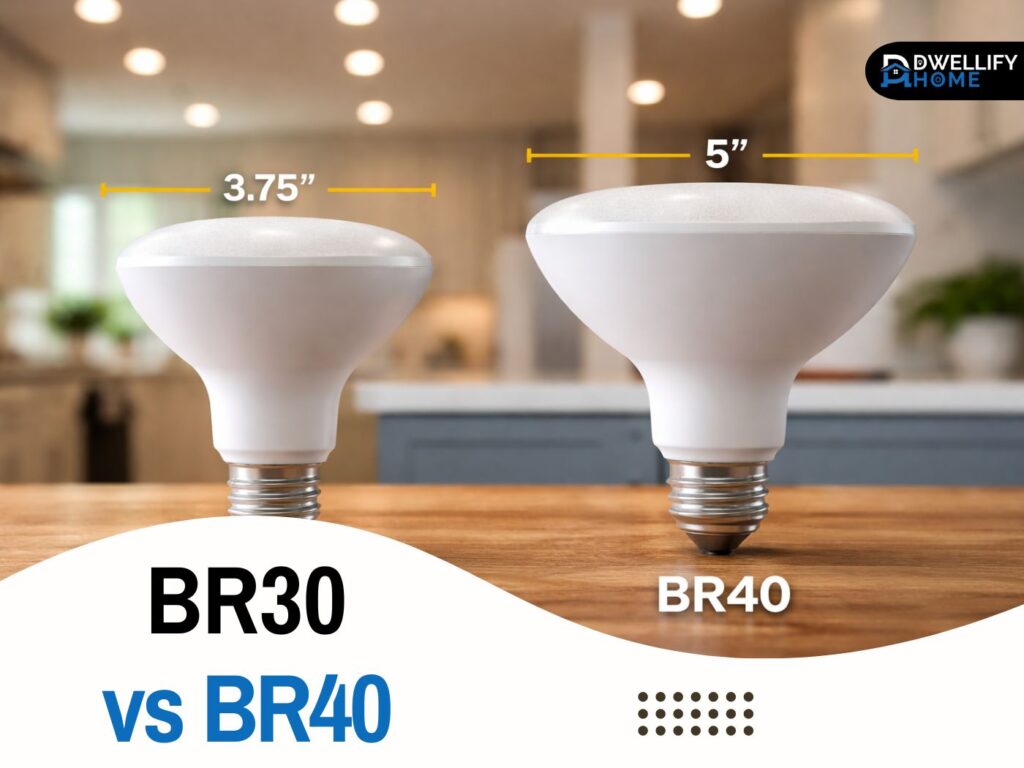
BR30 and BR40 are bulged reflector flood bulbs. BR30 is 3.75 inches wide for many 4–5 inch recessed cans, while BR40 is 5 inches wide for most 6-inch cans and wider, softer coverage.
Mission Statement:
At Dwellify Home, our mission is to make home lighting choices simple and practical, with clear guidance you can trust so you get the look you want without wasting money or redoing your setup.
BR30 vs BR40 in a Nutshell (Quick Answer)
Here’s the quick and practical difference. A BR30 is smaller and usually looks right in 4 to 5-inch recessed cans, giving a more focused pool of light. A BR40 is larger and typically belongs in 6-inch cans, where it spreads light wider and feels softer across the room.
In real homes, I treat this like choosing a paint roller. A smaller roller can be more precise. A bigger roller covers more area with fewer marks. Same idea, different ceiling.
If you want the short takeaway, match the bulb size to the can size first. Then fine-tune using beam spread and lumens so the light feels right in the room.
Quick Guide Table (Comparison)
| Feature | BR30 | BR40 |
| Diameter (face width) | 3.75 inches (30/8) | 5 inches (40/8) |
| Best recessed can size | Usually 4–5 inch cans | Usually 6 inch cans |
| Light coverage feel | More focused, tighter pool of light | Wider, softer spread for larger areas |
| Ceiling height tendency | Works well in standard ceilings (depends on lumens) | Often preferred for higher ceilings, wider coverage |
| Typical use | Kitchens, halls, smaller rooms | Living rooms, open areas, higher ceilings |
| Common related comparison | BR30 vs PAR38 | PAR38 vs BR40 |
Step-by-step: How to choose in 60 seconds
- Measure your recessed can opening (4, 5, or 6 inches).
- Match the bulb face to the can
- 4–5 inch can: start with BR30
- 6 inch can: start with BR40
- Pick your coverage style
- Want more defined task light: lean BR30
- Want softer room-filling light: lean BR40
- Compare lumens, not watts (brightness is about lumens).
- If you dim lights, confirm bulb and dimmer compatibility to avoid flicker or buzzing.
What Does “BR30” and “BR40” Mean? (Size Code Explained)
The number is a size code based on eighths of an inch. BR30 means 30 eighths, which equals 3.75 inches in diameter. BR40 means 40 eighths, which equals 5 inches in diameter. That’s the front face size you see when you’re looking up at the ceiling.
This is why the phrase br30 vs br40 size matters more than most people think. You’re not just picking brightness. You’re choosing how well the lamp visually fills the opening, and how the reflector shape sends light down into the space.
Quick recessed-can sizing cheat sheet (4”, 5”, 6”)
- 4-inch recessed can: BR30 is usually the safer fit
- 5-inch recessed can: BR30 commonly looks clean and intentional
- 6-inch recessed can: BR40 usually fills the opening better and spreads light wider
That cheat sheet will solve most situations without overthinking it.
BR30 vs BR40 Size, Length, and Fit in Real Fixtures
Diameter is the obvious difference, but length matters too. In many brands, a BR40 is longer than a BR30, and that can change how it sits inside the can. On some trims, a longer bulb can sit lower and feel more “present” in the room. On others, it can create glare because you can see more of the bulb face.
I’ve seen a common mistake in 5-inch cans: someone uses a BR40 because it looks like it should fit, then the trim doesn’t sit right or the bulb crowds the opening. Even if it technically screws in, it can look awkward, and the light pattern can get sloppy.
The other real-world issue is trim style. A deep baffle trim hides glare better and can forgive a slightly larger face. A shallow or reflective trim can make the same bulb feel harsh. So the fit is partly physical, and partly visual.
Beam Spread and Light Coverage (Why They Look Different on the Ceiling)
BR bulbs are bulged reflector lamps, made for a broad, softer flood compared with tighter, punchier reflector types. Between BR30 and BR40, the larger face tends to create a wider, gentler spread, especially in 6-inch cans.
In a living room with multiple recessed lights, BR40 often produces a smoother “wash” across the floor and furniture. A BR30 can feel more defined, which is great for task areas, but can look spotty if spacing is wide or ceilings are taller.
Shadow control and room feel (soft wash vs more directed light)
Here’s a simple way to picture it. If your counters, hallway floor, or entry table has sharp shadows, the light is acting more focused. If the room looks evenly lit with softer shadows, you’ve got a wider wash.
If you’re fighting dark corners or “puddles” of light, the fix is usually not higher wattage. It’s choosing the right beam spread and bulb size for the can and ceiling height.
Brightness (Lumens) and “BR30 vs BR40 LED” Reality
Let’s clear up a myth. BR40 is not automatically brighter than BR30. Brightness is measured in lumens, and both sizes come in a wide range. I’ve installed high-lumen BR30 LED lamps that outperform cheap BR40 LEDs, especially in kitchens that need real task light.
When you compare br30 vs br40 led options, look at these two things first:
- Lumens: how much light you’re getting
- Beam spread: how that light is distributed
A practical example. In one kitchen with 8-foot ceilings and 5-inch cans, the homeowner kept buying “brighter” bulbs, but the counters still felt uneven. The issue wasn’t output. The beam was too wide for the spacing, so the task zones lacked definition. A slightly tighter BR30 beam solved it, without increasing glare.
This is where br30 vs br40 specs can guide you, but don’t get buried in numbers. Use specs to confirm the basics, then think about the room.
Color Temperature + CRI (How the Light Will Feel)
Color temperature is the quickest way to make recessed lighting feel comfortable or uncomfortable. Warm white around 2700K to 3000K is cozy and forgiving, great for living rooms and bedrooms. Neutral white around 3500K to 4000K can work nicely in kitchens and bathrooms when you want a clean look. Daylight around 5000K is crisp, but in many homes it feels too clinical unless you really like that style.
CRI is color rendering, basically how accurately the light shows colors. In homes, I generally recommend CRI 90 if you care about how paint, wood tones, and fabrics look. CRI 80 can be fine, but it’s more hit-or-miss depending on the brand.
One practical tip I tell homeowners: keep color temperature consistent in connected spaces. If your kitchen opens into your living room, mixing 3000K and 5000K will feel “off” even if you can’t explain why.
Dimming, Flicker, Heat, and Smart Compatibility (Avoid the Annoying Stuff)
Dimming is where people waste money fast. A bulb labeled dimmable does not guarantee smooth dimming on your specific switch. I’ve been called out for flicker and buzzing more times than I can count, and the wiring wasn’t the problem. It was a mismatch between the LED driver and the dimmer type.
If you want dimming, here’s what usually prevents headaches:
- Use an LED-rated dimmer, not an old incandescent dimmer
- Stick to one bulb model in the same room, mixing brands often causes uneven dimming
- If you’re using smart controls, confirm the bulb is compatible with your smart dimmer system
Heat is less of an issue with LED than older incandescent BR bulbs, but recessed cans still trap warmth. A quality BR40 led bulb in a 6-inch can usually runs comfortably, but cheap bulbs can fail early in enclosed or warm fixtures.
If you notice flicker at low levels, try a higher-quality bulb first. If the problem stays, the dimmer is the next likely culprit.
Best Use Cases by Room (Simple Homeowner Guide)
In kitchens, I often lean toward BR30 in 4 to 5-inch cans because it gives more useful task light. Over counters, islands, and sinks, that slightly more defined beam can make the space feel brighter where you actually work. If the kitchen has 6-inch cans, BR40 can work beautifully for general light, but you may still want to pay attention to spacing so the counters aren’t left in shadow.
In hallways and entries, BR30 is usually the clean, practical choice. It gives a tidy look and doesn’t overfill the trim. Hallways also benefit from controlled light so you don’t get glare as you walk under each fixture.
In living rooms, BR40 often feels better in 6-inch cans because the wider spread creates a calmer, more even ambience. If you’ve got a high ceiling or a larger open-plan space, BR40 can help avoid that “spotlight ceiling” look.
In bedrooms, glare control matters. Warm color temperature and a softer spread win here. If your fixtures are 6-inch, BR40 is often more comfortable. If they’re 5-inch, BR30 still works, just choose a bulb with a softer beam and good dimming performance.
For vaulted ceilings, don’t assume “bigger is always better.” You can use BR40 for coverage, but sometimes a high-lumen BR30 or a different optic performs better depending on spacing and ceiling height.
BR30 vs BR40 vs PAR38 (When PAR Bulbs Make More Sense)
BR bulbs are great for general recessed downlighting. But sometimes PAR is the right tool. PAR bulbs usually produce a more controlled, defined beam. They’re often used for accent lighting, artwork, or places where you want light to land exactly where you aim it.
This is where comparisons like br30 vs br40 vs par38 come in. PAR38 can be a strong option for taller ceilings, track lighting, or highlighting a specific area. If you want punch on a kitchen island or a feature wall, PAR can outperform BR simply because it’s designed for control.
If you’re weighing br30 vs par38, think about the goal. BR30 is typically about comfortable coverage for recessed cans. PAR38 is more about focus and precision. For par38 vs br40, the difference is usually control versus wash. BR40 spreads light more broadly, PAR38 aims it more deliberately.
Can You Swap Them? (BR40 in a BR30 Spot and Vice Versa)
Physically, you can sometimes swap them because many use the same E26 base. Visually and functionally, it’s not always a good idea.
Putting a BR40 into a smaller can can cause problems:
- The bulb may sit too low, increasing glare
- The trim opening may look crowded or uneven
- The beam may spill in a way that creates bright rings or uneven patches
Putting a BR30 into a 6-inch can can work, but it may look like the fixture is under-filled. You’ll also notice more falloff at the edges, which can make the room feel dimmer even if the lumens are decent.
If you’re unsure, match the bulb to the can size first. That alone prevents most “why does this look wrong” situations.
Common Mistakes People Make (And How to Avoid Rebuying)
Most lighting regrets come from a handful of predictable mistakes.
- Buying by watts instead of lumens
- Ignoring can size and trim style
- Mixing color temperatures in connected rooms
- Choosing a super wide beam for task lighting, then wondering why counters look uneven
- Assuming dimming will work because the box says dimmable
A practical habit that saves money is testing one bulb first. Install a single bulb model, check it at night, and see how it looks from normal standing positions. If you like it, then buy the rest. That simple step prevents boxes of returns.
BR30 vs BR40 Reddit Takeaways (Real-World Opinions, Explained)
When homeowners talk about br30 vs br40 reddit style, the same theme comes up: BR40 feels wider and softer, BR30 feels more focused. That lines up with what I see on installs, especially when spacing and ceiling height change the outcome.
What I like about real-world opinions is they highlight comfort factors. If someone complains their lights feel like spotlights, they often need a wider spread, better trim, or a lower-glare bulb. If someone complains the room feels dim even with “bright bulbs,” the issue is usually distribution and placement, not raw output.
Use those takeaways as a gut-check, then base your final choice on can size, spacing, and how you use the room.
Quick Buying Checklist (Use This Before You Click “Add to Cart”)
- Confirm your recessed can size: 4-inch, 5-inch, or 6-inch
- Decide the goal: task light or soft ambient coverage
- Compare lumens, not watts
- Pick a color temperature you’ll enjoy living with
- Choose higher CRI if you care about how colors look
- If dimming matters, confirm compatibility with your dimmer or smart control
- Stick with one bulb model in a room for consistent light
FAQs
1) Will a BR40 fit in a 6 inch can?
In most standard 6-inch recessed cans, yes. BR40 is commonly used there because the 5-inch face fills the opening better and spreads light wider.
2) Why are people switching back to incandescent bulbs?
A common reason is dissatisfaction with some LED setups, especially flicker, buzzing, harsh light, or dimming problems when the bulb and dimmer aren’t compatible. Better LED bulbs and LED-rated dimmers usually solve it.
3) Will a BR30 fit a 4 inch recessed light?
Often, yes, and it’s a common recommendation for many 4-inch recessed cans. Still, trims vary, so it’s smart to test one bulb first if the opening is tight.
4) What does BR30 mean on a flood light?
“BR” means bulged reflector, and “30” refers to the bulb’s diameter in eighths of an inch. BR30 is about 3.75 inches wide.
5) Can I use a BR30 in a 6 inch can?
Sometimes it works, but it may look undersized and can leave a visible gap depending on the trim. If you want a fuller look and wider wash in a 6-inch can, BR40 is usually the better match.
Conclusion
The easiest way to make this decision is to start with the fixture. If you’ve got 4 to 5-inch recessed cans, BR30 is usually the clean fit and the most predictable result. If you’ve got 6-inch cans, BR40 often gives a nicer, wider wash that feels calm and even.
After that, focus on beam spread, lumens, and comfort. That’s what separates lighting that merely turns on from lighting that actually feels good in your home.
If you’re still on the fence, buy one bulb first and test it at night in the room you care about most. In my experience, that single test tells you more than any spec sheet, and it keeps you from wasting money on a full set that doesn’t look right.
Disclaimer:
This guide is for general information. Fixture designs vary by brand and trim, and electrical work should follow local codes. If you’re unsure about compatibility or wiring, consult a qualified electrician.

I’m Bilal, the founder of Dwellify Home. With 6 years of practical experience in home remodeling, interior design, and décor consulting, I help people transform their spaces with simple, effective, and affordable ideas. I specialize in offering real-world tips, step-by-step guides, and product recommendations that make home improvement easier and more enjoyable. My mission is to empower homeowners and renters to create functional, beautiful spaces—one thoughtful update at a time.