Stand at the end of your driveway and look up at the edge of your roof. If a board up there looks wavy, chalky, or a little saggy, you’ve just found the cheapest home repair you’ll ever do, and you’ve found it before it got expensive. That strip of wood is doing more structural work than most people realize.
Trim boards along the roofline hold your gutters, close off the attic, and take the first hit from every storm that rolls through. When they fail, the damage doesn’t stay on the outside for long. Water follows the path of least resistance, and that path usually ends somewhere in your walls or attic.
Here’s the good news: you can judge the condition of yours in about ten minutes with a ladder, a screwdriver, and a healthy dose of suspicion. And if it turns out you need fascia board installation in Fredericksburg, a local crew can usually tell you within an hour whether you’re looking at a patch job or a full replacement.
Why the edge of your roof fails first
Wind-driven rain doesn’t fall straight down. It hits vertical surfaces at an angle and pushes water sideways into seams, nail holes, and the back edge of your gutters. Over years of that treatment, paint cracks, caulk shrinks, and water starts soaking into the wood grain instead of running off of it.
According to the National Weather Service, severe thunderstorms can drive rain and hail at high velocity and from multiple directions, which is exactly the kind of weather that punishes exposed trim. Your roof shingles shed most of it. The boards at the edge absorb what slips past, and they don’t get a break between storms because they never fully dry out on the shaded side of a house.
I’ve walked around enough older homes to have an unpopular opinion: replace almost any trim board you catch early. A rotted board is a cheap fix on a Saturday. A rotted board that’s been feeding moisture into sheathing for three winters is a different project with a different number at the bottom.
Three checks you can run this weekend
You don’t need a contractor’s license to spot trouble. You need to get close enough to touch the boards and look at them in good light. Do all three of these before you call anyone, because the answers will shape the conversation.
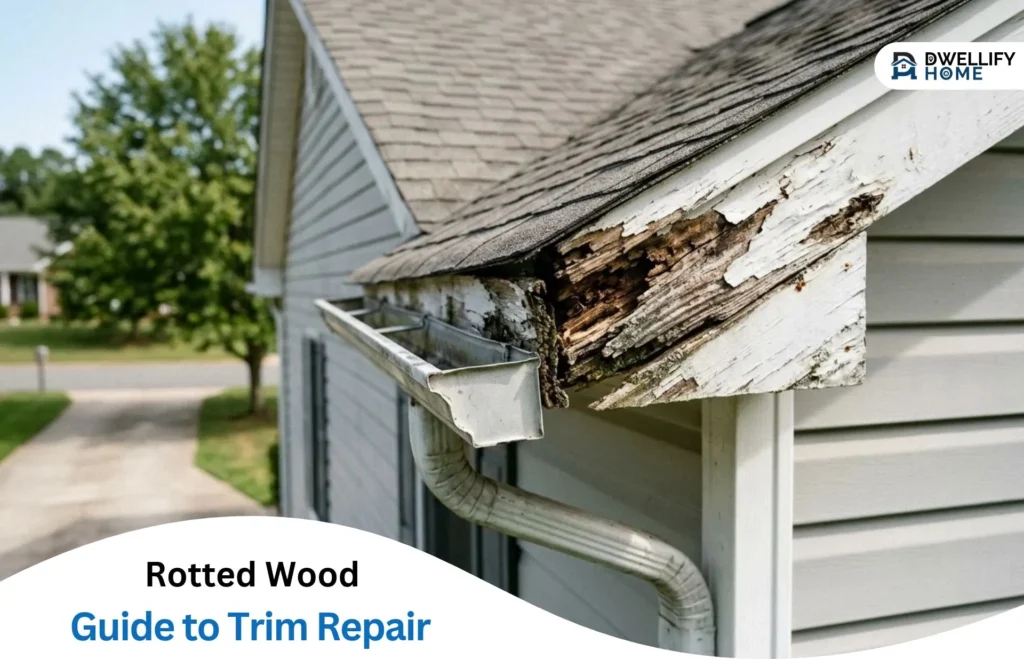
- The screwdriver test. Push the tip of a flathead into the wood at a few spots along each board. Firm resistance means the wood is still solid. If the tip sinks in like you’re pushing into a bar of soap, that section has rot below the paint.
- The paint and caulk survey. Look for paint that’s peeling in sheets rather than fading evenly, and caulk lines that have pulled away from the wall. Water gets in through those gaps, not through the face of the board.
- The gutter alignment check. Stand back and look down the length of your gutter line. Any dip, sag, or separation is a sign the fascia behind it may have softened and let the hanger fasteners pull loose.
Write down what you find by location. “The board above the garage” is a useful note. “The boards are bad” gets you a vague estimate and a lot of guesswork.
What actually drives the cost of a trim repair
Homeowners usually expect the price to hinge on the length of the roofline. It doesn’t, at least not mainly. The real cost drivers are access, height, and how much hidden damage sits behind the board you can see.
| Cost factor | Why it matters | What raises the number
|
| Access and height | Second-story and steep-slope work needs ladders, staging, or lifts | Limited space below, landscaping, tight side yards |
| Hidden damage | Soft fascia often means compromised sheathing or rafter tails | Any framing repair uncovered once the old board comes off |
| Material choice | Wood, composite, and aluminum-wrapped trim have different lifespans | Upgrading to a low-maintenance material along the whole run |
Notice what’s missing from that table: the number of boards. Replacement runs are priced as a system because the crew has to remove gutters, pull fasteners, cut out rot, and re-flash the edge before anything new goes up. If a quote only mentions board count, ask what happens when they open it up and find something unexpected. The answer tells you a lot about the contractor.
Repair or replace? My rule of thumb
Here’s the framework I’d hand any friend who asks. I call it the three-board rule, and it’s deliberately simple because the decision doesn’t need to be complicated.
Count the boards with soft spots. If it’s one or two isolated sections and the rest of the run is solid, spot repair is fine and you should probably seal and repaint the surrounding wood while you’re at it. If it’s three or more, or if the damage shows up on more than one side of the house, plan on a full replacement run. Boards fail together because they’ve weathered together, and patching one in the middle of a failing set just means you’ll be back up there next spring.
The other rule: if the gutter has pulled away from the house, treat the fascia behind it as guilty until proven innocent. Don’t reattach a gutter to soft wood. It’s like hanging a picture frame on drywall that’s been through a flood.
Material choices without the sales pitch
You’ll get three options quoted, almost every time. Real wood is the traditional choice and it looks right on older homes, but it needs paint maintenance every few years. Composite trim resists moisture better and holds paint longer, and it’s what I’d pick for a house I planned to stay in. Aluminum wrapping is the budget option, and here’s my honest take: it covers up a problem nicely, which is sometimes exactly what you want and sometimes exactly what you don’t.
Whichever you choose, the prep work matters more than the material. House wrap or flashing behind the new board, proper caulk at every seam, and a coat of paint on all six sides of a wood board before it goes up. Skip those steps and you’ve paid for the same failure again on a slightly longer schedule.
One practical note from the Environmental Protection Agency: older exterior paint on pre-1978 homes may contain lead, so testing and safe handling practices matter on repaint or removal work. Ask your contractor how they handle it. A crew that has a clear answer ready has done this before.
Timing the job before the season turns
Trim work is fair-weather work. Paint and sealant need dry conditions and a reasonable temperature range to cure properly, which means late fall and winter are not the time to discover soft boards. If you’re in a region with cold winters, get the inspection done while you can still book a crew. The National Association of Home Builders tracks maintenance trends across housing stock, and the recurring theme is simple: deferred exterior upkeep gets more expensive the longer it waits.
Schedule the check for a dry day, and schedule the repair before the rainy stretch you know is coming in your area. That’s not worry, that’s just sequencing.
What to ask before you sign anything
Ask how they plan to handle hidden rot behind the trim, and get the answer in writing with a per-linear-foot or per-hour rate for additional framing work. Ask what happens to your gutters, since they have to come off and go back on, and confirm whether reattachment is included. Ask for photos of the boards once they’re removed, because you’re paying for that view and you deserve to see it.
The boards above your front door are the first thing a buyer sees and the last thing most homeowners think about. Ten minutes with a screwdriver this weekend could save you a five-figure repair next summer. When’s the last time you actually looked up there?
Some links included in this article may be connected to affiliate or sponsored partnerships. Dwellifyhome.com may receive compensation from qualifying purchases or promotional arrangements, helping us continue offering useful content to our readers.