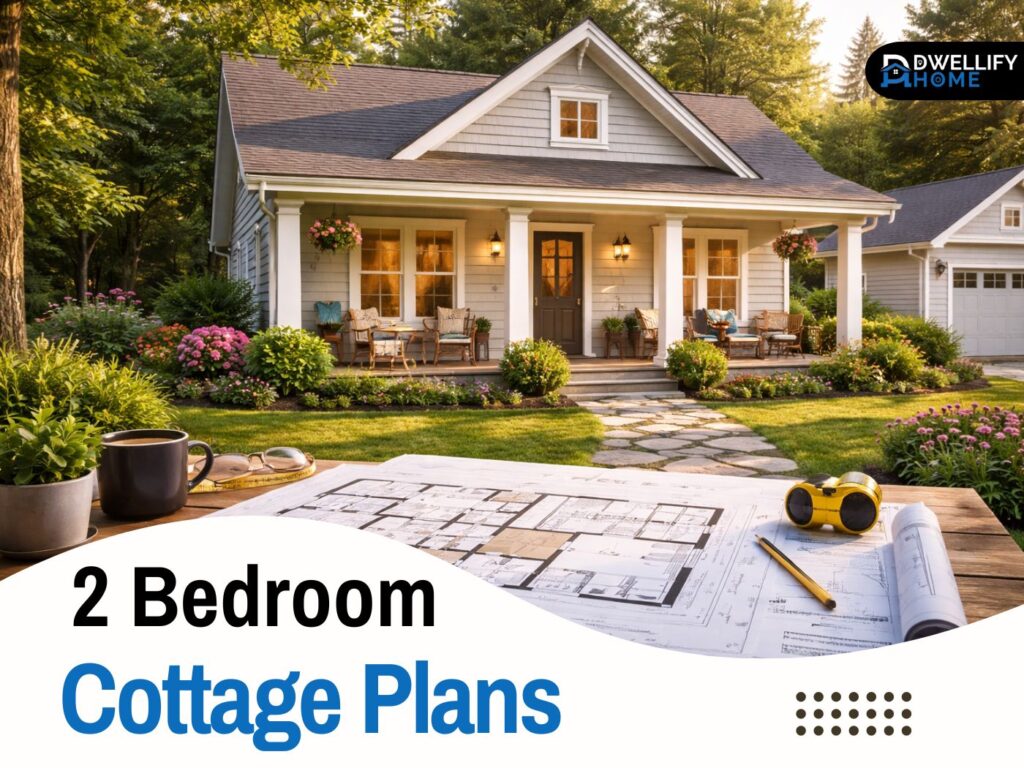
If you’re considering a small cottage, you’re probably craving something that feels cozy without feeling cramped. That’s exactly what a well-designed two-bedroom cottage can do. I’ve helped couples, small families, and downsizers review plans that looked adorable on paper, then fell apart in real life because the layout didn’t match how they actually live.
The best cottage plan isn’t the prettiest elevation. It’s the one that fits your lot, your daily routine, and your budget without making you compromise on comfort. In this guide, I’ll walk you through the layout choices, practical dimensions, and real planning details that make a small home feel easy and welcoming.
Snippet-Ready Definition:
2 bedroom cottage plans are compact home designs that focus on comfort, efficient layouts, and cozy living, usually featuring simple floor plans, smart storage, and a welcoming cottage-style feel.
Mission Statement:
At Dwellify Home, our mission is to help homeowners make confident decisions by sharing practical, experience-based guidance on home layouts, design choices, and everyday living comfort.
What Makes a Cottage Plan a “Cottage”
A cottage usually has a friendly, human scale. It tends to be compact, simple, and warm looking, often with a porch or covered entry that makes it feel inviting. Inside, cottages prioritize livability over impressing someone with a huge foyer.
In my work, I’ve noticed cottage homes also share a certain rhythm. Rooms connect naturally. Storage is tucked in smart places. Windows are placed for light and cross-breezes, not just symmetry.
Cottages can be traditional, modern, or somewhere in between. What keeps them in the cottage family is the sense of comfort and practicality. Even a modern 2 bedroom cottage plan can feel like a cottage if it stays grounded in that cozy, functional mindset.
Quick Guide Table: 2 Bedroom Cottage Plans at a Glance
| Feature | What It Means in Real Life |
| Typical Size | Around 800 to 1,200 sq ft, depending on layout efficiency |
| Bedrooms | Two well-sized rooms for sleeping, guests, or a home office |
| Bathrooms | One bath for simplicity, two baths for comfort and flexibility |
| Layout Style | Open living areas with private bedroom zones |
| Porch Options | Front, screened, or wraparound for outdoor living |
| Garage Options | Attached for convenience or detached for cottage charm |
| Best For | Couples, small families, downsizers, vacation homes |
Quick Decision Guide: How to Choose the Right Plan
If you want this to stay simple and practical, follow these steps:
- Check your lot first
Confirm width, depth, and setbacks before falling in love with a plan. - Pick the layout, not the look
Decide how you want bedrooms, living space, and bathrooms arranged. - Confirm real room sizes
Make sure bedrooms and living areas fit real furniture comfortably. - Decide on extras
Porch, garage, or second bath should support daily life, not complicate it. - Review the plan set
Know exactly what the drawings include before moving forward.
Helpful Bullet List: When a 2 Bedroom Cottage Plan Works Best
- You want a cozy home that’s easy to maintain
- You prefer smart design over extra square footage
- You’re downsizing or building a starter home
- You want flexible space for guests or remote work
- You value outdoor living like porches and patios
Start With Your Must-Haves (Before You Fall in Love With a Plan)
Before you commit to any plan, get clear on what you truly need. Not what looks nice, but what supports your everyday life. I’ve seen people buy a plan because the exterior felt charming, then realize there’s nowhere to put shoes, coats, or a vacuum.
Start with your lot and local rules. Lot width and depth, setbacks, driveway placement, and any height limits can rule out many options quickly. A plan that fits beautifully on a wide suburban lot can be a headache on a narrow lot.
Now think about how you’ll use the second bedroom. Is it a guest room that’s used twice a month, or a daily office? That answer changes everything, from privacy needs to storage and even lighting priorities.
A simple way to stay grounded is to write down three must-haves and three nice-to-haves. Keep that list nearby while you compare plans. It’ll save you from choosing with your eyes instead of your life.
Simple 2 Bedroom Cottage Plans That Live Bigger Than They Look
The most comfortable small cottages don’t waste space on long hallways or oversized rooms that don’t get used. They focus on making the main living area feel open and bright, while still keeping bedrooms quiet and private.
One trick I use often is designing the living, dining, and kitchen as one connected zone, then giving it a strong anchor. That might be a fireplace wall, a kitchen island, or a big window that frames a view. When the central space has a clear focal point, the home feels bigger and calmer.
Storage is the silent hero in small cottages. The best part is you don’t need tons of extra square footage to get it right. You just need it in the right spots: a pantry cabinet that actually holds groceries, a linen closet near the bathroom, and a small entry area where everyday clutter can land without taking over the living room.
Best Layout Options for 2 Bedroom Cottage Floor Plans
When you look at 2 bedroom cottage floor plans, you’ll usually see a few layout patterns repeated. They’re popular because they work, but each one fits a different lifestyle.
Split-bedroom layout (privacy for roommates or guests)
A split-bedroom plan puts the bedrooms on opposite sides of the home, usually with the living area between them. This is excellent if you host guests often, have a teenager, or want one bedroom to act as an office without feeling like it’s in the middle of everything.
In real life, this layout tends to feel calm. One couple I worked with used the second bedroom as a home office and occasional guest room. Because it was separated from the main bedroom, phone calls and late-night guest bathroom trips didn’t disturb anyone.
The tradeoff is that plumbing can be spread out if bathrooms are on opposite ends. If you want a 2 bedroom 2 bath cottage plan with a split layout, pay attention to where the bathrooms sit so you don’t pay extra in long plumbing runs.
Side-by-side bedrooms (family-friendly)
Side-by-side bedrooms are common in smaller footprints. They keep the private zone tight and efficient. This works well for a small family with young kids, or for anyone who wants both bedrooms close together.
This layout often simplifies heating and cooling, too. Bedrooms share walls, so temperature swings are easier to manage. It can also reduce construction cost because the plan is compact and plumbing can be grouped.
The downside is sound. If one person goes to bed early and the other watches TV, you’ll want better insulation and smart door placement so bedrooms don’t open straight onto the main living space.
Primary suite plus flexible second room (office or guest)
This is one of my favorites for modern living. The main bedroom gets a little more space, maybe a better closet, while the second room is sized to be flexible.
If you plan it well, that second room can be an office during the week and a guest room on weekends. Just make sure the room dimensions allow for real furniture. A room that technically fits a bed but blocks the door is a frustration you’ll feel every day.
2 Bedroom Cottage Plans With Dimensions (How to Choose the Right Footprint)
Most people want a quick number like, “What size should this cottage be?” In practice, the right size depends on layout efficiency and how you live, not just square footage.
For many homeowners, a comfortable two-bedroom cottage often lands somewhere in the range of about 800 to 1,200 square feet. That’s big enough for decent storage and real furniture, but still compact enough to feel cottage-like. If you go smaller, it can still work, but the plan has to be very efficient.
Here are a few dimension-related details I always check with clients:
- Plan width and depth: These numbers decide whether the home sits on your lot comfortably without squeezing setbacks.
- Bedroom sizing: A good bedroom should fit a bed and allow you to walk around it without doing the sideways shuffle.
- Hallway use: If the plan has a lot of corridor space, the home may feel smaller than its square footage suggests.
- Ceiling height and roof shape: Even a small cottage can feel airy with a sensible ceiling height and good natural light.
If you’re evaluating 2 bedroom cottage plans with dimensions, don’t just look at the overall footprint. Look at how the space is used. Two homes with the same square footage can feel completely different.
2 Bedroom 2 Bath Cottage Plans (When the Extra Bath Is Worth It)
A second bathroom is one of those features that feels optional until you’ve lived without it. If you host guests, plan to rent the home, or want a bit of long-term flexibility, a second bath is often worth the space.
In many 2 bedroom 2 bath cottage plans, the best approach is to keep plumbing grouped. That usually means placing bathrooms back-to-back or near the kitchen wall. It reduces cost and makes maintenance easier.
A smart compromise is a full bath for the primary bedroom and a second bath that’s compact but well-designed. It might be a shower instead of a tub, or a slightly smaller vanity. The goal is function, not luxury.
If the footprint is tight, sometimes a second bath works best as a shared bath near the second bedroom, while the primary bedroom gets direct access or a nearby door. That keeps circulation simple and avoids awkward hallway traffic.
Modern 2 Bedroom Cottage Plans (Clean Style Without Losing the Cozy Feel)
Modern doesn’t have to mean cold. The best modern 2 bedroom cottage plans keep the cottage comfort while simplifying the exterior and interior details.
On the outside, modern cottages often use clean rooflines, simple trim, and balanced window placement. Materials matter here. Warm wood tones, natural stone accents, or soft-colored siding can keep the home from feeling boxy.
Inside, modern cottage living is usually about light, flow, and practical storage. I often recommend larger windows in the main living area, plus layered lighting so the home feels warm at night. A modern plan also tends to favor a more open kitchen, but you still want subtle boundaries so the space doesn’t feel like one big room.
If you love modern style, look for plans that feel cozy in the details: a reading nook, a small mudroom, or a porch that invites you to sit down.
2 Bedroom Cottage Plans With Pictures (How to Read Images Like a Pro)
Pictures are helpful, but they can also be misleading. Wide-angle lenses make rooms look larger, and staged furniture is often smaller than real life. So yes, use pictures, but use them wisely.
Start with the exterior pictures. Check porch depth and roof overhangs. A porch that’s too shallow won’t be comfortable for chairs. Also look at window placement. Good cottage designs usually bring light into the main living zone and give bedrooms enough privacy.
For interior photos, focus on circulation. Can you walk from the entry to the kitchen without cutting through the living room seating area? Does the kitchen have a clear work zone? Does the dining area feel like a real spot, not a corner that only fits a tiny table?
If you’re choosing 2 bedroom cottage plans with pictures, always cross-check with the floor plan. Pictures show mood. Plans show reality.
Porches and Outdoor Living (A Cottage Staple)
Porches are one reason cottages feel so welcoming. A porch extends your living space without adding a lot of expensive interior square footage.
Front porches are great for curb appeal and daily use. A wraparound porch can be beautiful, but it adds cost and can reduce window space. Screened porches are fantastic in many climates, especially if bugs are a constant issue.
From a planning standpoint, porch depth matters more than porch length. If you want real seating, the porch needs enough depth for chairs and a walkway behind them. Otherwise, it looks nice but won’t get used.
Also think about how the porch connects to the kitchen or living area. A door from the living space to the porch makes outdoor life feel natural, like it’s part of the home.
2 Bedroom Cottage Plans With Garage (Attached, Detached, or Under)
A garage changes how a cottage looks and how it functions. The right choice depends on your lot, budget, and how strongly you care about classic cottage curb appeal.
Attached garage
Attached garages are convenient, especially in bad weather. The challenge is keeping the cottage from looking like a garage with a house attached. If you go this route, try to choose a plan where the garage is set back or visually softened with windows and rooflines.
Also consider the interior connection. A small mudroom or entry landing between the garage and kitchen is incredibly helpful. It gives you a place for shoes, bags, and coats.
Detached garage
A detached garage often looks more cottage-like. It can also be placed more flexibly on the lot. On top of that, it reduces noise transfer and makes the main house feel quieter.
The tradeoff is walking outside to reach it. In many cases, a short covered breezeway or a simple path with good lighting solves that.
Under or lower-level garage
This can work on sloped lots, but it’s more complex and tends to cost more. It’s usually not the simplest option, but for the right site it can be a smart solution.
If you’re comparing 2 bedroom cottage plans with garage options, think beyond parking. Consider storage, a small workbench area, and where bikes or tools will live.
2 Bedroom Cottage Plans PDF Explained (Plan Sets, Downloads, and What You Get)
Many homeowners start by downloading a plan set, often as a 2 bedroom cottage plans PDF. That’s a great first step, but you should know what you’re getting.
A typical plan set usually includes the basics: floor plans, elevations, sections, and some construction details. It often includes a basic electrical layout and roof information as well. That’s enough to understand the design clearly and move toward pricing.
What may vary is what local officials and builders require. Depending on where you build, you might need engineering, energy compliance documents, and details for HVAC and plumbing. Some plan packages offer options like CAD files or additional documents, but requirements are local.
Here’s a practical tip from my day-to-day work: before buying a plan, ask your local building department or your builder what they need to pull permits. That one step can prevent delays and extra redraw costs.
Site Fit and Foundation Choices (Slab, Crawlspace, Basement)
Foundation choice is partly about budget and partly about site conditions. It also affects how the home feels, especially in a small footprint.
A slab foundation is often cost-effective and simple, especially on flat lots. It’s also great for accessibility since there are no steps. Crawlspaces can work well in areas where moisture management is important or where you need space for plumbing access.
Basements can add storage or living space, but they’re not always practical depending on soil and groundwater conditions. They also add cost and complexity. For many cottage projects, basements make sense only when the site and local market support them.
If your site slopes, a foundation choice can become a design tool. I’ve worked on cottage homes where a crawlspace or stepped foundation helped the house sit naturally on the land without expensive grading.
Cost Reality Check: What Impacts the Build Price Most
People often assume small homes are always cheap. Sometimes they are, but it depends on choices. A compact cottage with a simple roofline and straightforward structure can be very cost-effective. But a small home loaded with high-end finishes and complex angles can cost more per square foot than a larger, simpler home.
The biggest cost drivers I see again and again are:
- Roof complexity and multiple roof lines
- Foundation type and site grading
- Window count and window sizes
- Kitchen and bathroom finish levels
- Local labor and material availability
If you want to stay budget-friendly, keep the building shape simple. Choose a plan that avoids too many corners and roof changes. Guess what, that also tends to improve energy efficiency and reduce maintenance.
For planning purposes, it’s smart to get a rough cost range from a local builder early. Even a ballpark estimate can tell you whether you’re in the right plan category before you get emotionally attached.
Customizing a 2 Bedroom Cottage Plan Without Breaking It
Most people customize a plan a little, and that’s normal. The key is knowing what changes are easy and what changes can unravel the design.
Small, safe changes usually include adjusting closet sizes, shifting door swings, adding built-ins, or tweaking the laundry area. These can improve daily life without major structural impact.
Bigger changes include moving bathrooms, relocating the kitchen, changing window sizes significantly, or altering roof lines. Those often require professional review because they affect structure, plumbing, and the home’s exterior balance.
The best part is you can often get what you want with small edits. For example, instead of moving a whole wall, I’ll sometimes add a pantry cabinet and rework appliance placement. That can transform the kitchen experience without big construction changes.
2 Bedroom Cottage Plans Free (What to Be Careful About)
It’s tempting to grab 2 bedroom cottage plans free online and run with them. Some free plans are fine for inspiration, but building from them can be risky if they’re incomplete or not designed for your local code requirements.
Common issues include missing structural details, unclear dimensions, or layouts that look nice but don’t work with real furniture. Another issue is that free plans may not include enough information for permits or for accurate pricing.
A safer approach is to use free plans for ideas, then work with a designer, architect, or qualified draftsperson to create a buildable set for your location. It costs more up front, but it usually saves money by avoiding mistakes and redesign during construction.
Expert-Style Tips and Common Mistakes to Avoid
Over the years, I’ve noticed the same mistakes pop up in small cottage planning. They’re easy to avoid once you know what to watch for.
One major mistake is choosing a plan without checking how it sits on the lot. A plan can be beautiful, but if the footprint doesn’t fit setbacks or the driveway doesn’t work, it becomes a costly puzzle.
Another common issue is underestimating storage. Small homes need storage even more than large ones because clutter shows up fast. Make sure there’s a place for cleaning supplies, coats, and daily items.
Furniture fit is another big one. A living room might look fine on paper, but if it can’t fit a sofa and a couple of chairs with a clear walking path, it’ll feel tight. I always recommend sketching furniture on the plan, even roughly, before you commit.
Lastly, watch bathroom placement. If the only bathroom is too far from the main bedroom, you’ll feel that every night. If there are two baths, keep them efficient and avoid awkward hallway traffic.
Quick Final Checklist Before You Choose Your Plan
Before you decide, walk through this list. It’s the same kind of checklist I use in client review meetings.
- Does the width and depth fit your lot and setbacks?
- Does the layout match your daily routine and privacy needs?
- Do the bedrooms fit real furniture without crowding?
- Is there enough storage where you actually need it?
- Do you want 2 bedroom 2 bath cottage plans for long-term convenience?
- Do you prefer modern 2 bedroom cottage plans, or a more traditional cottage look?
- Do you need a garage, and if so, which type fits your site best?
- Do you know what your plan set includes, especially if you’re buying a PDF?
- Does the design feel simple enough to build within your budget?
FAQs
What size is a typical two-bedroom cottage?
Many livable cottages fall around 800 to 1,200 square feet, depending on layout efficiency, storage, and whether you include a garage or second bathroom.
Is one bathroom enough, or should I choose two?
One bath can work for a couple, but two baths add comfort and flexibility, especially for guests or rentals. If the footprint allows it, a second bath is often a smart investment.
Are narrow lot cottage plans practical?
Yes, but you have to pay close attention to plan width, window placement, and privacy. Narrow homes can feel bright and comfortable when they’re planned well.
What should I look for in a PDF plan set?
Make sure it includes clear floor plans, elevations, and enough construction detail for pricing. Then confirm what your local permit process requires beyond that.
Are free cottage plans safe to build from?
They can be useful for inspiration, but many aren’t complete for permits or construction. For a real build, it’s safer to have plans prepared or reviewed for your local requirements.
Conclusion
A good cottage isn’t about cramming rooms into a small box. It’s about choosing a layout that supports real life, then backing it up with smart dimensions, storage, and a buildable plan set.
If you remember one thing, make it this: pick the layout first, then confirm the footprint and room sizes, then decide on features like a porch, a garage, or a second bathroom. After that, review the plan set details and get a realistic cost range before you commit.
Do that, and you’ll end up with a cottage that doesn’t just look good in pictures. It’ll feel good to live in, day after day.
Disclaimer
The information in this article is for general guidance and educational purposes only. Always consult local building professionals, designers, or authorities before finalizing construction plans or making design decisions.

I’m Bilal, the founder of Dwellify Home. With 6 years of practical experience in home remodeling, interior design, and décor consulting, I help people transform their spaces with simple, effective, and affordable ideas. I specialize in offering real-world tips, step-by-step guides, and product recommendations that make home improvement easier and more enjoyable. My mission is to empower homeowners and renters to create functional, beautiful spaces—one thoughtful update at a time.