This room sits at the crossroads of history and home design. It’s a famous White House guest suite with a powerful Lincoln-era story behind it, and it also inspires a whole traditional bedroom look that homeowners love.
In my work as a traditional bedroom interior specialist, I’ve helped people build “Lincoln-style” bedrooms for real homes, meaning warm wood, classic proportions, and a calm, stately feel. But to do that well, you need the real story first, because the myths and headlines often blur the facts.
So let’s walk through it like we’re standing in the room together. I’ll keep it practical, clear, and grounded, with design takeaways you can actually use.
Snippet-ready definition:
The Lincoln Bedroom is a historic guest suite in the White House’s second-floor Lincoln Suite. It was once Lincoln’s office and Cabinet Room, later furnished with Lincoln-era pieces, including the famous rosewood Lincoln Bed.
Mission Statement:
Dwellify Home helps homeowners understand timeless home styles and make confident, practical furniture and layout choices through clear guides, real-world tips, and historically grounded inspiration.
Quick guide table: Myth vs fact (clean and easy)
| Common claim | What’s accurate | Why it matters |
| “Lincoln slept in the Lincoln Bedroom” | There’s no documented evidence he slept there; it was his office and Cabinet Room | Clears up the biggest confusion fast |
| “The Lincoln Bed proves he slept there” | The bed is linked to the Lincolns because it was acquired during their time, not because he used it | Helps readers separate artifact from myth |
| “It’s on the public White House tour” | It’s part of the private residence, not typically included in public tours | Sets expectations realistically |
| “It’s famous only because it’s a guest room” | It’s famous because of Lincoln-era decisions and later historic furnishing choices | Explains the deeper historical value |
| “The haunted stories are confirmed history” | Ghost stories are folklore; history sources treat them as legend, not proof | Keeps the article balanced and trustworthy |
Step-by-step mini guide: How to recreate a Lincoln-style bedroom feel at home
- Start with one dominant wood tone (walnut, cherry, mahogany, deep espresso)
- Pick a traditional bed shape with a solid headboard and classic proportions
- Match case pieces (nightstands and dresser) in the same finish family, not mixed trends
- Use warm lighting (table lamps plus a soft overhead) to avoid harsh shadows
- Keep textiles tailored (quilt, coverlet, or duvet with a structured look)
- Edit your decor: one meaningful wall piece, one mirror, and a clean top surface or two
Lincoln Bedroom quick facts (for readers who want answers fast)
Where it is (Lincoln Suite, second floor)
The room is in the White House’s private residence on the second floor, in the southeast corner. It’s part of what’s commonly referred to as the Lincoln Suite, with the Lincoln Sitting Room next to it.
That location matters because it explains two things right away. First, it’s not a public walk-through space like the State Floor rooms. Second, it’s designed to function like a real bedroom suite, not a museum gallery.
What it is today (a guest suite)
Today, it’s used as a guest suite for certain visiting guests of the President. It’s kept formal, carefully furnished, and historically themed, but it’s still a working space in a living home.
Design-wise, this is exactly how you should think about a Lincoln-inspired bedroom in your house. It should feel elevated and traditional, but still comfortable enough that someone could genuinely rest there.
Why is the Lincoln Bedroom famous?
The Emancipation Proclamation connection (what happened in this room)
This room’s reputation is rooted in real history. During Lincoln’s presidency, this space served as his office and a Cabinet Room, and it is widely associated with major Civil War-era decisions, including the signing of the Emancipation Proclamation.
That’s the heartbeat of its fame. Not the bed, not the wallpaper, not the stories. The weight comes from what happened there.
Why the legend grew (fame beyond the history books)
On top of the history, the room gained a second life in popular culture. It became a symbol. People talk about who stayed there, what it looks like, what it represents, and yes, the ghost stories too.
When a room becomes a symbol, it takes on extra meaning. That’s why it keeps showing up in movies, books, and headlines.
If you’re borrowing the look for your home, that’s the lesson. A Lincoln-style bedroom works best when it has a clear mood and purpose, not when it’s stuffed with random antiques.
Why is it called the Lincoln Bedroom (and did Lincoln actually sleep there)?
The short, accurate answer: Lincoln used it as an office and Cabinet Room
No, Lincoln did not sleep in the room that’s called the Lincoln Bedroom today. During his presidency, this space functioned as a working office and Cabinet Room.
That single detail clears up most confusion. The room is named for Lincoln, but it was not his personal bedroom in the way people imagine.
How the “Lincoln Bedroom” name and concept were established later
The name and concept were formalized later, with President Harry S. Truman playing a key role in establishing it as a Lincoln-themed room in the mid-1940s.
This is a big deal from an interior design perspective. The room was curated to evoke an era. It wasn’t preserved as one untouched time capsule. That means it’s an interpretation, guided by history.
That’s also how you should approach a Lincoln-style bedroom in your home. You’re not recreating a set. You’re creating a timeless traditional space with the right materials, the right shapes, and the right balance.
A simple timeline of the room (how it changed over time)
From early bedchambers to a working office space
The White House has been remodeled and repurposed many times, and this room’s function shifted across different administrations. At various points in its earlier life, it was used as a chamber-like space, and later it became a working area.
By Lincoln’s era, it served a serious purpose tied to governance and wartime decision-making. That explains why the room’s identity is more “office and history” than “sleep and comfort,” even though it’s furnished as a bedroom today.
Becoming part of the private residence and later a famous “historic” guest room
As the residence evolved, the space moved toward what it is now, a guest suite with carefully chosen period-style furnishings and Lincoln-era associations.
The best part is this. It shows you how traditional interiors often work in real life. They blend function and story. They don’t freeze a room in time. They keep it usable, then anchor it with meaningful design choices.
Lincoln Bedroom interior (what the room looks like and why it’s decorated that way)
The “Lincoln-era” style goal (how curators and experts decide what fits)
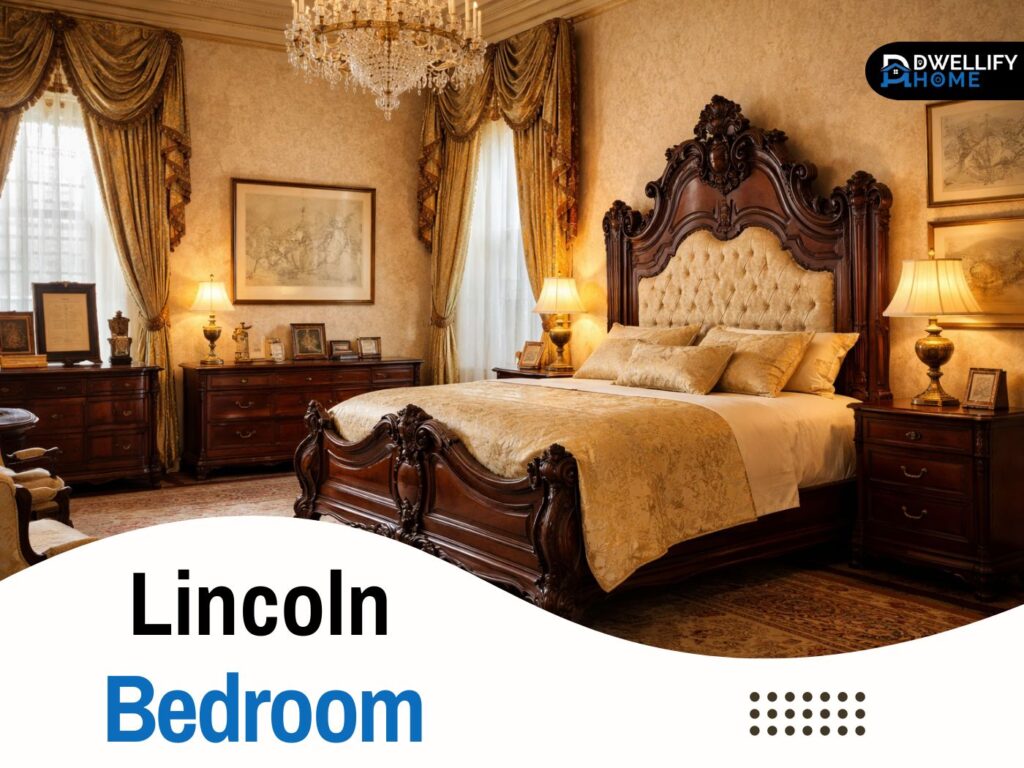
The interior aims to evoke the 1860s through classic forms, darker woods, and rich textures. The choices are intentional. You’ll see traditional silhouettes, historical references, and a sense of ceremony.
When I design a Lincoln-inspired bedroom for a homeowner, I start the same way. We choose the foundation first.
- A classic bed shape with a strong headboard
- Wood tones that feel deep and grounded
- Lighting that’s warm and flattering
- Fabrics that look tailored, not flimsy
Get those right, and the room naturally feels traditional without trying too hard.
The standout items people search for (documents, paintings, and meaning)
The space is known for historical objects and decor elements that reference Lincoln’s era. It’s not just decorative for decoration’s sake. The objects are part of the story.
In a home, you can translate that idea without copying it literally. Pick one or two pieces that feel meaningful and “anchored.”
Good options that work in most traditional bedrooms:
- A framed historical style print or a classic landscape
- A simple wood-framed mirror with depth
- A single heirloom item on a dresser, not a shelf full of trinkets
Traditional rooms feel expensive when they’re edited.
The Lincoln Bed (the most searched detail, and the most misunderstood)
Who bought it and why it’s called the “Lincoln Bed”
The famous bed associated with the suite is a large, formal piece tied to the Lincoln era, with Mary Todd Lincoln often credited for purchasing significant furnishings during that time.
That association helped the bed become iconic. It feels ceremonial, almost like furniture with a title.
The truth about whether Lincoln used it
Even though the bed is strongly linked to the Lincoln story, Lincoln did not sleep in the room that now carries his name.
Now let me translate this into practical design advice, because this is where homeowners often overthink it.
A Lincoln-style bed for a real home is not about copying a specific museum piece. It’s about characteristics:
- Solid wood or a high-quality wood veneer, never hollow or lightweight
- A headboard that has presence, but suits your ceiling height
- Traditional details like paneling, gentle curves, or carved edges
- A finish that reads as walnut, mahogany, cherry, or deep espresso
If your room is small, you can still do this. The trick is choosing a simpler frame with traditional proportions and letting the nightstands and lighting carry the “Lincoln” tone.
What is the Lincoln Bedroom used for today?
How the guest-suite tradition works (high-level, non-gossipy)
Today the suite functions as a guest space, used when the White House hosts certain visitors. It’s part tradition, part protocol, and part practical hospitality.
If you’re setting up a guest bedroom with this vibe, borrow the mindset. A traditional guest room should feel cared for.
Here’s what I prioritize in real homes:
- A comfortable mattress and supportive pillows first
- Blackout or lined curtains second
- Soft, warm bedside lighting third
- Storage and surfaces that make guests feel settled
A beautiful room is nice, but a comfortable room is remembered.
Can the public visit the Lincoln Bedroom?
What visitors can and cannot see on typical White House access routes (and what to do instead)
The public White House tour typically focuses on the State Floor and public rooms, not the private residence where this suite is located. So most visitors won’t see it in person through standard access.
What you can do instead is lean on reputable historical resources, official tour information, and museum-quality guides that explain the residence layout and how these rooms are used.
It’s a bit like touring a historic mansion. You often see the formal spaces, while private upstairs rooms stay private.
Lincoln Bedroom scandal (explained clearly and neutrally)
What the “Lincoln Bedroom for contributors” controversy was about
In the 1990s, the room became part of a political controversy involving allegations about overnight stays and fundraising. That period is often summarized as the Lincoln Bedroom scandal.
It’s important to discuss this carefully, without sensational language. The core reason it still gets referenced is because the suite became a symbol of access and privilege, not because of the furniture itself.
Why it still matters (ethics, perception, and why the keyword keeps trending)
This topic comes up because it connects history, politics, and public trust. When historic spaces get pulled into modern controversy, people remember the setting.
From a design standpoint, there’s a simple lesson here. When a room carries strong symbolism, less is more. You don’t need to over-style it. You build a strong foundation and keep the accessories minimal and intentional.
Lincoln Bedroom bathroom / Lincoln Bath (why people suddenly searched it)
What “Lincoln Bathroom” refers to (location and context)
The term Lincoln Bath generally refers to the bathroom connected to the Lincoln Suite area, associated with the guest suite setup.
In older historic homes, ensuite bathrooms are often updated later, and that creates tension between preservation and modern comfort. The White House faces the same basic challenge, just on a much bigger stage.
The 2025 renovation news and the preservation debate (what’s reported)
Recent reporting has discussed changes to the suite’s bathroom finishes and materials, sparking debate about preservation choices and how historic spaces should be updated.
For your home, this is a practical opportunity. A Lincoln-inspired bathroom look can be classic without being fragile.
My go-to formula:
- Stone look tile or marble look porcelain for durability
- Traditional brushed metal hardware
- A wood vanity in a deep stain
- Warm, soft lighting that flatters skin tones
- One framed mirror with a substantial frame
It ends up looking timeless, and it’s easy to live with.
Lincoln Bedroom Trump and modern headlines (what’s verifiable vs. viral)
How modern presidents/teams reshape the residence, and how to evaluate claims responsibly
Modern headlines sometimes attach a President’s name to design changes in the White House residence. That’s why phrases like Lincoln Bedroom Trump appear in conversation.
The calm way to handle this is to separate verified reporting from viral chatter. Look for clear dates, credible sources, and consistent details across multiple reports.
In home design, we do something similar. We don’t redesign based on one dramatic photo or one trend clip. We look for the full context, then make choices that will still look good five years from now.
Lincoln Bedroom haunted? Ghost stories, sightings, and what history sources actually say
Why Lincoln is the White House’s most famous “ghost” (origin of the stories)
This suite is tied to some of the most famous White House ghost lore, with Lincoln often named as the best-known figure in those stories.
It makes sense, honestly. Big historical weight plus an old building plus a room tied to wartime decisions creates the perfect setting for legends.
A balanced view: folklore vs. documented history
It’s fine to enjoy ghost stories as folklore, but it’s also healthy to label them properly. Legends aren’t the same thing as documented history.
If you want your bedroom to feel Lincoln-inspired, focus on calm authority, not spooky vibes. Rich wood, tailored bedding, and warm lamplight already create a strong atmosphere without leaning on theatrics.
Common confusion to clear up
Lincoln Bedroom vs. Lincoln’s actual sleeping arrangements (why people mix it up)
The confusion happens because the name sounds literal. Most people assume it was Lincoln’s personal bedroom, but historically he used the space as a working office and Cabinet Room.
Once you understand that, everything else clicks. The room is named to honor Lincoln and to hold Lincoln-era furnishings, not because it was his sleeping space.
Lincoln Bed vs. Lincoln slept here (the myth in one paragraph)
A historically associated bed can exist in a room, and the room can carry an honorary name, without the person ever sleeping there. That’s the myth in one sentence.
This is also why I tell homeowners not to chase trivia. Build the look with materials and balance, and you’ll get a more authentic result than trying to copy a rumor.
FAQs
Why is the Lincoln Bedroom so famous?
It’s famous because the room has deep Lincoln-era historical significance and was later curated with Lincoln-era furnishings and artifacts, making it one of the most talked-about suites in the White House.
Does the Lincoln Bedroom still exist?
Yes. It remains part of the White House private residence and is maintained as a historic guest suite within the Lincoln Suite.
Does the president live in the Lincoln Bedroom?
Not as a permanent living space. It’s primarily treated as a guest suite within the private residence, used when appropriate for visitors.
How did the Lincoln Bedroom get its name?
The name became official in the Truman era when the room was intentionally furnished with Lincoln-era pieces and positioned as a Lincoln-themed suite.
Can the public visit the Lincoln Bedroom?
Typically, no. Standard public tours focus on public rooms, while the Lincoln Suite sits in the private residence area.
Conclusion: Lincoln Bedroom, its real legacy, why it’s still searched, and what to remember
Let’s wrap this up in a way that’s actually useful.
The room’s legacy is real. It’s famous because of what it represents and the decisions tied to it, not because Lincoln slept there. Once you separate the facts from the myth, the whole story becomes clearer and more interesting.
And if you’re trying to create a Lincoln-inspired bedroom at home, keep it grounded. Choose solid wood tones, classic shapes, warm lighting, and tailored textiles. Then stop. Don’t overdo the accessories. The calm, traditional balance is what makes the style feel confident.
If you want, tell me your room size and whether it’s a master or guest room. I’ll map out a realistic furniture plan with bed scale, nightstand width, dresser placement, finishes, and lighting, so you can build the look without wasting money or overcrowding the room.
Disclaimer:
This article is for general informational and educational purposes. Historical details are summarized from reputable references, and design tips are general guidance, not a substitute for personalized professional advice or official White House communications.

I’m Bilal, the founder of Dwellify Home. With 6 years of practical experience in home remodeling, interior design, and décor consulting, I help people transform their spaces with simple, effective, and affordable ideas. I specialize in offering real-world tips, step-by-step guides, and product recommendations that make home improvement easier and more enjoyable. My mission is to empower homeowners and renters to create functional, beautiful spaces—one thoughtful update at a time.