Choosing a bedroom size isn’t just about copying a number you saw online. I’ve planned and furnished master bedrooms for more than 15 years, and I can tell you this with confidence, the “right” size is the one that fits your bed, your daily movement, and the way you actually live.
A room can look big on paper and still feel annoying in real life. Maybe the dresser blocks the walkway. Maybe the closet door crashes into the bed corner. Or maybe there’s technically space for a chair, but you’ll never use it because it sits in an awkward spot.
In this guide, I’ll walk you through typical sizes, what’s comfortable, what’s just “technically fits,” and how to plan the whole space like a pro, without making it complicated.
Snippet-Ready Definition:
Master bedroom size usually ranges from 200–400 sq ft, depending on bed size, furniture, and layout. The right size allows easy movement, storage, and comfort, not just space on paper.
Mission Statement:
At Dwellify Home, our mission is to help homeowners make confident, practical decisions through clear guidance, real-world experience, and design advice that actually works in everyday living.
Quick Comparison Table: Master Bedroom Size Guide
| Bedroom Type | Common Size (Feet) | Approx. Area | Best For |
| Small Master Bedroom | 12×14 – 14×14 | ~170–200 sq ft | Queen bed, compact furniture |
| Standard Master Bedroom | 14×16 – 15×15 | ~220–250 sq ft | King bed + dresser |
| Large Master Bedroom | 16×18 – 18×20 | ~290–360 sq ft | Seating area + storage |
| Luxury Master Bedroom | 20×20+ | 400+ sq ft | Full suite feel, lounge space |
Pro tip: Comfort depends more on walking space and furniture layout than total square footage.
Simple Step-by-Step: How to Choose the Right Master Bedroom Size
- Decide your bed size first (queen or king).
- Add walking space on both sides of the bed.
- Plan where the dresser and closet doors will open.
- Check if you want seating, a desk, or just sleep space.
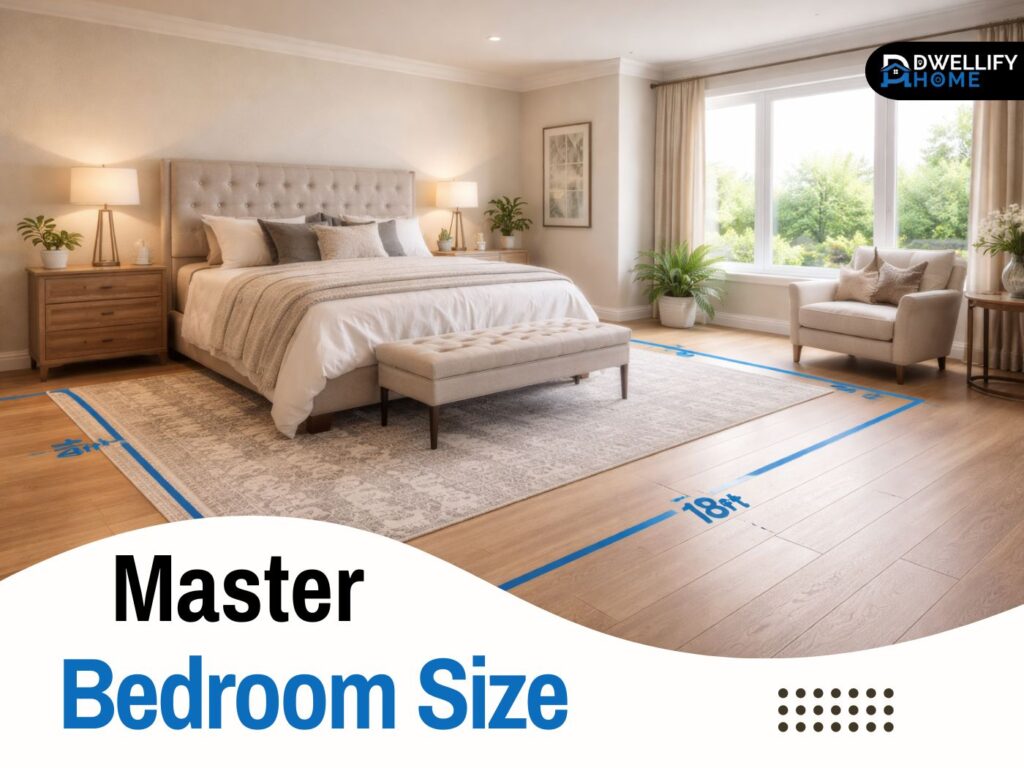
- Tape it out on the floor to test real movement.
Typical Master Bedroom Size Range (What Most People Mean by “Standard”)
When people ask about a typical master bedroom size, they’re usually trying to answer one question: “Will it feel comfortable with a big bed and real furniture?”
In most homes, the master bedroom size often lands somewhere in the 200 to 400 square foot range. That’s a wide span because it depends on whether the room is only for sleeping, or if it’s meant to include extra functions like a sitting area, a large dresser wall, or even a small desk.
From what I see in real floor plans, these are common “everyday” dimensions:
- 14×14 ft (often the smaller end for a primary bedroom)
- 14×16 ft (very common and workable)
- 15×15 ft (a popular balance)
- 16×18 ft (more comfortable with larger furniture)
- 18×20 ft (starts feeling like a true suite)
And guess what? A lot of frustration comes from confusing “bed fits” with “room works.” That’s why the next sections matter.
Average Master Bedroom Size by Home Type (Small to Luxury)
Small Homes
In smaller homes, you’ll often see master bedrooms around 200 sq ft, sometimes close to 14×14 ft. If the layout is clean, this can feel perfectly fine.
The key in a smaller master is not overloading the room. I usually recommend:
- A bed with slimmer frames
- Nightstands that don’t stick out too far
- A dresser that isn’t too deep
Small rooms can feel cozy and calm when circulation is respected. If you squeeze in too much, it’ll feel like you’re living around furniture instead of living in the room.
Standard Homes
In many standard homes, the average master bedroom size is closer to 200–350 sq ft. This range gives you breathing room for a king bed, two nightstands, and a dresser without constant bumping.
This is where you start seeing nice extras like:
- A bench at the foot of the bed
- A single accent chair
- Bigger dressers and wider walk paths
Large and Luxury Homes
Once the bedroom gets into the 350–500+ sq ft territory, you can create zones more comfortably. At 400–600+ sq ft, you’re often looking at a true “suite feel”, especially when closet and bathroom space is nearby.
But I’ll be honest: bigger isn’t always better. I’ve seen massive rooms that feel empty and awkward because the furniture isn’t scaled properly. If you go large, plan the layout intentionally so the space feels warm, not hollow.
Minimum vs Comfortable Sizing (The Walking Space Rule)
Here’s the thing most people don’t plan for: you don’t experience a room by its area. You experience it by how easily you can move around the bed, open drawers, and walk without turning sideways.
A room can be “big enough” but still feel tight if the clearances are wrong.
Clearance Around the Bed (What Feels Tight vs Easy)
In real homes, the most important clearances are:
- Along both sides of the bed
- At the foot of the bed
- Near door swings and closet access
If you’re planning for a king bed, you want enough space so two people can walk comfortably, not squeeze past each other.
A good rule I use in design consults is simple:
- If you can walk past the bed without twisting your shoulders, it’s comfortable.
- If you have to “slide” past furniture, the room will get old fast.
Also, don’t forget drawers. A dresser can “fit” on a wall, but if the drawers hit the bed clearance, it becomes a daily irritation.
Bed Size Matters (King vs Queen Changes Everything)
A king bed is often the dream. But if the room is tight, it turns into a constant compromise.
Most homeowners I work with assume the bed is the only factor. On top of that, they forget nightstands, lamps, wall outlets, and the simple act of making the bed.
A quick practical approach:
- If you’re working with a smaller master, a queen may give you a calmer, more functional room.
- If you want a king, you need to respect walking space and furniture depth.
This is why people search things like master bedroom size in feet. They’re trying to picture real dimensions, not vague “small/large” labels.
Master Bedroom Size in Feet, Meters, CM, and MM (Easy Conversion Guide)
If you’re comparing floor plans, builders, or international listings, conversions help.
Here’s a simple way to think about master bedroom size meters, master bedroom size in cm, and even master bedroom size in mm without getting overwhelmed.
Common examples:
- 14×14 ft ≈ 4.27×4.27 m
- 14×16 ft ≈ 4.27×4.88 m
- 15×15 ft ≈ 4.57×4.57 m
- 16×18 ft ≈ 4.88×5.49 m
Quick tip from real projects: when you’re measuring in cm, focus on clearances, not just the overall room size. Even a 20–30 cm difference near the bed can change how the space feels.
Furniture Fit Checklist (What You’re Really Trying to Fit)
This is where good planning becomes real. In most bedrooms, you’re not just placing a bed. You’re building a daily flow.
The core furniture set usually includes:
- Bed (queen/king)
- Two nightstands
- Dresser or wardrobe
- Mirror or getting-ready zone
Optional but common:
- Bench at foot of bed
- Chair in a corner
- Small vanity or compact desk
Here’s the best part: if you choose furniture based on the room, not your wishlist, the room instantly feels more expensive and more comfortable.
A personal rule I use: don’t buy the dresser first. Map the bed location first. The bed decides everything.
Layout Planning That Makes Any Size Feel Bigger (Practical, Not Fluffy)
A good layout can make a smaller master feel calm and spacious. A bad layout can make a large room feel frustrating.
Create Zones (Even in a Smaller Room)
I like to divide the room into simple zones:
- Sleep zone: bed + nightstands
- Storage zone: dresser/wardrobe
- Getting-ready zone: mirror, lighting, maybe a small vanity
- Optional sitting zone: chair or small loveseat if space allows
If the dresser blocks your walkway, the room will always feel cramped. But if you place it where the drawers open freely and you can still walk, the room feels instantly smoother.
Master Bedroom Size With Attached Bathroom (Ensuite Planning)
A lot of people search master bedroom size with attached bathroom because the bedroom alone doesn’t tell the full story.
If your bedroom connects directly to an ensuite, you need to plan the suite like one system:
- Bedroom comfort
- Bathroom access
- Door swings
- Morning traffic
And yes, master bedroom size with attached bathroom in feet matters because it changes furniture placement. If the bath door cuts through your best dresser wall, you’ll feel it every day.
Practical insight: pocket doors or smart door placement can save a surprising amount of usable wall space.
Master Bedroom Size With Walk-In Closet (What “Walk-In” Actually Requires)
The phrase master bedroom size with walk in closet sounds simple. But closets have one big issue: aisle space.
I’ve seen “walk-in closets” that technically allow you to walk in, but only if you turn sideways. That’s not a walk-in, that’s a tight corridor with hangers.
A walk-in closet works best when:
- You can step in and see what you own
- You can open drawers without bumping
- You can turn comfortably
Also, closet doors matter. Sliding doors and pocket doors often improve flow, especially in mid-size homes.
Master Bedroom Size With Attached Bathroom + Walk-In Closet (The Master Suite Math)
This is where many homeowners get confused. They focus on bedroom size, but the “suite” total is what affects comfort.
If you have a bedroom plus ensuite plus closet, the layout needs to support:
- Easy movement from bed to bath
- Closet access without crossing the room awkwardly
- A logical wall for dresser placement
Here’s the thing: sometimes a slightly smaller bedroom works better when the closet and bath are planned well. I’d rather have a calm 15×15 bedroom with a smart suite layout than a larger bedroom with awkward traffic paths.
Common suite mistakes I see:
- Bath door opening into a tight bed clearance
- Closet entry placed where a dresser should go
- Too many doors in one corner creating wasted space
Proportion Rules (How Big Should It Be Compared to the Whole House?)
A master bedroom should feel special, but it should still make sense in the overall layout.
If the primary bedroom is huge and the living area feels cramped, the home will feel unbalanced. On the flip side, if the bedroom is tiny compared to everything else, it won’t feel like a true primary space.
A simple proportion mindset:
- The bedroom should feel like a “retreat”
- But it shouldn’t steal function from the rest of the home
If you want the “suite feel,” sometimes it’s better to invest in closet and bathroom design rather than chasing extra bedroom square footage.
Modern vs Older Homes (Why Typical Sizes Vary)
This is a big reason why people get confused when searching for “standard” sizes.
Older homes often have:
- Smaller bedrooms
- Smaller closets
- Less focus on ensuite bathrooms
Modern homes often prioritize:
- Bigger master suites
- Walk-in closets
- Larger bathrooms and double vanities
So when you compare your home to an online “typical” number, remember that era and floor plan style changes the story.
Accessibility and Real-Life Comfort (Uncommon but High-Value)
Even if you’re not planning for accessibility right now, designing with comfort and ease is smart.
A room that works well long-term usually has:
- Wider walk paths
- Space to move around furniture easily
- A layout that doesn’t require squeezing past corners
This also helps with everyday life. Carrying laundry, changing sheets, moving a chair, even vacuuming, all of it is easier when the room isn’t planned too tightly.
Common Master Bedroom Sizing Mistakes (And How to Avoid Them)
I’ve seen these mistakes over and over, even in expensive homes:
- Picking the size before planning furniture
- Ignoring door swings (especially closet and bathroom doors)
- Oversizing the room but undersizing storage
- Putting the dresser where drawers can’t open fully
- Trying to force a king bed into a room that’s better suited for a queen
If you fix just one thing, fix the circulation. A bedroom that flows well feels bigger than one that doesn’t.
Quick Sizing Checklist Before You Build, Remodel, or Buy
Before you commit, do this. It’s simple and it works.
- Measure your bed and nightstands
- Measure your dresser depth
- Tape the bed footprint on the floor (painter’s tape is perfect)
- Walk around it like it’s real life
- Check door swings and drawer openings
If you’re planning from a floor plan, sketch furniture to scale. You don’t need fancy tools. You just need a realistic layout.
FAQs
What is a good size for a master bedroom?
A good master bedroom size is usually 200–300 sq ft. This comfortably fits a king bed, nightstands, and a dresser with proper walking space.
Is a 12×12 room small?
Yes, 12×12 ft (144 sq ft) is small for a master bedroom. It works better as a guest room or with a queen bed and minimal furniture.
Is a 15×15 bedroom big?
Yes, 15×15 ft (225 sq ft) is a solid, comfortable master bedroom size. It fits a king bed and standard furniture without feeling tight.
Is 7 feet too narrow for a bedroom?
Yes. 7 feet is generally too narrow for a bedroom. Most codes and comfort standards require at least 8–10 feet for proper movement and furniture use.
Conclusion
At the end of the day, the best master bedroom size isn’t a perfect number. It’s a space that feels good when you wake up, move around, and live in it every day.
If you remember one thing, remember this: plan the bed first, protect your walking space, and let the furniture guide the layout. That’s how you get a room that feels calm and comfortable, whether it’s 200 square feet or 400.
And if you’re choosing between slightly bigger space and a smarter layout, go with the smarter layout. That’s what makes a master bedroom feel like a true retreat.
Disclaimer:
This article is for general informational purposes only. Bedroom size needs may vary based on local building codes, personal preferences, and home layout. Always verify measurements before construction or renovation.

I’m Bilal, the founder of Dwellify Home. With 6 years of practical experience in home remodeling, interior design, and décor consulting, I help people transform their spaces with simple, effective, and affordable ideas. I specialize in offering real-world tips, step-by-step guides, and product recommendations that make home improvement easier and more enjoyable. My mission is to empower homeowners and renters to create functional, beautiful spaces—one thoughtful update at a time.