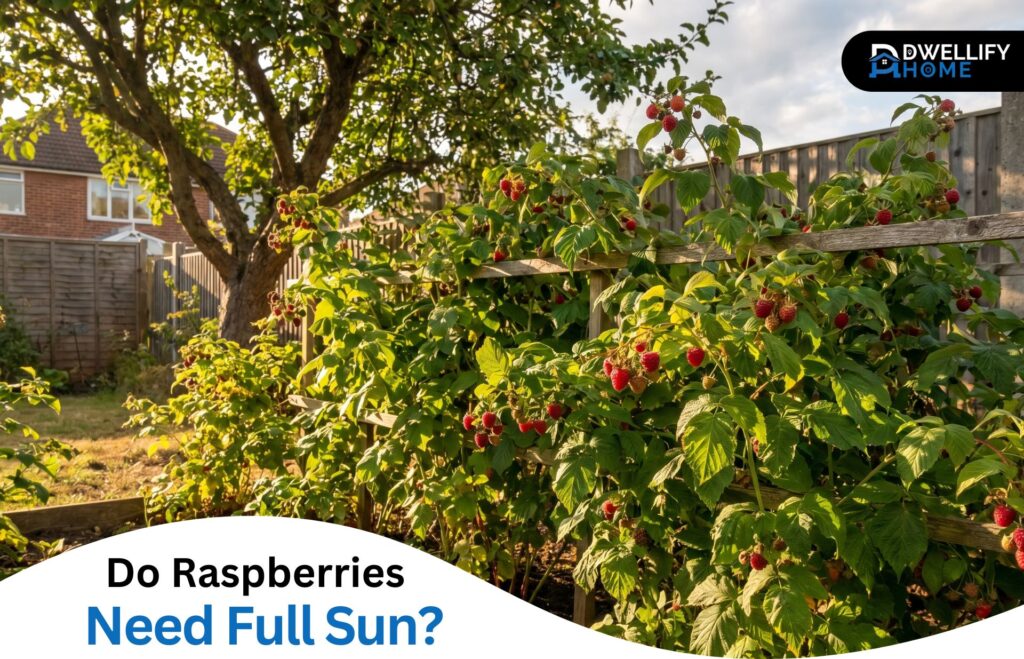
Most gardeners who come to me with struggling raspberry plants have one thing in common — they picked a spot that looked sunny enough in early spring and called it a day. By July, the canes are tall and healthy-looking, but the harvest is thin, the berries are small, and the flavor is flat. Light is almost always the reason.
Raspberries are forgiving in many ways. They’ll survive poor soil with a little help, bounce back from a cold snap, and keep producing for years with minimal fuss. But sunlight is the one thing they genuinely won’t compromise on. Get that part right, and everything else becomes much easier.
Snippet-Ready Definition
Raspberries need full sun — at least 6 to 8 hours of direct sunlight daily — to produce the best fruit yield and flavor. Insufficient light reduces berry production, lowers sweetness, and increases the risk of fungal disease on canes.
Mission Statement
At Dwellify Home, we help homeowners make practical, well-informed decisions — whether it’s designing a living space, planning a garden, or choosing what grows best in their backyard. Our goal is straightforward: give you clear, honest guidance so every decision you make at home feels confident and considered.
Do Raspberries Need Full Sun? Here’s the Direct Answer
Yes, raspberries need full sun to produce their best harvest. Full sun means at least 6 to 8 hours of direct sunlight per day. They can survive in partial shade, but reduced light directly lowers fruit yield, berry sweetness, and plant health. In hot climates, some afternoon shade is actually beneficial to prevent sunscald damage.
Quick Sunlight Reference Guide for Raspberry Growers
| Light Condition | Daily Sun Hours | Expected Outcome |
| Full Sun | 6–8+ hours | Best yield, sweetest berries, lowest disease risk |
| Partial Sun | 4–6 hours | Reduced yield, lower sugar content, acceptable crop |
| Partial Shade | 2–4 hours | Sparse fruit, flat flavor, higher fungal risk |
| Full Shade | Under 2 hours | Little to no fruit production |
| Hot Climate (afternoon shade) | 5–6 hrs morning sun | Protects against sunscald, maintains quality |
Key Points to Know Before You Plant
- Raspberries need a minimum of 6 hours of direct sunlight per day — 8 hours produces noticeably better results
- Sunlight hours don’t need to be consecutive; split morning and afternoon exposure counts toward the daily total
- Reduced light doesn’t just lower yield — it directly reduces berry sweetness by limiting sugar production
- Black raspberry varieties tolerate partial shade better than red varieties
- In hot climates (Florida, Gulf Coast, deep South), afternoon shade prevents sunscald and protects harvest quality
- A trellis system maximizes light exposure across all canes — untrained canes shade each other significantly
- Everbearing varieties still need adequate fall sun to ripen their second-season crop
What “Full Sun” Actually Means for Raspberry Plants
The term “full sun” gets thrown around a lot in gardening, but it’s worth being specific here because a lot of people misread it.
How Many Hours of Sun Do Raspberries Need Each Day?
Raspberry plants need a minimum of 6 hours of direct sunlight per day to grow and fruit properly. Eight hours is better. When you consistently hit that 8-hour mark, you’ll notice bigger berries, more of them, and noticeably better flavor. The 6-hour minimum is where you can still get a decent crop — but you’re leaving yield on the table.
This applies across USDA hardiness zones 3 through 10, which covers most of the country. The specific variety matters for cold hardiness, but the light requirement stays essentially the same regardless of where you garden.
Does Sunlight Have to Be Consecutive — or Can It Be Split Through the Day?
This is a question I hear often, and the answer genuinely surprises people. The 6 to 8 hours don’t have to be a solid, uninterrupted block. A spot that gets 3 to 4 hours of strong morning sun, a couple of hours of midday shade, and then full afternoon light again can absolutely work.
What matters is the total daily exposure and the quality of that light. Weak, filtered light through tree canopy doesn’t count the same way direct sun does. But split direct sun exposure? That works just fine for raspberries.
How Sunlight Affects Raspberry Yield, Sweetness, and Plant Health
Understanding why light matters — not just that it does — makes you a much better grower. It changes how you troubleshoot problems and how you evaluate a planting site.
Less Light Means Fewer Berries — This Is Why
Raspberries rely on photosynthesis to build the energy reserves needed to flower, pollinate, and set fruit. Less sunlight means less photosynthetic activity, which means the plant simply doesn’t have enough stored energy to support a heavy crop.
You’ll often see plenty of green growth in shaded plants. The canes look fine. But come harvest time, the fruit production is noticeably sparse. The plant is surviving — it’s just not thriving enough to produce the way you want.
What Shade Does to Berry Flavor and Sugar Content
This is one of the details that rarely gets explained clearly. Sunlight drives sugar production inside the berry. When a raspberry doesn’t get enough direct light, photosynthesis slows, and less sugar accumulates in the fruit.
The result is berries that look normal but taste noticeably flat — slightly tart, watery, and missing that deep sweetness you expect from a good homegrown raspberry. It’s not a soil problem, not a watering problem. It’s a light problem showing up in the flavor.
Why Sunlight Also Protects Raspberries from Fungal Disease
Sunlight does something else that’s easy to overlook — it dries the foliage. Raspberry canes that sit in damp, shaded conditions for extended periods become much more vulnerable to fungal diseases like botrytis and cane blight.
When plants get strong direct sun, moisture on the leaves and canes evaporates quickly. That drying effect is a natural disease barrier. I’ve watched side-by-side plantings in the same garden where the shadier row dealt with gray mold season after season while the sunny row stayed clean. Light wasn’t the only variable, but it was the biggest one.
Can Raspberries Grow in Partial Shade?
Raspberries can grow in partial shade and will still produce fruit — but the results will be noticeably reduced compared to a full-sun planting. Expect lower yields, smaller berries, and less sweetness. For most home growers, it’s workable if no better spot is available. In hot climates, some afternoon shade is actually recommended.
What You Can Realistically Expect from a Less-Sunny Spot
A partially shaded raspberry patch isn’t a total loss. You’ll still get fruit, and in some cases a decent amount of it — especially with the right variety. But you should go in with realistic expectations.
Yields will typically be lower, the harvest window may be shorter, and the flavor won’t match what you’d get from a sunnier site. Think of it as getting maybe 60 to 70 percent of the performance you’d see in full sun.
Raspberry Varieties That Tolerate Less Sun Better Than Others
Not all raspberries respond equally to reduced light. Black raspberries are generally more shade-tolerant than red varieties — in the wild, they naturally grow at forest edges where light is dappled. If you’re working with a partially shaded spot, black varieties tend to handle it with less of a yield penalty.
Among red varieties, Boyne, Heritage, and September have a reasonable reputation for performing in less-than-ideal light conditions. They won’t match their full-sun output, but they hold up better than more sun-hungry cultivars.
When Partial Shade Is Actually the Right Choice
In climates with genuinely hot summers — think the deep South, parts of Texas, or areas where July and August temperatures regularly push past 95°F — a spot with afternoon shade can actually outperform a full-sun position.
That afternoon shade prevents the fruit from overheating during the hottest part of the day. You sacrifice a little yield in exchange for protecting berry quality and reducing sunscald risk. In those conditions, morning sun plus afternoon shade is often the better setup.
Can Raspberries Get Too Much Sun?
What Is Sunscald and How Do You Recognize It?
Sunscald happens when raspberries are exposed to intense heat and strong direct sunlight — particularly during hot, dry periods. Affected berries develop white or pale patches, usually on the side facing the sun. The texture turns soft and mushy in those areas, and the flavor deteriorates.
It doesn’t affect every berry on the plant, but on a badly placed bush in the wrong climate, it can ruin a significant portion of your harvest. High elevations are also prone to sunscald because UV intensity is higher even when temperatures feel moderate.
Hot Climates and Afternoon Shade — When Less Sun Is the Smarter Play
For gardeners in Florida, the Gulf Coast, or any region with intense summer heat, the full-sun rule needs a qualifier. Morning sun from roughly 6 a.m. to early afternoon is ideal. After that, some protection — from a taller plant, a structure, or natural shade — keeps the berries from taking the full force of peak-heat sun.
This doesn’t mean planting in shade. It means being strategic about which direction your patch faces and what natural shade resources your yard already provides.
Do Raspberries Need Full Sun in the Fall?
Yes, fall sun still matters — especially for everbearing varieties. Everbearing raspberries (also called fall-bearing or primocane-fruiting types) produce their second crop in late summer and autumn, and they need consistent direct light to ripen that fall harvest properly.
The challenge is that by September and October, the sun sits lower in the sky. Shadows from fences, walls, and trees that barely touched your patch in July can now cover it for several hours of the day. A spot that gets 7 hours of sun in June might get only 4 to 5 hours by late September.
If you’re growing everbearing varieties specifically for that fall crop, factor seasonal sun-angle changes into your site selection. It makes a real difference in whether that second harvest is worth picking.
How to Choose the Right Spot for Your Raspberry Plants
How to Track Your Yard’s Sunlight Before You Plant
The most reliable method is also the simplest: go outside every 2 hours on a sunny day and note which areas are in direct sun and which are shaded. Do this in both spring and midsummer if you can, because they’ll look different.
There are also sun-tracking apps that use your phone’s GPS to estimate daily sun exposure at a given location. They’re not perfectly precise, but they’re a useful starting point before you commit to digging.
The Tree Leafout Trap — A Mistake Many First-Time Growers Make
This one catches a lot of people. In early spring, before nearby deciduous trees have fully leafed out, a spot can look like it gets excellent sun. Then by May or June, those trees fill in and suddenly your raspberry patch is getting two or three fewer hours of direct light than it did when you planted.
Always assess a planting site in full summer leaf, not in March or early April. What you see in late spring is what you’ll be working with all season.
Morning Sun vs. Afternoon Sun — Which Is Better for Raspberries?
Morning sun is generally preferred for two reasons. First, it starts photosynthesis early in the day when temperatures are still cool. Second, morning sun dries dew off the leaves and canes quickly, reducing the damp conditions that fungal diseases favor.
That said, a spot with primarily afternoon sun can still work well. The key is hitting that 6 to 8 hour daily total. Don’t turn down a solid afternoon-sun position just because it doesn’t catch the morning light.
Walls, Fences, and Reflected Heat — What to Watch For
South-facing walls and light-colored fences can reflect and amplify heat significantly. In cool climates, this is actually an asset — planting along a south-facing wall gives raspberries extra warmth and an extended season.
In warmer climates, that same setup can push temperatures past what raspberries handle well. If you’re in a hot region and your best sunny spot is directly against a sun-exposed wall, consider whether the reflected heat will create sunscald conditions even with adequate airflow.
Growing Raspberries in Pots — Do Sunlight Rules Still Apply?
How Much Sun Do Container Raspberries Need?
The sunlight requirement doesn’t change in a pot. Container-grown raspberries still need 6 to 8 hours of direct light per day to produce fruit well. What changes is your ability to deliver it.
Use a large container — at least 15 to 20 gallons — and choose a compact variety suited for pot growing. The smaller root zone means the plant dries out faster, so you’ll need to water more consistently. The best soil for raspberries in pots is a well-draining mix with added compost, not standard potting mix alone.
Using Pot Mobility to Chase the Best Light in Your Garden
The real advantage of growing raspberries in pots is that you can move them. If your patio gets morning sun on one side and afternoon sun on the other, you can rotate the pot to maximize daily exposure.
This also lets you pull the plant into partial shade during an extreme heat event and move it back out when temperatures drop. It’s a level of control you simply don’t have with in-ground plants.
Do Raspberries and Blackberries Need the Same Amount of Sun?
Not exactly. Both perform best in full sun, but blackberries are generally more tolerant of reduced light than raspberries. Blackberries can produce a reasonable crop with as little as 4 to 5 hours of direct sun, though full sun always produces better results.
If you’re working with a yard that has more shade than sun, blackberries are the more forgiving starting point. Gooseberries and currants go even further — they’re genuinely productive in partial shade and are worth considering for north-facing beds or spots that get filtered light most of the day.
Does a Trellis System Affect How Much Sun Your Raspberries Get?
More than most people realize. Raspberry canes left to flop and lean against each other create a tangled mass where the inner canes get almost no direct light. The outer canes catch the sun, but the interior of the plant stays shaded all season.
A simple post-and-wire trellis keeps the canes upright and spread out. Each cane gets its own exposure to direct sunlight rather than competing with its neighbors. It’s not just about support — it’s about giving every part of the plant access to the light it needs to produce.
Common Sunlight Mistakes That Cost Raspberry Growers Their Harvest
These are the situations I run into most often:
- Planting against a north-facing fence or wall, where the structure blocks sun for most of the day without the grower realizing it until the first harvest disappoints.
- Choosing a site based on how it looks in March, before nearby trees have leafed out — and losing 3 hours of summer sun to a canopy that didn’t exist at planting time.
- Placing raspberries in the hottest, most exposed south-facing corner of the garden in a climate where summer temperatures regularly exceed 90°F, then wondering why the berries are white and mushy.
- Not accounting for how the sun angle drops in fall, which leaves everbearing varieties in shade during exactly the weeks they need light to ripen their second crop.
- Letting canes overcrowd without a trellis, so the inner canes spend the whole season shaded by the outer ones.
Every one of these is avoidable with a little attention before planting rather than troubleshooting after.
Frequently Asked Questions
Can raspberries grow in full shade?
Raspberries can survive in full shade, but they will produce very little fruit. Without adequate sunlight, photosynthesis is insufficient for the plant to set and ripen berries. What fruit does appear will be sparse, small, and low in sugar. For meaningful harvests, a minimum of 6 hours of direct sunlight is necessary.
How many hours of sun do raspberries need per day?
Raspberries need a minimum of 6 hours of direct sunlight each day. Eight hours produces the best results in terms of yield, berry size, and flavor. The hours don’t need to be consecutive — split morning and afternoon sun exposure adds up effectively as long as the total daily light is sufficient.
Do raspberries need full sun in Florida?
In Florida and other hot, humid climates, raspberries benefit from full morning sun combined with some afternoon shade during the hottest months. Unfiltered afternoon sun in peak summer can cause sunscald, turning berries white and mushy. Heat-tolerant varieties adapted to southern climates perform best in these conditions.
Will raspberries fruit with only morning sun?
Yes, raspberries can fruit with morning-only sun as long as the total daily exposure reaches 6 hours. Morning sun is actually preferred by many growers because it dries the foliage quickly and reduces fungal disease risk. A full day of morning sun exposure typically provides both the light quantity and quality raspberries need.
Can I grow raspberries indoors or in a greenhouse?
Indoor growing without supplemental lighting doesn’t provide enough light intensity for productive raspberries. In a greenhouse positioned in full sun, raspberries can do well — they don’t typically need additional artificial light in a well-sited greenhouse. The greenhouse must face a direction that captures direct sunlight for most of the day.
Do raspberries grow on bushes or canes?
Raspberries grow on canes, not woody shrubs or bushes. The plant has a perennial root system, but the canes themselves are biennial — they grow in year one and produce fruit in year two, then die. New canes replace them each season. The plant looks like a bush when mature, but it’s technically a cane-producing bramble.
What happens to raspberry plants that don’t get enough sunlight?
Plants in insufficient light will grow tall and green but produce minimal fruit. What berries do develop will be smaller than normal, lower in sugar, and more prone to fungal issues. Over time, shaded plants become weaker, more disease-prone, and less productive with each passing season.
Where should you not plant raspberries?
Avoid spots with less than 6 hours of direct sun, poor drainage, or heavy clay soil. Don’t plant near tomatoes, peppers, or eggplants — these harbor verticillium wilt, which transfers to raspberries. Also avoid positions directly against south-facing walls in hot climates, where reflected heat causes sunscald.
Do raspberries grow better in pots or in the ground?
In-ground planting generally produces higher yields because roots have more space and consistent moisture access. Pots work well for smaller spaces and offer the advantage of mobility — you can reposition the plant to chase the best light. Use a large container (15–20 gallons minimum) with well-draining soil for container success.
How many years does it take for a raspberry bush to produce fruit?
Most raspberry plants begin producing fruit in their second year after planting. The first year focuses on cane development. Everbearing varieties can produce a small fall crop in their first year on new primocanes, but a full, reliable harvest typically comes from year two onward.
Can raspberries thrive in shade?
Raspberries can survive in shade but won’t thrive in it. Plants in shaded conditions produce significantly less fruit, and what does grow tends to be smaller, less sweet, and more prone to disease. For gardeners with limited sun, black raspberry varieties or alternative brambles like gooseberries handle lower light levels more reliably.
Final Thoughts
The bottom line on whether raspberries need full sun is straightforward: yes, they do — and the closer you get to 8 hours of direct daily light, the better your harvest will be in terms of volume, size, and flavor.
That said, the real skill isn’t just knowing the rule. It’s reading your actual garden carefully — tracking sun through the seasons, watching for the tree that fills in by June, noticing the fence that throws shade across your best spot by mid-afternoon. Raspberries reward gardeners who pay attention to the small details that most planting guides skip over. Get the light right from the start, and these plants will produce reliably for years.
Disclaimer
The content on Dwellify Home is intended for general informational purposes only. Growing conditions, plant performance, and results vary depending on climate, soil type, location, and individual care practices. Always consider your specific environment and, where needed, consult a local horticultural extension service for guidance tailored to your region.