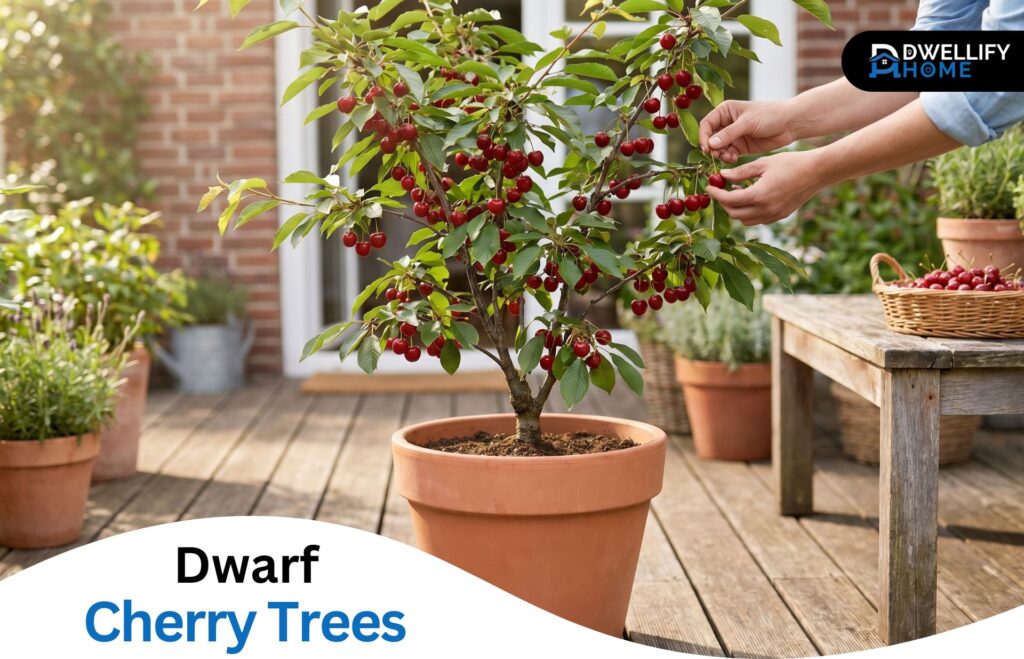
Cherry trees belong in more gardens than most people realize. The assumption that you need a sprawling yard — or a full orchard — has kept a lot of home growers from ever trying, and that’s genuinely a loss. Compact varieties have made fresh, homegrown cherries accessible even on a small patio, a narrow side yard, or a balcony with good sun.
This guide covers everything you need to get it right: how these trees actually work, which varieties suit which spaces and climates, how to plant and care for them correctly, and what realistic fruit production looks like over time. Whether you’re just starting to explore the idea or already standing in a nursery trying to decide, the information here will help you make a confident, well-informed choice.
Snippet-Ready Definition
Dwarf cherry trees are compact fruit trees grafted onto dwarfing rootstock, reaching 8 to 12 feet tall. They suit small gardens and containers, produce fruit within 2 to 3 years, and are significantly easier to prune, net, and harvest than standard trees.
Mission Statement
At Dwellify Home, we help homeowners make practical, well-informed decisions about their living spaces — from the rooms inside to the garden beyond the back door. Every guide we publish is built around real-world usability, honest guidance, and ideas that genuinely work in the spaces most people actually have.
What Is a Dwarf Cherry Tree?
A dwarf cherry tree is a fruit tree kept compact through grafting — a cherry variety joined to a size-controlling rootstock that limits how large the tree grows. The result is a productive fruit tree that tops out at 8 to 12 feet tall rather than the 20 to 30 feet you’d see with a standard variety. Most begin fruiting within 2 to 3 years of planting and produce a full, harvestable crop once established.
How Grafting onto Dwarfing Rootstock Controls Tree Size
The final size of a cherry tree isn’t determined by the cherry variety alone — it’s largely governed by the roots it’s growing on. When nurseries graft a cherry variety (called the scion) onto a dwarfing rootstock, those roots send growth-limiting signals that keep the top of the tree compact.
Gisela 5 and Gisela 6 are the two most widely used dwarfing rootstocks for cherries. Gisela 5 produces a more compact result — typically 50 to 60% of a standard tree’s size. Gisela 6 gives you something slightly larger but still very manageable. On each tree, you’ll notice a visible bump or slight offset near the base of the trunk. That’s the graft union, and understanding where it sits at planting time matters more than most people realize — more on that below.
Dwarf, Semi-Dwarf, and Standard Cherry Trees — How Do They Compare in Size?
Before buying anything, it helps to have a clear size reference:
- Standard cherry tree: 20–30 feet tall
- Semi-dwarf: 12–18 feet
- Dwarf: 8–12 feet
- Extreme dwarf / bush cherry: 4–6 feet
For most home gardens, a dwarf or extreme dwarf variety is the practical choice. A semi-dwarf can still get away from you if it isn’t pruned consistently, and a standard tree in a small garden creates maintenance problems that only grow over time.
Quick Comparison Table — Dwarf Cherry Tree Types at a Glance
| Type | Mature Height | Self-Pollinating | Best For |
| Dwarf Sweet Cherry | 8–12 ft | Varies | Fresh eating |
| Dwarf Sour Cherry | 8–10 ft | Usually yes | Baking, preserves |
| Bush Cherry (Romance series) | 4–8 ft | Yes | Cold climates, containers |
| Extreme Dwarf (Cutie Pie) | 5–6 ft | Yes | Patios, pots |
Key Benefits at a Glance
- Produces fruit 2 to 3 years after planting — faster than standard cherry trees
- Compact enough to net against birds, which protects the entire harvest
- Harvest from ground level without ladders or equipment
- Grows well in containers, making patios and balconies viable growing spaces
- Many varieties are self-pollinating, so a single tree delivers a full crop
- Lower annual pruning and maintenance demands than full-size trees
Why Dwarf Cherry Trees Are Worth Growing in a Small Space
Smaller trees aren’t a compromise in a home garden context — they’re genuinely the better option for most growers. The benefits go well beyond fitting into a tight spot.
The Real Advantages Over Full-Size Cherry Trees
- You can harvest while standing on the ground, no ladders needed, which means less effort and less bruised fruit.
- Netting against birds is straightforward on a tree under 10 feet — and netting matters enormously (more on that in the pest section).
- Pruning is less physically demanding and far easier to do correctly.
- Most dwarf varieties bear fruit 2 to 3 years after planting, compared to 4 to 7 years for standard trees.
- They grow well in containers, which makes patios, balconies, and rooftop spaces viable growing spots.
- Annual maintenance overhead is lower across the board.
Dwarf Cherry Tree vs. Cherry Bush — Which One Is Right for You?
This is a comparison most articles skip over, but it’s worth understanding before you spend money.
A dwarf cherry tree is grafted — a cherry variety joined to dwarfing rootstock, growing with a single trunk like a traditional tree. A cherry bush (such as those in the Saskatchewan Romance series) grows on its own roots as a multi-stemmed shrub. Here’s how they compare directly:
| Feature | Dwarf Cherry Tree | Cherry Bush |
| Form | Single trunk | Multi-stemmed shrub |
| Grafted | Yes | No |
| Mature size | 8–12 ft | 4–10 ft |
| Cold hardiness | Zones 3–7 (varies) | Zone 2+ |
| Self-pollinating | Varies by variety | Usually yes |
| Disease management | Harder — single trunk | Easier — remove infected stems |
| Fruit flavor | Sweet or tart | Sweet-tart |
In very cold climates — zone 3 and below — a bush cherry is often the more reliable option simply because grafted varieties can’t consistently survive those winters. In milder zones, a grafted dwarf cherry tree gives you more variety options and the traditional tree form most growers prefer.
Best Dwarf Cherry Tree Varieties to Grow at Home
Choosing the right variety is where most first-time growers make their biggest mistake — usually by picking something that looks good at the nursery without checking whether it suits their climate or actually fits the space they have.
Top Dwarf Sweet Cherry Tree Varieties
Stella is probably the most widely grown dwarf sweet cherry tree in home gardens. It’s self-pollinating, produces large dark-red fruit with rich flavor, and reaches about 8 to 10 feet at maturity. It’s a reliable choice across zones 5 to 7, and its self-fertile nature makes it ideal for single-tree planting.
Lapins is another self-fertile sweet cherry — large, firm, deep-red fruit that holds up well for fresh eating and resists cracking in wet weather. Slightly more vigorous than Stella but stays very manageable on dwarfing rootstock. Zones 5 to 8.
Black Gold offers excellent flavor with the added practical benefit of crack resistance, which matters in regions with wet summers. Also self-fertile. Zones 4 to 7.
Craig’s Crimson is a naturally semi-dwarf self-fruitful variety producing dark, flavorful cherries. Worth considering if you’re in zone 6 and want a sweet variety with distinctive character.
Top Dwarf Sour Cherry Tree Varieties
North Star is a self-pollinating tart cherry that performs consistently well in cold climates, down to zone 3. It stays compact naturally — typically 8 to 10 feet — and produces plump, dark-red cherries that are excellent for pies, jams, and preserving. One of the most dependable choices for northern gardens.
Montmorency is the most widely grown tart cherry in North America, and the variety behind most commercially produced sour cherry products. On dwarfing rootstock it stays workable, though it can push toward the larger end of dwarf sizing without consistent pruning.
Meteor is a natural dwarf sour cherry that some growers find easier to keep compact than North Star with less aggressive pruning. Good flavor, very cold hardy, and underused in home gardens relative to how well it performs.
The Saskatchewan Romance Series — Compact, Cold-Hardy, and Self-Pollinating
In the late 1990s, researchers at the University of Saskatchewan developed a series of cherry bush varieties that genuinely changed what’s achievable in cold climates. The Romance series — which includes Juliet, Romeo, Carmine Jewel, Wowza, and Cutie Pie — are crosses between sour cherry and Mongolian cherry, growing as multi-stemmed bushes rather than traditional trees.
These varieties are hardy to zone 2, self-pollinating, and produce a sweet-tart fruit that rivals what you’d get from larger trees. Juliet typically reaches 6 to 8 feet; Carmine Jewel stays slightly smaller. Cutie Pie, the most compact of the group, tops out at just 5 to 6 feet and is one of the best options available for patio container growing.
Best Dwarf Cherry Tree Varieties for Containers and Patio Growing
For containers specifically, compact size is the priority. Cutie Pie at 5 to 6 feet is an excellent choice. Stella and Compact Stella both perform reliably in large pots with proper care. Specific container planting guidance follows in the planting section below.
What Dwarf Cherry Trees Need to Grow Well
How Much Sunlight Do Dwarf Cherry Trees Need?
Dwarf cherry trees need a minimum of 6 to 8 hours of direct sunlight every day. This is non-negotiable — without adequate sun, the tree will produce very little fruit even if every other condition is right. Partial shade consistently leads to poor fruit set, weak growth, and a tree that looks fine but never delivers a real harvest. Always choose the sunniest spot available.
Soil Type and the Right pH Level
Well-draining loamy soil with a pH between 6.0 and 6.5 is the target. Cherry roots cannot tolerate standing water — root rot is one of the most common causes of unexplained tree death, and it almost always traces back to soil that holds moisture too long after rain.
In heavy clay soils, work in compost and coarse grit before planting to improve drainage. Raised beds are a practical solution if your native soil drains poorly. This step takes an afternoon but saves years of frustration.
Hardiness Zones — Which Varieties Grow in Your Climate?
- Dwarf sweet cherry trees: zones 4–7
- Dwarf sour cherry trees: zones 3–7
- Saskatchewan Romance series and bush cherries: zone 2+
In marginal zones, late spring frost is a real concern. Cherry trees bloom early, and a frost after flowers have opened can eliminate the entire crop for that year without killing the tree. Varieties known to hold up better under these conditions include North Star, Meteor, and the Romance series.
How to Plant a Dwarf Cherry Tree — Step by Step
When Is the Best Time to Plant?
Bare-root trees should go in the ground in early spring while the tree is still dormant — before any growth begins. Container-grown trees can be planted in spring or early summer, before hot dry weather sets in. Bare-root is generally less expensive and establishes just as well when planted correctly. The trade-off is a narrower planting window that you need to plan around.
How to Choose the Right Planting Spot
Full sun is the first requirement. Beyond that, look for a location with decent air circulation — stagnant air encourages fungal disease and makes pruning-based prevention less effective. Avoid low-lying areas where cold air pools, as these frost pockets can damage spring blossoms.
One detail that surprises many growers: cherry trees can be planted near black walnut trees without issue. Most stone fruits are intolerant of walnut proximity, but cherry is a consistent exception.
Getting the Planting Depth Right — The Graft Union Rule
This is the single most commonly missed planting detail, and getting it wrong can quietly undermine years of growth. On a tree grown on dwarfing rootstock, the graft union — the visible bump or offset near the base of the trunk — must stay above the soil surface after planting.
If the graft union gets buried, the scion starts producing its own roots directly from the soil. Once that happens, the dwarfing effect of the rootstock is bypassed entirely. You’ll end up with a full-size tree that no one recognized as such until it was already 15 feet tall. Plant slightly high rather than deep, and the soil will naturally settle to the right level over the first season.
Spacing Your Dwarf Cherry Trees Correctly
In-ground dwarf trees need 8 to 10 feet between them for proper airflow and canopy development. In tight spaces, 6 feet is workable but requires consistent canopy management. Container-placed trees have full flexibility since they can be repositioned as needed.
How to Grow Dwarf Cherry Trees in Pots and Containers
Start with a 15-gallon container and move up to a 25-gallon as the tree matures. The pot needs proper drainage holes — at least 3 to 5 of them — and a quality potting mix, not garden soil. A mix of loam, perlite, and compost in roughly equal parts works well and drains reliably.
Placing the pot on wheels makes it easy to move for sunlight optimization and to pull it under cover during unexpected late frosts. In winter, container trees need protection — their roots are above ground and far more vulnerable to hard freezes than in-ground trees. An unheated garage or shed works well, or insulate the pot itself with burlap and bubble wrap if moving it isn’t practical.
Pollination — Does a Dwarf Cherry Tree Need a Second Tree?
Many dwarf cherry trees are self-pollinating, meaning a single tree will produce fruit on its own without a companion. However, this varies significantly by variety, and buying the wrong type without checking is one of the most common and costly purchasing mistakes.
Dwarf Cherry Tree Varieties That Pollinate Themselves
These confirmed self-fertile varieties don’t need a second tree:
- North Star
- Stella
- Montmorency
- Juliet
- Romeo
- Carmine Jewel
- Wowza
If you have space for only one tree, start here and you won’t be waiting years for fruit that never comes.
Which Sweet Cherry Varieties Need a Companion Tree?
Most sweet cherry varieties are not self-fertile and require a second compatible tree flowering at the same time to set fruit. This is where buying mistakes happen most often. Someone plants a single sweet cherry, waits three years, gets nothing, and assumes the tree is faulty — when in reality the pollination requirement was never met.
Check the specific variety’s pollination requirements before buying. Compatible trees also need to bloom at overlapping times — planting a late-blooming variety next to an early-blooming one won’t result in reliable cross-pollination.
Simple Ways to Improve Pollination in a Small Garden
Even self-fertile varieties produce better fruit set with active pollinators nearby. Planting clover or other legumes around the base of your trees draws bees consistently and improves results noticeably.
For container trees on a balcony where bee activity is limited, hand-pollination with a small soft brush is easy and genuinely effective. Cluster two or three compact trees together — even self-fertile ones — and overall yield tends to be higher than from a single isolated tree.
How to Care for Dwarf Cherry Trees Through the Seasons
Watering and Mulching
In-ground trees need roughly 1 inch of water per week during the growing season. Container trees dry out faster and need more frequent checking — in summer heat, that can mean watering every two to three days.
Apply a 2 to 3 inch layer of organic mulch in spring, keeping it pulled back a few inches from the trunk base. Mulch holds moisture, moderates soil temperature, and reduces weed competition. It also protects the shallow feeder roots from temperature swings, which matters more than many growers expect.
How and When to Fertilize
Use a low-nitrogen fertilizer — a 5-10-10 formulation works well — applied in early spring before flowering begins. High-nitrogen fertilizers push lush leafy growth at the direct expense of fruit production. That trade-off is one you don’t want to make unknowingly.
Stop fertilizing by midsummer. Late-season fertilizing encourages new growth that won’t have time to harden before winter, increasing cold damage vulnerability significantly.
Pruning Dwarf Cherry Trees — Timing, Technique, and What to Avoid
Prune in late winter, after the hardest cold has passed but before the buds break into growth. Autumn pruning is a common mistake — it leaves fresh cuts exposed during the period when bacterial canker and other diseases are most active.
The goal is an open center or vase shape that allows sunlight and air to reach all parts of the canopy. Remove water sprouts (the fast-growing vertical shoots that appear mid-canopy), suckers from the base, and any branches that cross or rub against each other. Never remove more than a third of the tree in a single season.
For trees showing signs of bacterial canker, summer pruning in August — after fruiting — can reduce disease risk. In dry summer conditions, the tree heals cuts more effectively and the pathogen is less active.
Winter Care for In-Ground and Container Trees
For in-ground trees, mulch the root zone generously before winter, and avoid any fertilizing after midsummer. In cold zones, wrapping the trunk and graft union with burlap adds a useful layer of insulation against hard temperature swings.
Container trees need more active protection since their root zone has no surrounding soil mass to buffer temperature. Move pots into an unheated garage or outbuilding, or insulate them well in place. The goal isn’t warmth — it’s preventing the root zone from cycling repeatedly between frozen and thawed, which does more damage than a steady cold period.
Common Pests, Diseases, and Problems — and How to Handle Them
Bird Damage — Why Netting Is the Single Most Important Step
Birds — particularly starlings and robins — will strip a dwarf cherry tree in a single morning once the fruit begins to color. This is not an overstatement. Netting is the only reliably effective solution, and the compact size of these trees makes it completely practical, which is one of the genuine advantages of growing dwarf varieties.
Drape fine mesh netting over the entire canopy before the cherries begin to color — not after you’ve already spotted damage. Secure the base to prevent birds from getting underneath. Reflective tape and decoys lose their deterrent effect within a few days and shouldn’t be relied on as primary protection.
Aphids, Cherry Fruit Fly, and Borers
Aphids cluster on new shoot tips in spring, sometimes in dense colonies that curl the leaves. A strong blast of water removes most of them. For persistent infestations, insecticidal soap or neem oil applied in the early morning works well without harming beneficial insects.
Cherry fruit fly lays eggs in developing fruit, and the larvae damage the flesh internally — often invisible until harvest. Kaolin clay sprays and yellow sticky traps help monitor and reduce populations through an organic approach.
Borers announce themselves with small entry holes in the bark that ooze a gummy, amber-colored sap. Catching them early is key. A thin wire pushed into the hole can disrupt the larvae effectively. Remove any heavily infested branches cleanly back to healthy wood.
Brown Rot, Bacterial Canker, and Powdery Mildew
Brown rot spreads quickly in warm, wet conditions and turns developing fruit into shriveled, powdery masses. Remove affected fruit immediately — don’t let it fall to the ground and sit there. A copper-based fungicide spray in late autumn and again at bud swell in spring significantly reduces recurrence.
Bacterial canker shows up as sunken, gummy lesions on branches, often with a distinctly sour odor. Prune out affected wood well below the visible damage using clean, sterilized tools, and treat the wounds with copper spray.
Powdery mildew presents as a white, dusty coating on leaves. It rarely kills a tree outright but weakens it over time and reduces productivity. Good airflow from consistent pruning is the best prevention — which is another reason the open center shape matters beyond just fruit production.
Why Isn’t My Dwarf Cherry Tree Fruiting? — Troubleshooting
A tree that’s leafing out and growing but producing little to no fruit is one of the more frustrating situations in home fruit growing. The cause almost always falls into one of these categories:
- Insufficient sunlight — fewer than 6 hours of direct sun will suppress fruiting reliably, often completely
- Frost damage to blossoms — a late frost can silently eliminate the entire season’s crop without any visible harm to the tree itself
- Pollination failure — the variety requires a companion tree that isn’t present, or bloom times don’t overlap
- Graft union buried at planting — if the scion has rooted, the dwarfing effect is gone and the tree may be too vigorous to fruit consistently
- Excessive nitrogen — overly lush growth at the expense of fruit, usually from high-nitrogen fertilizer
- Incorrect pruning timing — pruning in autumn or at the wrong stage removes the fruiting buds before they can develop
When and How to Harvest Dwarf Cherries
How to Tell When Your Cherries Are Ready to Pick
The most reliable method is a taste test. Color deepening is a useful early signal, but cherries don’t continue to ripen after they’re picked — so waiting until they’re genuinely ripe on the tree is essential. Sweet cherry varieties are typically ready from mid-June through July depending on location and variety. Tart varieties tend to ripen a couple of weeks earlier.
Pick with the stem attached when possible, and handle the fruit gently to avoid bruising. Bruised cherries deteriorate quickly.
How Much Fruit Can You Realistically Expect?
A mature dwarf sour cherry tree produces around 25 to 30 pounds of fruit per season. A dwarf sweet cherry tree in good health can yield 50 to 100 pounds at peak maturity. First fruit usually appears in years 2 to 3; full, consistent production typically comes around years 5 to 6. Container trees tend to yield somewhat less than in-ground trees of the same variety, but a well-maintained potted tree in full sun can still produce a meaningful harvest.
Storing and Using Your Cherry Harvest
Fresh cherries keep in the refrigerator for up to one week. For longer storage, freeze them: pit first, spread on a tray to freeze individually, then transfer to sealed bags. Frozen cherries work well in pies, crumbles, and jams with no significant quality loss.
Tart varieties like North Star and Montmorency are the ones to reach for in baking and preserving — their higher acid content delivers better flavor in cooked applications. Sweet varieties are best eaten fresh or used in lighter preparations where their natural sugar content comes through clearly.
How to Buy Dwarf Cherry Trees — What to Know Before You Shop
Bare-Root vs. Potted Trees — What to Buy and When
Bare-root trees are less expensive, available in a wider range of varieties, and establish just as well as potted trees when planted correctly. The trade-off is a narrow planting window — early spring only, while the tree is dormant. Miss that window and you’ll need to wait.
Potted trees give you flexibility on timing and are easier to assess for health before you commit to buying. They cost more, but for growers who miss the bare-root season or want to inspect what they’re getting in person, the extra cost is reasonable.
What to Look for When Choosing a Healthy Tree
Check the graft union first — it should be firm, well-healed, and clearly visible. In container trees, look at the roots: they should be white or tan, not circling the base of the pot (circling roots cause long-term structural problems that don’t resolve easily). Both the variety name and the rootstock should be labeled clearly. If a nursery can’t tell you what rootstock a tree is growing on, that’s a gap worth noting before you buy.
Look for a balanced branch framework and avoid trees with one or two dominant stems that will create structural imbalance as the tree matures and carries fruit weight.
Online Nurseries vs. Local Garden Centers — Honest Pros and Cons
Online nurseries carry a far wider selection than most local garden centers can stock. If you’re looking for a specific variety — Cutie Pie, Carmine Jewel, Meteor, or Craig’s Crimson — online is often the only practical route. Bare-root trees ship well and arrive at the right planting time with proper packaging.
Local garden centers let you see exactly what you’re buying. You can check the root structure, inspect the graft union, and ask questions before any money changes hands. Neither option is universally better — it comes down to whether variety selection or hands-on assessment matters more for your particular situation.
Frequently Asked Questions About Dwarf Cherry Trees
How long does a dwarf cherry tree take to bear fruit?
Most dwarf cherry trees produce their first fruit 2 to 3 years after planting. Full, consistent production typically develops by years 5 to 6. This is notably faster than standard-size cherry trees, which often take 4 to 7 years before delivering a harvestable crop.
Can I grow a dwarf cherry tree in a pot on a balcony?
Yes — compact varieties like Cutie Pie, Stella, and Compact Stella are well-suited to container growing. Use a 15 to 25-gallon pot with proper drainage, a quality potting mix, and position it where it will receive full sun. Container trees need more frequent watering and specific winter root protection compared to in-ground trees.
How tall do dwarf cherry trees grow at maturity?
True dwarf cherry trees reach 8 to 12 feet at maturity. Extreme dwarf and bush varieties, such as those in the Romance series, stay closer to 4 to 8 feet. The rootstock plays a larger role in final height than the cherry variety itself.
Are dwarf cherry trees self-pollinating?
Some are, and some aren’t. Reliably self-fertile varieties include Stella, North Star, Montmorency, Juliet, Romeo, Carmine Jewel, and Wowza. Many sweet cherry varieties require a second compatible tree nearby for fruit production. Always check the specific variety’s pollination requirements before purchasing.
What is the best dwarf cherry tree for a small garden?
For a small garden, North Star (sour) and Stella (sweet) are consistently reliable choices — both are self-pollinating, compact, and well-adapted across a range of climates. In colder zones (zone 3 and below), Juliet or Carmine Jewel from the Romance series are the more practical options.
How do I stop birds from eating my dwarf cherries?
Fine mesh netting draped over the entire canopy before the cherries begin to color is the only consistently effective method. Secure the base well to prevent birds from getting underneath. Reflective tape and decoys lose their effect within days and should not be relied upon as primary protection.
What is the difference between a dwarf cherry tree and a cherry bush?
A dwarf cherry tree is grafted onto dwarfing rootstock and grows with a single trunk, reaching 8 to 12 feet tall. A cherry bush grows on its own roots as a multi-stemmed shrub, typically 4 to 8 feet tall. Bush cherries tend to be hardier in cold climates and easier to manage for disease, while grafted trees offer a wider range of varieties — particularly for sweet cherries.
How tall do dwarf cherry trees get?
Most dwarf cherry trees reach 8 to 12 feet at full maturity, depending on the variety and rootstock used. Bush-type varieties like Cutie Pie stay closer to 5 to 6 feet. The rootstock has more influence over final height than the cherry variety itself.
Can you eat cherries from a dwarf cherry tree?
Yes, completely. Dwarf cherry trees produce the same edible fruit as full-size trees. Sweet varieties like Stella are excellent for fresh eating, while sour varieties like North Star and Montmorency are ideal for pies, jams, and preserves. A mature dwarf tree can yield 25 to 100 pounds per season depending on type.
Which dwarf cherry tree is best?
For most home gardens, Stella is the top choice among sweet varieties — it’s self-pollinating, compact, and consistently productive. For sour cherries, North Star is the most reliable option, particularly in colder climates. In zone 3 and below, Juliet or Carmine Jewel from the Saskatchewan Romance series are the most practical picks.
What is the disadvantage of a dwarf fruit tree?
The main trade-offs are a smaller total yield compared to a standard tree, a shallower root system that makes the tree less drought-tolerant, and higher vulnerability of container-grown roots to winter freeze damage. Grafted dwarf trees also require correct planting depth — burying the graft union eliminates the dwarfing effect entirely.
Conclusion
Growing cherries in a small space is entirely achievable, and more rewarding than most people expect going into it. Dwarf cherry trees bring together ornamental spring blossoms, manageable size, and a genuine fruit harvest in a package that works in small backyards, raised beds, and container gardens on a patio.
The fundamentals matter most: matching the variety to your climate, planting with the graft union above the soil, providing full sun, and netting the tree before the birds get there first. Most problems that growers run into are preventable with the right information upfront.
With the right variety and consistent basic care, a dwarf cherry tree will fruit reliably for 20 years or more. That’s a lot of harvests from a tree that fits comfortably in a garden of almost any size.
Disclaimer
The content published on Dwellify Home is intended for general informational purposes only. Growing conditions, variety performance, and results will vary depending on climate, soil, location, and individual care. We recommend consulting a local nursery or horticultural extension service for advice specific to your region.