Few trees earn their keep through a brutal winter the way the Siberian crab apple does. It shrugs off cold that kills most fruit trees outright, covers itself in fragrant white bloom every spring, and hangs onto tiny red or yellow fruit long after the leaves drop and the birds start looking for something to eat. But it’s a bigger, longer-lived tree than most people expect, and the wrong spot causes years of regret. This guide walks through what a Siberian crab apple tree actually is, how large it gets, how much cold it takes, and what it needs from you — so you can decide whether it belongs in your yard before you dig the hole.
SHORT DEFINITION
The Siberian crab apple (Malus baccata) is the most cold-hardy species of crabapple, surviving USDA Zone 2. Gardeners plant it for fragrant spring blossom, persistent winter fruit, wildlife value, and use as cold-hardy apple rootstock in harsh climates.
Dwellify Mission:
Dwellify Home helps people make practical, stylish, and informed decisions about their homes, gardens, and properties — turning big choices into confident ones.
What Is a Siberian Crab Apple Tree?
The Siberian crab apple (Malus baccata) is a hardy, deciduous ornamental tree in the rose family (Rosaceae), native to a broad sweep of northern Asia — Siberia and the Russian Far East, northern China, Mongolia, Korea, and the Himalayas of Bhutan, India, and Nepal. It’s grown for spring flowers, wildlife value, cold-hardy rootstock, and bonsai.
You’ll see it sold under several names, which trips people up. Siberian crab apple, Siberian crab, Manchurian crab apple, and Chinese crab apple all refer to the same species. In the wild it grows at elevations up to around 1,500 meters, which is part of why it’s built for cold. Of all the ornamental crabs a cold-climate gardener can plant, this is the toughest of the bunch, and that reputation is well earned rather than marketing.
SERP ENHANCEMENT ELEMENTS
Key facts at a glance:
| Attribute | Detail |
| Botanical name | Malus baccata (family Rosaceae) |
| Mature size | ~30–40 ft tall and wide (varies by variety and rootstock) |
| Hardiness | USDA Zone 2–7; among the hardiest of all crabapples |
| Bloom | Fragrant white spring flowers from pink buds |
| Fruit | Tiny (¼–⅝ in), red or yellow, tart, persists into winter |
Why gardeners plant one:
- Extreme cold-hardiness where few fruit trees survive
- Four-season interest: spring bloom, summer canopy, winter fruit
- Strong food source for birds and wildlife
- Reliable pollinizer for nearby apple trees
- Valued as cold-hardy rootstock for grafting apples
What Does a Siberian Crab Apple Tree Look Like?
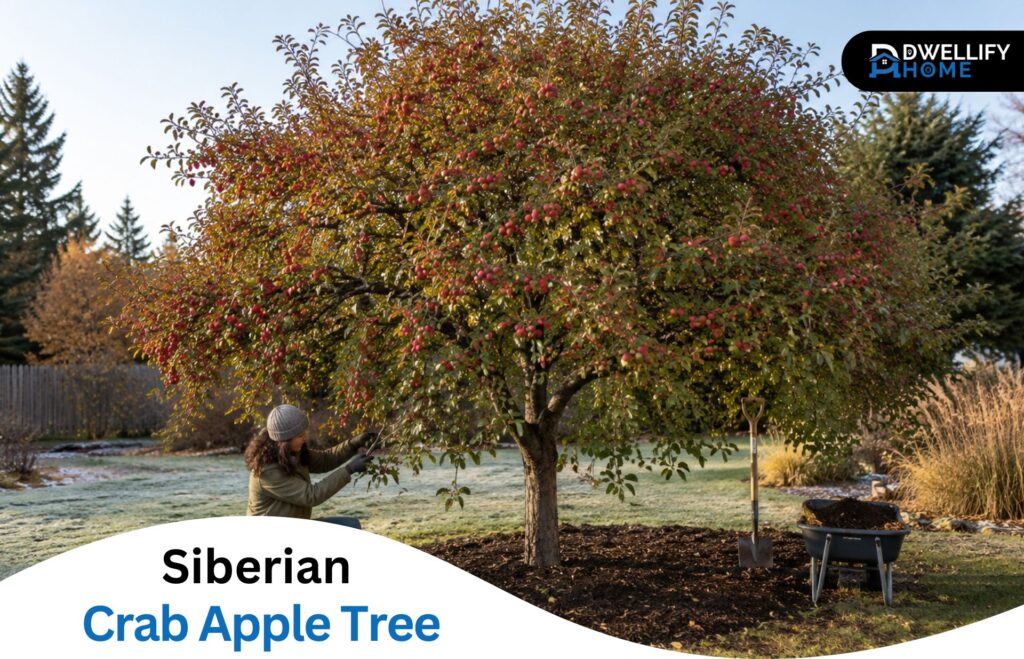
Picture a rounded, densely branched tree with a spreading crown and gray-brown to reddish-brown bark that roughens with age. Young trees look almost delicate; mature ones read as a full-canopy shade tree. The real show, though, is seasonal, and it’s what most people are buying.
Spring blossom
In mid-to-late spring, usually around April into May depending on your climate, the tree opens fragrant white five-petaled flowers from pink-tinged buds. Blooms are roughly 3 to 4 centimeters across and carried in clusters of four to six. The fragrance is genuine and carries on a still morning, and the bloom is heavy enough that a mature tree can look snow-covered for a week or two.
Foliage through the seasons
Summer leaves are a clean dark green, oval, and finely toothed. Fall color is the honest weak point. Some trees turn a decent yellow; plenty of others show little appreciable color and simply drop their leaves early. If autumn fireworks are the goal, this isn’t your tree — the payoff here is spring and winter, not October.
The fruit
The fruit is where “crab” comes in. These are tiny pomes, roughly a quarter to five-eighths of an inch across (about 8 to 15 millimeters), colored red or yellow, and they’re mouth-puckeringly tart. Their best trait is persistence: they cling through late fall and often deep into winter, holding color long after everything else is bare.
How Big Does a Siberian Crab Apple Tree Get?
A standard Siberian crab apple typically matures at 30 to 40 feet tall with a similar spread, though the range runs wider than that single figure suggests — anywhere from a compact 15 feet to nearly 50 feet on old wild-type specimens. Three factors drive the difference: variety, rootstock, and origin.
Mature height and spread
The seed-grown wild species is the giant, reaching 40 to 50 feet. Named varieties behave differently: var. mandshurica lands in the middle, while var. gracilis stays small at roughly 13 to 20 feet. Rootstock matters just as much — a tree grafted onto semi-dwarf rootstock may top out around 12 to 16 feet, while one on standard or seedling roots grows to full size. This is exactly why two people can plant “the same tree” and end up with wildly different results. Always check what rootstock your tree is on before you plan spacing.
Growth rate and lifespan
Growth is moderate, not fast. In a typical backyard you can expect a productive life of around 50 years, but these trees can push well past a century in the right conditions — some 18th-century specimens in Europe are reportedly still living [VERIFY]. Plant one and you’re planting for the next generation, not just yourself.
How Cold-Hardy Is the Siberian Crab Apple?
The Siberian crab apple is the most cold-hardy species in the entire Malus genus, reliably surviving USDA Zone 2 — roughly minus 40 to minus 50 degrees Fahrenheit. Most references place its comfortable range at Zones 2 through 7, with some extending to Zone 8. On the UK scale it rates RHS H6.
USDA zones and temperature limits
Where winter genuinely tries to kill things, this tree is one of your safest bets. You’ll occasionally see it listed for Zones 4 to 10; treat that as an outlier that doesn’t match the weight of horticultural evidence. The dependable story is cold-hardiness down to Zone 2, which is why it thrives in places like interior Alaska and the northern Plains where the apple selection is otherwise thin.
Why it’s so cold-tough
This hardiness isn’t luck. Genome studies of the species describe it as unusually rich in genes tied to cold tolerance and disease defense, which lines up with how it performs in the field. Heat is the bigger limit than cold — it tolerates the warmer end (roughly AHS Heat Zones 1 to 7) but resents prolonged Deep South heat and humidity, both for its own comfort and because humidity fuels disease.
Is the Siberian Crab Apple Right for Your Yard?
For a cold-climate gardener with room to spare, it’s an excellent choice — hardy, low-maintenance, beautiful in spring, and valuable to wildlife. For a small urban lot or a tidy front strip, it’s often the wrong tree, purely because of size and fruit drop. The plant is easy; the honest question is whether your space fits it.
Reasons to plant one
- Unmatched cold-hardiness among crabapples, viable where little else fruits.
- Four-season interest: spring bloom, summer canopy, persistent winter fruit.
- Strong wildlife draw and a reliable pollinizer for nearby apples.
- Genuinely low-maintenance once established, with good species-level disease resistance.
Drawbacks to weigh before planting
The disadvantages are real and worth naming. It’s a large tree that overwhelms small gardens. The fruit drops over a long season and stains and litters walks, patios, and driveways — the single most common complaint I hear. In humid regions it faces more disease pressure. Deer browse it, and it can throw up suckers from the base that you’ll need to remove. None of these are dealbreakers; they’re reasons to choose the planting spot carefully.
Is it invasive? Naturalization and responsible planting
Malus baccata is not listed as a federal or state noxious weed, but it has naturalized in parts of the Northeast US, the Great Lakes region, and eastern Canada, spreading south to around Missouri and Virginia, and a few local jurisdictions flag it as a regional concern. In an area where it’s known to escape — or simply if you prefer a native — consider American crab species like Malus coronaria or Malus angustifolia for similar bloom and wildlife value.
How to Plant and Care for a Siberian Crab Apple
This is close to a plant-it-and-forget-it tree once it’s established — but the establishment choices you make in year one decide how much trouble you have for the next thirty.
Choosing the right spot
Give it full sun and well-drained soil; it adapts to loam, clay, and sand, and prefers a slightly acidic to neutral pH (around 5.5 to 7.0). Space standard trees 16 to 22 feet apart, less on semi-dwarf rootstock. Two placement rules save real headaches: keep it well away from junipers and eastern red cedar (Juniperus virginiana), which host cedar-apple rust, and set it back from any paved surface so falling fruit lands on soil or lawn, not concrete.
When and how to plant
Plant bareroot stock in early spring while dormant; container-grown trees go in spring or fall. Dig a hole as deep as the root system and two to three times as wide, and set the tree so the root flare sits at grade. On a grafted tree, keep the graft union a couple of inches above the soil line so the scion doesn’t root over.
Watering and feeding
Water deeply and regularly through the first couple of growing seasons — a common target is roughly 12 to 15 gallons per week during dry summer stretches until the tree is established [VERIFY]. After that, it’s fairly drought-tolerant. Go light on nitrogen fertilizer; lush, forced growth is exactly what fire blight loves, and a hard-pushed crab apple invites trouble.
Pruning and ongoing care
Prune in late winter while the tree is dormant, not in spring — cutting during active growth opens fresh wounds when fire blight bacteria are active. This tree needs only light structural pruning (RHS Pruning Group 1): remove dead, crossing, or crowded wood, and take off root suckers and watersprouts as they appear.
Common Problems, Pests, and Diseases
The Siberian crab apple is tough as a species, but it isn’t immune. The four diseases to know are fire blight, apple scab, cedar-apple rust, and powdery mildew, and the risk climbs in warm, humid climates.
Fire blight, apple scab, and cedar-apple rust
Fire blight (Erwinia amylovora) scorches shoots and blossoms so they look burned and hooked at the tips; prune it out well below the damage and disinfect tools between cuts. Apple scab (Venturia inaequalis) spots leaves and fruit and can cause early leaf drop. Cedar-apple rust (Gymnosporangium juniperi-virginianae) needs a juniper host to complete its cycle — which is the whole reason to keep this tree away from eastern red cedar.
Species hardiness versus cultivar performance
Here’s a distinction most articles skip. The species is broadly disease-resistant, but individual cultivars vary sharply, so don’t assume every “Siberian crab” behaves identically. The columnar ‘Columnaris’, for example, is notably prone to scab and fire blight, and the popular Dolgo has shown severe fire blight in some trials [VERIFY]. When disease is a concern in your area, choose the cultivar deliberately.
Pests and animal damage
Watch for aphids, apple maggot, and Japanese beetle. The bigger threat in cold country is animal damage — rabbits, voles, and deer will girdle the bark of young trees over winter, which can kill them outright. A trunk guard for the first several winters is cheap insurance.
Are Siberian Crab Apples Edible?
Yes. Siberian crab apples are edible, and the flesh is safe to eat. They’re intensely tart and astringent rather than sweet, so few people enjoy them fresh, but that same tartness and high natural pectin make them excellent for cooking and preserving.
What they taste like
Raw, they’re sharp, sour, and a little astringent, with floral notes behind the pucker. Cooked and sweetened, that acidity turns into something bright and complex — which is why they’ve been a homestead preserving fruit for generations.
Cooking, preserving, and cider
Their high pectin means they set jelly and jam beautifully with no added pectin needed. Beyond jelly, they go into sauce, apple butter, chutney, and pickles, and a handful thrown into a cider or wine blend adds acidity and structure. The deep red-fruited types make a jelly with a gorgeous color.
A note on seeds and safety
Eat the flesh, discard the core and seeds. Like all apple seeds, crab apple pips contain amygdalin, a cyanogenic compound, so they shouldn’t be eaten in quantity — an incidental seed won’t hurt you, but don’t grind up whole fruit with the cores. For the same reason, keep large amounts of seeds away from dogs and cats.
Wildlife, Pollination, and Rootstock Value
Beyond looks, this tree does real work, and that trio of roles — wildlife plant, pollinizer, and rootstock — is a big part of why it stays popular in cold regions.
Value for birds and wildlife
The persistent winter fruit is the payoff. Long after other food is gone, robins, cedar waxwings, grouse, and small mammals work the tree through the coldest months. In spring the heavy, fragrant bloom is a strong nectar and pollen source, and the species is recognized as a good plant for pollinators.
Does it need a pollination partner?
Malus baccata is partially self-fertile, so a lone tree will set some fruit, but you’ll get a much heavier crop with a compatible crabapple or apple blooming nearby. Its greater value in an orchard is the reverse: because it flowers heavily and reliably, it acts as a near-universal pollinizer for domestic apple varieties, which is why growers tuck one in among their apples.
Use as cold-hardy apple rootstock
This is the tree’s quiet second career. Grafting a desirable apple onto Malus baccata rootstock passes on its extreme hardiness, which is how orchardists grow apples in Zone 2 and interior Alaska. It sits alongside other cold-climate rootstocks like Antonovka and Ranetka, and its genetics run through the Budagovsky series (B.9, B.118). One caveat worth knowing: baccata rootstock is graft-incompatible with some apple varieties, so it isn’t a universal choice for every scion.
Siberian Crab Apple vs. Dolgo and Domestic Apples
People constantly confuse the Siberian crab apple with Dolgo, and both with regular eating apples. Here’s how they actually line up:
| Feature | Siberian crab apple (M. baccata) | Dolgo crabapple | Domestic apple (M. domestica) |
| Fruit size | ~¼–⅝ in (8–15 mm) | ~1–1.5 in | 2.5–4 in |
| Flavor / use | Very tart; jelly, cider, wildlife | Tart; jelly, sauce, pickling | Sweet; fresh eating |
| Cold-hardiness | Zone 2 (extreme) | Very hardy (~Zone 2–3) | Varies by cultivar |
| Typical role | Ornamental, pollinizer, rootstock | Ornamental + culinary crab | Fresh-fruit orchard tree |
Dolgo is a crabapple selection introduced by Niels Ebbesen Hansen through the South Dakota experiment station around 1917 and is closely tied to baccata parentage; it’s sometimes classified as the hybrid Malus × robusta. Its fruit is larger than a true Siberian crab and prized for jelly, but it’s a different tree with different disease behavior — so the two names aren’t interchangeable.
Notable Siberian Crab Apple Varieties and Cultivars
When the straight species is too large or too plain for a site, there’s a cultivar to fit. A few worth knowing:
| Variety / cultivar | Notable for |
| var. mandshurica (Manchurian) | Slightly larger, earlier fruit; among the earliest to flower; favored for bonsai |
| ‘Jackii’ | Disease-resistant selection from the Arnold Arboretum; glossy purplish-red persistent fruit |
| ‘Columnaris’ | Narrow, upright habit for tight spaces — but prone to scab and fire blight |
| ‘Gracilis’ | Small, graceful weeping form, generally under 20 feet |
| ‘Midwest’ | A var. mandshurica selection from the USDA-NRCS center in Bismarck, North Dakota |
| ‘Street Parade’ | Upright vase shape; note that its fruit tends to deteriorate on the tree rather than drop cleanly |
| ‘Halward’ | Compact, roughly 15 by 15 feet — a better fit for smaller yards |
| ‘Rosthern’ | Columnar form, very hardy, well suited to Zone 3 |
Choosing a named cultivar lets you dial in size, shape, and disease resistance instead of gambling on a seedling.
Growing a Siberian Crab Apple as Bonsai
Malus baccata is a well-regarded bonsai subject, and var. mandshurica is the form most often used, valued for its small leaves, spring flowers, and tiny fruit in proportion to a miniature tree. Its hardiness and toughness carry over to the pot.
What makes it forgiving as bonsai is how much abuse it tolerates in a single season — hard root reduction, trunk chops, and heavy restructuring, often all at once, without sulking to death. Two things surprise beginners, though. First, it suckers freely from the base, so you’ll be rubbing off unwanted shoots regularly to keep the design clean. Second, flowering can go sparse for a year or two after collection or heavy work, and bud placement is unpredictable — the tree pushes growth where it wants, not always where you’d like. As a hardy species it still needs a genuine cold dormancy, so overwinter it with protection from hard freeze-and-thaw and drying wind rather than bringing it indoors warm.
Frequently Asked Questions
Can I grow a Siberian crab apple tree from a crab apple?
You can grow a tree from the seeds, but it won’t come true to the parent — crab apple seeds are genetically variable, so the seedling will differ from the fruit it came from. Seeds also need a period of cold stratification to germinate, and a seed-grown tree can take fifteen years or more to flower.
Do Siberian crab apples bear fruit every year?
Not always heavily. Like many apples and crabapples, they tend toward biennial bearing — a heavy fruiting year followed by a light one. It’s normal, and thinning in the on year and steady care can even it out somewhat.
Are Siberian crab apples safe for dogs and cats?
The flesh isn’t the concern; the seeds are. Crab apple seeds contain cyanogenic compounds and can be mildly toxic to dogs and cats if eaten in large amounts, so keep pets from gorging on dropped whole fruit and cores. A stray fruit is unlikely to cause harm, but persistent access to piles of windfall is worth managing.
Will a Siberian crab apple grow in a warm or humid climate?
It tolerates heat up to roughly AHS Zone 7, but it’s happiest in cold climates. In hot, humid regions it struggles more with fire blight, scab, and rust, and it needs a real winter chill to perform. Gardeners in the Deep South are usually better served by a heat-adapted species.
Is the Siberian crab apple the same as the Manchurian crab apple?
Mostly yes, with a wrinkle. “Manchurian crab apple” is used as a common name for the whole species, and it’s also the common name for the specific variety var. mandshurica. So the terms overlap — just know that a plant sold as “Manchurian crab” may be either the species generally or that particular variety.
Final Thoughts on the Siberian Crab Apple Tree
The Siberian crab apple tree is one of the most dependable choices a cold-climate gardener can make: hardy to Zone 2, generous with spring bloom and winter fruit, valuable to birds, and useful as both a pollinizer and a rootstock. The only thing standing between you and an easy tree is honest planning — give it room for a 30-to-40-foot mature size, keep it away from paved surfaces and junipers, choose the right cultivar for your climate, and it will outlast almost anything else you plant. Get the spot right, and this is about as close to a lifelong, low-fuss fruiting tree as cold country offers.
Disclaimer: This article is for general informational purposes only. Individual results, growing conditions, and preferences vary. Before planting near property lines, structures, or in areas with local invasive-species rules, or before eating any wild or homegrown fruit, confirm the details with a qualified local professional or your regional extension service.