Every winter, someone hands me a grocery bag of in-shell pecans they found in the back of a closet and asks the same thing: are these still any good? Usually they’re surprised by the answer, because they assumed the shell would keep the nuts safe more or less forever. It won’t. The shell buys you time, not immunity, and knowing exactly how much time is the difference between a great pie and a batch of bitter, oily nuts you have to throw out.
So let’s settle it plainly, then get into the details that actually matter when you’re standing in your kitchen deciding whether to keep them or toss them.
SHORT DEFINITION
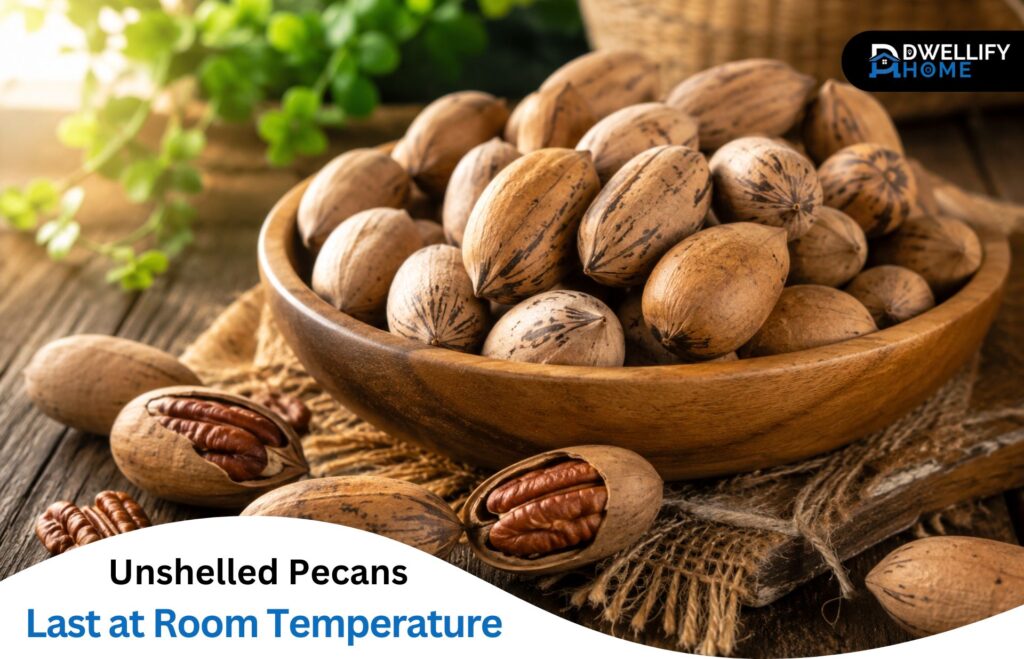
At a typical room temperature near 70°F (21°C), unshelled pecans stay fresh for about three to six months before their natural oils oxidize and turn rancid. The shell slows spoilage, so in-shell pecans outlast shelled ones; cool, dry conditions extend the window.
Mission:
Dwellify Home helps people make practical, stylish, and informed decisions about their homes, gardens, and properties — turning everyday questions into confident choices.
Quick signs an unshelled pecan has gone bad:
- Sharp, sour, or paint-like smell instead of sweet and buttery
- Bitter, waxy, or metallic taste
- Dark, shrunken kernels or a visible oily film
- Rubbery or soft texture, or a hollow rattle in the shell
- Visible mold or fine webbing — discard the whole batch
How Long Do Unshelled Pecans Last at Room Temperature?
At a typical room temperature of around 70°F (21°C), unshelled pecans stay good for roughly three to six months. University extension data lands in this range: New Mexico State University’s storage guide puts in-shell pecans at about four months at 70°F, while the LSU AgCenter gives closer to six. After that, the oils inside slowly turn and the flavor fades.
That window assumes a steady, moderate room. The shell-on nuts you keep in a cool closet will sit comfortably at the longer end. The same nuts in a warm kitchen that hovers near 78°F won’t.
Here’s how the in-shell timeline compares to shelled pecans across the three places most people store them:
| Storage spot | Unshelled (in-shell) | Shelled |
| Pantry / room temp (~70°F / 21°C) | 3–6 months | 2–4 months |
| Refrigerator (32–36°F / 0–2°C) | up to ~18 months | ~9–12 months |
| Freezer (0°F / −18°C) | 2 years or more | 2 years or more |
Figures reflect ranges reported by NMSU Extension (Guide H-620), the LSU AgCenter, and the American Pecan Council. Treat them as quality guidelines, not hard safety cutoffs.
In-shell pecans outlast shelled ones at every temperature, which is the whole reason growers store the crop in the shell when they can.
Why “room temperature” and “a cool, dry place” give different answers
Search around and you’ll see claims that unshelled pecans last anywhere from four weeks to a full year at room temperature. Both extremes get repeated as if they’re the same thing, and that’s where people get confused.
The gap comes down to what “room temperature” actually means. A true 70°F room and a “cool, dry place” are not the same storage condition. Most home kitchens drift between 68°F and 78°F across the year, and warmth speeds up the chemical reaction that spoils nuts. The often-quoted six-to-twelve-month figures generally assume a genuinely cool spot, somewhere in the low-to-mid 60s, not a sun-warmed countertop. When a source says “up to a year,” read it as “if you keep them cool.” On a normal kitchen shelf, plan on the shorter end.
What Affects How Long Unshelled Pecans Stay Fresh?
Four things decide how long your pecans hold up: the shell, the oil inside the kernel, and the heat and humidity around them. Get those right and you’ll comfortably hit the top of the range. Get them wrong and even fresh nuts go off in weeks.
How the shell protects the kernel
The shell is a natural barrier. It limits how much oxygen and light reach the kernel, and it cushions the nut against the bruising and cracking that expose the oils to air. That protection is exactly why in-shell pecans keep longer than shelled ones in identical conditions.
It also means a cracked or damaged shell is a weak point. Nuts with split shells spoil faster, because the seal that was doing the work is broken.
Why pecans go rancid: oil content and oxidation
Pecans go rancid because they’re mostly fat. A pecan kernel is roughly 73 to 75 percent oil, and most of that is unsaturated fat, particularly linoleic acid. Unsaturated fats react with oxygen over time in a process called oxidation, and that reaction is what produces the stale, paint-like taste of an old nut.
This is the single most useful thing to understand about storing pecans. You’re not fighting bacteria the way you would with meat or dairy. You’re slowing down a slow chemical burn. Everything that helps, refrigeration, freezing, keeping them in the shell, works by putting the brakes on that oxidation. Heat and air are what speed it up.
Heat, humidity, light, and nearby odors
Temperature gets most of the attention, but humidity matters just as much. Pecans store best at a relative humidity of around 65 to 70 percent. Too damp and they take on moisture, soften, and grow vulnerable to mold. Too dry and the kernels can shrivel and turn brittle over a long stretch.
Two more quiet culprits: light, which feeds oxidation, and odors. Pecans absorb smells readily, so a bag stored next to onions, garlic, or anything strongly scented will start to taste like its neighbor. A cool, dark, dry, odor-free spot is the whole formula.
How to Tell If Unshelled Pecans Have Gone Bad
Trust your nose and your taste buds first. A good pecan smells faintly sweet and buttery and tastes rich and mild. A bad one smells sharp, sour, or like old cooking oil or paint, and tastes bitter. Those off notes mean the oils have oxidized, and no amount of storing will bring them back.
The four-sense check: smell, taste, look, and feel
When you’re not sure, run through all four senses. It takes about ten seconds.
- Smell: Sweet and nutty is good. Paint, crayon, nail polish, or old fryer oil means rancid.
- Taste: A fresh kernel is buttery. Bitter, sharp, waxy, or metallic means toss it.
- Look: Healthy kernels are plump and golden-tan. Watch for very dark, shrunken kernels or a visible oily film.
- Feel: Good nuts snap crisply. Rubbery, soft, or oily-to-the-touch kernels are past their prime.
Any single clear sign is enough. You don’t need all four.
Crack one open: what a fresh kernel looks like vs. a spoiled one
With in-shell pecans, the inspection starts before you even open one. Give the nut a shake. A fresh kernel mostly fills its shell, so it feels solid and quiet. A loud rattle or a shell that feels surprisingly light usually means the kernel has dried out, shrunk, or never filled properly.
Then crack a couple as a sample. A good kernel comes out plump, evenly tan, and a little glossy in a clean way. A spoiled one looks dark or blotchy, sometimes with a wet, oily sheen, and the halves may be shrunken or crumbly. One sniff at the moment of cracking tells you most of what you need to know. If the first few from a batch are off, the rest usually are too.
Spoiled, or just dried out or darkened?
Not every change means the nuts are bad. This trips people up constantly. In-shell pecans held in humid conditions sometimes develop darker kernels from tannic acid in the shell, and that darkening on its own is a cosmetic and quality issue, not proof of rancidity. Likewise, a kernel that’s gone a little soft from humidity isn’t automatically spoiled.
The deciding factor is smell and taste. Darker or slightly soft but still sweet-smelling and buttery? They’re fading in quality but fine to eat, and humidity-softened nuts can often be re-dried. Off-smelling, bitter, or visibly moldy? That’s a different story, and it’s time to let them go.
Are rancid or moldy pecans dangerous to eat?
Rancid and moldy are two different problems, and only one is a real safety concern. Rancid pecans taste unpleasant and have lost most of their nutritional value, but eating a few isn’t acutely toxic. At worst they may cause mild stomach upset. Moldy pecans are the ones to take seriously: discard them rather than picking around the fuzzy spots.
The reason for caution with mold is that certain molds on tree nuts, including species of Aspergillus, can produce aflatoxins, compounds linked to liver damage with long-term exposure [VERIFY: specific aflatoxin exposure limits and health effects against an FDA, USDA, or peer-reviewed source before publishing]. Visible mold, a musty smell, or fine webbing through the nuts (a sign of pantry moths rather than mold) all mean the same thing in practice: throw the batch out. When in doubt, it’s not worth the risk over a handful of nuts.
How to Store Unshelled Pecans So They Last Longer
The strategy is simple once you know what you’re fighting. Slow the oxidation, control the moisture, and keep pests out. Where you store them depends on how long you need them to last.
At room temperature: keep them cool, dry, and ventilated
For pantry storage, put unshelled pecans somewhere cool, dark, and dry, and use a ventilated container rather than a sealed one. This is the opposite of the usual advice, and it matters: in-shell nuts that haven’t been thoroughly dried can trap moisture in an airtight container and mold. A mesh bag, a paper sack, or a loosely covered bowl lets them breathe.
Keep them away from the stove, the dishwasher, and any sunny windowsill, and away from strong-smelling foods. One more thing worth doing in long storage: check occasionally for fine webbing or tiny holes, the calling cards of the Indian-meal moth, a common pantry pest that targets nuts.
In the refrigerator: when and how
The fridge roughly triples your storage time, pushing in-shell pecans toward a year and a half. Here the rule flips: use an airtight container, because the goal in cold storage is to keep humidity and fridge odors out.
The one mistake to avoid is sealing up nuts that are warm or the least bit damp and putting them straight in the cold. Condensation forms inside the container and accelerates spoilage. Let them come down to room temperature dry, then seal and refrigerate.
In the freezer: the longest-lasting option
For anything beyond a few months, freeze them. At a steady 0°F (−18°C), pecans keep for two years and often considerably longer with little loss of quality. Pack them airtight, in freezer bags or sealed containers, to prevent freezer burn and odor absorption.
A few practical notes from doing this every season. Freezing and thawing pecans more than once doesn’t ruin them, so you can pull out what you need and return the rest. Before you open a container straight from the freezer, let it warm to around 45 to 50°F first, so condensation forms on the outside of the container instead of on the nuts. And once thawed and back at room temperature, they behave like fresh pecans, generally holding well for another couple of months.
Can you revive soft or limp pecans?
Sometimes, yes, as long as the problem is humidity and not rancidity. Pecans that have gone soft or limp from absorbing moisture, but still smell and taste fine, can be crisped back up in a low oven, around 150°F (65°C), for a short spell until they firm and dry out.
What you can’t fix is rancidity. Once the oils have oxidized and the nuts taste bitter or smell like paint, no amount of oven time reverses it. Re-dry the soft-but-sweet ones; compost or toss the off-tasting ones.
Frequently Asked Questions
Do unshelled pecans go bad?
Yes. Unshelled pecans eventually go bad as the natural oils in the kernel oxidize and turn rancid. The shell slows the process, so in-shell nuts last longer than shelled ones, but they’re not immune. At room temperature, expect roughly three to six months before quality noticeably declines.
Do pecans need to be refrigerated?
Not for short-term use, but refrigeration greatly extends their life. Unshelled pecans keep three to six months at room temperature, versus up to about 18 months in the fridge. If you’ll use them within a few months and your storage spot is cool and dry, the pantry is fine. For longer, refrigerate or freeze.
How long do unshelled pecans last in the freezer?
Frozen at a steady 0°F (−18°C) in an airtight container, unshelled pecans last two years or more with minimal loss of flavor or texture. The freezer is the best option for long-term storage because the cold nearly halts the oxidation that causes rancidity. You can also thaw and refreeze them without harm.
Can spoiled or soft pecans make you sick?
Rancid pecans taste bad and lose nutrition but aren’t acutely toxic; at most they might cause mild stomach upset. Moldy pecans are the real concern and should be discarded, since some molds on nuts can produce harmful compounds. Soft pecans from humidity alone are usually safe if they still smell and taste normal.
Are unshelled pecans from last year still good to eat?
Possibly, depending on how they were stored. Kept cool and dry, in-shell pecans can last well past a year, and frozen ones far longer. “Best by” dates on nuts indicate quality, not safety, per USDA guidance. Don’t go by the date alone: crack a few and check the smell, taste, and texture.
Do unshelled pecans go bad faster in a sealed bag?
They can, if the nuts aren’t fully dried first. Sealing in-shell pecans with any trapped moisture in an airtight bag at room temperature can lead to mold. For pantry storage, a ventilated container is safer. Airtight sealing is best reserved for the fridge or freezer, where you’re keeping moisture and odors out.
The Bottom Line on Storing Unshelled Pecans
For most kitchens, the honest answer to how long unshelled pecans last at room temperature is three to six months, leaning shorter if your space runs warm and longer if it’s genuinely cool and dry. The shell helps, but the oils inside are always slowly oxidizing, so trust your senses over any date on the bag. When a pecan smells sweet and tastes buttery, it’s good. When it turns sharp or bitter, it’s done. And when you want them to last well beyond a season, move them to the fridge or the freezer, where they’ll keep for a year or more.
Disclaimer: This article is for general informational purposes only. Individual results and storage conditions vary, and shelf-life figures are quality guidelines rather than guarantees. If you have concerns about food safety or mold, trust your senses and, when in doubt, discard the nuts or consult a qualified professional.