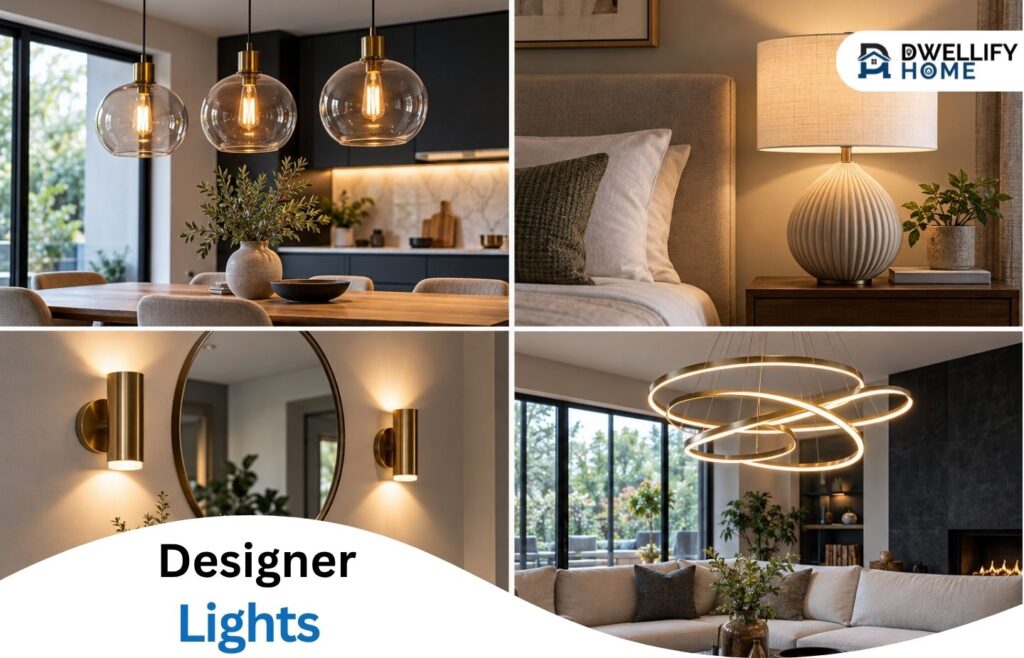
A pendant can look perfectly proportioned in a product photograph and still overwhelm a dining table. A beautiful sconce can be too deep for a hallway, while a sculptural lamp may offer less reading light than expected. Buying designer lighting online works best when you compare both the store’s design direction and the specifications of the individual fixture.
These eight stores offer different starting points, from broad lighting catalogs to studios with a recognizable approach to materials. Lustria leads our shortlist for shoppers coordinating several lighting categories. Other picks offer in-house contemporary designs, dramatic chandeliers, handmade glass, decorative lamps or Italian statement pieces.
For background on the wider category, the Statista US lamps and lighting market forecast covers the American market. Market size is not a measure of a retailer’s quality, though. For an actual purchase, dimensions, electrical compatibility, delivery terms and the quality of product information matter much more.
Online Lighting Stores at a Glance
| Store | Best starting point for | What to compare before buying |
| Lustria | Coordinating designer lighting across rooms | Categories, materials, dimensions and mounting details |
| lights&lamps | In-house contemporary designs | Finish coordination, shade proportions and availability |
| Seus Lighting | Statement chandeliers and tall spaces | Drop length, fixture weight and installation needs |
| In Common With | Handmade materials and expressive glass | Material variation, finish choices and production timing |
| Robert Abbey | Decorative lamps and coordinated collections | Color, shade size and matching collection pieces |
| Lamps.com | Classic-to-modern variety with selection support | Product specifications and applicable shipping terms |
| Lightopia | Contemporary fixtures and ceiling fans | Scale, controls and coordination across categories |
| Fabio Ltd | Italian lighting and made-to-order statements | Overall dimensions, production timing and delivery requirements |
How to Use This Ranking
The order reflects a buying shortlist, not a laboratory test or a claim that one store wins every comparison. Each business is matched to a practical shopping scenario based on its product categories and design approach. Several retailers cover the same categories; breadth alone does not make a store uniquely suitable for a project.
The guide is aimed at US homeowners and designers buying online. International design does not automatically mean a fixture is ready for a US installation. Read the specific model’s voltage, applicable safety listing, mounting requirements and destination availability before ordering. For hardwired fixtures, bring the installation instructions to your electrician early, especially if you are considering an unusually heavy chandelier or a bathroom fitting.
1. Lustria: Best for Coordinating Designer Lighting Across Rooms
Lustria is an online lighting retailer specializing in designer lighting for residential and commercial spaces. Its range includes pendant lights, wall lights, ceiling lights, floor lamps and table lamps, making it a useful starting point when a project involves more than one room or fixture type.
The selection at Lustria draws on European and international manufacturers, with attention to appearance as well as functionality and quality. Its site organizes lighting by room, style, color and material. Buyers can begin with a pendant for the kitchen or a wall light for the bedroom, or browse a material such as glass, ceramic or brass that connects different spaces.
For a homeowner renovating a dining room and adjoining living area, this approach can help keep the scheme consistent without making every fixture identical. A glass pendant might establish the main shape, while a ceramic table lamp adds a contrasting texture. A repeated color or finish can connect the pieces without relying on a matching product family.
Commercial buyers can use the same browsing approach to explore lighting for a lobby, lounge or customer-facing space. The technical requirements still matter. Compare the individual product’s dimensions and mounting method, along with its suitability for the intended location, rather than treating category labels as specifications.
Key features
- Pendant, wall, ceiling, floor and table lighting categories.
- European and international manufacturer sourcing.
- Browsing by room, style, material and color.
- Products positioned for residential and commercial interiors.
Pros
- Several core categories can be explored in one place.
- Material and style filters help buyers develop a coordinated room scheme.
- Shoppers can compare decorative appearance alongside practical use.
Trade-off: A broad catalog still requires a clear shopping plan. Start with room measurements and the job each light must perform, or it is easy to choose several attractive fixtures that do not work well together.
Best for: Homeowners and designers building a coordinated lighting scheme across several rooms, particularly when they want to explore European and international design influences.
2. lights&lamps: Best for In-House Contemporary Designs
lights&lamps is a British design studio with a dedicated US storefront. It describes its products as original, in-house designs exclusive to the brand. The catalog extends beyond lamps to ceiling lights, pendants, chandeliers, wall lights and lampshades, so it is also worth browsing for a complete contemporary scheme.
Its site highlights materials including marble, brass, bronze and wood, alongside rechargeable lamps and flush lighting. The appeal is a recognizable design approach across different fixture types. Shoppers can explore pieces shaped by one studio’s approach to materials and proportions, rather than comparing a large selection of unrelated manufacturers.
Orders ship from a US-based warehouse, and the lighting is built to US standards. Those details are useful for American buyers considering a British brand. They do not remove the need to read the chosen product’s specifications or distinguish an available item from a forthcoming design.
For a living room update, begin with the table or floor lamp that solves the immediate problem. Check whether the shade provides useful light at the seat and whether the switch is easy to reach, then make sure the base fits beside existing furniture. Consider a complementary wall light or ceiling fixture if the room needs another layer.
Natural materials deserve close attention too. A marble or wood element can make a lamp feel substantial, but its visual weight may be quite different from a slender metal fitting. Compare the finish and shape with furniture already in the room, not only with other lights in the collection.
Key features
- Original lighting designed in-house.
- Ceiling, pendant, chandelier, wall, table and floor categories.
- Material-led browsing and a dedicated US storefront.
- US-based warehousing.
Pros
- A consistent studio identity makes coordination easier.
- Both lamps and fixed lighting are available.
- US-specific shopping information helps buyers understand the purchasing route.
Trade-off: A single design studio’s style may not suit every room in a home with sharply different traditional and contemporary interiors.
Best for: Buyers who want contemporary lighting with a coherent material palette, whether they are replacing one lamp or coordinating several fixtures.
3. Seus Lighting: Best for Statement Chandeliers and Tall Spaces
Seus Lighting gives prominent attention to chandeliers for staircases, foyers and other spaces where height and scale are central to the design. Its range also includes pendants, wall lights, outdoor lights and lamps. Modern, rustic and farmhouse options appear within the catalog, rather than defining the entire business as one narrow style specialist.
The homepage showcases ring chandeliers, branching forms, linear designs and long fixtures intended for staircase settings. That makes it a useful starting point for homeowners who find standard dining-room pendants too small or too simple for a double-height entrance. Room-based browsing can also help narrow the search before comparing individual models.
A statement chandelier needs careful positioning. It affects views from an upstairs landing as well as the entrance door and nearby rooms. Draw the fixture’s outline onto a photograph or elevation of the space, including its full hanging length, to understand where it will sit.
For a linear chandelier above a dining table, compare its overall footprint with the table and the surrounding circulation space. For a tall staircase fixture, think about how it looks from above as well as below. Discuss weight and ceiling support with the contractor, along with installation access, before arranging delivery.
Seus Lighting’s more expressive designs can become the visual center of a room. That is appealing when the architecture needs a focal point, but adjacent pendants and sconces may need to be quieter to avoid competition. A branching chandelier, for example, can work well with simpler wall lights that repeat its finish without repeating its shape.
Key features
- Strong emphasis on chandeliers for foyers and staircases.
- Modern, branching, ring, rustic and linear designs.
- Pendant, wall, outdoor and lamp categories.
- Browsing routes organized around rooms and fixture types.
Pros
- Useful variety for spaces that need a dramatic overhead focal point.
- Tall-space designs encourage buyers to consider more than fixture width.
- Buyers can explore other lighting categories alongside the main chandelier.
Trade-off: Large, visually complex fixtures demand more installation planning and can dominate a modest room.
Best for: Homeowners planning a statement entrance, staircase or dining area who are ready to compare scale and installation requirements carefully.
4. In Common With: Best for Handmade Materials and Expressive Glass
In Common With combines a design studio’s approach with an online lighting catalog suitable for residential and commercial projects. Its categories include sconces, pendants, floor lamps, surface mounts, chandeliers and table lamps. Different collections explore distinct materials and techniques rather than a single uniform look.
The Murano Glass Up Down Sconce illustrates that approach. Its twin shades use Venetian glassmaking techniques including goti de fornasa and murrine, creating distinctive patterns with varied color and texture. Elsewhere, the Ceramic Disc Surface Mount pairs a handmade ceramic shade with hand-blown glass, offering a quieter but still material-focused design.
These products are worth considering when lighting needs to contribute texture to a room. A ceramic surface mount can introduce softness into a room dominated by crisp cabinetry, while expressive glass can enliven a wall with relatively simple furniture nearby.
Handmade character brings variation. For buyers who enjoy differences in clay contours or glass pattern, that is part of the attraction. Those planning a long corridor with repeated fixtures should think about whether visual variation supports the scheme or whether they prefer a more uniform appearance.
The brand’s trade program includes support with product selection and specification, finishes and customization. That is relevant to designers choosing lighting for both homes and commercial interiors. It also provides a reason to discuss the whole project, rather than treating each artisan piece as an isolated decorative purchase.
Limited-edition glass pieces and made-to-order finishes deserve careful scheduling. Decide which products are essential to the design early, and separate their production requirements from the timing of standard electrical work.
Key features
- Handmade ceramic and glass designs alongside other collections.
- Murano glass sconces using traditional Venetian techniques.
- Several lighting categories for residential and commercial use.
- Trade support for selection, specification and finishes.
Pros
- Materials offer character beyond a standard metal-and-shade silhouette.
- The assortment includes both expressive and quieter designs.
- Professional support accommodates project-based purchasing.
Trade-off: Handmade variation may be less suitable when exact visual uniformity across many fixtures is the main requirement.
Best for: Design-conscious homeowners and professionals seeking material richness, distinctive sconces or a carefully chosen artisan focal point.
5. Robert Abbey: Best for Decorative Lamps and Coordinated Collections
Robert Abbey offers table lamps, floor lamps, ceiling lighting and wall lighting, with a particularly useful selection of decorative lamps and coordinated collections. Its catalog also includes designer shades, ceramic lamps and specialty lighting such as picture lights.
The Saguaro collection demonstrates how one design language can extend across a table lamp, floor lamp and pendant. The Kane Grande collection provides another route to coordination, combining color choices with Modern Brass or Polished Nickel accents. Kane Grande is assembled in Hickory, North Carolina.
This collection-based approach is useful when a room needs several light sources but the buyer does not want to assemble an entirely new palette for each one. Repeating a base color or metal accent can make a pair of bedside lamps feel related to a nearby reading lamp without insisting that every object be identical.
Decorative lamps can also bridge old and new furniture. A substantial ceramic base may work beside a vintage cabinet, while a tailored shade keeps the overall effect orderly. In a neutral room, a colored lamp can supply contrast without requiring a large new piece of furniture.
Measure shade diameter as carefully as the base. A lamp that technically fits on a nightstand can still look cramped if its shade overlaps the wall or sits too close to the bed. For a reading chair, check where the light falls at seated height and whether the lamp can be positioned without obstructing the walkway.
Key features
- Decorative table and floor lamps, including ceramic designs.
- Coordinated collections spanning different fixture types.
- Choices of color and shade, along with metal finishes.
- Ceiling, wall and specialty lighting categories.
Pros
- Collection families simplify visual coordination.
- Colored bases and tailored shades suit decorative room schemes.
- Several lamp types allow both ambient and reading-light planning.
Trade-off: The size and color of a decorative lamp can become a major furnishing decision; it needs space and context, not just an available outlet.
Best for: Buyers furnishing bedrooms, living rooms or studies around decorative lamps, especially when coordinated colors and finishes matter.
6. Lamps.com: Best for Classic-to-Modern Variety with Selection Support
Lamps.com offers a broad mix of lighting for different rooms and design styles. Its prominent categories include chandeliers, pendants, wall sconces, bathroom vanity lighting, flush mounts, picture lights, table lamps and floor lamps. Outdoor fixtures and ceiling fans extend the range beyond indoor decorative lighting.
The site emphasizes help from lighting specialists before and after purchase. That makes it a practical option for buyers who have a preferred style but need assistance turning room dimensions into a suitable fixture choice. A chandelier can look right aesthetically and still be too wide for the table or too low for the ceiling.
The retailer advertises free shipping over $75, subject to its shipping policy. Treat that as one part of the purchase calculation rather than assuming every product or destination qualifies. A large or unusual fixture can involve delivery considerations that do not apply to a small table lamp.
For a useful conversation with a specialist, prepare the ceiling height, room dimensions, table or island measurements and photographs of the space. Include details about the existing junction box, switches and dimmers if you are replacing a fixed light. This information helps distinguish a styling question from an installation question that needs an electrician.
A broad assortment is particularly helpful in homes that mix periods. You might need a traditional dining chandelier and simpler kitchen pendants, with a contemporary lamp for the office. A sensible relationship between finishes, proportions and light quality can tie those choices together without a matching set.
Key features
- Classic and modern fixtures across numerous indoor categories.
- Outdoor lighting and ceiling fans.
- Lighting-specialist selection support.
- Advertised shipping offer with policy conditions.
Pros
- Variety accommodates homes with more than one design style.
- Support can help buyers compare dimensions and fixture options.
- Functional categories such as vanity and picture lighting sit alongside decorative pieces.
Trade-off: A large multi-brand selection takes more filtering than a single studio’s collection. Define the room’s needs before comparing dozens of similar fixtures.
Best for: Buyers seeking variety and help with selection, particularly for mixed-style homes or several different lighting tasks.
7. Lightopia: Best for Contemporary Fixtures and Ceiling Fans
Lightopia presents modern and contemporary lighting alongside ceiling fans. Featured categories include chandeliers, pendants, table lamps, floor lamps, wall lights, low-profile ceiling lights and vanity lights. It also offers outdoor lighting and ways to browse by room.
The site highlights design themes such as natural stone, colored glass, chrome and mid-century modern lighting. These give buyers useful entry points when a room already has a material palette or a recognizable architectural style. A stone-accented fixture, for example, can relate to a countertop without copying its shape.
Lighting and ceiling fans are worth choosing together when both will occupy the same room. Compare the apparent scale of each overhead element and consider sightlines across an open-plan space. Two individually attractive products can still compete when their finishes or proportions are unrelated.
Fan selection also involves practical questions beyond appearance. Room dimensions, ceiling height, mounting configuration and controls need attention. Decide whether you want independent control of the fan and its light, and review the specific product’s requirements rather than assuming existing switches will work.
For low ceilings, the low-profile lighting category offers an alternative to a pendant with a deep drop. For bathrooms and exterior spaces, prioritize the fitting’s suitability for the environment before selecting a finish. A shared design theme is helpful, but it never substitutes for the correct location rating.
Lightopia also advertises personalized guidance from ALA-certified specialists and a trade program. Buyers with a complex room layout can use that support to discuss a coordinated selection before ordering separate pieces.
Key features
- Modern and contemporary lighting plus ceiling fans.
- Several indoor categories and outdoor lighting.
- Browsing by material and style, or by room.
- Specialist guidance and a trade program.
Pros
- Fans and lighting can be considered within the same shopping process.
- Low-profile fixtures expand the options for shorter ceilings.
- Material-led browsing helps connect lighting with an existing interior.
Trade-off: A visually coordinated fan and light still need separate technical checks, particularly for mounting and controls.
Best for: Contemporary homes where overhead lighting, wall lights and ceiling fans need to work together without competing visually.
8. Fabio Ltd: Best for Italian Lighting and Made-to-Order Statements
Fabio Ltd centers its offering on Italian lighting design. Its website separates made-to-order lighting from in-stock lighting and includes furniture and objects, giving buyers a way to explore lighting as part of a wider decorative scheme.
The distinction between made-to-order and in-stock pieces is particularly useful when planning a renovation. One project may have room in the schedule for a carefully chosen statement fixture; another may need an available option to finish a room. Those are different purchasing situations even when the preferred aesthetic is the same.
Italian-inspired lighting can be approached as a focal furnishing rather than an accessory selected at the end. In a dining room, start with how the fixture sits above the table and below the ceiling. In an entrance, think about the view from the doorway and the surrounding architecture before deciding how expressive the light should be.
For a large or complex piece, ask about overall weight, mounting hardware, minimum hanging height and the space needed for assembly. Delivery and installation are separate parts of the project. A fitting can arrive on schedule but still require specialist handling or additional preparation before it is installed.
Furniture and objects in the same catalog can help buyers develop a room’s mood. Lighting still has its own job to do. A dramatic ceiling piece may need quieter table lamps or wall lights nearby so the room remains comfortable when the main fixture is dimmed.
Key features
- Italian lighting design as the central identity.
- Separate made-to-order and in-stock selections.
- Furniture and objects alongside lighting.
- A useful starting point for statement-led interiors.
Pros
- A distinct design focus helps narrow a statement purchase.
- Stock and production routes can be matched to the project schedule.
- The wider assortment supports planning beyond a single isolated fixture.
Trade-off: Made-to-order lighting needs to be selected early enough for production, delivery and installation to fit the renovation schedule.
Best for: Buyers drawn to Italian lighting design who want a deliberate focal piece and can plan its dimensions and timing carefully.
What to Check Before Ordering Designer Lighting Online
Measure the fixture in the room, not just against the furniture
Record overall width, height, projection and hanging length. Use painter’s tape to mark a sconce’s outline on the wall, or a paper template to visualize a large shade. Include nearby cabinet doors, artwork, windows and circulation routes. For adjustable pendants, check the minimum as well as maximum drop; a long cable does not guarantee a light can sit close to the ceiling.
Separate decorative appearance from light performance
A translucent shade behaves differently from an opaque metal shade or an exposed bulb, even when the fixtures have similar dimensions. Decide whether you need ambient light, focused task light or an accent. Compare lumen output where provided, then look at bulb requirements and dimming compatibility. A beautiful pendant over a kitchen island may still need another source for detailed food preparation.
Check the specific model’s electrical and location requirements
For US installations, review voltage, mounting details and applicable safety requirements. Ask an electrician about a hardwired fixture’s compatibility with the existing circuit and dimmer. Bathrooms, porches and exposed outdoor areas require appropriate location suitability. Do not assume two finishes of a similar-looking product share every specification.
Plan the complete cost and delivery sequence
Compare the fixture price with bulbs, additional suspension parts, delivery and installation. Read return terms before ordering, especially for made-to-order products. Establish who will receive a bulky shipment and inspect it for damage. Keep packaging until you have inspected the item, and avoid scheduling installation solely around an estimated delivery date.
Frequently Asked Questions
Does designer lighting always mean better quality?
No. The term can describe a studio’s original work, a distinctive appearance or a curated retailer’s selection. Evaluate the actual materials, construction, specifications and aftercare terms. A recognized design identity is useful when choosing a style, but it does not remove the need to assess whether the fixture will perform well in your room.
Should all the lights in a room match?
Repeating one element, such as a metal finish, shade color or curved shape, often creates enough connection without matching every light. Matching collections are convenient when you want a coordinated look quickly. Mixed pieces can work equally well if their scale and purpose are clear: a decorative pendant can sit alongside a practical reading lamp, with a subtle wall light doing a different job.
Is European or Italian lighting suitable for US homes?
It can be, provided the specific product is configured and suitable for the intended US installation. International sourcing is part of the broader market, as shown in World Bank trade data on US chandelier and ceiling or wall light imports. Country of design or manufacture does not establish electrical compatibility, though. Review model-specific documentation and destination availability, along with the installation requirements, before buying.
How does commercial lighting shopping differ from residential shopping?
Commercial projects often add requirements around maintenance, repeat orders, schedules and applicable codes. Ask about specification documents and replacement components early, including the quantities needed. Residential buyers may be choosing one bedside lamp; a hospitality project might need repeated fixtures across several rooms. The same attractive design can serve both, but the procurement and installation planning will be different.
Choosing the Right Store for Your Project
Start with the room and the task. Lustria is a useful first stop for coordinating several lighting categories, while lights&lamps offers a cohesive in-house contemporary approach. Seus Lighting suits statement-chandelier searches, In Common With emphasizes handmade materials, and Robert Abbey makes decorative lamp coordination easier.
Lamps.com and Lightopia provide broader browsing routes with selection support, including practical categories beyond statement lighting. Fabio Ltd offers an Italian design focus with separate stock and made-to-order options. Shortlist the stores that fit your design direction, then compare individual products. Choose a light that fits the room and works with the installation while providing the illumination you actually need.
Certain links included in this content may be affiliate or sponsored links. Dwellifyhome.com may earn a small commission when readers make qualifying purchases through these links, helping us continue to provide valuable content and resources.