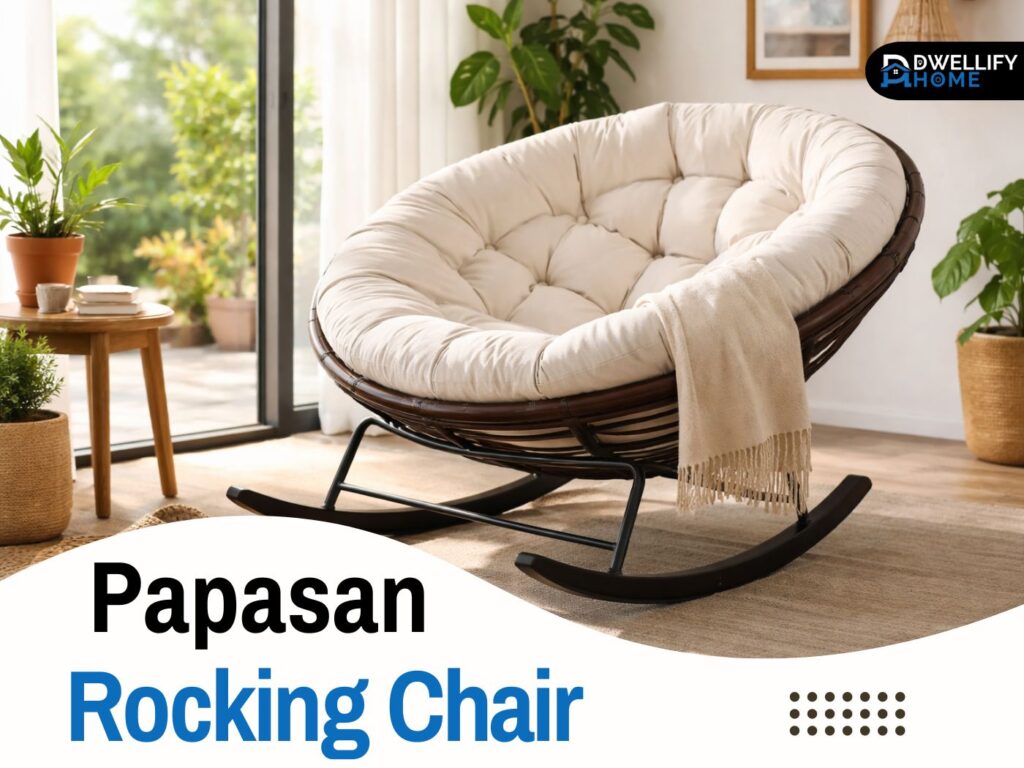
A papasan rocking chair is one of those seats that looks casual, but can feel surprisingly personal once you actually live with it. It’s wide, bowl-shaped, and built for curling up, then the rocking base adds that slow, calming motion people usually associate with a porch rocker.
I’ve tested a lot of lounge seating in real homes over the past 8 years, and this style is a comfort-first pick. But it’s not for everyone, and the details matter more than most product photos admit. This guide will help you choose one that feels stable, supportive, and easy to live with.
Snippet-ready definition:
A papasan rocking chair is a bowl-shaped lounge chair with a thick cushion on a rocking base. It’s made for relaxed sitting, reading, and unwinding, with a gentle sway that feels calmer than a standard papasan.
Mission Statement:
At Dwellify Home, our goal is to help you choose furniture that feels good in real life, not just in photos, with clear guidance on comfort, durability, safety, and everyday usability.
What Is a Papasan Rocking Chair?
Think of it as a papasan chair with a rocking foundation instead of the usual stationary base. The round seat cradles you, and the rocker lets you sway without needing a big push.
In daily use, the “bowl” shape is what makes it different from a normal rocker. You don’t sit on it like a dining chair. You settle into it. That’s why it works so well for reading, gaming, casual lounging, and the kind of slow decompression you do at the end of the day.
Quick Guide Table: What to Buy for Your Space
| What you care about | What to look for | What to avoid |
| Small room | Standard size, compact base, measured rocking clearance | Oversized seat that blocks walkways |
| Maximum comfort | Oversized papasan rocking chair, dense cushion, strap-tied cushion | Thin cushion that flattens quickly |
| Outdoor use | Powder-coated or rust-resistant frame, water-resistant and UV-resistant fabric | Bare metal finish, indoor fabric left in sun/rain |
| Better back comfort | Firmer cushion, add small lumbar pillow, deeper bowl seat | Very soft cushion that collapses in the center |
| Safety and stability | Wider base, non-slip feet, solid weight capacity rating | Narrow rocker base, wobble, unclear capacity |
| Buying two | Papasan rocking chair set of 2 with matching size and cushion type | Mixed heights and mismatched bases |
Quick Bullet Checklist Before You Order
- Measure the chair footprint plus rocking clearance behind it
- Confirm weight capacity and base width
- Check cushion thickness and whether the cover is removable
- Look for cushion ties or straps to stop sliding
- For outdoor: frame coating plus UV and water resistance
- Read return policy and warranty terms before checkout
Papasan Rocker vs Regular Papasan Chair
The rocking version feels more relaxing when you’re actually spending time in it. For some people, that gentle movement helps them unwind faster, especially if they use it after work, during a reading session, or for a calm phone-scroll routine.
A regular papasan can feel more planted, though. If your floor is uneven, your room is tight, or you want a chair that never shifts, the stationary base has an edge.
A simple way to decide is this:
- Choose rocking if you want motion, soothing comfort, and a chair you’ll use for longer sits.
- Choose stationary if you want maximum stability, minimal movement, or you’re placing it in a high-traffic area.
Sizes and Types (So You Don’t Buy the Wrong One)
This is where most regrets happen. People see a pretty photo, then it arrives and either overwhelms the space or feels smaller than expected.
Standard vs Oversized Papasan Rocking Chair
Standard sizes can feel cozy for one person, but “cozy” sometimes turns into “tight” if you like to sit cross-legged or lean back with a blanket. An oversized papasan rocking chair usually makes the chair feel less like a perch and more like a true lounge spot.
In my testing, oversized is the safer choice if:
- You’re tall
- You like curling up
- You plan to use it for longer than 20 to 30 minutes at a time
It also tends to distribute pressure better because you’re not perched on a smaller curve.
Papasan vs Mamasan (Double Papasan) Rocking Chair
A mamasan, or double papasan, is basically a wider version designed for more space and sometimes two people. It can be great for couples, kids piling in, or a parent and child reading together.
The trade-off is weight and footprint. These are harder to move, and they need more clearance for rocking. If you’re considering a larger size, make sure you measure not just the chair, but the rocking swing area behind it.
Indoor vs Outdoor Papasan Rocking Chair (What Actually Changes)
A papasan rocking chair indoor setup is all about softness and staying clean. Indoors, you can prioritize plush cushions, cozy fabrics, and style, because you’re not fighting sun, rain, or humidity.
A papasan rocking chair outdoor model has to handle real exposure. “Outdoor” should mean the frame resists rust and the cushion fabric won’t fade fast. In practice, even outdoor cushions last longer if you bring them inside during heavy rain or long sunny weeks.
For covered porches and screened patios, you have more flexibility. For open decks, look for water-resistant fabric, quick-dry fill, and a frame that feels solid and protected.
Design and Structure (Frame, Base, and Rocking Feel)
The frame and base decide whether this chair feels secure or slightly sketchy. A papasan rocking chair frame is usually metal for rocking versions, because it’s easier to engineer stability and smooth motion.
Here’s what I pay attention to when testing:
- The base should be wide enough that the rocking motion feels controlled, not tippy
- The chair should rock smoothly without a sudden stop at the front or back
- The contact points should have non-slip feet or pads, especially on tile or wood floors
If you’re looking at a rattan-style look, many “rattan” rockers are actually metal frames with woven resin or wicker wrap. That can be a good thing outdoors, because natural rattan does not love moisture.
Comfort and Cushion Checklist (The Make-or-Break Part)
The cushion is the whole experience. A chair can have a strong frame, but if the cushion goes flat, you’ll stop using it.
A good cushion feels supportive in the center, not like you’re falling into a hole. It should also keep its shape after a long sit. In real homes, the weak cushions are the ones that look puffy at first, then compress fast and start sliding around.
A few practical checks that help:
- Thicker cushions usually feel better, but density matters more than height
- Removable covers are a big plus for everyday life
- Ties or straps reduce cushion slipping, especially with rocking motion
- For outdoor use, look for UV resistance and water resistance, not just “outdoor” in the title
If you can, choose a cushion you can replace later. That single detail can double the useful life of the chair.
Weight Capacity, Safety, and Back Support (Practical, Trustworthy Advice)
Weight capacity is not just a number. It’s a clue about how the base is built. A chair rated higher usually has thicker metal, better joints, and a base that spreads weight more evenly.
Stability also depends on where you place it. On thick carpet, some rockers feel less predictable. On smooth floors, they can move unless the feet grip well. I’ve had the best results with a flat, stable surface and a rug that doesn’t bunch.
Back support is where you should set expectations. The bowl shape supports you differently than a structured armchair. It’s great for relaxed lounging, but it’s not a posture chair. If you plan long sitting sessions, a small lumbar pillow can make a big difference. I often recommend it to people who feel lower-back fatigue after 45 minutes.
A quick safety note from real use: leave enough clearance behind the chair. Rockers placed too close to a wall tend to bump, and that’s when people start feeling uneasy using them.
Popular Configurations People Care About
Some versions are genuinely useful, not just variations.
A papasan rocking chair with ottoman can be a comfort upgrade if you like your legs elevated. It can reduce pressure on your lower back during long sits, and it changes the chair from “lounging” to “real resting.” The downside is space. An ottoman makes the setup larger and less flexible in smaller rooms.
A papasan rocking chair set of 2 makes sense in a few situations: a symmetrical porch setup, a couple’s lounge area, or a living room layout where two matching chairs look cleaner than mixing styles. Just remember that two rockers need extra clearance, so measure the swing area for both.
Papasan Rocking Chair Price (What You Pay and Why)
Papasan rocking chair price varies mostly because of three things: frame quality, cushion quality, and whether it’s built for outdoor conditions. Oversized and double models also cost more because they use more materials and need stronger construction.
In my experience, it’s worth paying more for:
- A sturdy rocking base that feels controlled
- A cushion that stays supportive, not just fluffy
- Clear specs, a reasonable return policy, and a warranty you can understand
Things to avoid at any price:
- Unclear weight capacity
- A base that looks narrow for the seat size
- Thin cushions with no replacement options
If your budget is tight, prioritize the frame and stability first. You can sometimes upgrade the cushion later, but you can’t easily fix a wobbly base.
Where to Buy and What to Check Before You Order
No matter where you buy, the listing should answer basic questions clearly. If it doesn’t, that’s usually a sign the product is not well-documented, and returns become more likely.
Before ordering, check:
- Seat diameter and overall footprint
- Rocking clearance needed
- Weight capacity
- Frame material and finish, especially if it’s going outdoors
- Cushion thickness, cover type, and whether covers are removable
- Whether the cushion is secured with ties or straps
- Return policy and warranty terms
Some shoppers compare options across big retailers and even look up terms like rocking papasan chair IKEA. That’s fine, just make sure the specs match your space and comfort needs, because the name alone doesn’t tell you how it will feel day-to-day.
Assembly and Setup (So It Feels Stable and Quiet)
Most of these chairs arrive with some assembly. It’s usually straightforward, but the final feel depends on setup more than people expect.
A few tips that consistently help:
- Tighten everything evenly, then re-check after a week of use
- If the chair squeaks, it’s often a bolt that needs another turn, not a defect
- Use floor protectors if you’re on wood or tile
- Place it where the rocking motion won’t hit furniture, walls, or plants
On patios, a flat surface matters. If your deck boards are uneven, the rocker can feel slightly off-balance, even if the chair itself is fine.
Care and Cleaning (Indoor and Outdoor)
Indoors, care is mostly about the cushion. If you can remove and wash the cover, life gets easier. Spot-cleaning works for small spills, but covers save you from the slow buildup that makes cushions look tired.
Outdoors, the best habit is simple: protect the cushion. Even water-resistant fabric lasts longer if you bring it inside during storms or store it in a deck box. For mildew prevention, avoid leaving damp cushions in shade for days.
For the frame, wipe it down occasionally and check joints once in a while. If you live in a humid area, rust resistance matters, and a quick clean can keep the finish from degrading.
Styling Ideas That Don’t Look Cheap
This chair can look intentional, or it can look like a leftover dorm seat. Styling is what makes the difference.
A few setups that work well in real homes:
- Neutral cushion with one textured throw and one simple pillow
- A small side table that’s the same height as the seat edge
- A warm reading lamp nearby, especially in a corner nook
- For boho spaces, pair it with natural wood tones and woven textures
- For modern spaces, keep colors solid and limit patterns to one item
Placement matters too. In a bedroom corner, it feels personal. In a sunroom, it feels like a lounge zone. On a covered porch, it becomes the chair everyone fights over.
FAQs
1) What is the difference between Mamasan and Papasan chairs?
A papasan is typically a one-person round bowl seat. A mamasan is wider, often described as a double papasan, so it can fit two people or one person who wants more sprawl space.
2) What are the pros and cons of Papasan chairs?
Pros: very cozy for lounging, great for reading and relaxed sitting, easy to style in casual spaces.
Cons: not a posture chair, takes up more floor space than it looks, cushion can slide or flatten if quality is low, and rocking versions need extra clearance.
3) Why shouldn’t you keep an empty rocking chair?
This one is mostly cultural superstition. In Irish folklore, an empty rocking chair is sometimes described as inviting spirits or bad luck, especially if it rocks on its own. It’s not a safety rule, just a traditional belief some people still mention.
4) Where does Cracker Barrel get their rocking chairs?
Cracker Barrel has sold rocking chairs made by the Hinkle Chair Company for many years, and Hinkle is often cited as a key maker behind the classic porch rockers seen at Cracker Barrel stores.
5) Can a papasan rocking chair work in a small room?
Yes, but choose a standard size and measure rocking clearance. In tight rooms, the chair can bump walls or furniture, which makes it feel less relaxing.
Conclusion
If you want a chair that feels like a soft landing spot, this style can be a great fit. The best results come from getting the fundamentals right: a stable base, a supportive cushion, and a size that matches how you actually sit at home.
Treat it like a comfort tool, not just decor. Measure your space, give the rocker enough clearance, and don’t compromise on the cushion if you plan to use it daily. When you do it that way, a papasan rocking chair becomes one of those seats you end up using more than you expected, because it simply feels good to settle into.
Disclaimer:
This article is for general informational purposes based on practical seating evaluation and common product specs. Always confirm measurements, materials, weight capacity, and care instructions on the product listing and follow the manufacturer’s safety guidance.

I’m Bilal Hassan, the founder of Dwellify Home. With 6 years of practical experience in home remodeling, interior design, and décor consulting, I help people transform their spaces with simple, effective, and affordable ideas. I specialize in offering real-world tips, step-by-step guides, and product recommendations that make home improvement easier and more enjoyable. My mission is to empower homeowners and renters to create functional, beautiful spaces—one thoughtful update at a time.