
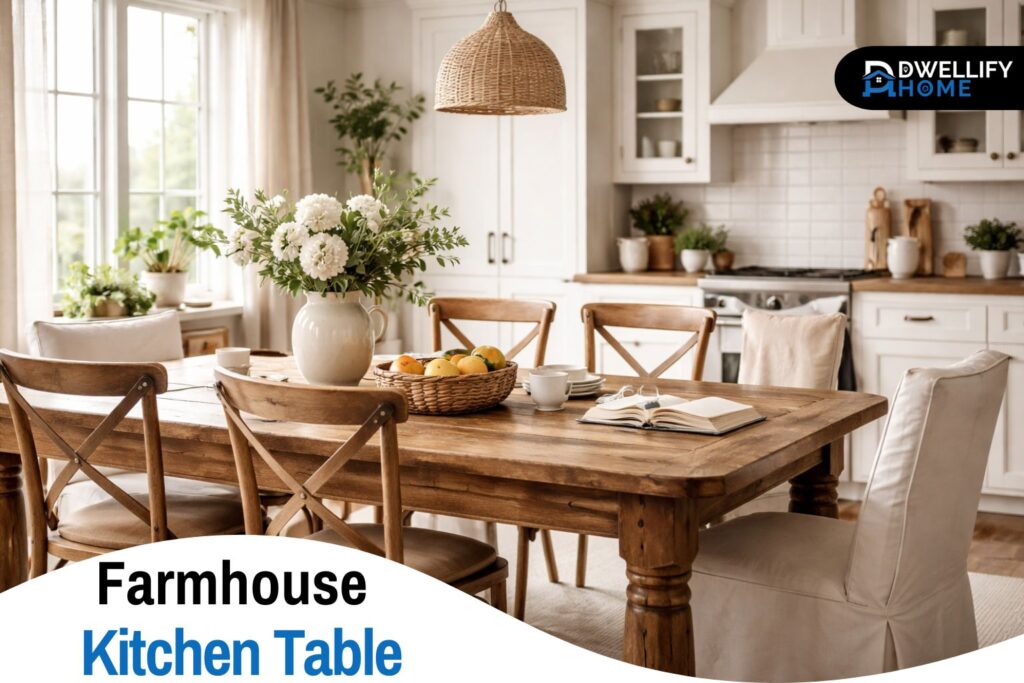
A farmhouse kitchen table carries more weight than just its physical heft. It becomes the place where morning coffee turns into afternoon homework sessions, where weeknight dinners stretch into long conversations, where birthday candles get blown out and holiday puzzles get half-finished. I’ve helped hundreds of families navigate this purchase over the years, and the ones who love their tables five years later didn’t necessarily spend the most money. They simply thought through how they actually live before they bought.
The farmhouse style resonates because it promises warmth and durability—qualities we all want in the center of our homes. But that promise only holds if you choose wisely. A table that looks perfect in a styled photograph might fight your daily routine. One that fits your space physically might still feel wrong for your life. Here’s how to get it right.
Snippet-Ready Definition
A farmhouse kitchen table is a sturdy, often wooden dining table characterized by simple construction, natural materials, and rustic warmth. It serves as a multi-functional gathering space for meals, work, and connection in residential kitchens.
Mission Statement
Dwellify Home helps homeowners navigate décor decisions with practical guidance and honest information. We believe good design serves daily life, not the other way around.
How Your Actual Life Should Drive This Decision
Start with honest observation. Walk through a typical week in your mind. Does breakfast happen in five-minute shifts or lingering weekend brunches? Do kids spread homework across the surface while you prep dinner? Is this table also your home office, your craft station, your bill-paying desk? The more jobs this piece needs to do, the more carefully you need to choose.
Families often buy for their current headcount and regret it eighteen months later. A couple with a toddler buys a four-seater, then finds themselves cramped when grandparents visit or a second child arrives. Conversely, empty nesters sometimes oversize for imagined holiday gatherings that happen twice a year, enduring a too-large table daily. Think in stages. Buy for where you’re headed, not just where you are.
Traffic patterns matter more than most people realize. I’ve seen beautiful tables that blocked the refrigerator door or created awkward bottlenecks between kitchen and living space. You need at least 36 inches of clearance on all sides for comfortable movement. Less than that, and every meal becomes a navigation puzzle.
Key Benefits
- Accommodates daily family life and occasional entertaining
- Adapts to multiple uses beyond dining
- Ages visibly and develops character over time
- Anchors kitchen design with warmth and permanence
- Available in sizes and shapes for various spaces
The Space Reality Check
Measure twice, then measure differently. Most people measure their room and buy accordingly, but they forget to account for visual weight. A chunky, dark farmhouse table can overwhelm a space even if the dimensions technically fit. In open-concept areas, the table needs to relate well to both kitchen and living zones without dominating either.
Small spaces don’t disqualify you from this style. I’ve placed compact farmhouse tables in galley kitchens that transformed the room. The key is choosing appropriately scaled proportions. A massive trestle base in a tight space feels like furniture bullying. A slender turned-leg design with a thinner top profile breathes easier.
For genuinely tight quarters, consider a farmhouse kitchen table round. Circles flow better in square rooms and encourage conversation since everyone faces center. They also eliminate sharp corners in high-traffic paths. A 42-inch round table seats four comfortably—sometimes five if you’re friendly. For daily dining with occasional guests, look for round tables with extension leaves that convert to ovals.
Choosing Dimensions That Work
The standard rule allocates 24 inches of table width per person. That’s minimum, not comfortable. For daily use, 30 inches per person prevents elbow wars. Length depends on your space and needs, but here’s practical guidance: a 60-inch table fits four perfectly, six tightly. A 72-inch table seats six well, eight with squeeze. An 84-inch table accommodates eight with comfort, ten for holidays.
Height matters too. Standard dining height is 30 inches, but farmhouse tables sometimes run 31 or 32 inches, especially thick-plank designs. That extra height changes everything about how chairs fit and how your arms rest while eating. Always check before buying, especially if you’re mixing table and chairs from different sources.
Bench seating changes the math entirely. A farmhouse kitchen table with bench allows you to squeeze in more people when needed since benches don’t have individual width requirements. Three kids fit on a 48-inch bench that would only accommodate two chairs. Benches also tuck completely under the table when not in use, reclaiming floor space. The trade-off is comfort—benches work for shorter meals, less so for three-hour dinner parties.
Wood Types and What They Mean for Daily Life
Oak remains the workhorse of farmhouse tables for good reason. It’s hard, durable, and develops character gracefully. The open grain hides small scratches better than tight-grain woods. I’ve seen twenty-year-old oak farmhouse tables that look better than they did new—the patina becomes the point.
Maple offers similar hardness with a cleaner, more contemporary look. It takes stain evenly and resists denting, making it practical for homes with young children. Cherry starts lighter and darkens to a rich reddish-brown over time, which some people love and others find unpredictable. Pine sits at the opposite end of the durability spectrum. It’s affordable, warm, and authentic to traditional farmhouse construction. It’s also soft. I’ve watched pine tables acquire dents and scratches within the first month of family use. That distressing can look charmingly rustic or frustratingly damaged, depending on your temperament.
Reclaimed wood carries stories in its nail holes and saw marks. It’s environmentally responsible and visually rich. It also requires more care. Old wood moves differently than new wood. It may have hidden weaknesses or incompatible finishes. If you choose reclaimed, buy from a reputable craftsman who understands how to stabilize and seal it properly.
Construction Details That Indicate Quality
Flip the table over or look underneath if you can. Quality farmhouse tables use traditional joinery—mortise and tenon joints for legs, apron connections that distribute weight properly. Screws and brackets alone suggest shortcuts that loosen over time.
Tabletop construction reveals longevity. Solid wood planks should be properly seasoned and joined with allowance for seasonal expansion. Breadboard ends (the perpendicular pieces at short ends) should be attached with tongue-and-groove joints, not glued rigidly, or they’ll crack as wood moves. Ask about the moisture content of the wood and how long it was kiln-dried or air-dried. Rushed drying leads to warping.
Finish quality determines maintenance burden. Oil finishes penetrate and protect from within, requiring periodic reapplication but allowing easy spot repair. Lacquer and polyurethane create surface shields that resist water and heat better but show scratches more obviously and require complete refinishing when damaged. Painted bases with natural wood tops offer the best of both worlds—durability where hands touch daily, warmth where eyes rest.
Style Variations and What They Signal
Traditional farmhouse tables feature turned legs, often chunky and substantial, with thick plank tops and visible wood grain celebrated rather than hidden. They read as collected over time, inherited rather than purchased. This style works best in homes with other traditional elements—cabinets with raised panels, vintage lighting, collected rather than coordinated décor.
Modern farmhouse cleans up the lines. Trestle bases replace turned legs. Lighter finishes—whitewashed, pale gray, natural oak—replace the darker stains. Metal accents, often black iron or aged brass, add industrial notes. This variation suits contemporary homes, open-concept spaces with clean-lined kitchens, and people who want warmth without heaviness.
The rustic end of the spectrum embraces distressing: hand-scraped surfaces, visible knots, wormholes, uneven edges. It’s authentic to agricultural origins but high-maintenance for daily life. Food gets caught in crevices. Liquids pool in low spots. The rustic farmhouse dining table looks beautiful but demands acceptance of imperfection or diligent maintenance.
Where to Buy and What to Expect
Local craftsmen build relationships along with furniture. You get exact sizing, wood selection, finish customization, and someone to call if problems arise. Expect to wait eight to twelve weeks and pay 30-50% more than retail. The investment shows in details like properly oriented grain, hand-rubbed finishes, and joinery that survives moves and generations.
Online and big-box retailers offer speed and return policies. The risk is visual—screens distort color and scale. What looks like warm honey oak online arrives as orange-toned pine. Read reviews focusing on durability mentions, not just appearance. Check return policies carefully; some exclude large furniture or charge restocking fees that erase your savings.
Vintage and secondhand markets provide authentic character at variable prices. I’ve found solid 1940s oak tables for less than particleboard new ones. Inspect for structural soundness—wobbly legs can often be tightened, but cracked aprons or severely warped tops require professional restoration. Factor that cost into your budget.
Mistakes I See Repeatedly
The Pinterest trap claims the most victims. People fall for a styled photograph without considering scale, maintenance, or lifestyle fit. That heavily distressed, dark-stained table looks romantic in a white kitchen with professional lighting. In your home with three kids and two dogs, it shows every crumb and paw print.
Measurement errors extend beyond room dimensions. People forget to account for chair depth when pushed back from the table, creating walkways that don’t work. They ignore knee clearance—standard aprons need at least 27 inches from floor to bottom edge for adult comfort. They neglect delivery path: that beautiful table won’t fit through your narrow stairwell or tight hallway corner.
Lifestyle mismatches hurt long-term satisfaction. Delicate finishes and young children create constant anxiety. Fixed large tables in apartments or transitional life stages become moving burdens. Style choices that ignore existing kitchen elements—cabinet colors, flooring tones, hardware finishes—create jarring dissonance rather than intentional contrast.
Living With and Caring for Your Table
Daily protection isn’t complicated. Use coasters consistently, especially under hot mugs which can cloud finishes. Wipe spills promptly—water is wood’s enemy, even with protective coatings. Keep a small supply of touch-up markers or wax sticks matching your finish for quick scratch concealment.
Clean with damp, not wet, cloths. Avoid spray cleaners, especially those containing ammonia or silicone, which degrade finishes over time. For sticky spots, mild dish soap diluted in water works fine. Dry immediately afterward.
Refinishing becomes necessary eventually, typically after five to fifteen years depending on use and original finish quality. Light sanding and fresh oil application suits oil-finished tables and takes an afternoon. Painted or lacquered surfaces require more intensive stripping and repainting, often worth professional handling unless you’re experienced.
FAQs
What makes a table farmhouse style?
Farmhouse tables feature solid wood construction, straightforward joinery, substantial proportions, and finishes that show natural grain or intentional distressing. Turned legs, trestle bases, and plank tops are common, but the defining quality is honest materiality over ornamentation.
What is replacing farmhouse style?
Transitional and organic modern styles are gaining ground, blending farmhouse warmth with cleaner lines. However, farmhouse remains relevant when executed with restraint—lighter finishes, simpler bases, and integration with contemporary elements rather than full thematic commitment.
Are farmhouse tables still in style?
Yes, when chosen thoughtfully. The trend has evolved from heavy, dark distressing toward lighter, more versatile interpretations. A well-proportioned farmhouse table in oak or maple with clean lines transcends trend cycles and functions as a neutral, lasting piece.
How do I style a farmhouse kitchen table daily?
Start with functional protection: woven placemats or simple runners that handle spills. Add one low centerpiece—a ceramic bowl, wooden dough bowl, or small potted herb—that doesn’t obstruct sightlines. Keep daily styling minimal; let the wood and the living that happens there provide the interest.
How much should I expect to spend on a quality farmhouse table?
Solid hardwood farmhouse tables typically range from $800 to $2,500 depending on size, wood species, and construction. Custom or reclaimed pieces command premium prices. Budget options in pine or engineered wood start around $300 but require earlier replacement or refinishing.
Finding the Table That Becomes Part of Your Story
The right farmhouse kitchen table doesn’t announce itself with the highest price tag or the most dramatic styling. It fits your space physically and your life practically. It accommodates both daily solitude and occasional celebration. It tolerates the reality of meals, not just their idealization.
Start with honest assessment of your space, your habits, and your trajectory. Choose materials and construction that match your maintenance willingness. Buy from sources that stand behind their work. Then commit fully—use the table daily, mark it with living, let it accumulate the patina that makes it unmistakably yours.
Years from now, the dents and scratches won’t be flaws. They’ll be the record of your life, written in wood.
Disclaimer
Product recommendations and pricing reflect market conditions at publication. Always verify dimensions, materials, and return policies with specific retailers before purchasing.

I’m Bilal, the founder of Dwellify Home. With 6 years of practical experience in home remodeling, interior design, and décor consulting, I help people transform their spaces with simple, effective, and affordable ideas. I specialize in offering real-world tips, step-by-step guides, and product recommendations that make home improvement easier and more enjoyable. My mission is to empower homeowners and renters to create functional, beautiful spaces—one thoughtful update at a time.