Over the years, Ive walked into a lot of kitchens that should feel like the heart of the home but dont. Theyre beautiful, sure. High-end appliances, pristine countertops, perfect lighting for food photography. But theres no warmth. You dont want to linger. You certainly dont want to pull up a chair and stay awhile.
Ive been helping homeowners transform these spaces for about 14 years now, and Ive learned that the problem is rarely about spending more money or chasing the latest trend. Its usually about something simpler: we forgot that kitchens are for people, not just for cooking.
Lets talk about how to fix that.
Short answer
Transform your space with small, intentional changes that actually work.
Our Mission
Dwellify Home helps homeowners make practical, stylish, and informed décor decisions.
Why So Many Modern Kitchens Feel Cold and Uninviting
Heres what I see most often. Someone invests in a kitchen renovation, picks out everything they see in design magazines, and ends up with a space that feels more like a surgical suite than a place where family actually gathers.
The all-white, hard-surface kitchen became popular because it photographs well. But living in it is different. Every sound echoes. Every fingerprint shows. Theres nothing soft to lean against or touch. You walk in and instinctively lower your voice, like youre in a gallery.
I worked with a family a few years ago who had this exact problem. Beautiful kitchen, brand new, and they ate every meal in the breakfast nook with their backs to it. The kitchen itself felt too formal, too sterile. They cooked there, but they didnt live there.
Thats the moment you realize a kitchen can be functional and still fail you emotionally.
Quick Comparison: Comfort Kitchen (Home Design) vs. Comfort Kitchen (Restaurant)
| Aspect | Comfort Kitchen (Home Design) | Comfort Kitchen (Restaurant) |
| What it is | A design philosophy for warm, inviting home kitchens | A restaurant located in Boston’s Dorchester neighborhood |
| Purpose | Creating spaces where people want to gather and linger | Serving globally inspired cuisine with a focus on comfort food |
| Relevance to this article | The main topic—how to transform your own kitchen | Not covered here; this article focuses on residential design |
The Three Pillars of Kitchen Comfort
Through years of trial and error with clients, Ive come to think of kitchen comfort in three layers. If any one is missing, the space feels off.
Visual warmth is what you see first. Colors, textures, shapes. If everything is hard and glossy and white, your eye never rests.
Physical ease is how the space works. Do drawers slam? Do you have to walk around an island thats too big to talk to someone on the other side? Do you feel relaxed cooking there or rushed?
Emotional resonance is harder to define but you know it when you feel it. Its the kitchen where people gravitate during parties. Where kids do homework while dinner happens. Where you actually want to sit and have your coffee.
Introducing the Soft Kitchen Philosophy
Theres a shift happening in kitchen design, and honestly, its about time. Designers are starting to talk about the soft kitchen approach. What that means in practice is simple: were borrowing ideas from living rooms and bringing them into the kitchen.
A designer friend put it well recently. She said people want a room where you can cook, sure, but also sit and relax. A place thats a pleasure to pass time in, not just a place to get through a task.
Thats the goal. Not a cooking machine. A living space.
Color Psychology for Kitchen Comfort
When I work with clients who feel their kitchen is too cold, the first place we look is color. And almost always, theyve gone too neutral in a way that reads sterile rather than calm.
Im not saying you need bright red walls. But look at your whites. Are they stark, blue-toned whites? Those read cold because they literally reflect more blue light. Switching to a warm white with cream or yellow undertones changes everything.
One client was convinced she hated her kitchen cabinets. Wanted to replace them all. We painted them a soft greige instead, something with warmth but still neutral. She cried when she saw it. Not because it was dramatic, but because it finally felt like hers.
Other colors that work well: muted terracottas, earthy neutrals, soft greens. Nothing bold or shouting. Gentle colors.
Materials That Say Welcome
Heres something beginners overlook. Glossy finishes reflect light and also reflect noise and movement. They feel busy. Matte finishes absorb light. They feel calm.
When Im specifying materials for a kitchen renovation, I almost always push clients toward matte cabinetry. It hides fingerprints better too, which is practical, but the main reason is it just feels quieter.
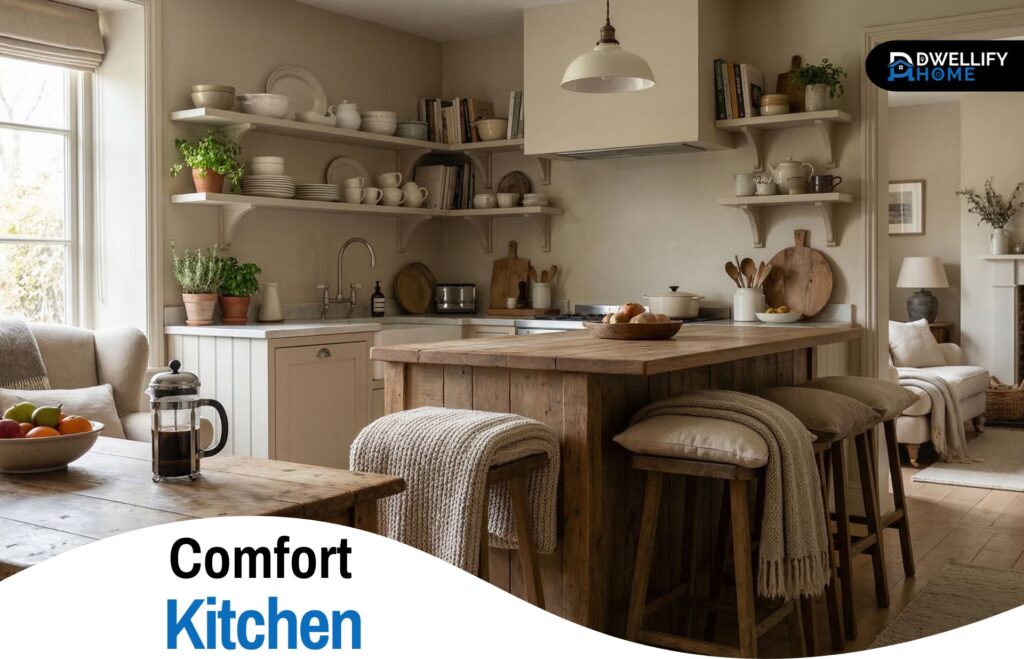
Natural materials matter more than people realize. Wood that you can see the grain in. Stone that has variation and depth. Metals that will patina and age rather than stay perfectly shiny forever. These things make a kitchen feel alive because they are alive. They change over time.
The Rise of Curves and Soft Edges
This is one of those details that people notice only when its missing. Sharp corners everywhere. Square islands. Rectangular everything.
Curves matter psychologically. They signal safety. They feel organic rather than manufactured.
You dont have to rip out your kitchen to add curves. Sometimes its as simple as a rounded island if youre renovating, or curved bar stools, or arched openings if youre doing bigger work. But if youre stuck with sharp corners, soften them visually with plants, fabric, anything that breaks that hard line.
Designing for Flow, Not Just Efficiency
Kitchen designers love to talk about the work triangle. Sink, stove, refrigerator. Efficient movement between them.
I care about that, but I care more about how people actually move through the space when theyre not cooking.
I worked with a couple where one person would cook and the other would sit at the island to keep them company. But the island was positioned so they were basically staring at a wall. They could talk, but they couldnt see each other easily. We moved a few things, opened up one side, and suddenly the whole dynamic changed.
Flow isnt just about steps. Its about connection.
Storage That Serves Peace of Mind
Heres the truth. Clutter stresses people out. Even if you dont realize it, walking into a kitchen with stuff everywhere raises your cortisol.
But storage solutions dont have to be complicated. Quiet-close drawers arent just a luxury. They reduce noise, which reduces stress. Interior organizers mean you can find what you need without rummaging.
One of my favorite upgrades is corner carousels for base cabinets. Such a simple thing. But clients always tell me later they didnt realize how much they hated digging into dark corners until they didnt have to anymore.
Lighting for Mood and Function
Overhead lighting is the enemy of cozy kitchens. I know you need it for tasks. But if thats all you have, your kitchen will feel like a classroom.
Layered lighting is the answer. Under-cabinet lights for counter work. A pendant over the island thats on a dimmer. Maybe even a small lamp on the counter, which sounds strange but works beautifully.
Warm bulbs, not cool ones. Dimmers everywhere. The ability to change the feel of the room depending on time of day and what youre doing.
Seating That Invites Lingering
Bar stools are fine for quick breakfasts. But if you want people to stay, give them something comfortable to sit on.
Ive put upholstered chairs at kitchen islands before. Clients worry about spills. Get performance fabric or washable covers. Its worth it when someone actually sits down and stays for an hour talking while you cook.
Window seats are another favorite. Even a small one. People gravitate toward them naturally.
When Kitchens Become Living Spaces
The line between kitchen and living room is disappearing, and thats a good thing.
I recently worked on a house where we basically treated the kitchen as part of the living room. Same flooring throughout. Same trim details. Same lighting fixtures. You walk in and theres no transition. The kitchen is just where the stove happens to be.
Thats the goal. A space that feels like one room, not two rooms pushed together.
Furniture-First Kitchen Design
Heres a trick I stole from a designer I admire. Choose your kitchen island like youd choose a dining table. Furniture legs. A piece that could stand alone in a room, not just a cabinet with a counter on top.
Same with appliances. Panel-ready refrigerators that look like cabinets. Dishwashers hidden behind matching panels. The technology is there, but it doesnt announce itself.
Rugs, Textiles, and Soft Layers
People are terrified of rugs in kitchens. I get it. Spills happen.
But washable rugs exist now. And the difference they make is enormous. A runner down a galley kitchen changes the whole feel. Suddenly theres softness underfoot, color, pattern.
Same with fabric at windows. Linen napkins left out. Cushions on stools. Anything that adds a layer of softness.
Soundscaping Your Kitchen
This is something almost no one thinks about until they notice it. Kitchens are loud. Hard surfaces reflect sound. Slamming cabinet doors. Clattering dishes.
Soft-close features arent just about preserving your cabinets. Theyre about preserving your peace. Same with runners that absorb sound. Same with avoiding huge expanses of bare wall.
The Emotional Connection
At the end of the day, the kitchens that work best are the ones where people actually want to be together.
I had a client tell me recently that after we changed her kitchen, her teenagers started hanging out there. Just sitting at the island doing homework while she cooked. She said it was the first time in years theyd all been in the same room without phones.
Thats not design. Thats something else. But design made it possible.
When Technology Disappears
Smart kitchens are great, but the best smart technology is the kind you dont notice.
Integrated extraction hobs that vent downward so you dont need a hood. Refrigerators with cameras inside so you can check whats there from the grocery store. Water taps that give you boiling, chilled, and sparkling from one spout.
The technology should serve you, not demand your attention.
Quick Wins You Can Do This Weekend
If youre not ready for a renovation, here are things Ive done with clients that cost almost nothing:
Swap out cabinet hardware for something warmer. Brushed brass, unlacquered brass that will patina over time. It changes the whole feel.
Add a washable runner. Just one. See how it feels.
Put a lamp on your counter. Not under-cabinet lighting, an actual lamp. Plug it into a dimmer outlet if you can.
Display something meaningful. Not a decor item you bought because it matched. Something that matters to you.
Add one upholstered stool. Just one. See if you sit on it more than the others.
Common Mistakes to Avoid
Dont over-automate. Ive seen kitchens where you need an instruction manual to make coffee. Its not comforting, its frustrating.
Dont choose aesthetics over comfort. That beautiful marble countertop that stains if you look at it wrong will stress you out every time you use it.
Dont forget how you actually live. Design for your real life, not the life you think you should have.
The Future of Comfort Kitchens
I think were going to see kitchens become even more like living rooms. More personal. Less trend-driven. More about what actually works for the people who use them.
Sustainability will play a bigger role too. Not because its trendy, but because things that last and age well are inherently more comforting than things that need constant replacement.
Frequently Asked Questions
Who owns Comfort Kitchen?
Comfort Kitchen is a restaurant in Boston’s Dorchester neighborhood. For residential comfort kitchen design questions, this article covers how to transform your own home kitchen.
What was Tom Brady’s favorite restaurant in Boston?
Tom Brady has mentioned several Boston-area favorites over the years, but this article focuses on home kitchen design rather than restaurant recommendations.
What’s the dress code in comfort kitchen Boston?
For the Boston restaurant, check their website directly. This article is about residential kitchen design and comfort in your own home.
What is the hardest restaurant to get into in Boston?
Restaurant popularity fluctuates constantly. For home kitchen design advice, you’re in the right place.
Wrapping This Up
A comfort kitchen isnt about spending a lot of money or chasing the right look. Its about paying attention to how you want to feel in the space and making small, intentional choices that support that feeling.
Start with one thing. A warmer light bulb. A rug. A stool thats actually comfortable. See how it feels. Then do another.
The goal isnt a perfect kitchen. The goal is a kitchen where life happens warmly. Where people want to be. Where you feel fed in more ways than one.
Disclaimer
This article provides general design guidance. Individual results may vary based on space, budget, and personal preference.

I’m Bilal, the founder of Dwellify Home. With 6 years of practical experience in home remodeling, interior design, and décor consulting, I help people transform their spaces with simple, effective, and affordable ideas. I specialize in offering real-world tips, step-by-step guides, and product recommendations that make home improvement easier and more enjoyable. My mission is to empower homeowners and renters to create functional, beautiful spaces—one thoughtful update at a time.