
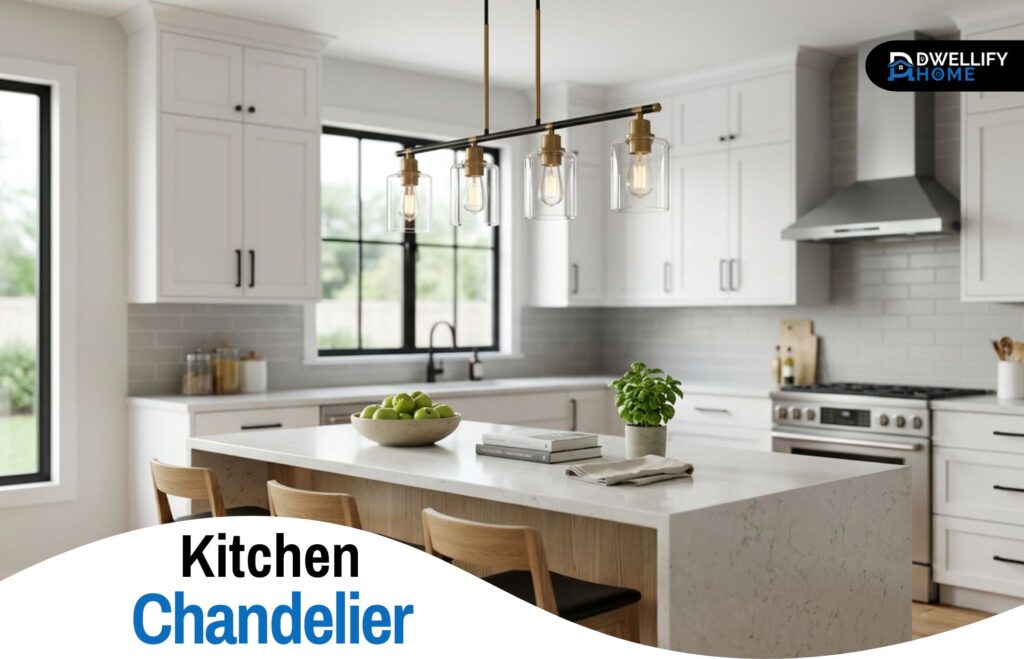
Walking into a kitchen usually tells you two things immediately: how the owner cooks and how they feel about their home’s personality. The light hanging over the island or the table is almost always the first thing people notice. It acts as the visual anchor for the entire room. After years of walking onto job sites and helping homeowners fix lighting mistakes, I have learned that a kitchen chandelier is much more than a source of brightness. It is a piece of furniture that hangs from the ceiling.
Getting this choice right involves a mix of basic math and an eye for how you actually use your space. You want a fixture that makes a statement without making you duck every time you set the table. Whether you are looking for a modern touch or a rustic feel, the goal is to find a balance between the architecture of your cabinets and the warmth of your dining area.
Snippet-Ready Definition
A kitchen chandelier is a decorative ceiling-mounted light fixture designed to provide ambient illumination and a visual focal point. Homeowners choose them to balance functional task lighting with a personal style statement that anchors the room’s design.
Mission Statement: Helping homeowners make practical, stylish, and informed décor decisions.
Key Benefits of a Kitchen Chandelier
- Visual Anchor: Defines the dining or prep area in open-concept floor plans.
- Layered Lighting: Complements recessed “can” lights to eliminate harsh shadows.
- Aesthetic Upgrade: Instantly modernizes a kitchen without a full renovation.
- Dimmable Ambiance: Easily transitions the room from high-energy cooking to relaxed dining.
The Sizing Blueprint: Formulas for a Perfect Fit
One of the most frequent phone calls I get starts with a homeowner realizing the light they just bought looks tiny in their open-concept kitchen. It is a common mistake. If a fixture is too small, the room feels unfinished. If it is too large, it feels like the ceiling is falling on you.
To find the right diameter for a general kitchen area, use the simple addition rule. Take the length and width of your room in feet. Add those two numbers together. The resulting number, in inches, is the ideal diameter for your chandelier. For example, a 12-foot by 12-foot kitchen needs a fixture about 24 inches wide.
When you are looking for a chandelier for kitchen island placement, the rules change slightly. You have to consider the scale of the island itself. A good rule of thumb is the 2/3 rule. Your light fixture should be about two-thirds the length of the island. If you have a massive 9-foot island, a single small pendant will look lost. In that case, you might want a long, linear kitchen chandelier or a pair of larger round ones.
The shape of your furniture matters just as much as the size. If you have a long, rectangular dining table, a linear suspension light usually looks best because it follows the lines of the wood. If your table is round or square, a single circular chandelier helps soften the sharp angles of the surrounding cabinetry and creates a more intimate dining nook.
Precision Placement: Height and Sightlines
Once you have the right size, you have to decide exactly where to hang it. I have seen many beautiful kitchens ruined by a light hung so low that you can’t see the person sitting across from you. On the flip side, hanging it too high makes the light feel disconnected from the room.
For a standard 8-foot ceiling, the bottom of your kitchen chandelier over table surfaces should sit between 30 and 36 inches above the tabletop. This is the sweet spot that provides enough light for reading a recipe or eating a meal without obstructing your view.
If your ceilings are higher, you need to adjust. For every extra foot of ceiling height above 8 feet, add about 3 inches to the hanging height. So, if you have 10-foot ceilings, your chandelier should hang about 36 to 42 inches above the table.
Sightlines are another detail beginners often overlook. Stand in the doorway of your kitchen and look toward the window or the living room. Does the chandelier block the view of your backyard or the TV? You might need to shift the placement or choose a more open, airy frame to keep the space feeling large. Also, always center the light over the furniture, not the room. If your table is pushed slightly to one side to allow for a walkway, the light should move with it.
2026 Style Direction: Trends and Materials
We are seeing a significant shift in how people think about kitchen aesthetics. For a long time, everything was white, gray, and industrial. Now, the move is toward organic modernism. This means we are seeing a lot of matte mineral finishes, stone accents, and hand-blown glass. A modern kitchen chandelier in 2026 often features soft, rounded edges rather than sharp, cold steel.
The farmhouse kitchen chandelier has also evolved. The heavy, dark wrought iron look is being replaced by lighter-toned woods, bleached oak, and woven textures. It still feels cozy and grounded, but it doesn’t feel as heavy. These materials bring a bit of the outdoors inside, which helps a kitchen feel less like a laboratory and more like a living space.
Sculptural focal points are also gaining ground. Because most kitchens are full of rectangles—cabinets, islands, fridges—a non-linear, sculptural light fixture can break up that monotony. Think of 3D-printed shapes or glass that looks like moving water. Even the crystal chandelier for kitchen island use has changed. Instead of the ornate, Victorian styles of the past, we now see minimalist crystal bars or singular large drops that catch the light without looking dated.
The Performance Layer: Brightness and Color Quality
A chandelier can be the most beautiful thing in the house, but if it doesn’t provide good light, it’s a failure. In a kitchen, you need to distinguish between task lighting and ambient glow. Task lighting is what you need to chop vegetables safely. Ambient lighting is what makes the room feel inviting at night.
When shopping, look at lumens rather than watts. For a kitchen, you generally want about 30 to 40 foot-candles of light on your work surfaces. This usually translates to a chandelier that puts out at least 2,000 to 3,000 lumens, depending on the size of the room.
The Color Rendering Index, or CRI, is something I always tell clients to check. It measures how accurately a light source reveals the true colors of objects. In a kitchen, you want a CRI of 90 or higher. Low CRI lighting can make fresh vegetables look dull or meat look gray. You want your food to look as good as it tastes.
Layering is the secret to a professional look. Your kitchen chandelier shouldn’t be the only light source. Use it in tandem with recessed ceiling lights and under-cabinet LEDs. This prevents harsh shadows and allows you to dim the chandelier when the cooking is done and it’s time to eat. A dimmer switch is the cheapest and most effective way to change the entire mood of your kitchen instantly.
The Kitchen-Proof Factor: Durability and Safety
One thing you quickly learn after years of kitchen design is that kitchens are messy. Steam, grease, and smoke all rise. This is why I rarely recommend fabric shades or intricate beaded fixtures for a kitchen. Within a year, those materials will trap grease and dust, making them nearly impossible to clean.
Metal, glass, and smooth stone are your best friends. They can be wiped down easily with a damp cloth. Open-frame designs are also great because they don’t have large flat surfaces where dust can settle.
Safety is another practical point. Check the UL rating of any fixture you buy. Most kitchen chandeliers are rated for dry locations, which is fine for over a table or island. However, if you are hanging a light near a sink or a high-steam area like a commercial-grade range, you might want to look for a damp-rated fixture. It’s a small detail that ensures the internal wiring won’t corrode over time.
Advanced 2026 Tech: Smart and Circadian Lighting
The biggest technological change recently is the move toward tunable white light. We now have fixtures that can change their color temperature throughout the day. In the morning, you can set your kitchen chandelier to a crisp, cool white that helps you wake up and focus. In the evening, it can shift to a warm, golden amber that mimics a sunset and helps your body prepare for sleep.
Smart home integration has also become much more seamless. Most high-end chandeliers now work with voice assistants or apps that allow you to set specific scenes. You can have a “Cooking” scene where everything is at 100% brightness and a “Dinner Party” scene where the chandelier dims to 20% and the under-cabinet lights provide a soft glow.
Frequently Asked Questions
How high should a chandelier hang over a kitchen island?
It should sit 30 to 36 inches above the countertop. If the household has taller members, lean toward 36 inches to maintain clear sightlines across the room.
How do I calculate the right size for my kitchen?
Add the room’s length and width in feet. That total, in inches, is your ideal diameter. For islands, ensure the fixture is about two-thirds the island’s total length.
Are crystal chandeliers practical for kitchens?
Yes, provided they have a streamlined design. Look for crystals with smoother surfaces that are easier to wipe down, as kitchen fixtures are prone to catching grease and dust.
How many lumens do I need for a kitchen chandelier?
Aim for 2,000 to 3,000 lumens for a primary fixture. Ensure it is paired with a dimmer switch so you can adjust from bright task lighting to a soft evening glow.
Final Thoughts on Your Kitchen Glow
Choosing the right kitchen chandelier is about finding that intersection where math meets personal style. Start with the measurements to make sure the scale is right. Think about the height to keep your sightlines clear. Then, pick a material that can handle the reality of a working kitchen.
When you get these elements right, the light does more than just help you see. It pulls the cabinets, the counters, and the flooring into one cohesive story. It turns the room into a space where people want to linger long after the meal is finished. Take your time with the decision, trust the formulas, and choose something that reflects the way you live in your home.
Disclaimer:
This guide provides general design advice. Please consult a professional electrician for all installation and safety requirements.

I’m Bilal, the founder of Dwellify Home. With 6 years of practical experience in home remodeling, interior design, and décor consulting, I help people transform their spaces with simple, effective, and affordable ideas. I specialize in offering real-world tips, step-by-step guides, and product recommendations that make home improvement easier and more enjoyable. My mission is to empower homeowners and renters to create functional, beautiful spaces—one thoughtful update at a time.