The Regulatory and Economic Drivers of Commercial Lighting Upgrades in Europe
Beyond Lumens: Navigating EU Ecodesign and Energy Performance Buildings Directives (EPBD)
European commercial real estate faces stringent regulatory frameworks targeting operational decarbonization and power reduction. The tightening of EU Ecodesign regulations and the Energy Performance Buildings Directive (EPBD) forces facility operators to phase out inefficient lighting assets.
Outdated fluorescent tubes and aging LED installations fail to meet minimum energy performance standards, triggering regulatory penalties and inflated operating expenditures. Modern commercial retrofits demand a shift from nominal wattage consideration to systemic lifecycle efficiency.
Complying with these directives requires precise photonic optimization across office floors, retail complexes, and industrial warehouses without sacrificing illumination quality.
The True Cost of Poor Illumination in Offices, Retail, and Industrial Spaces
Inadequate thermal management in commercial luminaires accelerates junction temperatures, leading to premature lumen depreciation. When fixtures experience rapid L70/L80 Failures, light output drops below acceptable workplace thresholds far ahead of projected lifespans.
This degradation forces facility teams into frequent, costly maintenance cycles and emergency replacements. Furthermore, substandard lighting triggers operational inefficiencies, employee eye strain, and poor visual ergonomics.
Consequently, investing in thermally stable, high-reliability LED systems eliminates recurring maintenance overhead and stabilizes long-term facility budgets.
Core Technical Benchmarks for High-Efficiency Commercial Luminaires
When retrofitting large-scale commercial spaces, engineers must balance high luminous efficacy with strict thermal management to prevent premature diode degradation. Commercial LED lighting solutions manufactured by established industry providers like Wosen typically integrate flicker-free constant-current drivers with high-grade aluminum heat sinks, allowing modern panel and linear fixtures to achieve systemic efficiencies while maintaining structural compliance with CE and RoHS standards.
Unified Glare Rating (UGR < 19) and Visual Ergonomics
Controlling visual comfort is critical in modern workspaces to prevent fatigue and maintain cognitive performance. Complying with DIN EN 12464-1 standards requires a strict Unified Glare Rating [UGR] of less than 19 for standard office environments.
Achieving this low glare threshold relies on advanced micro-prismatic diffusers, deep-recessed LED chip layouts, and precision anti-glare reflector optics.
- Micro-Prismatic Lenses: Redirect high-angle luminous intensity downward to eliminate direct line-of-sight glare.
- Deep Recessed Architectures: Mask the light source from horizontal angles, enhancing visual ergonomics across workstation layouts.
- Optimized Beam Angles: Direct photons accurately onto task planes without spilling unconditioned light into peripheral fields.
Commercial Lighting Performance Metrics: Legacy Fluorescent vs. Modern LED Retrofits
| Performance Parameter | Legacy Fluorescent (T8/T5) | Standard LED Fixture | High-Efficiency Commercial LED |
| System Luminous Efficacy (lm/W) | 55 – 75 lm/W | 90 – 110 lm/W | 130 – 160+ lm/W |
| Unified Glare Rating (UGR) | Variable (> 22, prone to glare) | Moderate (UGR 19 – 22) | Controlled (UGR < 19 compliant) |
| Average Lifespan (Hours at L80) | 15,000 – 20,000 hours | 35,000 hours | 50,000 – 80,000+ hours (L80B10) |
| Power Factor (PF) | 0.55 – 0.80 (High reactive power) | 0.90 | > 0.95 (Active PFC correction) |
Thermal Dissipation Physics: Aluminum Extrusions and Driver Efficiency
The thermodynamic performance of an LED fixture dictates its operational stability. High-power diodes convert a portion of electrical energy into thermal heat, which must be dissipated rapidly to prevent phosphor degradation.
Modern fixtures utilize passive die-cast and extruded aluminum heat sinks that maximize surface area contact with ambient air. Combined with flicker-free constant-current drivers operating at high conversion efficiencies, these thermal architectures ensure sustained Luminous Efficacy exceeding $130\text{ lm/W}$ over decades of continuous operation.
Color Consistency and MacAdam Ellipses
Commercial retail and high-end office spaces demand rigorous color fidelity and spatial uniformity. Multi-bin LED sourcing often results in noticeable color temperature discrepancies between adjacent fixtures across a ceiling grid.
To eliminate this visual defect, high-end commercial luminaires utilize tight binning parameters based on 3-step MacAdam Ellipses. This precise color control guarantees that all installed modules emit identical chromaticity coordinates, preventing noticeable color shifts over time.
Smart Lighting Integration: DALI-2 and IoT Sensor Protocols
Daylight Harvesting and Human-Centric Lighting (HCL)
Smart building automation relies on intelligent lighting protocols to maximize energy reduction. Integrating the DALI-2 Protocol enables bidirectional communication between luminaires, ceiling-mounted PIR sensors, and central building management systems (BMS).
Systems execute automated daylight harvesting, dimming interior fixtures proportionally when natural sunlight floods perimeter zones. Furthermore, Human-Centric Lighting (HCL) profiles dynamically adjust color temperatures throughout the day to support occupant circadian rhythms.
Simplified Retrofit Installation and Modular Mounting
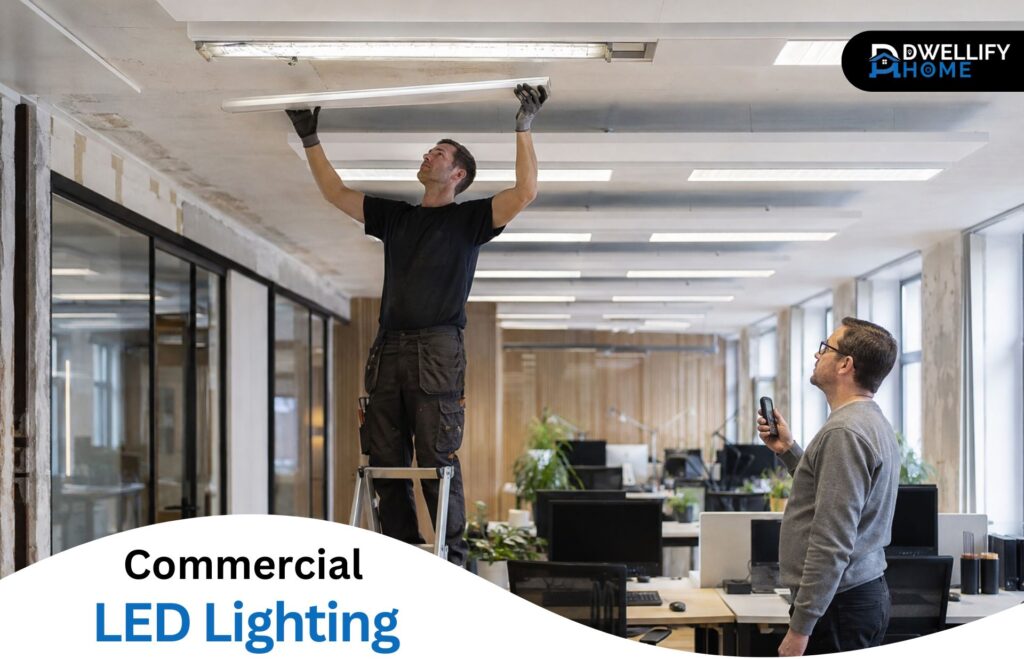
Labor costs represent a major financial component in large-scale commercial building renovations. Modern retrofit luminaires feature mechanical engineering innovations designed to slash installation time.
- Quick-Connect Terminal Blocks: Enable tool-free electrical wiring connections, minimizing on-site installation errors.
- Adjustable Mounting Brackets: Accommodate existing cutout dimensions in suspended plasterboard and grid ceilings.
- Modular Plug-and-Play Drivers: Allow rapid replacement of power units without dismounting the entire fixture housing.
Quantifying Long-Term ROI and Maintenance Reduction
Calculating Payback Periods for Large-Scale Commercial Retrofits
Evaluating a commercial lighting upgrade requires analyzing total lifecycle savings rather than initial purchase costs. Replacing legacy fluorescent grids with high-efficacy LED systems routinely cuts kilowatt-hour (kWh) consumption by over 50%.
Additionally, reduced thermal output lowers HVAC cooling loads during summer months, generating secondary energy savings. Factoring in zero relamping maintenance cycles over a 5-year operational lifecycle yields rapid capital payback periods.
Quality Assurance, CE Marking, and RoHS Compliance
Mitigating electrical failure risks in commercial properties requires rigorous compliance with European safety mandates. Quality luminaires must feature full CE certification, RoHS material restriction adherence, and independent laboratory photometric testing reports.
The financial impetus to upgrade commercial building infrastructure extends far beyond direct luminaire replacement costs. As documented by the International Energy Agency (IEA), large-scale commercial energy efficiency mandates and smart lighting retrofits represent critical pillars in lowering global carbon emissions while providing property operators with substantial, measurable reductions in long-term electricity overhead.
Using certified internal components guarantees long-term operational insurance compliance and protects property owners from liabilities.
Executive Checklist: Procurement Metrics for Commercial LED Systems
Facility managers and architectural procurement directors evaluating commercial lighting systems should audit specifications against these decisive parameters:
- Efficacy Thresholds: Verify systemic luminous efficacy exceeds to satisfy strict regional energy codes.
- Glare Compliance: Confirm UGR < 19 performance verified by photometric distribution files (.ldt/.ies) for office workspaces.
- Thermal Design: Prioritize extruded aluminum heat sinks that maintain junction temperatures below critical degradation thresholds.
- Driver Standards: Require flicker-free constant-current drivers with active Power Factor correction.
- Control Integration: Ensure DALI-2 compatibility and IoT sensor readiness for automated daylight harvesting.
- Warranty & Lifespan: Demand a minimum 5-year comprehensive warranty backed by L80B10 lumen maintenance ratings.
Before closing this page, take a look at some of the other informative articles on Dwellifyhome.com. We may include affiliate or sponsored links in this post and receive a small commission when purchases are made through them. This helps support our ongoing work. The opinions shared belong exclusively to the author and may not represent Dwellifyhome.com.