
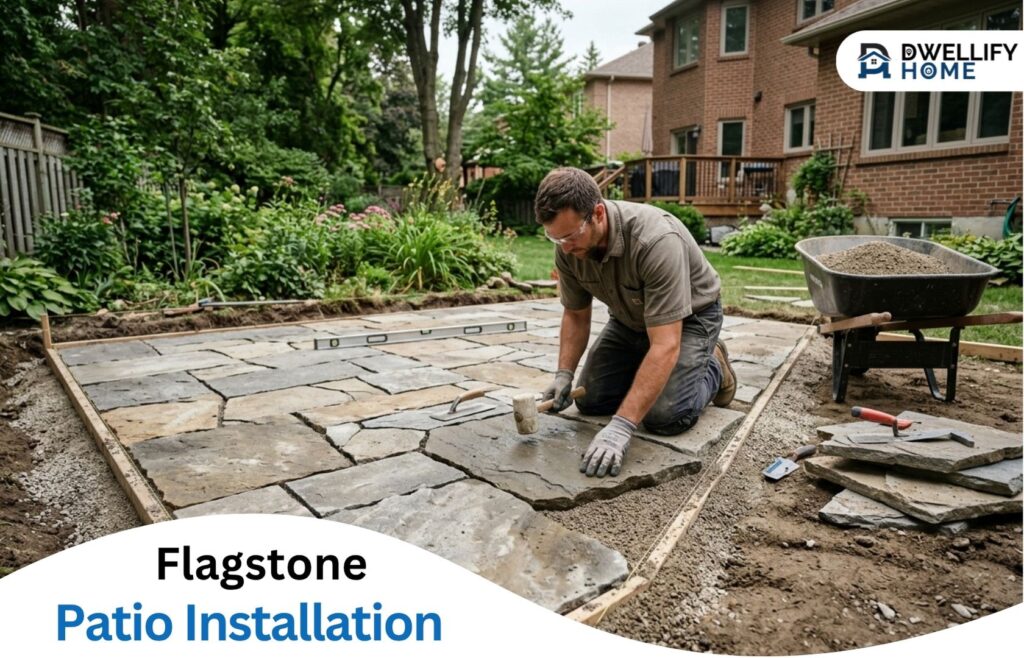
Flagstone occupies a distinctive place among outdoor paving materials. It has the natural variation and character of quarried stone, a rustic and organic quality that manufactured pavers can’t fully replicate, and a track record of durability that goes back centuries in stone-building traditions. For GTA homeowners planning a backyard patio, front walkway, or garden path, flagstone is one of the more visually compelling options, but it also comes with specific installation requirements and material considerations that are worth understanding before committing to it.
This guide covers what flagstone actually is, how it’s installed using different methods, what stone types perform best in Ontario’s climate, and what the real costs and maintenance expectations look like for a flagstone installation.
What Flagstone Actually Is
Flagstone is a general term for flat, thin pieces of stone that split naturally along bedding planes, making them suitable for paving without extensive cutting or shaping. Unlike quarried block stone that’s cut to precise dimensions, flagstone retains much of its natural, irregular shape, which is part of its visual appeal and also part of what makes installation more involved than laying uniform manufactured pavers.
Several stone types are marketed and sold as flagstone in the GTA, and their performance characteristics vary meaningfully. Understanding which type is being proposed for a specific project, rather than treating flagstone as a single uniform product, matters for both appearance and long-term durability.
Common Flagstone Types Available in the GTAOntario Fieldstone and Limestone Flagstone
Locally quarried limestone flagstone is widely available across the GTA and tends to be among the more cost-effective flagstone options given the reduced transportation distance from Ontario quarries compared to imported stone. Ontario limestone flagstone typically has a grey to buff colour range and reasonable durability for the region’s climate, though performance varies by the specific quarry source and the stone’s density and porosity.
Pennsylvania Bluestone
Bluestone, quarried primarily in Pennsylvania and New York, is one of the most popular flagstone choices for GTA patios given its dense, durable composition and attractive blue-grey colour range with occasional buff and lilac tones. Bluestone’s density gives it strong freeze-thaw resistance, making it a reliable choice for Ontario’s climate. It’s sold in both irregular flagstone pieces and more uniform cut dimensional stone, offering flexibility for different design aesthetics.
Sandstone Varieties
Various sandstone flagstones, sourced from different regions, offer warmer colour tones ranging from tan and buff to red and rust shades. Sandstone’s performance in freeze-thaw conditions varies considerably depending on its specific density and porosity; harder, less porous sandstone varieties perform reasonably well in Ontario’s climate, while softer, more porous varieties are more susceptible to surface flaking and deterioration over repeated freeze-thaw cycles. Sourcing sandstone from a supplier who can speak specifically to its cold-climate performance history, rather than relying on appearance alone, is worth doing.
Granite Flagstone
Granite flagstone, while less commonly available in true irregular flagstone form compared to cut granite pavers, offers the best freeze-thaw performance of any common flagstone option given its extremely low porosity and high density. It’s also typically the most expensive option and less commonly used for large-area residential patios given the cost, though it appears frequently in accent applications and smaller feature areas.
Installation Methods: Dry-Laid vs. MortaredDry-Laid Flagstone Over a Compacted Base
Dry-laid flagstone installation involves setting the stone pieces over a properly prepared and compacted granular base, typically with a bedding layer of coarse sand or stone dust that allows each piece to be leveled individually. The joints between pieces are filled with polymeric sand, a similar product to that used in interlock paver installations, or in some cases with a coarser gravel or planted ground cover for a more naturalistic appearance.
The genuine advantage of dry-laid installation in Ontario’s climate is flexibility. Because the individual stones aren’t rigidly bonded together, minor frost heave in the base can cause small individual movements in specific stones rather than the widespread cracking that would occur in a rigid mortared surface experiencing the same movement. This flexibility is a significant reason dry-laid stone installations have such a long track record of durability in freeze-thaw climates.
Maintenance for dry-laid flagstone involves periodic releveling of individual pieces that have settled or shifted, which is a straightforward task compared to repairing a cracked mortared surface. Joint material, whether sand, gravel, or ground cover, may need occasional replenishment as well.
Mortared Flagstone Over a Concrete Base
Mortared flagstone installation involves setting the stone pieces in a mortar bed over a poured concrete slab, with the joints between stones filled with mortar as well. This produces a more formal, rigid surface with tighter, more uniform joint lines than dry-laid installation typically achieves.
The trade-off is that mortared installation requires more rigorous base preparation, since the rigid concrete base beneath needs proper depth, reinforcement, and control joints to manage its own expansion and contraction without cracking, and any movement in that base transfers directly to the stone and mortar joints above it. Mortared flagstone that’s installed over an inadequately prepared concrete base is more prone to cracking issues over time than dry-laid installation would be under similar site conditions.
Mortared installation is generally the appropriate choice when a more formal, uniform appearance is the design goal, or in specific applications like steps or areas transitioning to a house structure where a rigid, integrated surface makes more practical sense than a flexible dry-laid one.
Base Preparation: The Foundation of Any Flagstone Installation
Regardless of whether the final installation is dry-laid or mortared, proper base preparation is what determines long-term performance. For dry-laid installation, this means excavating to appropriate depth, typically at least 150mm of compacted granular base for pedestrian applications, with a geotextile separation layer in clay-heavy soil conditions to prevent fines from migrating up into the base material over time.
For mortared installation over a concrete base, the concrete itself needs adequate thickness and, depending on the application, reinforcement to resist cracking, along with proper control joint placement and a footing depth appropriate to the region’s frost conditions if the patio connects to any structural elements like steps.
In either case, drainage design matters significantly. A flagstone patio surface, whether dry-laid or mortared, should slope away from the house at a minimum of 1 to 2 percent to prevent water pooling against the foundation or on the patio surface itself, where standing water contributes to freeze-thaw damage over successive winters.
Joint Treatment Options
The material used between flagstone pieces significantly affects both the appearance and the maintenance requirements of the finished patio. Polymeric sand joints, similar to interlock paver applications, create a semi-rigid joint that resists weed growth and erosion better than plain sand while still allowing for the natural flexibility that benefits dry-laid installations in freeze-thaw conditions.
Planted joints, where low-growing ground cover such as creeping thyme or Irish moss is established between stones, create a softer, more naturalistic appearance that many homeowners find appealing for garden-adjacent patios and pathways. This approach requires more ongoing maintenance to keep the plantings healthy and appropriately contained, and it’s generally better suited to lower-traffic walkways and garden paths than to primary entertaining patios that see heavy foot traffic.
Gravel or stone dust joints offer a middle option, providing good drainage and a natural appearance with less maintenance than planted joints, though they’re somewhat more prone to displacement and weed establishment over time than polymeric sand.
Cost Expectations for Flagstone Patios in the GTA
Flagstone installation costs vary considerably based on stone type, installation method, and project scale. Locally sourced Ontario limestone flagstone in a dry-laid installation is generally the most cost-effective option for GTA homeowners, given both material availability and installation labour that doesn’t require the more involved base preparation of mortared work.
Bluestone, given its higher material cost and the additional care often taken in fitting its more uniform cleft surfaces attractively, typically costs more per square foot than local limestone in a comparable dry-laid installation. Mortared installations generally cost more than dry-laid regardless of stone type, given the additional concrete base preparation involved.
Site conditions affect cost meaningfully as well. A flat, easily accessible backyard requires less site preparation than a sloped yard needing grading work, or a space with limited equipment access requiring more manual labour for material transport and base preparation.
Combining Flagstone with Other Materials
Flagstone patios are frequently combined with other materials in a cohesive design. A flagstone patio surface bordered by a low natural stone retaining wall, connected to the house via flagstone steps, and transitioning to a lawn or planting bed at its perimeter creates a more integrated outdoor space than a single-material installation. These combinations require coordinated planning, since the base preparation, drainage, and structural requirements of each element need to work together rather than being designed independently.
For homeowners planning a patio that includes a grade change addressed with a stonework retaining wall, or a design that incorporates natural stone features beyond the paving itself, working with a contractor who can plan the full scope together produces a more cohesive result than treating the patio and any accompanying structural elements as separate projects with separate sequencing.
Maintenance and Longevity Expectations
A well-installed flagstone patio, whether dry-laid or mortared, using an appropriate stone type for Ontario’s climate, should provide decades of service with modest ongoing maintenance. Dry-laid installations benefit from periodic inspection for individual stones that have shifted or settled, particularly after severe winters, and releveling those as needed rather than allowing displacement to accumulate over multiple seasons.
Sealing is optional for most flagstone but can be worthwhile for stones with higher porosity, both to reduce staining susceptibility and to slow moisture absorption that contributes to freeze-thaw wear over time. Dense stones like bluestone and granite benefit less from sealing than more porous limestone or sandstone varieties, since their natural density already provides substantial moisture resistance.
Mortared installations require periodic attention to joint condition, similar to any mortared masonry surface, with repointing needed as joints erode over years of freeze-thaw exposure. Catching joint deterioration early, before water has had extended opportunity to work beneath the stones, keeps repair scope manageable rather than allowing widespread joint failure to develop.
Choosing a Contractor for Flagstone Installation
Flagstone installation, particularly dry-laid work with irregular stone pieces, requires more skill and judgment than laying uniform manufactured pavers. Fitting irregular stones together attractively while maintaining consistent joint width and a level surface is a craft that experienced installers develop over many projects, and the quality difference between an experienced flagstone installer and a general landscaping contractor attempting their first flagstone project is often visible in the finished result.
Asking to see photos of previous flagstone installations, and ideally visiting a completed project if possible, gives a clearer sense of a contractor’s actual skill with this specific material than a general portfolio of hardscaping work might. Confirming the proposed base depth, drainage slope, and joint treatment before work begins ensures the project is scoped to Ontario’s climate requirements rather than a generic specification that might be adequate in a milder climate but insufficient for the freeze-thaw stress GTA installations experience. A patio installation using flagstone, properly planned and executed, is one of the more durable and visually rewarding exterior investments available to GTA homeowners.
FAQ
Is flagstone slippery when wet?
It depends on the specific stone type and its surface finish. Naturally cleft flagstone, with its irregular, textured surface, generally provides better traction than a smoothly honed or polished stone finish. Bluestone and most fieldstone flagstones with a natural cleft surface offer reasonably good slip resistance even when wet. For pool surrounds or other areas where slip resistance is a particular priority, discussing surface texture options specifically with your supplier or contractor helps ensure the selected stone performs appropriately for that application.
Can flagstone be installed over an existing concrete patio?
Mortared flagstone can sometimes be installed directly over an existing concrete slab, provided the slab is structurally sound, level, and free of significant cracking or movement. This approach can be more cost-effective than full removal and replacement in appropriate situations. Dry-laid flagstone generally isn’t suitable for installation directly over an existing rigid concrete surface, since the flexibility that makes dry-laid installation perform well in freeze-thaw conditions depends on a granular base rather than a rigid concrete one beneath it.
How do I clean and maintain a flagstone patio?
Routine cleaning with a stiff brush and water handles most day-to-day maintenance for flagstone surfaces. Avoid pressure washing on dry-laid joints, since high pressure can displace polymeric sand or gravel joint material. For staining, cleaning products should be matched to the specific stain type and confirmed as appropriate for the specific stone, since some cleaning chemistries can etch or discolour certain stone types, particularly softer limestone varieties. Sealed flagstone surfaces should have their sealer reapplied on the schedule recommended by the sealer manufacturer, typically every few years depending on the product and exposure conditions.
Is flagstone more expensive than interlock pavers?
Generally yes, flagstone installations typically cost more than comparable concrete interlock paver installations, given both higher material costs for quarried natural stone and the additional labour required to fit irregular pieces compared to placing uniform manufactured units. The cost premium varies by stone type, with locally sourced Ontario stone generally narrowing the gap compared to imported stone types like bluestone. Many homeowners view the additional cost as justified by flagstone’s distinctive natural appearance and long-term durability, but for larger surface areas on a constrained budget, interlock paving remains a more economical option that still performs well in Ontario’s climate.
We believe in keeping things transparent with our readers. Some of the links included in this article may be affiliate or sponsored links. If you purchase something through them, we may receive a small commission, which helps support Dwellifyhome.com and our ongoing content.