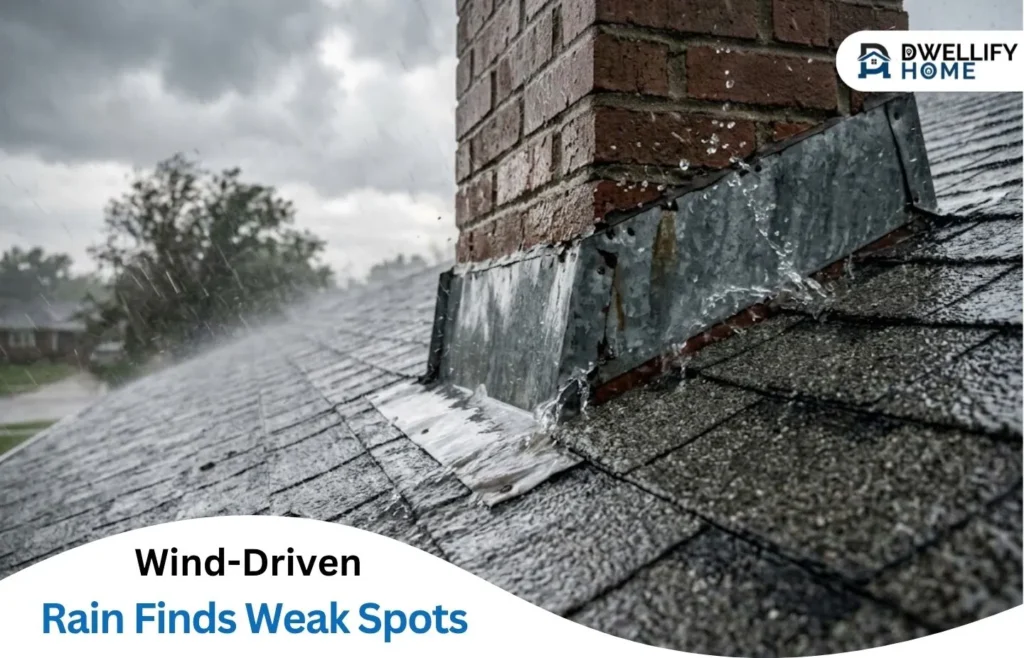
Heavy rain does not always fall straight down. During Kansas thunderstorms, strong wind can push water sideways and upward against roofing details that stay dry during ordinary rain. That is why some leaks only appear during severe weather even when the roof performs normally the rest of the year. For homeowners evaluating Wichita roofing, understanding how wind changes the path of water can make leak diagnosis much more accurate. Roofing built for Wichita weather should manage not only runoff moving down the shingles but also rain being forced against edges, flashing, vents, valleys, and other vulnerable transitions. Wichita roofing problems that appear only during high-wind storms often require a different investigation than a leak that happens during every rainfall.
Wind Can Push Water Beneath a Shingle That Still Looks Intact
Asphalt shingles are designed primarily to shed water downward, but strong gusts can challenge that pattern. If a shingle seal has weakened, wind can lift the edge slightly while rain is being driven underneath it. On Wichita roofing systems, the shingle may settle back down after the storm and leave almost no visible clue. Wichita roofing homeowners should pay attention to leaks that occur only when rain and strong wind arrive together. A close inspection should look for raised tabs, broken seals, creases, or uneven shingle courses on the side of the roof that faced the storm.
Roof-to-Wall Connections Are Common Pressure Points
Where a sloped roof meets a vertical wall, flashing has to redirect water away from the joint. During ordinary rain, gravity helps that system work. Wind-driven rain can approach from the side and expose gaps that otherwise remain dry. For Wichita roofing, this makes sidewalls, dormers, and similar transitions especially important when a stain appears near an exterior wall. The inspection should check whether step flashing is properly integrated, whether visible metal has shifted, and whether sealant has become brittle. Wichita roofing leaks at these transitions are often misdiagnosed when someone repairs the nearest shingle instead of following the actual water path.
Valleys Can Be Overwhelmed During Intense Rain
Roof valleys collect water from two adjoining slopes, so they handle significantly more runoff than open shingle areas. When strong wind accompanies heavy rain, water can be pushed against the sides of the valley or into damaged material that would remain dry under lighter conditions. On Wichita roofing systems, debris, granule loss, cracked shingles, or poorly positioned valley material can make the problem worse. Homeowners should watch for attic staining beneath valleys and for leaks that appear only during the heaviest storms. Wichita roofing repairs in these areas need to restore the full drainage path rather than simply cover one visible crack.
Pipe Boots and Roof Penetrations Can Open With Age
Any object passing through the roof creates a transition that has to remain watertight while materials expand, contract, and age. Pipe boots, vents, and other penetrations may develop cracks or small separations that ordinary rainfall does not reach. Wind changes that. On Wichita roofing systems, rain can be driven directly against a damaged boot or beneath flashing around a vent. If an interior stain appears near a bathroom, utility area, or plumbing wall, inspect the corresponding roof penetration before assuming the main shingle field is leaking. A localized Wichita roofing repair may be enough if the surrounding material remains healthy.
Roof Edges Can Let Water Enter From an Unexpected Direction
Eaves and rakes are designed to move water off the roof, but damage around starter shingles, drip edges, or lower courses can create an entry point when wind pushes rain back toward the structure. Wichita roofing homeowners should inspect edges after severe storms for lifted shingles, separated materials, or signs that water has traveled behind rather than over the edge. The location of the interior moisture may be misleading because water can follow decking or framing before it becomes visible. Wichita roofing repairs at the perimeter should restore both secure attachment and the correct route for runoff.
Old Sealant Can Hide a Weak Flashing Detail
Sealant is useful in specific roofing details, but it should not be the main defense where correctly installed flashing is supposed to manage water. On older Wichita roofing systems, homeowners may find thick layers of roofing cement or caulk around chimneys, vents, or wall transitions. Those patches can crack after years of heat and temperature changes. Wind-driven rain then finds the opening because it is being pushed directly against the joint. If the same area has been resealed repeatedly, Wichita roofing repair should focus on whether the flashing itself needs to be rebuilt instead of adding another temporary surface layer.
Storm Direction Can Help Narrow Down the Leak Source
The direction of the wind is valuable diagnostic information. If a room only leaks when strong rain comes from one direction, the affected side of the roof should receive extra attention. Wichita roofing homeowners can note which rooms became wet, when the leak started, and whether the storm was unusually windy. That information helps compare the interior stain with exterior slopes, walls, valleys, and penetrations. Wichita roofing diagnosis becomes much more efficient when the inspection uses the storm pattern rather than treating every nearby roof component as equally likely to be responsible.
The Attic Often Shows Where Water Traveled
The stain on a ceiling is usually the end of the water path, not the beginning. With safe attic access, homeowners may be able to see dark tracks on decking, damp insulation, or moisture following a rafter. On Wichita roofing systems, tracing those marks uphill can reveal that water entered several feet away from where it finally dripped. The inspection should also distinguish between rain intrusion and condensation from indoor moisture or ductwork. Wichita roofing repairs are far more likely to succeed when the actual entry point is confirmed before shingles or flashing are disturbed.
Repeated Wind-Driven Leaks Usually Mean the Root Cause Is Still There
A leak that returns only during severe thunderstorms can be frustrating because ordinary rain may not reproduce it. If several repair attempts have targeted the same ceiling stain without success, the problem may be farther upslope or related to how wind is pushing water into a transition. Wichita roofing homeowners should review previous repair locations and compare them with the direction and timing of new leaks. If the same storm pattern keeps producing moisture, another patch in the same place is unlikely to solve a Wichita roofing defect that was never correctly identified.
Repair the Water Path, Not Just the Wet Spot
Wind-driven rain exposes roofing weaknesses that calm weather may never reveal. Wichita roofing inspections should focus on broken shingle seals, roof-to-wall flashing, valleys, penetrations, roof edges, and previous repairs while also tracing moisture through the attic. The goal is to understand exactly how water reached the interior.
When Wichita roofing damage is limited to one failed flashing detail, vent boot, or small section of loosened shingles, a targeted repair may restore dependable protection. When Wichita roofing leaks are appearing at several transitions or surrounding shingles are already brittle, the problem may be broader than one storm opening. Correctly identifying the path of wind-driven rain gives homeowners a much better chance of fixing the actual weakness instead of repeatedly repairing the place where the water happened to show up.
Dwellifyhome.com may receive compensation through affiliate or sponsored links included in this article. Commissions may be earned when qualifying purchases are made through these links and help support our website’s continued operation.