
The engineering behind a consistent professional finish
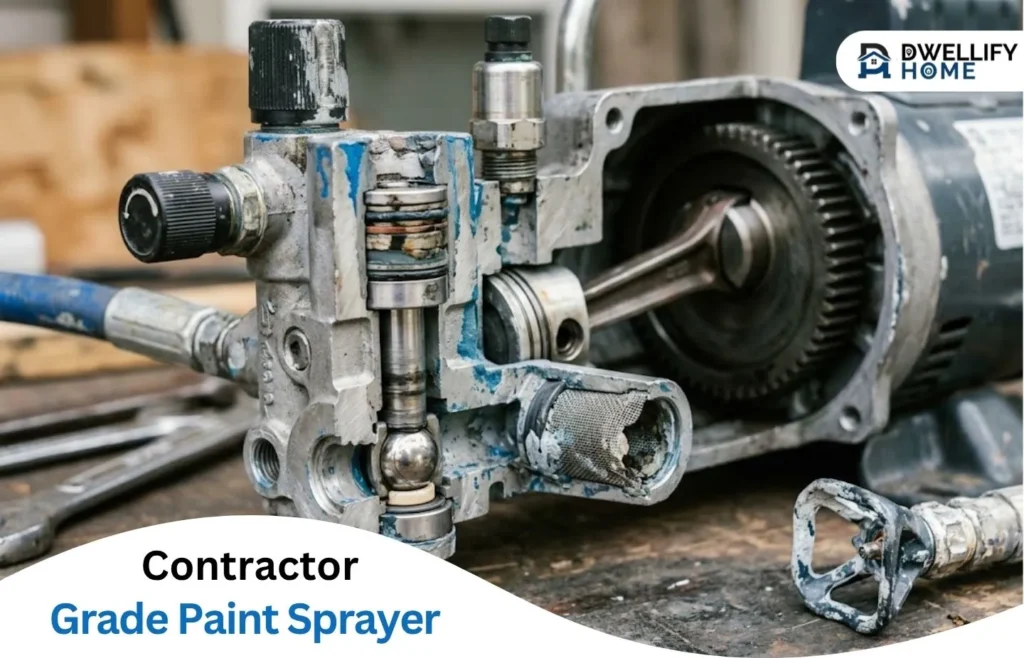
From the outside, a contractor-grade airless sprayer appears to be a motor, pump, hose and gun. Inside, the drive, fluid section, valves, pressure regulation and filtration form a connected system. A weakness in any stage can affect material delivery and finish quality.
Maximum PSI and gallons per minute are important specifications, but neither alone explains reliability or how a machine behaves with a particular coating and tip.
Follow the material through the machine
In a typical electric piston-pump sprayer, the motor drives a mechanism that reciprocates the pump. The inlet system supplies coating, internal valves direct flow, and the fluid section pressurizes the material. The hose carries it to the gun, where the tip produces a fan-shaped pattern.
Changes in suction supply, valve sealing, tip demand or pressure control can alter the behavior of the entire system. Diagnosis works best when each stage is evaluated in sequence.
The fluid section: where hydraulic performance begins
The fluid section includes a displacement rod or piston, cylinder, packings, inlet and outlet valves, and associated seals. Worn packings can allow leakage; a damaged rod can accelerate seal wear; contaminated valve seats can reduce pumping efficiency.
Pressure loss, unusual cycling or leakage may indicate fluid-section wear, but these symptoms also have other possible causes. A proper inspection distinguishes normal service wear from damage requiring additional components.
Serviceable construction can extend useful life, provided the correct parts are installed and mating surfaces are checked.
The drive system: converting motor output to pump movement
Electric piston sprayers commonly use gears, bearings and connecting mechanisms to convert motor rotation into pump reciprocation. Wear or damage can create noise, vibration, interrupted motion or a motor that runs without effective pumping.
Internal drive repairs can require specialized tools and careful assembly. Equipment buyers should consider service documentation and replacement-part availability, not just motor specifications.
Pressure control: stability matters more than headline PSI
Pressure-control systems regulate pump operation to support the desired material delivery. Some use electronic sensors and control boards; others use different mechanical or electrical arrangements.
Too little effective pressure for the selected coating and tip can produce an uneven fan. Excessive pressure may increase overspray and wear. Painters should use the lowest pressure that provides an acceptable pattern within the coating and equipment manufacturers’ recommendations.
Flow rate and pressure are not interchangeable. A sprayer may reach a high pressure yet lack sufficient output for an oversized tip under actual spraying conditions.
Inlet and outlet valves: small parts, large effects
Check valves control the direction of fluid movement through the pump. Debris, sticking components or worn seating surfaces can disrupt priming and pressure retention.
A failure to prime does not automatically prove a bad inlet valve: air leaks and blocked screens can produce similar symptoms. Repeated valve problems should prompt inspection for contamination and damage to mating surfaces.
Filtration protects the pump and the finish
An inlet screen captures larger debris, a pump or manifold filter protects the downstream fluid path, and a gun filter can help prevent tip blockage. Exact configurations vary by model.
Mesh selection balances filtration against flow. Filters that are too fine can clog or restrict heavy coatings; filters that are too coarse can permit particles that obstruct small tips. Follow coating and equipment recommendations.
The spray tip is a precision component
For many conventional airless tips, a three-digit code identifies approximate fan width and orifice diameter. A 515 generally indicates an approximately 10-inch fan at the specified distance and a 0.015-inch orifice. Actual performance varies with material and pressure.
As the orifice wears, material flow and fan geometry can change, producing uneven coverage and excess paint use. A worn tip should be replaced rather than compensated for indefinitely with higher pressure.
Confirm the sprayer’s supported tip size and the compatibility of gun, guard and tip system.
Hoses and guns complete the delivery system
Hose length, diameter and condition influence fluid delivery. Long or restrictive arrangements can increase pressure loss. Gun valves, filters and trigger characteristics influence application and operator comfort.
High-pressure hoses with cracks, bulges or damaged fittings must be replaced with correctly rated components; improvised repairs are unsafe.
Why exploded diagrams are essential
A model-based collection of Graco sprayer parts diagrams helps owners locate the right assemblies and part numbers. The Titan Impact 440 parts reference serves a similar purpose for that contractor machine.
Even similar machines may use different revisions or component dimensions. Always verify the complete model and applicable series before ordering.
Compare Graco and Titan at the model level
Both Graco and Titan manufacture equipment for different workloads. Neither brand is uniformly superior in pressure stability, durability or repairability across every product family.
Compare material output, supported tip sizes, coating compatibility, fluid-section construction, pressure regulation, service procedures and parts support for the exact models under consideration.
A practical approach to troubleshooting
Start with coating requirements and application setup, then check the tip, filters, suction supply and accessible fluid-path components. If the fault remains, move to manufacturer-prescribed pump and pressure-control diagnostics.
When the issue requires specialist attention, an airless paint sprayer repair resource can help owners evaluate service options. Seek qualified help for electrical faults, internal drive damage and uncertain high-pressure failures.
Always relieve pressure according to the equipment manual before servicing. Injection injuries require emergency medical treatment.
What dependable equipment performance really requires
A professional finish depends on the complete system: a sound fluid section, effective valves, suitable filtration, stable pressure regulation, an appropriate tip and a safe delivery path.
Understanding these relationships helps contractors diagnose faults earlier, choose correct replacement components and evaluate machines on practical performance rather than headline specifications alone.
This article may contain links associated with commercial affiliate or sponsored arrangements. Dwellifyhome.com may receive compensation from qualifying transactions completed through these links, contributing to the ongoing operation and maintenance of the website.



