
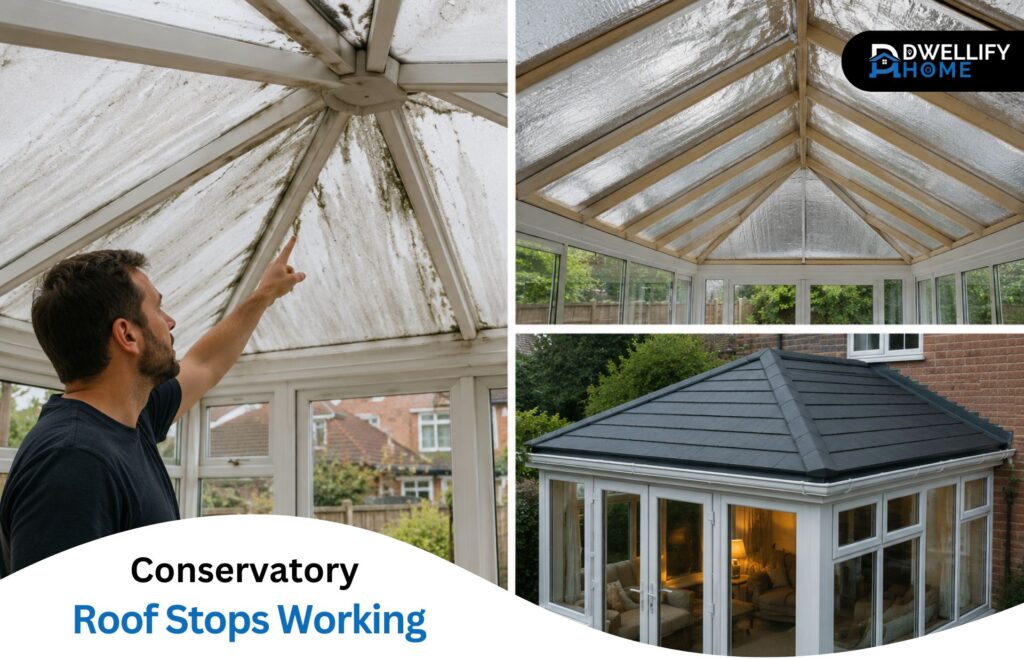
If your conservatory roof is leaking, letting in excessive heat in summer, or failing to hold warmth in winter, you have three options: repair the existing structure, add insulation to improve thermal performance, or replace the roof entirely. The right choice depends on the age and condition of your roof, your budget, and how you want to use the space long-term.
Your conservatory was built to give you more space and more light. But when the roof starts failing, that extra room becomes the most uncomfortable in the house — freezing in January, sweltering in July, and dripping when it rains. Knowing when to consider changing your conservatory roof, and which route to take, is what this guide is designed to help you work out.
The decision — repair, insulate, or replace — doesn’t need to be overwhelming. Each option suits a different situation. The key is understanding what your roof is actually telling you, what the likely cause is, and what each route will genuinely cost you in time, money, and disruption. Work through the sections below, use the scoring tool, and you’ll arrive at a clear decision rather than an expensive guess.
What Are the Symptoms of a Failing Conservatory Roof?
Before you can choose a solution, you need to name the problem. These are the most common signs that your conservatory roof is no longer doing its job:
- Leaks or damp patches — Water ingress after rain, staining on frames, or condensation pooling on internal surfaces.
- Extreme temperatures — The space is too cold to use from October to March, or too hot from May to September.
- Excessive noise — Rain hammering on a polycarbonate roof makes the room unusable during a downpour.
- Visible damage — Cracked or yellowed polycarbonate panels, broken glazing bars, or corroded flashings.
- Draughts — Cold air entering through gaps around the roof edge or at the ridge.
- Rising energy bills — Your central heating works harder because heat escapes through the roof into the conservatory and out.
One or two of these symptoms may point to a straightforward repair. Several of them together — especially temperature extremes alongside leaks — usually indicate the roof material has reached the end of its useful life.
What Causes Conservatory Roof Problems?
Understanding the cause helps you avoid fixing the wrong thing. The most common culprits are:
Age and material degradation
Polycarbonate panels typically last 10–15 years before they yellow, become brittle, and lose their insulating properties. Single-skin glass panels, common in older conservatories, offer very little thermal performance and are prone to condensation and cracking.
Poor original installation
A roof that was fitted without proper sealants, with inadequate flashings, or without appropriate drainage channels will leak years before the materials themselves fail. In these cases, repair can address the specific failure point — but if the underlying installation was poor throughout, problems tend to recur.
Structural movement
Buildings settle over time, and this can cause conservatory frames to shift slightly. Where the roof meets the house wall (the flashing zone) is particularly vulnerable. A professional roof survey will identify whether movement is the root cause, which matters enormously before you commit to a solid or tiled replacement roof.
Inadequate insulation from the outset
Many conservatories built before 2010 have roofs with very low U-values — meaning they transfer heat rapidly. No amount of repair will correct this; it is a design limitation. Insulation or replacement are the only routes to a year-round comfortable space.
Repair vs Insulation vs Replacement: How Do They Compare?
Choose repair
when your roof is fewer than 10 years old and the damage is isolated — a single cracked panel, a leaking flashing, or a failed seal around a vent.
Choose insulation
when your roof structure is sound but the space is too hot or cold. The Energy Saving Trust notes that a typical uninsulated home loses around 25% of its heat through the roof — and a conservatory with a single-skin polycarbonate roof loses heat even faster. Adding insulated roof panels reduces that loss significantly, lowering your heating bills and making the room usable year-round.
Choose replacement
when the roof is old, structurally compromised, or the material itself (usually ageing polycarbonate) is the source of multiple problems simultaneously.
What Does Each Option Actually Cost?
Getting a realistic sense of the numbers helps you weigh the options honestly.
Repair: Minor repairs — resealing flashings, replacing individual polycarbonate panels, fixing guttering — typically cost £200 to £1,500 depending on access difficulty and the extent of the damage. This is the lowest upfront cost, but if the underlying roof is failing, repairs become a recurring expense rather than a solution.
Insulation: Internal insulation panels typically cost between £2,000 and £4,500 including the finish, according to Cosy Panels conservatory roof insulation price guide. This option causes minimal disruption — most installations complete within one to three days — and delivers an immediate improvement in thermal comfort without requiring planning permission or building regulations approval in most cases.
Replacement: According to Checkatrade’s 2026 UK price guide, the average conservatory roof replacement costs around £10,000, with a typical range of £6,300 to £18,225 or more depending on size and material. Polycarbonate replacements sit at the lower end; glass and solid or tiled roofs command higher prices. A solid tiled roof replacement, for example, generally costs between £9,600 and £14,850.
Bear in mind that replacing an existing roof covering may require building regulations approval. GOV.UK confirms that replacing roof coverings on pitched and flat roofs is listed as work that may need approval — so this check must be part of your decision-making, not an afterthought.
What Happens If You Delay?
Putting off a decision has a cost of its own. A small roof leak, left untreated, allows water to penetrate the frame, damage the walls, and create conditions for damp and mould. What starts as a £300 repair can become a £3,000 remediation project within a single winter.
There is also a comfort cost. Every month your conservatory is too hot or too cold is a month you are not using the space you paid to build. For homeowners working from home, hosting family, or planning to sell, that underused room represents real, ongoing loss.
From an energy perspective, heat escaping through a poorly insulated conservatory roof puts upward pressure on your heating bills every single day. The sooner you act, the sooner the savings begin to compound.
Your Scoring Rubric: Which Route is Right for You?
Work through these questions and award points for each yes answer to identify your most likely route.
Score 1 point for each “”yes””:
Signals pointing toward Repair:
- My roof is fewer than 10 years old
- The leak or damage is in one specific area only
- I have had no problems with temperature extremes
- A professional has confirmed the structure is sound
Signals pointing toward Insulation:
- The roof structure is intact but the room is unusable in winter or summer
- My roof has no visible cracks, leaks, or broken panels
- I want to improve comfort without major disruption
- I am looking for a cost-effective upgrade rather than a full renovation
Signals pointing toward Replacement:
- The roof is more than 15 years old
- I have multiple problems simultaneously (leaks, noise, temperature)
- The polycarbonate has yellowed or turned brittle
- A surveyor has identified structural or installation concerns
How to use your score: If you scored highest in one category, that is your likely route. If your scores are split between insulation and replacement, a professional survey will give you a definitive answer without costing you a full installation.
Key Questions to Ask Installers Before You Commit
Before hiring anyone for insulation or roof replacement work, ask these questions directly. The National Federation of Roofing Contractors (NFRC) recommends checking credentials and getting multiple written quotes before committing to any major roof work.
Citizens Advice also recommends getting at least three written quotes, confirming insurance cover, avoiding large upfront cash payments, and securing all warranty terms in writing before work begins.
Use this checklist when meeting potential installers:
Are you registered with a competent person scheme or trade association?
This confirms they have the qualifications to self-certify certain types of work.
Do you carry public liability and professional indemnity insurance?
Ask to see the policy documents.
Will you provide a written quote — not just an estimate — that breaks down materials and labour?
A quote is a fixed price; an estimate is not.
What warranty do you offer on both materials and workmanship, and is it insurance-backed?
An insurance-backed guarantee protects you if the company ceases trading.
Will this work require building regulations approval?
A reputable installer will know the answer and advise you accordingly. For conservatory projects, the Planning Portal’s conservatory guide sets out when exemptions apply and when you need to check with your local authority.
How will you handle any structural concerns discovered during the survey?
If they have no answer, proceed with caution.
What is your payment schedule?
Avoid any installer who requests full payment upfront.
Download Your Decision Checklist
To make this process easier, use the scoring rubric above as a physical checklist you can print, share with a partner, or bring to a surveyor appointment. Rate each question, total your scores across the three categories, and note which vendor questions you still need answered. This one document gives you the clarity to walk into any installer conversation already knowing what to ask and what a good answer looks like.
When Should You Replace a Conservatory Roof?
The clearest signal is when a single problem has become several. A roof that leaks, fails to hold heat, amplifies rain noise, and shows visible yellowing or cracking has reached the end of its serviceable life. Repairs at this stage are a short-term patch on a long-term problem.
Replacement is also worth considering when you are changing how you want to use the space. A solid or tiled roof transforms a conservatory into a year-round room — warmer, quieter, and better integrated with the rest of your home. Before proceeding with a solid roof, LABC guidance recommends a professional structural survey to confirm the existing walls and foundations can support the additional weight.
If your roof is broadly intact but simply not insulating well, insulated panels are often a faster, lower-cost route to the same outcome — a room you can actually use in December.
Request a Professional Roof Survey
The most reliable way to end the repair-or-replace question is a professional survey. A thorough assessment tells you the condition of your roof structure, identifies any hidden leaks or damage, checks whether your conservatory can support a solid roof, and gives you a clear recommendation backed by evidence — not guesswork.
Armed with a survey report, you walk into installer conversations with confidence. You know what the roof needs, you know the right questions to ask, and you avoid paying for a solution that does not match the problem.
Some links featured in this article may be affiliate or sponsored links. We may receive a small commission when you purchase through them, which helps support Dwellifyhome.com and allows us to continue creating helpful home and lifestyle content. Our views remain our own.