
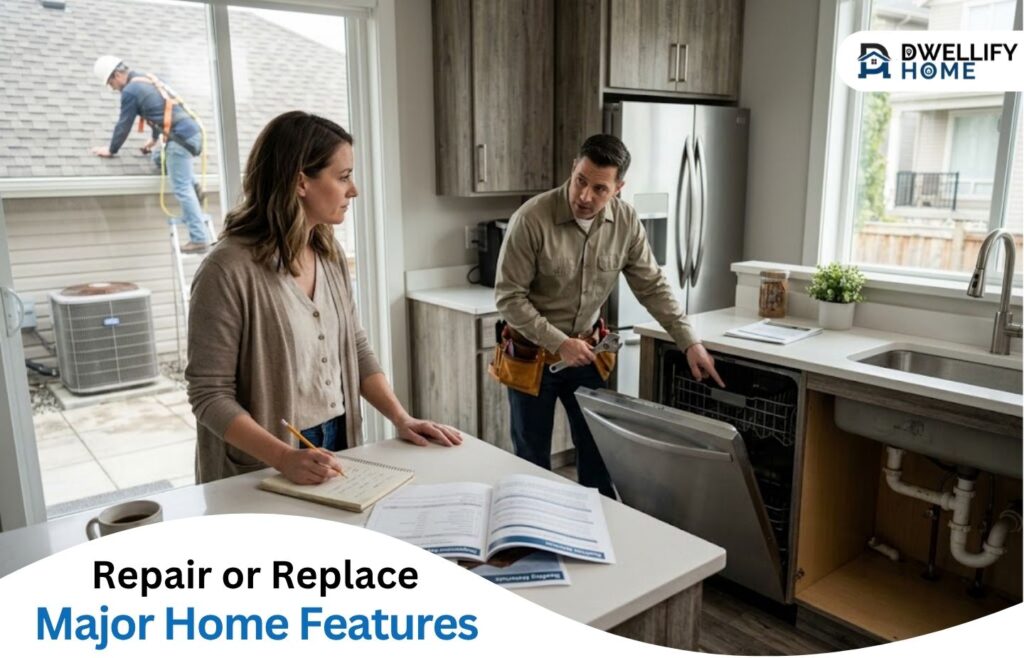
Every major part of a home eventually reaches the point where another repair may no longer make financial sense. Roofs, HVAC systems, windows, appliances, plumbing, and exterior materials can often be fixed several times before replacement becomes the better option.
The difficult part is knowing when that point has arrived. Age matters, but so do repair frequency, operating cost, safety, efficiency, and what you plan to do with the property next.
Start With the Cost of the Current Problem
Begin with an actual diagnosis rather than assuming an older system needs replacement.
A failed component may cost a few hundred dollars to repair even though replacing the entire system would cost thousands. On the other hand, repairing one problem on a badly deteriorated system may simply delay another failure.
Ask for a written estimate that separates labor, parts, diagnostic fees, and any related work.
Then compare that cost with replacement, remaining useful life, and the likelihood of another repair within the next few years.
Consider Your Plans for the Property
The right decision can change depending on whether you plan to stay or sell.
If you expect to remain in the house for another decade, replacing an inefficient or unreliable system may provide years of practical value. If you are preparing to sell soon, the calculation becomes more focused on marketability and net proceeds.
Homeowners dealing with extensive deferred maintenance can also compare repairing the property with selling it in its present condition. A direct buyer such as Obi Buys states that it purchases Jacksonville-area homes as is without requiring sellers to complete repairs or renovations first.
The important comparison is not simply repaired value versus as-is value. Include the money and time needed to reach each outcome.
Repair or Replace the HVAC System?
HVAC decisions often depend on both system age and the type of failure.
A capacitor, contactor, sensor, or fan motor on an otherwise dependable system may justify repair. A major compressor failure on an aging unit with repeated problems is harder to justify.
Dwellify Home makes a similar distinction, noting that isolated problems on reliable equipment can support repair while expensive failures on older systems may point toward replacement.
Consider Replacement When
- Repairs are becoming frequent
- Major components are failing
- Parts are difficult to source
- Comfort is inconsistent
- Energy use has increased noticeably
- Replacement is already likely within a few years
Get a professional diagnosis before making the decision based on age alone.
Evaluate the Roof as a System
A small roof leak does not automatically require a complete replacement.
Localized flashing damage, isolated missing shingles, or a minor penetration problem may be repairable when the surrounding roofing remains sound.
Replacement becomes more likely when deterioration is widespread.
Look for repeated leaks, large areas of damaged material, sagging, extensive granule loss on asphalt shingles, or underlying decking problems.
The condition of the entire roof matters more than the size of the first visible leak.
If several repairs have already been completed in different areas, continuing to patch may cost more without solving the underlying problem.
Know When Windows Can Be Repaired
Window problems are often localized.
Failed locks, damaged caulk, worn weatherstripping, or isolated hardware can usually be repaired without replacing the complete window.
The decision changes when deterioration affects several units.
Repeated seal failures, warped or rotting frames, persistent drafts, and recurring repair needs can indicate that full replacement is becoming more practical.
Inspect the frame as well as the glass. Replacing glazing will not solve structural deterioration around the opening.
Treat Plumbing Problems Individually
A leaking faucet and deteriorated whole-house piping are completely different projects.
Repair isolated valves, fixtures, traps, and accessible leaks when the surrounding system remains in good condition.
Consider larger replacement work when corrosion, leaks, pressure problems, or material deterioration are widespread.
Watch for Patterns Such As
- Repeated leaks in different locations
- Visible pipe corrosion
- Discolored water
- Persistent pressure problems
- Multiple emergency repairs
- Water damage behind walls or ceilings
Repeated failures are often more important than the age of the plumbing alone.
Compare Appliance Repair With Replacement Cost
Large appliances are easier to evaluate because replacement prices are relatively transparent.
Start with the repair estimate and the appliance’s overall condition.
A minor repair on a newer refrigerator, dishwasher, or range may be worthwhile. An expensive compressor or control-system repair on an older appliance with other problems may not be.
Also consider whether replacement would materially improve energy use, capacity, reliability, or function.
If the appliance has required several repairs in a short period, continuing to spend on it may simply delay replacement.
Be Careful With Cosmetic Replacement
Not every dated feature needs to be removed.
Solid wood cabinets can often be refinished. Hardwood floors may be sanded rather than replaced. Tile with sound installation may only need grout repair.
This is especially important when preparing a home for sale.
Replacing functional materials simply because the style is older can consume a large renovation budget without producing the same increase in selling price.
Low-cost styling can sometimes make more sense than replacing permanent features. In a finished basement, game room, home bar, or entertainment space, decorative elements such as neon signs can add personality without requiring major construction or replacing usable finishes.
Preserve durable materials when restoration or light cosmetic updates can achieve the needed result at a lower cost.
Include Hidden Costs in the Decision
Replacement often costs more than the equipment or material itself.
A new HVAC system may require electrical modifications. Window replacement can reveal damaged framing. Bathroom plumbing work may disturb tile or drywall.
Calculate the entire project.
Include permits, demolition, disposal, finish repairs, temporary accommodation where necessary, and a contingency for unexpected work.
A repair may be less attractive if another major failure is likely soon, but replacement can also become less attractive when secondary work significantly increases the original quote.
Consider Energy and Operating Costs
Repair-versus-replace decisions should also account for what the feature costs to operate.
An older HVAC system, water heater, appliance, or window system may still function but use considerably more energy than a newer alternative.
Compare expected annual operating costs rather than focusing only on the purchase price.
A replacement that reduces monthly energy bills may recover part of its cost over several years.
This matters most when you plan to stay in the home long enough to benefit from the savings.
Check Whether Repairs Affect a Future Sale
If you expect to sell soon, some defects may have a larger effect on the transaction than others.
A failed HVAC system, active roof leak, serious water damage, or major electrical issue can make buyers more cautious and may create financing or insurance complications.
Minor cosmetic defects usually carry less risk.
Prioritize repairs that affect safety, function, and the buyer’s ability to evaluate the property confidently.
Avoid over-improving the home beyond what comparable properties in the neighborhood support.
Check Whether Repairs Affect Financing or Insurance
Some property conditions can create problems beyond buyer preference.
Serious roof deterioration, structural issues, unsafe electrical systems, or other major defects may affect insurance availability or financing depending on the property and buyer.
That can reduce the pool of conventional buyers.
If a known problem is likely to create financing or insurance complications, get professional estimates before deciding whether to repair or sell in the current condition.
You need to understand whether fixing the problem expands the buyer pool enough to justify the expense.
Use a Simple Repair-or-Replace Framework
Before approving a major expense, answer four questions.
- Is the problem isolated or systemic? One failed component favors repair. Repeated failures across the system favor replacement.
- How much useful life remains? Spending heavily on something already close to the end of its expected service life carries more risk.
- What is the total replacement cost? Include associated construction and finishing work.
- How long will you keep the property? Long-term owners can benefit from reliability and efficiency improvements that short-term sellers may never recover.
The decision should be based on the complete cost over the period you expect to own the home.
Spend Money Where It Solves the Real Problem
Repair makes sense when the failure is contained, the underlying system remains sound, and the fix provides meaningful additional life.
Replacement becomes more attractive when failures are recurring, major components are deteriorating, or repair costs are accumulating without improving reliability.
Do not replace something simply because it is old, and do not keep repairing it simply because replacement feels expensive.
Inspect the condition, get qualified estimates, calculate the full cost, and consider how long you expect to keep the property. That approach produces a much better decision than relying on age or appearance alone.
Before you continue exploring, here’s a quick note about our links. Some may be affiliate or sponsored links that provide us with a small commission when you make a purchase. This support helps Dwellifyhome.com continue producing helpful content for our readers.