
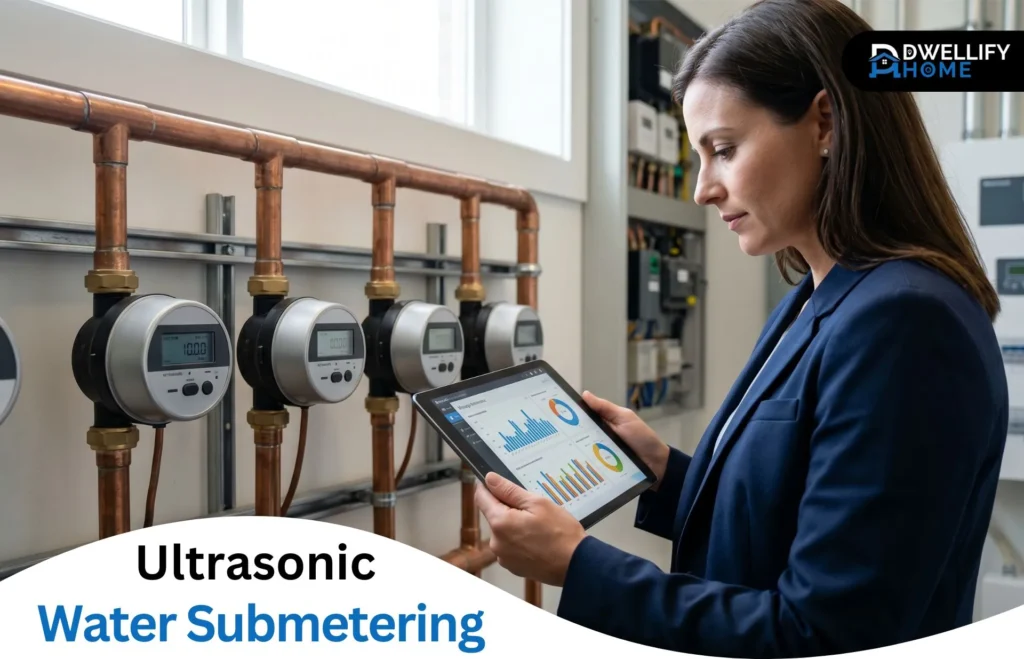
Submetering adoption keeps climbing. Some of it comes from new regulations, and some from owners thinking ahead about long-term building performance. Either way, the pressure is real — meters need to stay accurate, report remotely, and stop pulling maintenance crews into the basement every few months.
That’s where modern ultrasonic water submetering fits in as a practical answer. Axioma Metering is one of the companies leading this shift on the hardware side.
This article walks through how ultrasonic meters actually function, where industry adoption is heading, and why the QALCOSONIC W1 from Axioma Metering — distributed through its partner Mainlink — deserves a closer look.
How Ultrasonic Technologies Work in Water Submetering
Ultrasonic water meters take a different approach from the spinning-mechanism meters most people picture. There’s nothing sitting inside the pipe to slow the water down or wear out, which already removes a long list of common failure points.
The measurement itself is clever. Sound pulses travel through the water, both with the flow and against it, and the meter reads the tiny time difference between the two journeys. That difference is what reveals actual flow rate and total volume.
The Axioma QALCOSONIC W1 uses this transit-time method, which is why its readings stay consistent even after years in service.
These meters aren’t flawless — some designs can be a bit sensitive to air trapped in the line — but in day-to-day operation they’re hard to beat for reliability.
Industry Adoption
According to Grand View Research, the global smart water meter market is expected to reach $16 billion by 2030, growing at a CAGR of 10.3%. Mechanical meters still hold the larger installed base, but ultrasonic uptake is picking up speed — especially where utilities and property groups care about non-revenue water loss and digital integration.
Several forces are pushing this shift: water scarcity in drier regions, tighter regulations, fairer tenant billing, and straightforward cost savings.
For building owners, rolling out submetering isn’t always smooth. The right technology partner makes a noticeable difference.
Mainlink takes the bundled approach, pairing ultrasonic meters with communication infrastructure, an analytics platform, and a mobile app. That kind of packaged offering answers the usual concerns owners raise around connectivity, data security, and staff training.
Their setup is already deployed across very different environments — projects run from California to Iceland to Dubai. The solution combines Axioma’s meters, a LoRaWAN network, and the Mainhive cloud platform for secure processing, automated monitoring, and straightforward integration with existing systems. The end-user app is a genuinely useful piece here, since residents can see what they’re paying for in real time.
Adoption, then, sits at the meeting point of push and pull — outside pressure nudges owners to act, and vendors offer solutions simple enough to actually deploy.
Why Mainlink’s Ultrasonic Submetering Offering Stands Out
Water submetering has advanced quickly in recent years, and the market now has several dependable long-life options. Mainlink sits firmly in that group, offering ultrasonic meters built around durability, precision, and modern connectivity standards.
The core specs are worth laying out:
- Battery life of 16+ years
- Accuracy of ±1.5% within the normal flow range
- Built-in leak and burst alarms
- Integrated LoRaWAN, AMI-ready
- Low-flow sensitivity down to 0.01 gpm
For owners thinking across a 10- or 20-year horizon, those numbers translate into real benefits on the ground:
- Accurate billing: Tenants are charged for what they actually consume, which cuts down on disputes and awkward back-and-forth at the property office
- Leaner budgets: Low-maintenance hardware means fewer service calls and later replacement cycles, while tighter conservation brings real utility savings
- Reliable long-term performance: With no moving internals to wear out, accuracy drift stays minimal year after year
- Automated alerting: Instead of waiting for a tenant to notice a running toilet or hidden slab leak, managers get an alert the moment something’s off
Considerations
No solution comes without trade-offs. Ultrasonic systems carry higher upfront costs than mechanical meters, and the LoRaWAN connectivity only performs well when gateways are properly placed across the site. Skip that planning step and data reliability suffers.
It’s also worth thinking through how the meters fit with what’s already running — billing software, tenant portals, and facility dashboards. And as always, it pays to work with a vendor that has a real track record.
Ultrasonic Water Submetering is the Future
Smart measurement is reshaping how buildings track and manage water, and ultrasonic water submetering sits right at the center of that change. It brings steady accuracy, long service life, and real-time visibility — while removing routine site visits, slow leak detection, and mechanical servicing from the operations list.
When tenants can match their daily use in the app with what they see on the bill, trust goes up and wasteful habits tend to drop. Mainlink’s full-stack approach lines up well with where modern building management is heading, giving owners a sensible, future-ready foundation to build on.
Before you leave, take a look at our other useful articles! Some of the links featured in this post may be affiliate or sponsored, which means we may earn a small commission if you make a purchase — at no extra cost to you. This support helps us continue providing helpful content. The opinions expressed in this article are those of the author and do not necessarily reflect the official position of Dwellifyhome.com.