
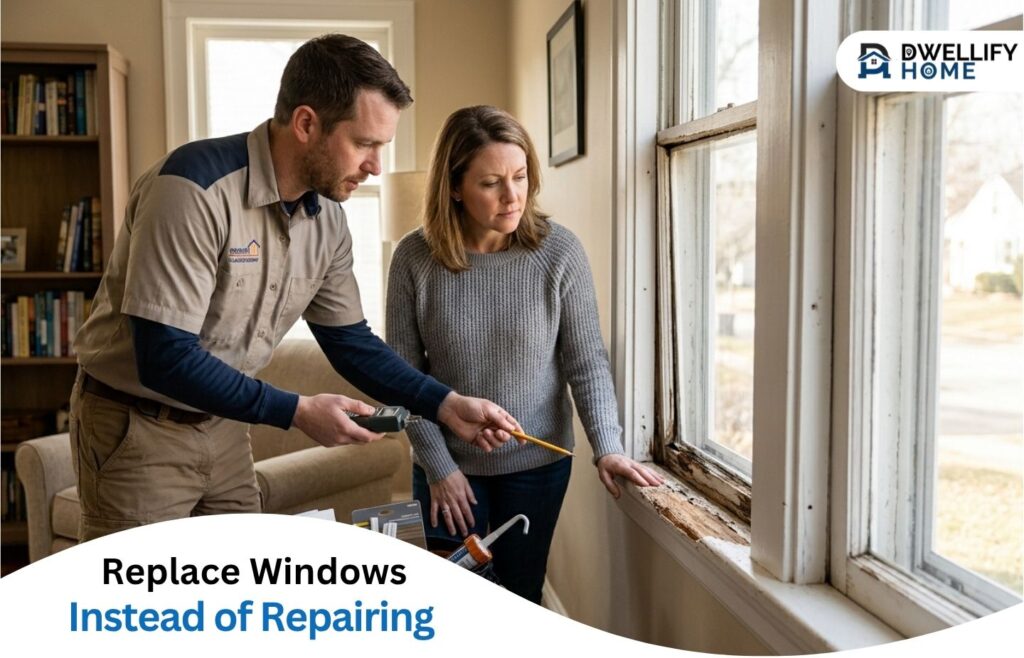
A drafty or difficult-to-open window does not always need to be replaced. Some problems can be corrected with new weatherstripping, adjusted hardware, fresh exterior caulking, or a replacement glass unit.
There is also a point at which repeated repairs stop making financial sense.
If the frame is deteriorating, several components are failing, or the window no longer provides reasonable comfort, complete replacement may offer better long-term value. The challenge for homeowners is determining whether they are dealing with one repairable defect or a window system that has reached the end of its practical service life.
The right decision depends on the cause of the problem, the condition of the complete opening, and what the homeowner expects from the window after the work is finished.
Start by Identifying the Actual Problem
A symptom does not always reveal its cause. Cold air near a window could be coming through worn weatherstripping, but it might also be travelling through an uninsulated gap behind the trim. Condensation can result from excessive indoor humidity, cold glass, or a failed seal between the panes.
Replacing the entire window without identifying the cause can result in unnecessary expense. Repairing the most visible component without checking the rest of the opening can be equally ineffective.
A useful assessment should consider:
- The condition of the glass
- The stability of the frame and sash
- Weatherstripping and hardware
- Insulation around the opening
- Interior and exterior seals
- Signs of water entry
- The age and performance of the existing window
Once the source is understood, it becomes easier to compare the likely lifespan and value of repair against complete replacement.
Can a Failed Glass Seal Be Repaired?
Modern double- and triple-pane windows contain sealed glass units. The panes are separated by spacers, and the space between them may contain insulating gas.
When the perimeter seal fails, moisture can enter between the panes. The window may develop fog, haze, water droplets, or mineral deposits that cannot be cleaned from either side.
A failed seal reduces visibility and may affect the insulating performance of the glass unit. It does not always mean the frame must be replaced.
When Glass-Only Replacement Is Reasonable
Replacing only the sealed glass unit may be a practical option when:
- The frame remains strong and undamaged
- The sash still opens and closes correctly
- The weatherstripping is in good condition
- There are no significant drafts around the frame
- The window is otherwise suitable for the home
- A correctly sized replacement glass unit is available
This approach preserves the existing frame while addressing the failed glass. It can be more economical than replacing the complete window.
When a Failed Seal Points Toward Full Replacement
Glass-only replacement may offer limited value if the window has several other problems. A new sealed unit will not correct a warped sash, unstable frame, poor hardware, or missing insulation around the opening.
If multiple glass units throughout the home are failing and the windows are already older or inefficient, replacing them as complete units may provide a more consistent result.
The decision should account for the remaining condition of the frames, not just the appearance of the glass.
Drafts May Be Repairable, but the Source Matters
Drafts are among the most common reasons homeowners consider new windows. They are also one of the easiest symptoms to misdiagnose.
Cold air may enter through damaged weatherstripping, a sash that does not close tightly, cracked exterior caulking, or a perimeter gap hidden behind the interior casing. Each source requires a different response.
Minor Air Leaks Can Often Be Corrected
A repair may be enough when the window is structurally sound and the leak comes from an isolated maintenance issue.
Possible repairs include:
- Replacing worn weatherstripping
- Adjusting locks or hinges
- Resealing exterior joints
- Correcting a small gap around the trim
- Realigning an operable sash
These repairs can restore a reliable seal without replacing the entire unit.
However, homeowners should be cautious about repeatedly applying caulking without understanding where the air is entering. A new bead on the visible exterior may not affect a leak travelling through the wall cavity.
Persistent Drafts Can Indicate a Larger Problem
If drafts return shortly after repairs, the problem may involve frame movement, poor original installation, or inadequate insulation around the opening.
This is particularly important in Alberta communities exposed to cold winter temperatures and strong winds. Homeowners considering window replacement in Drayton Valley should have the entire opening assessed rather than assuming that the glass or weatherstripping is the only source of discomfort.
Complete replacement provides an opportunity to remove the existing unit, inspect the rough opening, add appropriate insulation, and create new interior and exterior seals.
Damaged Frames Often Change the Decision
The frame supports the glass, keeps the sash aligned, and connects the window to the wall. Once the frame loses its structural integrity, small repairs may no longer solve the underlying problem.
Damage can result from long-term moisture exposure, physical impact, material deterioration, or movement within the opening.
Signs of Significant Frame Damage
Homeowners should look for:
- Soft, cracked, or rotting wood
- Warped frame sections
- Separation at frame corners
- Loose or unstable sashes
- Water staining that continues to return
- Gaps that change with the seasons
- Interior or exterior materials pulling away from the frame
Surface damage may sometimes be repaired. A small area of peeling paint on an otherwise solid wood window is different from rot extending into the frame and surrounding opening.
When deterioration affects the frame’s strength or prevents the sash from sealing properly, replacement is often the more reliable choice.
Water Damage Should Be Investigated Before Installation
Installing a new window without correcting the source of moisture can lead to the same problem again.
Water may be entering through deteriorated caulking, damaged flashing, improperly finished siding, or another part of the wall above the window. The visible frame damage could be a symptom rather than the starting point.
After removing the old unit, the installer should inspect the rough opening and identify damaged materials. Necessary repairs should be completed before the new window is sealed into place.
Condensation Does Not Automatically Mean Replacement
Condensation is often treated as proof that a window has failed. Sometimes it is, but the location of the moisture matters.
Condensation on the room-facing surface usually develops when humid indoor air reaches cold glass. It may be especially noticeable during severe winter weather, when the temperature difference between the interior and exterior is greatest.
Cooking, showering, drying laundry, humidifiers, and a large number of indoor plants can all increase household humidity. Closed curtains and blinds may also contribute by reducing warm-air circulation across the glass.
When Indoor Condensation May Be Managed
Replacement may not be necessary if the window is otherwise sound and condensation appears only during very cold weather.
Homeowners can try:
- Reducing the humidifier setting
- Using bathroom and kitchen exhaust fans
- Opening blinds to improve airflow
- Keeping heating vents unobstructed
- Checking whether the home’s ventilation is working properly
- Wiping away accumulated moisture before it damages the trim
These steps address indoor conditions rather than the window itself.
When Condensation Supports the Case for Replacement
Older, low-performing glass tends to have colder interior surfaces. Even at reasonable humidity levels, it may collect more condensation than an energy-efficient window.
If recurring moisture is accompanied by cold glass, drafts, deteriorated frames, or other performance problems, replacement may provide a more complete improvement.
Moisture trapped between the panes is different. It usually indicates a failed sealed glass unit. The decision then comes down to whether replacing the glass alone is worthwhile based on the condition of the frame and sash.
Operational Problems Range From Simple to Serious
Windows should open, close, and lock without excessive force. When they do not, the cause may be as simple as loose hardware or as serious as a distorted frame.
A window that will not remain open can create a safety concern. One that does not close fully may allow air and water inside. A lock that no longer aligns can affect both airtightness and home security.
Problems That May Be Repaired
Depending on the window design and availability of parts, a professional may be able to:
- Replace a worn crank
- Adjust hinges
- Repair or replace a lock
- Install new balances in a hung window
- Clean or replace damaged track components
- Reposition a sash that has shifted slightly
Repair is usually more attractive when the frame remains square, the glass is performing properly, and the necessary parts are available.
When Operation Problems Suggest Replacement
Repeated hardware failures may indicate that the sash or frame is no longer aligned. A warped frame can place ongoing pressure on locks, cranks, and hinges, causing new parts to wear prematurely.
Replacement may also make more sense when parts are no longer available for an older window system. A custom repair can become expensive without resolving other performance limitations.
Operational problems should not be dismissed as minor inconveniences. A window that cannot close or lock reliably is not performing its basic function.
Older Glazing Can Limit Comfort
Some older windows remain physically intact but provide far less thermal performance than modern units. Single-pane glass and early double-pane systems can become noticeably cold during winter.
Cold glass affects comfort even if no outdoor air is entering. Warm room air cools when it reaches the window and falls toward the floor, creating air movement that feels like a draft. People sitting near the opening may feel chilled while the thermostat reports a normal indoor temperature.
When Retaining Older Glass May Be Reasonable
Replacement is not always necessary if the window is in a low-priority space, remains in good condition, and does not create significant comfort or moisture problems.
Some owners of character homes may also prefer to retain original windows for architectural reasons. In those situations, maintenance, storm windows, or selective improvements may be considered.
The decision involves balancing appearance, performance, maintenance, and budget.
When New Glazing Offers More Than a Repair
If older glass contributes to uncomfortable rooms, repeated condensation, or severe temperature differences, repairing isolated hardware or seals may not deliver the improvement the homeowner wants.
Modern double- and triple-pane configurations can provide warmer interior glass temperatures. Low-E coatings and insulating gas fills help control heat transfer, while improved spacer systems can reduce cold conditions near the edge of the glass.
These features are most effective when combined with a stable frame and professional installation.
When Repairs Are Still the Better Choice
Window replacement is a significant project. Repair remains the sensible choice when the issue is isolated, the surrounding components are sound, and the repair is likely to last.
Examples include:
- A damaged screen
- A worn crank or handle
- One broken lock
- Minor weatherstripping deterioration
- Localized exterior caulking failure
- A single failed glass unit in a newer frame
- A window that needs adjustment rather than structural correction
The age of the window should not be the only factor. A well-built older window in good condition may still be worth maintaining, while a newer unit with widespread defects may not be.
The key question is whether the repair restores dependable performance or merely postpones a larger problem.
Signs That Replacement May Provide Better Value
Complete replacement becomes more reasonable when several problems appear together.
A window with failed glass, a warped frame, worn hardware, and persistent air leakage would require multiple repairs. Even after that work, its original glazing and frame design may continue to limit performance.
Replacement should be seriously considered when:
- The frame has extensive rot or structural damage
- The sash cannot be aligned or sealed
- Air leaks continue after reasonable repairs
- Several sealed glass units have failed
- Replacement parts are unavailable
- Water repeatedly enters around the opening
- The glass provides poor winter comfort
- The windows no longer meet the needs of the room
- Repair costs are high compared with the expected remaining life
- Several windows throughout the home have similar problems
Replacement also allows homeowners to change the operating style, improve ventilation, select a different glass package, or update the exterior appearance.
Compare the Full Cost, Not Just the Immediate Price
Repair almost always has a lower initial price than complete replacement. That does not automatically make it less expensive over time.
Homeowners should consider how many components need attention, how long the repair is expected to last, and whether other problems are likely to appear soon. Paying for glass this year, hardware next year, and perimeter sealing the year after may eventually approach the cost of a new window without providing the same performance.
At the same time, homeowners should avoid replacing a sound window simply because one inexpensive component has failed.
A useful comparison includes:
- The cost of the proposed repair
- The likely service life after repair
- The condition of the remaining components
- The efficiency of the existing glazing
- Available warranties
- The disruption involved in future work
- The expected benefits of complete replacement
This creates a more realistic picture than comparing price alone.
What to Ask During a Window Assessment
A homeowner should receive a clear explanation of why repair or replacement is being recommended.
Useful questions include:
- What is causing the current problem?
- Can the failed component be replaced separately?
- Is the frame still structurally sound?
- Is there evidence of water damage around the opening?
- Are replacement parts still available?
- How long is the repair expected to last?
- Will the repair improve comfort or only restore operation?
- What would a complete replacement correct that repair would not?
- How will the opening be insulated and sealed if the window is replaced?
- What warranty applies to the work?
A contractor should be able to discuss both options without treating replacement as the automatic answer to every defect.
Avoid Making the Decision Based on Appearance Alone
A window can look worn but still operate properly. Another may appear almost new while allowing air through an installation gap behind the trim.
Cosmetic condition is only one part of the assessment. Glass performance, frame stability, hardware, drainage, and perimeter sealing matter more than surface appearance alone.
The same principle applies after repair. Fresh caulking and paint can improve the look of an opening, but they do not prove that hidden moisture or insulation problems have been corrected.
Repair the Component or Replace the System?
The repair-versus-replacement decision becomes clearer when the window is viewed as a complete system.
If one serviceable component has failed and the rest of the window remains sound, repair is usually reasonable. If the frame, glass, hardware, seals, and installation are all contributing to poor performance, replacing one component at a time may offer diminishing returns.
Canglow helps homeowners assess window condition and compare appropriate replacement options for Alberta’s climate. By examining the glass, frame, operation, and surrounding opening, the company can help determine when a targeted repair may be sufficient and when complete replacement is more likely to provide lasting comfort and value.
Before you continue exploring, here’s a quick note about our links. Some may be affiliate or sponsored links that provide us with a small commission when you make a purchase. This support helps Dwellifyhome.com continue producing helpful content for our readers.