
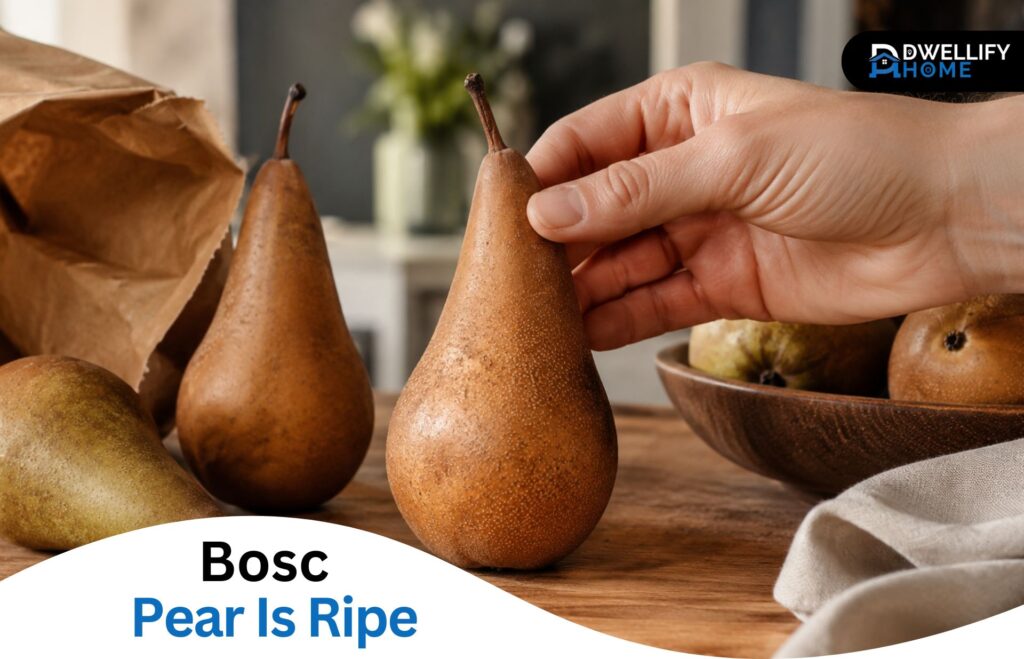
A Bosc pear can be tricky because it doesn’t behave like the softer, juicier pears many people expect. Its brown, russeted skin may not change much, and even a ripe one can still feel firm in your hand. That’s why judging a Bosc pear ripe by color or overall softness often leads to confusion.
The best way to check is simple: press gently near the stem. That small area, often called the neck, tells you more than the rest of the pear. Once you know what to feel for, it’s much easier to decide whether to eat it, leave it on the counter, move it to the fridge, or use it for cooking.
Short Definition
A Bosc pear ripe enough to eat gives slightly near the stem while staying firm through the body, helping you know when to eat, ripen, or refrigerate it.Mission Statement
DwellifyHome helps homeowners, renters, and home lovers make practical, stylish, and informed choices for more comfortable everyday living.
Quick Checklist
• Press gently near the stem, not the wide body
• Look for slight give, not full softness
• Don’t judge ripeness by brown skin alone
• Leave hard pears on the counter
• Use a paper bag to help speed ripening
• Refrigerate once ripe to slow over-softening
• Discard pears with mold, leaking juice, or sour smell
Quick Answer: How to Tell When a Bosc Pear Is Ripe
A Bosc pear is ripe when the neck near the stem gives slightly under gentle pressure. It should not feel mushy, collapsed, or soft all over. Because Bosc pears have a naturally firm texture, the body of the pear may still feel fairly dense even when the fruit is ready to eat.
The Neck Test: Where to Press
Hold the pear gently in your hand and use your thumb to press just below the stem. This upper part of the pear softens before the wider body does.
You’re looking for a small amount of give, not a deep dent. The pressure should feel similar to pressing a ripe avocado near the stem, but often a little firmer.
Avoid squeezing the middle or bottom of the pear to check ripeness. That can bruise the fruit, and it can also mislead you because the wide body of a Bosc pear may stay firm even after the neck is ready.
What “Slight Give” Should Feel Like
A ripe Bosc pear should feel firm but not rock-hard near the stem. When you press gently, the neck should yield just a little and then hold its shape.
Here’s a quick way to read it:
| What You Feel | What It Usually Means |
| Hard near the stem with no give | Still underripe |
| Slight give near the stem | Ripe or close to ripe |
| Very soft neck and soft body | Possibly overripe |
| Mushy spots, leaking, or sour smell | Likely spoiled |
The key is not waiting for the whole pear to become soft. With Bosc pears, that can mean you waited too long.
Why Bosc Pears Stay Firm Even When They Are Ripe
Bosc pears have a dense, firm texture compared with many other pear varieties. That’s one reason people often think they’re underripe when they’re actually ready to eat.
A Bartlett pear, for example, may become noticeably softer and change color as it ripens. A Bosc pear is more reserved. It may develop a sweeter aroma and soften slightly at the neck, but its body can still feel sturdy.
That firmness is part of what makes Bosc pears useful in the kitchen. They hold their shape well for baking, poaching, roasting, and slicing. For fresh eating, the texture can feel crisp-firm rather than soft and melting.
Ripe-Firm vs Underripe-Hard
The difference between ripe-firm and underripe-hard is subtle but important.
A ripe-firm Bosc pear has a little give at the neck, a gentle pear aroma, and a texture that feels dense but pleasant when sliced. It may still have some bite, especially if you prefer pears before they become very soft.
An underripe Bosc pear feels hard near the stem, tastes less sweet, and may have a dry or starchy texture. It can be eaten, but it usually won’t give you the flavor or juiciness you’re expecting.
When Softness Means It May Be Overripe
Softness is not always a good sign. If the entire pear feels soft, especially around the middle or bottom, it may be past its best point for fresh eating.
A slightly overripe pear may still work in smoothies, sauces, baked fillings, or cooked dishes. But a pear with mold, leaking juice, broken skin, a fermented smell, or large brown mushy areas should be discarded.
What Color Is a Ripe Bosc Pear?
A ripe Bosc pear is usually still brown or cinnamon-colored because its russeted skin is natural. Some Bosc pears may show a warmer golden or yellow undertone as they ripen, but color is not the most reliable sign.
This is where many people get confused. With Bosc pears, brown skin does not mean the fruit is old or spoiled. It’s simply how this variety looks.
Why Brown Skin Is Normal
Bosc pears are known for their rough-looking russeted skin. The surface can look matte, bronze, tan, or brown even when the pear is fresh.
That skin can make it hard to judge ripeness visually. Unlike pear varieties that shift clearly from green to yellow, Bosc pears often keep a similar appearance from firm to ripe.
For that reason, the pear neck test matters more than color.
Color Clues That Can Help
Color can still offer small clues, but it should not be your only guide.
A Bosc pear may be closer to ripe if:
- The brown skin looks slightly warmer or more golden underneath
- The stem area looks a little less tight
- There is a faint sweet pear aroma
- The neck gives slightly under gentle pressure
Still, touch should decide. A good-looking pear can be too hard, and a dull brown Bosc pear can be ready to eat.
How Long Does a Bosc Pear Take to Ripen?
Bosc pear ripe time depends on how firm the pear was when you bought it, how it was stored before purchase, and the temperature in your kitchen. In many homes, a firm Bosc pear may take several days on the counter to soften enough at the neck.
Some pears ripen in a few days. Others take longer, especially if they were very firm, stored cold, or kept in a cooler room.
Counter Ripening Time
For normal countertop ripening, leave Bosc pears at room temperature in a fruit bowl or on the kitchen counter. Keep them away from direct sun, heat vents, and very warm spots.
Check the neck once a day. Don’t squeeze the whole pear each time; a gentle press near the stem is enough.
A pear that feels almost ripe today may be ready tomorrow. A pear that is hard as a rock may need more time.
Why Some Bosc Pears Take Longer
Some Bosc pears stay hard longer because they started out very firm or were held in cold storage. Temperature also matters. A cool kitchen can slow ripening, while a warmer room can move it along faster.
There’s also natural variation from pear to pear. Even pears from the same bag may not ripen on the same day.
That’s why daily checking works better than relying on an exact number of days.
How to Ripen Bosc Pears at Home
The easiest way to ripen Bosc pears is to leave them at room temperature and check them daily. For a faster method, place them in a brown paper bag, with or without an apple or banana.
The goal is to help the pear soften naturally without trapping too much moisture or causing spoilage.
The Counter Method
Place unripe Bosc pears on the counter at room temperature. Keep them in a spot where you’ll remember to check them.
This method is best when:
- The pear is firm but not extremely hard
- You don’t need it immediately
- You want a steady, controlled ripening process
- Your kitchen is not too cold
Do not refrigerate an unripe Bosc pear if you want it to ripen soon. Cold slows ripening and can make the wait much longer.
The Paper Bag Method
A brown paper bag can help ripen pears by holding some of the natural ethylene gas around the fruit. Ethylene is part of the fruit-ripening process.
Place the pear in a paper bag, fold the top loosely, and leave it at room temperature. Check it daily so it doesn’t pass from ripe to overripe before you notice.
Use paper, not airtight plastic. Plastic can trap moisture and create a poor environment for fruit.
Should You Add an Apple or Banana?
Adding an apple or banana to the paper bag can help speed things up because those fruits also release ethylene. This can be useful when your Bosc pear is still firm and you want it ready sooner.
That said, it’s not an instant fix. A very hard pear may still need time, and a pear that was picked too early or stored poorly may not ripen as nicely as expected.
Think of the paper bag as a helpful nudge, not a guarantee.
How to Store Bosc Pears Before and After They Ripen
Unripe Bosc pears should stay at room temperature until the neck gives slightly. Once ripe, move them to the refrigerator to slow further ripening and keep them from becoming too soft too quickly.
This simple counter-to-fridge routine solves most storage confusion.
Where to Keep Unripe Bosc Pears
Keep unripe Bosc pears on the counter, in a fruit bowl, or in a loosely closed paper bag. They need room-temperature conditions to continue ripening.
Avoid storing unripe pears in:
- The refrigerator, unless you’re intentionally slowing ripening
- Airtight plastic bags
- Hot windowsills
- Damp areas
- Crowded bowls where fruit gets bruised
A little airflow helps. So does checking them every day once they begin to soften.
When to Move Ripe Bosc Pears to the Fridge
Move a Bosc pear to the refrigerator once the neck has a slight give and the pear is ready to eat. Refrigeration will slow ripening, which gives you more time to use it.
This is especially helpful if several pears become ripe at once. Eat the ripest ones first, and keep the rest chilled until you’re ready.
Before eating a refrigerated pear, you can let it sit at room temperature for a short while if you prefer a fuller flavor and less cold texture.
Why Your Bosc Pear Is Still Hard
A Bosc pear may stay hard because it needs more room-temperature time, the room is too cool, or the fruit was stored cold before you bought it. In some cases, a pear may simply not ripen well, even with the paper bag method.
This is one of the most common frustrations with Bosc pears. The skin looks fine, the pear sits on the counter, and several days later it still feels like a small wooden sculpture.
Start by checking the neck, not the body. If the neck is still hard, give it more time at room temperature. Try the paper bag method if you want to encourage ripening.
When the Paper Bag Method Does Not Work
The paper bag method helps many pears, but it can’t fix every problem.
It may not work well if:
- The pear was picked too early
- The pear was stored very cold for a long time
- The kitchen is too cool
- The pear is drying out instead of ripening
- The fruit quality was poor from the start
After several days in a paper bag, check for smell, texture, and skin condition. If the pear remains hard but starts to shrivel or develop bad spots, it may not ripen into good eating quality.
Store-Bought vs Home-Grown Bosc Pears
Store-bought Bosc pears are usually meant to finish ripening at home. They may arrive firm because pears are often sold before they are fully soft.
Home-grown Bosc pears can be more complicated. Some European pear varieties ripen best after being picked mature but firm, then held under the right conditions. Fruit left too long on the tree can sometimes develop poor texture.
For a kitchen-focused article like this, the main rule is simple: store-bought Bosc pears usually belong on the counter until the neck gives slightly, then in the fridge once ripe.
Can You Eat a Bosc Pear Raw?
Yes, you can eat a Bosc pear raw. A ripe Bosc pear has a firm, dense texture and a sweet flavor that works well sliced fresh, especially if you like pears with a little structure. For a softer, juicier bite, wait until the neck gives slightly before eating.
Bosc pears don’t have to be cooked. They can be sliced into salads, served with cheese, packed in lunches, or eaten as a simple snack.
Their firmer texture just means the eating experience is different from softer pear varieties.
Best Uses for Firm-Ripe Bosc Pears
A firm-ripe Bosc pear is useful when you want clean slices that hold together.
It works well for:
- Fresh slices with cheese or nuts
- Lunchbox fruit
- Salads
- Fruit boards
- Simple desserts
- Thin slices on toast or oatmeal
Because the flesh is denser, it can feel less juicy than softer pears. That is normal for Bosc.
When to Use Bosc Pears for Baking
Bosc pears are a strong choice for baking, poaching, roasting, and other cooked dishes because they hold their shape well.
Use them for cooking when:
- They are ripe but still firm
- You want slices that don’t collapse
- The pear is slightly too firm for fresh eating
- You need a pear that can handle heat
Very soft pears can still be used in sauces, compotes, or blended preparations, as long as they show no signs of spoilage.
Signs a Bosc Pear Is Overripe or Bad
A Bosc pear may be overripe if it feels soft all over, has large mushy spots, or gives off a fermented smell. It may be bad if you see mold, leaking juice, broken skin with decay, or an unpleasant sour odor.
Softness alone doesn’t always mean the pear is unsafe, but it does mean you should look more closely.
Overripe But Still Usable
A slightly overripe Bosc pear may not be pleasant for fresh slices, but it can still be useful.
You may be able to use it for:
- Smoothies
- Pear sauce
- Baked fillings
- Muffins or quick breads
- Cooked compotes
Use your judgment. If the pear smells sweet and looks clean inside, it may still be fine for cooking. If it smells sour, alcoholic, or unpleasant, don’t use it.
When to Throw It Away
Throw away a Bosc pear if it has:
- Visible mold
- Leaking liquid
- A sour or fermented smell
- Large brown mushy areas
- Broken skin with decay
- Slimy texture
- Fruit flies gathering around damaged spots
Food safety is not the place to stretch a pear one more day. When the signs are clearly bad, discard it.
Common Mistakes to Avoid When Ripening Bosc Pears
The biggest mistake is treating a Bosc pear like every other pear. Its firm texture and brown skin make it easy to misread.
Avoid these common mistakes:
- Judging ripeness by color only: Bosc pears are naturally brown and russeted.
- Waiting for full-body softness: By then, the pear may be overripe.
- Pressing the wide body: Check the neck near the stem instead.
- Refrigerating too early: Cold slows the ripening process.
- Using airtight plastic bags: They trap moisture and can encourage spoilage.
- Forgetting to check daily: Pears can move from ripe to overripe faster than expected once they soften.
- Assuming every hard pear will ripen well: Some pears may never develop ideal texture.
A better routine is simple: counter while hard, paper bag if you want to speed it up, fridge once ripe, and discard if spoiled.
FAQs About Bosc Pear Ripeness
How do I know if a Bosc pear is ripe?
A Bosc pear is ripe when the neck near the stem gives slightly under gentle pressure. The body may still feel firm because Bosc pears have dense flesh. Don’t rely on brown color alone, and don’t wait for the whole pear to become soft before eating it.
Do Bosc pears ripen on the counter?
Yes, Bosc pears ripen on the counter at room temperature. Keep them in a fruit bowl or paper bag and check the neck daily. Once the pear gives slightly near the stem, move it to the refrigerator if you’re not eating it right away.
Are Bosc pears supposed to be crunchy?
Bosc pears are naturally firmer than many other pear varieties, but they should not feel hard and dry when ripe. A ripe Bosc may have a firm bite, yet it should still taste sweet and feel slightly softer near the stem.
Can you eat Bosc pear skin?
Yes, Bosc pear skin is edible. The brown, russeted surface may look rougher than other pear skins, but it does not need to be peeled for fresh eating. Wash the pear first, then slice or eat it according to your preference.
Should Bosc pears be refrigerated?
Refrigerate Bosc pears after they are ripe. Keeping unripe pears in the refrigerator can slow the ripening process. A good rule is to leave firm pears on the counter, then move them to the fridge once the neck gives slightly.
Can you eat an unripe Bosc pear?
You can eat an unripe Bosc pear, but it may taste less sweet and feel hard, dry, or starchy. For better flavor and texture, let it ripen at room temperature until the neck gives slightly. Very firm pears can also work better in cooked dishes than as fresh snacks.
Final Thoughts on Getting Bosc Pear Ripeness Right
Getting Bosc pear ripeness right comes down to one reliable habit: check the neck, not the color or the whole body. A Bosc pear ripe enough to eat should give slightly near the stem while still feeling firm through the middle.
Leave hard pears on the counter, use a paper bag if you want to speed things along, and refrigerate them once they’re ready. Once you stop waiting for a Bosc pear to become soft like other varieties, it becomes much easier to enjoy it at the right time.
Disclaimer
This content is for general informational purposes only. Homes, needs, budgets, and situations vary. For safety, installation, repair, legal, structural, electrical, plumbing, HVAC, or major property decisions, consider professional advice.