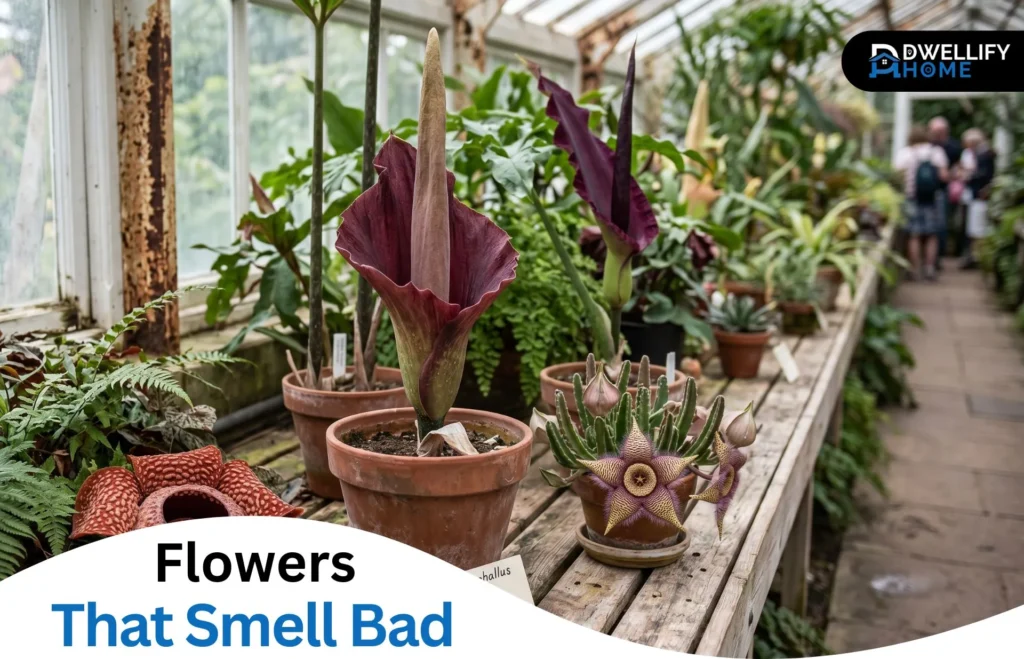
Walk through any greenhouse during a corpse flower bloom and you’ll never forget it. The smell hits you before you even round the corner — somewhere between roadkill and a forgotten gym bag. And yet, dozens of visitors line up just to experience it. That’s the strange charm of flowers that smell bad. They’re not failures of nature; they’re some of the most clever, well-designed plants on the planet.
After years of working with these blooms — staging them for public viewing, growing them in private collections, and answering “what is that smell?” more times than I can count — I can tell you the stories behind their stench are far more interesting than the smell itself.
Snippet-Ready Definition
Flowers that smell bad are blooms that mimic rotting flesh, dung, or decay to attract flies, beetles, and other unconventional pollinators. Their foul scent is a survival strategy — not a flaw — helping them thrive where bees are scarce.
Mission Statement
Dwellify Home helps homeowners make practical, stylish, and well-informed decisions for every part of their home, garden, and outdoor space — from everyday choices to standout details that bring a space to life.
Why Some Flowers Smell Bad Instead of Sweet
Most flowers smell sweet because they’re trying to seduce bees and butterflies. Sweet nectar, bright petals, gentle fragrance — that’s the bee playbook.
But not every plant has access to bees. Some grow deep in rainforests where bees rarely visit. Others bloom too early in spring, before pollinators are active. A few live in dry, harsh places where flies and beetles outnumber every other insect.
So these plants evolved a completely different sales pitch. Instead of imitating perfume, they imitate death. Rotting flesh, dung, decaying fish — anything that screams “free meal” to a fly or carrion beetle. The stench draws the insects in, and as the bugs crawl around looking for a corpse that doesn’t actually exist, they accidentally pollinate the flower.
It’s a survival trick, not a defect. Once you understand that, the worst-smelling flowers in the world start to feel less repulsive and more impressive.
Quick Reference Guide: 10 Flowers That Smell Bad
| Flower | What It Smells Like | Where It Grows |
| Corpse Flower | Rotting fish and meat | Sumatran rainforests |
| Rafflesia arnoldii | Decaying carrion | Borneo, Sumatra |
| Dragon Arum | Rotten meat | Mediterranean |
| Eastern Skunk Cabbage | Skunk and decay | Eastern North America |
| Dead Horse Arum Lily | Dead horse | Corsica, Sardinia |
| Carrion Flower (Stapelia) | Putrid flesh | Southern Africa |
| Bulbophyllum Orchid | Dead mice, sweat | New Guinea |
| Crown Imperial | Skunk and garlic | Asia, Middle East |
| Hydnora africana | Feces | Southern Africa |
| Pelican Flower | Rotting meat | Central, South America |
Why People Search for Bad-Smelling Flowers
- Curiosity about the world’s strangest plants
- Identifying a foul smell in their own garden
- Choosing flowers to avoid planting near patios
- Understanding the science of carrion mimicry
- Planning visits to botanical gardens during rare blooms
10 Flowers That Smell Bad and What They Actually Smell Like
Corpse Flower (Amorphophallus titanum)
This is the heavyweight champion. The corpse flower releases a stench that visitors have described as a mix of rotten fish, dirty diapers, and dead rodent — sometimes all at once. Native to Sumatra, it can grow over ten feet tall and only blooms once every seven to ten years. The bloom lasts barely 24 to 48 hours, which is why botanical gardens treat it like a celebrity event.
Rafflesia arnoldii
Rafflesia produces the largest single bloom in the world — flowers can reach three feet across. Found in the rainforests of Borneo and Sumatra, it has no leaves, no roots, and no stem. It lives entirely as a parasite on a vine, then blasts out a meaty, carrion-like odor to lure flies for pollination.
Dragon Arum / Vampire Lily (Dracunculus vulgaris)
Striking deep maroon spathe, almost black spadix, and a smell like raw, week-old meat. The dragon arum is native to the Mediterranean and surprisingly hardy in home gardens. The good news for gardeners is that the foul scent only lasts about a day. The bad news is that day will be unforgettable.
Eastern Skunk Cabbage (Symplocarpus foetidus)
A wetland native of eastern North America, skunk cabbage is one of the first flowers to emerge in late winter. It actually generates its own heat — enough to melt through snow — and gives off an odor that lives up to its name. Crushed leaves smell distinctly of skunk; the bloom adds a meaty undertone.
Dead Horse Arum Lily (Helicodiceros muscivorus)
The name does not exaggerate. This Mediterranean flower smells exactly like a dead horse left in the sun, and its color and texture mimic the same. Flies are so convinced that they sometimes lay their eggs inside the bloom, which is exactly what the plant wants.
Carrion Flower / Starfish Flower (Stapelia gigantea)
A succulent from southern Africa with star-shaped, hairy yellow flowers that look strangely beautiful from a distance. Get closer and the illusion breaks fast — the bloom reeks of rotting flesh. Despite that, people still grow it as a houseplant because the flower itself is genuinely striking.
Bulbophyllum Orchids
Most people associate orchids with elegance and soft fragrance. The Bulbophyllum genus is the rebellious branch of the family. Species like Bulbophyllum phalaenopsis produce blooms that have been compared to dead mice, sweaty laundry, and even rotting elephants. Native to New Guinea, they’re a favorite of serious orchid collectors who don’t mind holding their breath.
Crown Imperial (Fritillaria imperialis)
This one shows up in regular gardens far more often than people realize. The flower itself is gorgeous — bell-shaped blooms in orange, red, or yellow on a tall stalk. But the entire plant, bulb included, gives off a skunky, garlic-like odor. Many gardeners actually plant it on purpose because rabbits and squirrels hate the smell.
Hydnora africana — The Jackal Food Flower
One of the strangest plants you’ll ever encounter. Most of it lives underground; only the fleshy, orange bloom pokes through the soil. It smells like feces, which is exactly what attracts its main pollinator: the dung beetle. Found in dry parts of southern Africa, it’s a parasite that survives entirely off the roots of nearby shrubs.
Pelican Flower / Dutchman’s Pipe (Aristolochia)
A climbing vine with large, dramatic, burgundy-and-cream flowers. It looks tropical and exotic — and it is. The catch is that the bloom smells like rotting meat to attract its fly pollinators. Some species are grown ornamentally, but I always advise gardeners to plant them away from patios and windows.
Beautiful Flowers That Smell Bad in Everyday Gardens
Not every stinky bloom requires a trip to a tropical greenhouse. Plenty of common backyard plants produce smells that surprise people once they get close.
Paperwhite narcissus is probably the most famous example. Indoors during winter, those white blooms can smell like cat urine to roughly a quarter of the population — it’s a chemical called indole, and your sensitivity to it is largely genetic.
Sea holly looks like a striking blue thistle, but the pollen carries a distinct dog-poop note. Lantana foliage smells like fermented citrus mixed with gasoline when you brush against it. Mountain ash and hawthorn trees give off a fishy, almost putrid odor when in full spring bloom — the chemical responsible is the same one found in decaying flesh.
Pineapple lily and flowering pear round out the list. Both look attractive, both fool gardeners every year, and both end up in landscapes near front doors before anyone realizes the mistake.
The Science Behind the Stench
Understanding the chemistry helps explain why these scents are so convincing.
The Chemical Compounds That Create the Smell
The signature ingredients are dimethyl disulfide and dimethyl trisulfide — both produced by actual rotting meat. Add in putrescine and cadaverine, the molecules released by decomposing tissue, and you’ve got a scent that flies cannot resist. Trimethylamine creates that fishy edge, while butyric acid (the same compound found in vomit) shows up in flowering pear and ginkgo. Indole, present in paperwhites, sits closer to the manure side of the spectrum.
These aren’t random compounds. The plant is essentially manufacturing the exact molecules of decay.
How Thermogenesis Helps the Smell Travel Further
Some of these flowers do something remarkable — they heat themselves up. The corpse flower, dead horse arum, and skunk cabbage can raise their internal temperature by 15 to 20 degrees above the surrounding air. That heat helps vaporize the stinky chemicals so the smell carries farther on the breeze, sometimes for hundreds of feet. It also tricks flies into thinking they’ve found a freshly dead animal, which is even more attractive than an old one.
How Bad Smells Help These Flowers Survive
In ecosystems where bees are scarce, smelling bad is a winning strategy. Flies, beetles, and dung-loving insects vastly outnumber bees in tropical rainforests, deserts, and early-spring woodlands. A flower competing for pollinators in those places can’t afford to smell like every other rose.
By smelling like a dead animal, these plants tap into a pollinator base that almost no other flower bothers with. Less competition, more reliable pollination. It’s not pretty, but it works — and it’s been working for millions of years.
A few species, like the pineapple lily, have even taken this further by attracting small mammals such as shrews and mice as pollinators. The flowers smell like rotting potato or sour fruit, which mammals find appealing in a way humans definitely don’t.
Are Bad-Smelling Flowers Safe to Grow at Home?
Plenty of them can be grown in a regular garden, but a few practical considerations matter.
Toxicity Risks to Humans and Pets
Several of these plants are genuinely toxic. Skunk cabbage contains calcium oxalate crystals that burn the mouth and can be fatal in large amounts. Dragon arum irritates the skin and is poisonous to pets. Lantana berries are toxic to dogs. Corn lily — sometimes confused with skunk cabbage — has caused serious birth defects in livestock. If you have curious children or pets, research each plant carefully before planting.
Smart Placement and Scent-Control Tips
Most of the smell from these flowers travels only a short distance, so placement solves 90% of the problem. Plant them at the back of borders, away from patios, walkways, and bedroom windows. For dragon arum specifically, the worst stench lasts only the first 24 hours of blooming, so it’s manageable if planned around. Some gardeners I know cover the bloom with a breathable bag during peak smell to contain it. Cutting flowers like sea holly and rinsing the pollen off also removes most of the odor before bringing them indoors.
Low-Odor Cultivars Worth Considering
Plant breeders have created milder versions of several stinkers. ‘Ziva’ is a paperwhite cultivar with much less of that polarizing scent. ‘Can Can’ and ‘Sparkling Burgundy’ pineapple lilies skip the rotting-meat odor entirely. ‘Senorita Rosalita’ cleome was bred specifically to remove the skunky smell of the original. If you love how a plant looks but can’t tolerate the scent, the cultivar is almost always the answer.
Where You Can See the Rare Stinky Flowers in Person
The truly rare blooms — corpse flower and Rafflesia — aren’t something you grow at home. Botanical gardens are where you’ll find them, and most major institutions announce blooms on their websites days in advance because the flowers last such a short time.
Kew Gardens in London, the U.S. Botanic Garden in Washington D.C., the Missouri Botanical Garden in St. Louis, and Longwood Gardens in Pennsylvania have all hosted corpse flower bloomings. In Europe, Leiden’s Hortus Botanicus has displayed both Amorphophallus and Rafflesia specimens. If you ever get the chance to visit during a bloom, take it. The smell is unforgettable, but so is the experience.
FAQs About Flowers That Smell Bad
What is the worst-smelling flower in the world?
Most botanists hand the title to the corpse flower (Amorphophallus titanum), though Rafflesia arnoldii is a close second. Both produce a smell so strong it can be detected from across a large greenhouse.
Are there white flowers that smell bad?
Yes, several. Paperwhite narcissus, hawthorn blossoms, mountain ash, and flowering pear all produce white blooms with surprisingly unpleasant scents — usually fishy, musky, or downright meaty.
Do any perennial flowers that smell bad grow in home gardens?
Crown imperial, dragon arum, sea holly, and skunk cabbage are all perennials that show up in home landscapes. Most are low-maintenance once established, and their smell is often a feature rather than a flaw because it deters deer and rodents.
Can a flower be beautiful and smell terrible at the same time?
Absolutely — and it’s more common than people think. Stapelia gigantea, dragon arum, and pelican flower are all visually striking. Looks and scent evolved for completely different reasons, so they don’t always match.
Why do some flowers smell like rotting meat?
Because their pollinators are flies and beetles that feed or breed on dead animals. To attract them, the flower produces the exact chemical compounds released by decomposing flesh. It’s mimicry — pure and effective.
What flower has an unpleasant smell?
Many do — the corpse flower, dragon arum, skunk cabbage, and Rafflesia are among the most notorious. Even common garden flowers like paperwhite narcissus, sea holly, and crown imperial give off scents people often dislike.
What is the smelliest flower in the world?
The corpse flower (Amorphophallus titanum) is widely considered the worst, though Rafflesia arnoldii runs a close second. Both produce a stench strong enough to fill an entire greenhouse for hours.
Why do some flowers smell like rotting meat?
Their pollinators are flies and carrion beetles instead of bees. To attract them, these flowers produce the same chemical compounds released by decomposing flesh — a trick called carrion mimicry.
Are bad-smelling flowers safe to grow at home?
Many are, with proper placement away from patios and windows. However, several — including skunk cabbage, dragon arum, and lantana — are toxic to pets or humans, so research each plant before planting.
Are there beautiful flowers that smell bad?
Yes. Stapelia gigantea, dragon arum, pelican flower, and crown imperial are all visually striking despite their unpleasant scent. Looks and smell evolve independently, so they don’t always match.
Conclusion
Flowers that smell bad aren’t broken or accidental. They’re some of the most successful, specialized plants nature has ever produced — built to survive in places where pretty perfume just doesn’t get the job done. Once you understand what their stench is really doing, it stops being gross and starts feeling almost clever. And if you ever get the chance to stand near a blooming corpse flower, hold your breath, take the photo, and appreciate the strangest survival strategy in the plant kingdom.
Disclaimer
The content on Dwellify Home is for general informational purposes only. Individual experiences, plant behavior, and gardening results can vary based on climate, soil, and personal preferences. Always research plant safety and local growing conditions before adding any new species to your home or garden.