Plant a healthy young peach tree this spring and it’ll surprise you. Most add a foot or two of new growth in their first full season, close in on their mature height within three to four years, and hand over a first real crop around their third summer. For a fruit tree, that’s quick.
So how fast do peach trees grow? Fast in the ways you can see, and slower in the way you’re actually waiting for. That distinction is the whole game, and it’s where nearly every first-timer gets rattled.
The tree shoots up. The peaches take their time. Here’s how both timelines really unfold, year by year, so you’ll know what’s on track and what’s worth a second look.
Short Definition
Peach trees grow fast, adding about 1–2 feet of new growth per year and nearing mature height in 3–4 years. Most grafted trees bear their first real crop around year 3, then stay productive for roughly 10–15 years.Our Mission
Dwellify Home helps people make practical, stylish, and well-informed decisions about their homes, gardens, and properties — turning everyday questions into confident choices.
Key things the article helps you do:
- Tell the “size clock” from the “fruit clock” so year two doesn’t worry you
- Know how tall a peach tree is at 1, 2, and 3 years
- Pick the right tree type — dwarf, semi-dwarf, or standard
- Match a variety to your region’s chill hours
- Spot whether your tree is genuinely on track or falling behind
The Two Clocks — Tree Size vs. Fruit Production
A peach tree runs on two separate clocks, and they don’t keep the same time.
The first is the size clock — how quickly the tree gains height and fills out its frame. That one runs fast. The second is the fruit clock — how long before the tree carries a crop worth picking. That one is patient, and no amount of fussing speeds it up much past its natural pace.
Here’s the situation I see constantly. Someone plants a peach in April, and by August of year two it’s a lush, chest-high tree with not a single peach on it. They’re certain they’ve done something wrong. They haven’t. The tree is spending everything it’s got on roots and branches, exactly as it should. The fruit comes once that frame is built.
Keep those two clocks separate in your head and the rest of this makes sense.
Peach Tree Growth Rate — How Fast It Gains Height
A peach tree in good health puts on roughly one to two feet of new growth a year. Young trees, under three years old, tend to run at the top of that range — often 18 to 24 inches of new shoot growth in a single season. Once a tree matures, past year four or so, that slows to around a foot a year as its energy shifts from getting bigger to bearing fruit.
There’s a rule of thumb worth holding onto: a healthy peach tree should push about 18 inches of new growth a year. Much less than that on an established tree usually means something’s holding it back — poor drainage, low fertility, or too little sun.
How fast it grows and how big it gets both come down heavily to the rootstock the tree is grafted onto, plus your climate and USDA hardiness zone. More on rootstock further down, since it’s the single biggest lever on final size.
How big is a peach tree after 1, 2, and 3 years?
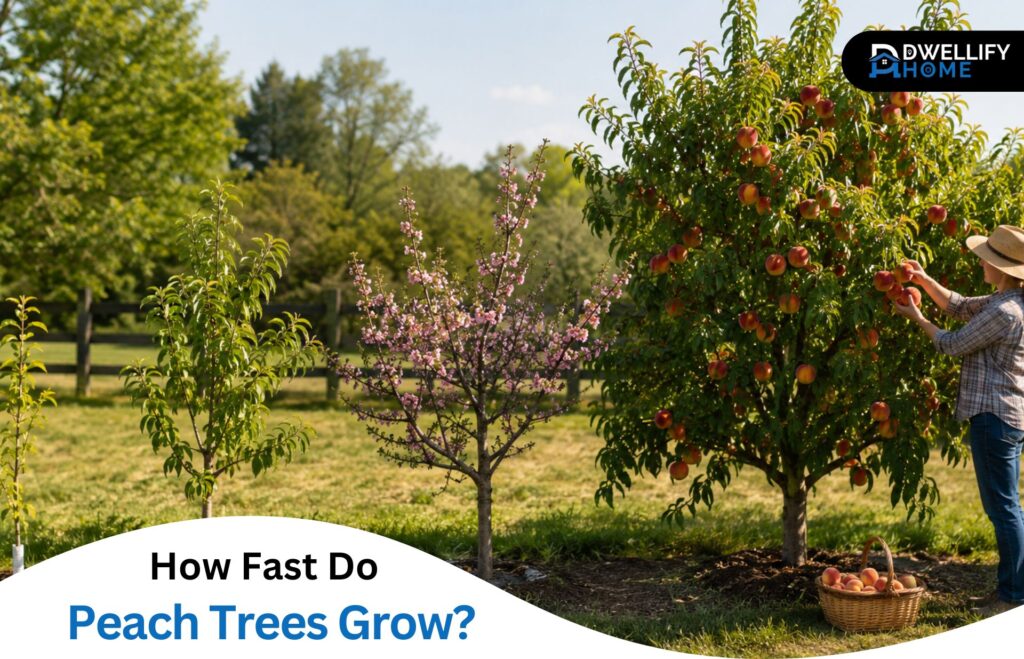
A nursery peach tree is usually a one-year-old whip about three to four feet tall when you buy it. Under good conditions it often reaches five to seven feet by the end of its second year and eight to ten feet by its third, close to mature height. Growth slows noticeably after that.
| Tree age | Typical height | What’s happening |
| At planting (1 yr old) | 3–4 ft | Nursery whip, headed back at planting |
| End of year 1 | 4–6 ft | Roots establishing, first scaffolds forming |
| End of year 2 | 5–7 ft | Framework filling in |
| End of year 3 | 8–10 ft | Near mature height, first real crop |
| Year 4+ | 10–15 ft (standard) | Growth slows, full fruiting |
That table clears up two questions people ask a lot. A two-year-old peach tree is usually five to seven feet, and a four-foot peach tree is almost always just a one-year-old nursery tree at its typical sale size.
From Planting to First Harvest, Year by Year
The fruit clock is the one you’re really counting. A grafted peach tree typically gives its first light crop in year two or three and its first genuinely worthwhile harvest in year three. Here’s why it can’t be rushed, season by season.
Year 1 — Getting established
The first year is mostly underground. The tree is growing roots and putting up its initial branches, and you shouldn’t expect fruit. If a few peaches try to set, pull them off so the tree keeps its energy on establishing. Water consistently and otherwise leave it be. This is the year that decides how strong everything after it will be.
Year 2 — Building the framework
Year two is framework year. The tree fills out its main scaffold branches and may set a handful of peaches. Take most of them off again, or thin hard. A young tree allowed to overbear grows slower and can even snap a limb under weight it isn’t ready for. The absence of a crop here is normal and, honestly, preferable.
Year 3 — Your first real harvest
Year three is usually when it pays you back. By now the tree has the roots, the scaffold structure, and — this is the key part — enough one-year-old wood to carry fruit buds, because that’s the only wood a peach fruits on. Everything had to be in place first. That’s the real reason the wait runs about three years: not because the tree is slow, but because it’s been assembling the parts.
Year 4 to maturity — Peak production
From year four onward the tree hits its stride, filling out to a full crop and settling into peak production for years to come. A mature standard tree can produce around three bushels — roughly 120 to 150 pounds of fruit — in a good season, with vigorous trees pushing higher.
How Long Does a Peach Take to Ripen After Flowering?
From full bloom to a ripe peach usually takes about three to five months, depending on the variety. [VERIFY exact days by cultivar] Early cultivars can ripen in as little as ten to twelve weeks after bloom; late ones take well over four months. The tree flowers in early spring, before the leaves fully open, and the fruit develops through the warm months.
What throws people is that the fruit doesn’t swell steadily. It grows in distinct stages:
- Shuck split — the dried flower remnant splits off the tiny developing fruit.
- Pit hardening — the fruit sizes up a little, then the pit inside hardens and growth visibly stalls.
- The stall — for several weeks, the fruit barely changes size. This is the phase that makes growers nervous.
- Final swell and color-up — in roughly the last month before harvest, the fruit balloons in size and colors up fast.
That mid-season stall is completely normal. The tree is building the pit before it fills the flesh. Most of the size you’re waiting for shows up in the final few weeks, so hold your judgment until then.
One practical note: the ripening dates in nursery catalogs tend to run a week or so ahead of when a backyard peach is actually ready. Those dates reflect commercial picking, which happens early for shipping. Yours will taste best a little later, when it gives slightly to a gentle squeeze and pulls free with a light twist.
| Cultivar season | Rough time from bloom to ripe | Example |
| Early | ~10–12 weeks | Springcrest, Flordaking |
| Mid | ~13–16 weeks | Redhaven |
| Late | ~17+ weeks | Elberta, O’Henry |
What Speeds Up — and Slows Down — Peach Tree Growth
You can’t shortcut the fruit clock by much, but you can absolutely make sure your tree hits its timeline instead of falling behind it. These are the levers that matter, roughly in order of impact.
Start with the right tree
The fastest path to fruit is starting with a strong grafted tree suited to your area. A grafted, container-grown or bare-root tree from a reputable nursery — typically a one-year-old, three-to-four-foot whip — beats a seed-grown tree to fruit by a year or more. Just as important is matching the rootstock and variety to your soil, climate, and chill hours, which is where a lot of struggling trees go wrong before they’re even in the ground.
Give it the site it needs
Peaches are sun-hungry and hate wet feet. Give the tree at least eight hours of direct sun a day, well-drained sandy loam around pH 6.0 to 7.0, and steady water — about an inch a week while it’s establishing. A peach planted in heavy, soggy soil will limp along no matter what else you do. Poor drainage is one of the surest ways to stall or kill one.
Prune and train from day one
This is the counterintuitive one. When you plant a peach tree, you cut it back hard, heading the whip to about 24 to 30 inches. It feels brutal, especially on a nice-looking tree, but that cut forces strong low branching and an open, vase-shaped structure that carries fruit and light well. A tree trained right from planting fruits sooner and stays productive longer than one left to grow tall and shady in the middle.
Feed, thin, and protect the crop
Feed to match the tree’s age rather than overdoing it. Young trees need modest, steady nitrogen, not a heavy dose that pushes soft, floppy growth. Once fruit sets, thin it to about one peach every six to eight inches along the branch (a little tighter, five to six inches, in short-season cold climates). And stay ahead of the setbacks that steal a season — late frosts, brown rot, and peach tree borers can each undo a year’s progress if you ignore them.
How to Tell If Your Peach Tree Is on Track
The simplest gauge is new growth. On a healthy young peach, you want to see roughly 18 to 24 inches of fresh shoot growth a year; on an established one, around a foot. Run your hand to where this year’s lighter, greener wood meets last year’s darker wood — that length is your report card.
A year-two tree that’s five to seven feet, well-branched, and leafy is doing fine even with no fruit. A year-three tree should be near full height and setting its first real crop. What you don’t want to see is an established tree barely adding growth, with pale or sparse leaves. That points to drainage, feeding, or sunlight problems, not to patience.
And that mid-summer moment when the fruit seems to quit growing? On track. That’s the pit-hardening stall, not a stall in the tree. The signs actually worth acting on are oozing sap or sawdust near the base (borers), brown fuzzy rot on the fruit, curled reddened spring leaves (peach leaf curl), or a tree that simply refuses to leaf out well in spring — often a sign it didn’t get enough winter chill.
Dwarf, Semi-Dwarf, and Standard Peach Trees — Size and Speed Compared
The type of peach tree you plant sets how much room it needs and, to a lesser degree, how soon and how much it fruits. All three types reach bearing age in a similar three-ish-year window; the bigger difference is footprint and yield.
| Type | Mature size | Yield | Best for |
| Dwarf / genetic dwarf | 6–10 ft | Small | Containers, tiny yards |
| Semi-dwarf | 12–15 ft | Moderate | Most home gardens |
| Standard | 15–20+ ft | 3–6 bushels | Space, maximum harvest |
Genetic dwarfs like Bonanza [VERIFY chill hours] stay small enough for a large pot on a patio. Semi-dwarfs are the sweet spot for most backyards — enough fruit to matter, small enough to prune and net from the ground. Standards give the biggest harvest but need real space and a ladder at picking time.
How rootstock controls a peach tree’s size and vigor
Almost every peach tree you buy is two plants in one: a fruiting variety grafted onto a rootstock chosen for the roots’ traits. The rootstock is what actually governs size, vigor, and much of the tree’s disease resistance.
The common choices tell the story. Lovell and Halford are vigorous seedling rootstocks that give full-size, sturdy trees. Guardian is the Southeast standard for resisting the Peach Tree Short Life complex, though Texas growers report it performs poorly there — a good reminder that the right rootstock is regional. Nemaguard resists root-knot nematodes and suits warmer zones. For smaller trees, MP-29 and Citation reduce size, and newer clonal rootstocks like Controller 7 and 8, along with Krymsk, are bred for controlled size with strong yield efficiency. When a nursery lists the rootstock, read it — it tells you more about how the tree will behave than the variety name alone.
Growing a Peach Tree From Seed vs. a Grafted Tree
You can grow a peach from a pit, but it’s the slower road and a bit of a gamble. A seed-grown peach typically takes three to five years to fruit [VERIFY], versus two to four for a grafted nursery tree. The bigger issue is what you’ll actually get.
Peaches come fairly true to seed compared with, say, apples. But most peaches you buy at the store are grafted hybrids, so their pits won’t reliably reproduce the parent. Sprout a Redhaven pit and you might get something decent, something mediocre, or a surprise. It’ll usually grow into a healthy tree; the fruit is just unpredictable.
Growing from seed is a genuinely fun project, and worth doing for the experience of it. But to get a known variety fruiting on the shortest reliable timeline, a grafted tree wins every time.
How Long Do Peach Trees Live?
A peach tree stays productive for roughly 10 to 15 years, with well-managed trees pushing 20 to 25. That’s short for a fruit tree — apples and pears can run for decades — and it’s worth planning around, since a backyard peach is closer to a long-term perennial than a permanent fixture.
Why so short? Peaches take a hard living. Winter cold injures the wood and buds, borers tunnel into the trunk, and diseases accumulate over the years. In the Southeast, a cluster of soil and cold-related problems known as Peach Tree Short Life can kill trees suddenly in their prime. You can stretch a tree’s life with good drainage, a well-matched rootstock, borer control, and sensible pruning. Even so, it’s smart to plant a replacement every several years so you’re never left without fruit when an old tree gives out.
How Climate and Chill Hours Shape Peach Growth
The same variety can thrive in one yard and sulk a few hundred miles away, and chill hours are usually why. Getting this right matters more for success than almost anything you’ll do after planting.
What are chill hours, and why do they matter?
Chill hours are the hours a tree spends between 32 and 45°F during winter dormancy, and peaches need a set amount to break dormancy and bloom properly in spring. Requirements range widely by variety — roughly 150 hours for low-chill types up to well over 1,000 for high-chill ones. Fall short and the tree leafs out unevenly, blooms poorly, and sets little or misshapen fruit, a problem growers call buttoning.
The fix is simple: plant a variety whose chill requirement matches your winters. This is the number-one reason to buy from a nursery that knows your region rather than grabbing whatever’s on offer.
Matching a peach variety to your region
Once you know your area’s chill hours, choosing a variety gets easy. A rough guide:
| Region | Chill profile | Example varieties |
| Southeast (GA, SC) | Low to moderate | Flordaking, Redhaven, Belle of Georgia |
| Southwest / Texas | Low to moderate, frost-prone | Flordaking and other low-chill types |
| Intermountain West | Moderate to high | O’Henry, Elberta, Redhaven |
| Northeast / Midwest | High, cold-hardy | Reliance, Contender, Redhaven |
Most peaches are self-fertile, so a single tree will fruit on its own — you don’t need a second one to pollinate it. The main exception is J.H. Hale, which needs another variety nearby to set fruit. Planting a mix of early, mid, and late varieties won’t improve pollination, but it will stretch your harvest across the summer instead of dumping it all in one week.
The frost reality
Here’s the honest part nobody selling trees leads with: even in an ideal spot, plan to lose roughly one crop in six or seven to a late spring frost. Peaches bloom early, and a hard frost on open blossoms can wipe out a year’s fruit in a night. It doesn’t mean you did anything wrong, and it’s a big reason experienced growers favor late-blooming varieties in frost-prone areas and keep their expectations realistic.
Frequently Asked Questions
Do you need two peach trees, or will one produce fruit?
One peach tree will produce fruit on its own. Nearly all peach varieties are self-fertile, meaning a single tree pollinates itself and sets a full crop. The main exception is J.H. Hale, which needs a second variety nearby. A second tree isn’t required — it only helps if you want to extend the harvest season.
How many times a year does a peach tree produce fruit?
Once. A peach tree bears a single crop per year, ripening over about a one-week window for a given variety. To harvest peaches across a longer stretch of summer, plant several trees with early, mid, and late ripening times rather than expecting repeat crops from one tree.
How old is a 4-foot peach tree?
A four-foot peach tree is almost always a one-year-old nursery tree — that’s the standard size peaches are sold at. If a tree in the ground is still only four feet by its second or third summer, it’s likely under-vigorous from poor drainage, low fertility, or too little sun.
How tall is a peach tree after two years?
A two-year-old peach tree is typically five to seven feet tall, well-branched and leafy, under good growing conditions. It’s near the halfway point to mature height and may set its first few peaches, though it’s best to thin those off so the tree keeps building structure.
Why isn’t my peach tree fruiting yet?
The most common reason is age — peaches don’t crop meaningfully until year three. Beyond that, too little winter chill, a late frost killing the blossoms, over-pruning that removed fruiting wood, or heavy shade can all prevent fruit. A young, healthy, growing tree with no fruit is usually just not old enough yet.
Can you grow a peach tree from a store-bought pit?
Yes, though it takes three to five years to fruit [VERIFY] and the peaches may not match the one you ate, since most store peaches are grafted hybrids. The pit needs a few months of cold before it will sprout. It’s a rewarding project, but a grafted nursery tree is faster and gives you a known variety.
How fast do peach trees grow in Georgia and Texas?
Peaches grow quickly in both, adding one to two feet a year and fruiting by year three, because the warm, long seasons suit them well. The catch in both states is chill hours and frost: pick a variety matched to your local chill and, in frost-prone spots, one that blooms late to dodge spring freezes.
The Bottom Line
Peach trees are among the faster fruit trees to grow, but the pace splits in two: quick to size up, patient about fruiting. Expect a foot or two of growth a year, near-full height in three to four years, a first real harvest around year three, and roughly 10 to 15 productive years after that. Knowing how fast peach trees grow — and why the tree and the fruit run on different clocks — is what keeps you from panicking in year two and lets you plant with the right expectations.
Match the variety to your chill hours, give it sun and good drainage, prune it open from the start, and thin the fruit. Do that, and your tree will keep to its timeline. The first summer you pick a sun-warm peach off a tree you planted yourself, the wait makes complete sense.
Disclaimer: This article is for general informational purposes only. Individual results vary with climate, soil, variety, and care, so your peach tree’s growth and harvest may differ. For decisions specific to your site or conditions, consider consulting a local nursery, cooperative extension office, or qualified horticulturist.