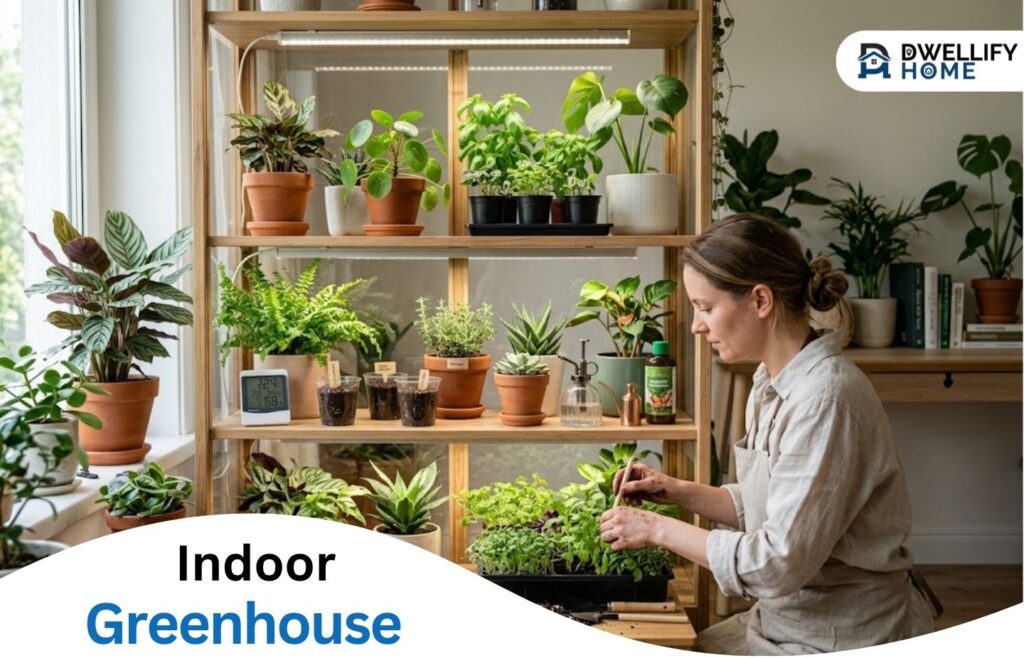
An indoor greenhouse gives you more control over the conditions around your plants, but the enclosure itself isn’t what makes plants thrive. Light, moisture, temperature, airflow, drainage, and plant choice still have to work together.
The most useful setup is usually the simplest one that solves a specific problem. Seedlings may mainly need reliable light and warmth. Tropical foliage may benefit from higher humidity. A propagation cabinet may need good moisture control and ventilation. Start with what you want to grow, then build the environment around those needs.
Short Definition
An indoor greenhouse is an enclosed or partly enclosed growing space that helps manage light, humidity, temperature, and airflow for seedlings, houseplants, propagation, or indoor food growing.
My First-Hand Experience
I can’t truthfully claim a first-hand indoor greenhouse test or invent a personal timeframe that wasn’t provided. This box should use your real setup, how long you used it, the result you observed, and one genuine drawback or lesson.
DwellifyHome Mission Statement
DwellifyHome helps homeowners, renters, and home lovers make practical, comfortable, stylish, and well-informed choices for the spaces they live in.
Quick Comparison Table
| Indoor Greenhouse Type | Best Fit | Main Trade-Off |
| Mini greenhouse or humidity dome | Seed starting and propagation | Limited growing space |
| Covered shelving rack | Multiple trays or small plants | Conditions can vary between shelves |
| Greenhouse cabinet | Tropical houseplants and display | Requires careful moisture and space management |
| Grow tent | Greater control over lighting and ventilation | Less decorative for living spaces |
What Is an Indoor Greenhouse, and Is It Right for You?
An indoor greenhouse is an enclosed or partly enclosed growing space used inside a home, apartment, basement, or similar indoor area. It can be as simple as a covered seed tray or as elaborate as a glass cabinet with lighting, fans, and environmental monitoring.
The enclosure helps create a more stable microclimate. It can retain warmth and moisture, protect plants from drafts, organize grow lights, and separate plants from the surrounding room.
What an indoor greenhouse can and cannot control
An enclosure can make conditions easier to manage, but it doesn’t automatically provide the correct conditions.
It can help with:
- Retaining humidity around moisture-loving plants
- Creating a protected propagation space
- Organizing seedlings under artificial light
- Reducing exposure to drafts
- Keeping a plant collection contained in a small footprint
It cannot compensate for weak lighting, poor drainage, excessive watering, unsuitable temperatures, or plants with conflicting environmental needs.
Illinois Extension identifies light, temperature, humidity, and water as key factors in indoor plant success and recommends matching plant requirements to the environment rather than treating all houseplants alike.
Indoor greenhouse vs grow shelf, terrarium, and grow tent
An open grow shelf is often enough when the main problem is insufficient light rather than low humidity.
A terrarium is generally smaller and is best suited to plants that tolerate the enclosed conditions it creates.
A greenhouse cabinet combines display and environmental control and works particularly well for compact collections.
A grow tent offers greater isolation and control over lighting and ventilation but usually prioritizes function over appearance.
Types of Indoor Greenhouses and What Each Is Best For
The best type depends less on what looks attractive and more on what job the enclosure needs to do.
Mini greenhouses and humidity domes
These compact enclosures are useful for seed germination, propagation, and small batches of young plants. They retain moisture well and take up little room.
For seedlings, however, the cover shouldn’t remain closed indefinitely. University of Maryland Extension recommends removing clear covers once seedlings emerge so young plants can transition into suitable growing conditions.
Covered shelves and tiered greenhouses
A shelving rack with a clear cover provides much more growing space without taking up a large floor area. It works well for seed trays, propagation projects, or several small plants.
The trade-off is that each shelf may receive different amounts of light and airflow. A setup that works well on the upper shelf may need adjustment lower down.
Greenhouse cabinets and more controlled enclosures
Glass or clear-front cabinets are popular for houseplant collections because they combine plant display with greater control over humidity and lighting.
They also require more planning. Plant height, fixture clearance, cable routing, condensation, and access for watering can become frustrating if the cabinet is chosen for appearance alone.
How to Choose the Right Indoor Greenhouse
Choosing correctly starts with the plants rather than the enclosure.
Start with what you want to grow
Ask what problem you are trying to solve.
Seedlings primarily need suitable temperature, moisture, and strong light after germination. Cuttings may benefit from increased humidity during rooting. Some tropical houseplants appreciate a more humid environment, while drought-adapted plants may be poor candidates for a consistently humid cabinet.
Penn State Extension emphasizes that there is no single ideal humidity level for every indoor plant.
Match the setup to your space and plant growth
Measure more than the greenhouse footprint. Account for:
- Plant height at maturity
- Pots and drainage trays
- Grow-light fixtures
- Distance between lights and foliage
- Fans or monitoring devices
- Room needed to remove plants for watering or cleaning
A compact cabinet can quickly become cramped once equipment and growing plants occupy the shelves.
Consider access, materials, and maintenance before buying
Doors should open far enough to make watering and cleaning practical. Shelves should support the intended pots and trays, and materials exposed to repeated moisture should be easy to clean and appropriate for that environment.
A setup you can comfortably maintain is more useful than a complicated enclosure that becomes difficult to service.
What Do You Need for an Indoor Greenhouse?
Most setups need less equipment than beginners initially expect.
Grow lights and timers
Light is often the most important upgrade because indoor window light may not be sufficient for vigorous growth, particularly for seedlings.
University of Maryland Extension notes that window light is often inadequate for strong seedlings and that plants can become stretched and lean toward insufficient light.
A timer makes the lighting schedule consistent. The correct fixture, duration, and mounting distance depend on the plants and the light itself, so use the manufacturer’s specifications together with plant-specific requirements rather than copying a universal setting.
Thermometer, hygrometer, airflow, and drainage
A thermometer and hygrometer tell you what is actually happening inside the enclosure.
Drainage trays protect shelves and nearby surfaces. A small circulation fan can help prevent stagnant pockets of air, particularly in densely planted cabinets.
Good drainage remains essential even in humid conditions. Increased humidity does not mean roots should stay waterlogged.
When a humidifier, heater, or automation makes sense
Add this equipment only when measurements show a genuine need.
A greenhouse cabinet may already retain enough moisture without a humidifier. Penn State also notes that misting produces only a temporary rise in humidity, so repeatedly spraying leaves is not a reliable way to control the enclosure’s ambient humidity.
The same principle applies to heating and automation: diagnose the problem before buying the solution.
How to Set Up an Indoor Greenhouse Step by Step
Choose the location and protect nearby surfaces
Start with a stable location near a suitable electrical source but away from obvious water hazards, heating vents, or extreme temperature swings.
Place waterproof or water-resistant trays beneath pots. Consider how condensation or accidental spills could affect wood flooring, furniture, walls, or cabinetry.
Install lighting, airflow, drainage, and monitoring
Install the grow lights so their height can be adjusted as plants grow. Position a thermometer/hygrometer where it reflects the plant environment rather than directly against a lamp or humidifier.
Provide drainage for every watered container and add gentle air circulation where the enclosure tends to remain stagnant.
Test the greenhouse before filling it with plants
Run the lights and other equipment before packing the enclosure.
Check temperature and humidity during the day and again after the lights have been off for a while. This can expose overheating, dramatic temperature changes, or persistent condensation before plants make the system harder to adjust.
How to Balance Light, Humidity, Temperature, and Airflow
These conditions influence one another. Changing one can alter the rest.
Get enough usable light and coverage
Plants need usable light at leaf level, not simply a bright-looking fixture.
Light intensity changes with distance from the fixture, and different parts of a shelf can receive different amounts of light. For technical grow-light specifications, PPFD is useful because it describes the amount of photosynthetically active light reaching a surface.
The practical lesson is simple: choose a fixture that can adequately cover the growing area, position it according to its specifications, and watch the plants for stretching, bleaching, or uneven growth.
Match humidity and temperature to your plants
Avoid chasing one supposedly ideal humidity number.
Fittonia and some other tropical plants benefit from humid conditions, while many drought-adapted plants prefer substantially drier surroundings.
Group plants with broadly compatible needs rather than forcing unrelated species into the same microclimate.
Air circulation vs ventilation—and why condensation matters
Circulation moves air around the enclosure. Ventilation exchanges enclosure air with the surrounding environment.
They aren’t identical.
UGA Extension explains that greenhouse ventilation helps remove warm, moist air, and that excessive humidity can lead to condensation on cooler surfaces.
Occasional condensation isn’t automatically a crisis, but glass or plastic that remains heavily wet is a reason to check humidity, temperature changes, watering, plant crowding, and ventilation.
What Can You Grow in an Indoor Greenhouse?
Seedlings and cuttings
Seed starting and propagation are natural uses for a small greenhouse because young plants benefit from controlled moisture and temperature.
Once seedlings emerge, strong light and sensible moisture management become especially important.
Humidity-loving houseplants
Plants that naturally prefer stable, humid conditions can benefit from a cabinet-style enclosure. Fittonia and Calathea are examples commonly associated with higher-humidity indoor conditions.
That doesn’t mean every tropical plant should be kept constantly wet. Humid air and saturated potting mix are different conditions.
Herbs, leafy greens, and other indoor edibles
Herbs and leafy greens can be grown indoors when their lighting, temperature, space, and container needs are met. Fruiting crops generally demand more light and room and may also introduce pollination considerations.
For vegetables started indoors for later transplanting, University of Maryland Extension recommends strong supplemental lighting because window light is commonly insufficient for sturdy growth.
Plants that may do better outside a humid enclosure
Succulents, cacti, and other plants adapted to drier conditions usually don’t benefit from being placed in a greenhouse designed primarily to retain high humidity.
Sometimes the better solution is an open grow shelf with stronger lighting.
Watering and Maintaining an Indoor Greenhouse
Water without keeping the enclosure constantly wet
Check the growing medium rather than watering on a rigid schedule. Because enclosed spaces can slow evaporation, pots may stay moist longer than similar plants elsewhere in the room.
Empty standing water from outer containers and drainage trays when appropriate.
Clean, inspect, and adjust the setup as plants grow
Remove dead plant material, clean trays and surfaces, and reposition lights as plants become taller.
Also check whether leaves are touching wet walls or crowding neighboring plants.
Watch for pests and overcrowding
Inspect leaves, stems, and the growing medium regularly. University of Minnesota Extension recommends regular pest checks and isolating affected indoor plants when insects are detected.
Dense plant collections make pests easier to overlook and reduce airflow between leaves.
Common Indoor Greenhouse Problems and How to Fix Them
Mold, heavy condensation, and stale conditions
Start by looking for excess moisture rather than immediately adding chemicals.
Reduce unnecessary watering, remove standing water, improve spacing, and evaluate ventilation. Persistent condensation can indicate that warm, moisture-laden air is repeatedly reaching cooler surfaces.
Leggy plants, leaf stress, and uneven growth
Long, stretched stems commonly point toward inadequate light. Penn State lists insufficient light among possible causes when seedlings emerge successfully but grow poorly.
Uneven growth between shelves can also indicate poor light distribution.
Wet growing media, fungus gnats, and seedling problems
Seedlings are particularly vulnerable to excessive moisture.
Penn State reports that damping-off is most severe under excessive soil moisture and high humidity and that overcrowded seedbeds can encourage its spread. Clean equipment, appropriate spacing, drainage, and avoiding overwatering are important preventive measures.
Protect Your Home and Use Electrical Equipment Safely
Protect floors, walls, shelves, and cabinets from moisture
Use trays beneath watered plants and wipe up spills promptly. Don’t allow persistent condensation to run onto wood cabinetry, flooring, or walls.
A cabinet intended as ordinary furniture may also need more moisture protection than a purpose-built growing enclosure.
Keep cords and powered equipment safer around water
Grow lights, fans, timers, heaters, and humidifiers put electricity close to watering activity.
The U.S. Consumer Product Safety Commission recommends GFCI protection where electrical equipment is used near water, and NC State Extension specifically recommends GFCI-protected circuits for electrical devices in damp greenhouse environments.
Keep electrical connections away from locations where water can drip or collect. Permanent wiring changes or uncertainty about a circuit are jobs for a qualified electrician.
Fine-Tune the Greenhouse Before Adding More Equipment
Check conditions during both lights-on and lights-off periods
A reading taken at midday doesn’t tell the whole story.
Grow lights can add heat, while temperatures may fall after they switch off. That change can affect relative humidity and condensation. Check the enclosure at different points in its daily cycle before deciding it needs more equipment.
Change one variable at a time and watch the plant response
Troubleshooting becomes difficult when the light height, fan speed, watering schedule, humidity, and temperature are all changed simultaneously.
Identify the strongest clue first.
Stretching? Investigate light.
Constantly wet media? Reconsider watering and drainage.
Heavy condensation? Look at humidity, temperature changes, crowding, and ventilation.
The goal is a stable growing environment, not the largest collection of gadgets.
Indoor Greenhouse FAQs
Is there really such a thing as an indoor greenhouse?
Yes. Indoor greenhouses range from covered propagation trays and clear shelving units to greenhouse cabinets and grow tents. What they share is the ability to create a more controlled growing environment than plants would have on an ordinary open shelf.
Do indoor greenhouses need grow lights?
Not every setup requires artificial lighting, but many do. Indoor light falls quickly as plants move away from windows, and seedlings in particular often become weak and stretched without adequate supplemental light. Judge the need by the plants, location, and actual light available rather than by the enclosure itself.
How humid should an indoor greenhouse be?
There isn’t one correct humidity level for every indoor greenhouse. Different plants come from different environments and have different requirements. Group plants with compatible needs, monitor relative humidity with a hygrometer, and avoid increasing moisture simply because the enclosure is called a greenhouse.
Does an indoor greenhouse need ventilation?
An enclosed greenhouse generally needs some way to prevent excessively warm, stagnant, or moisture-laden air from building up. A fan can improve circulation, while ventilation exchanges air with the surrounding room. How much is needed depends on enclosure size, temperature, plant density, and humidity.
Can you make a simple indoor greenhouse yourself?
Yes. A clean seed tray with a clear humidity cover, a covered shelving unit, or a repurposed cabinet can all create protected growing spaces. The design should still provide suitable drainage, lighting, access, and ventilation for the plants being grown.
Can you use an indoor greenhouse in an apartment?
Yes, provided the setup fits the available space and you can manage light, ventilation, water, and electrical equipment responsibly. Compact cabinets and covered racks can work particularly well, but protect floors and walls from spills and condensation.
What is the difference between an indoor greenhouse and a grow tent?
An indoor greenhouse usually uses transparent or translucent surfaces and may rely partly on room light, while a grow tent is typically opaque and designed around artificial lighting and controlled ventilation. Both can create managed growing environments, but their appearance, light containment, and level of control differ.
Is an Indoor Greenhouse Worth It for Your Plants?
An indoor greenhouse is worthwhile when it solves a real growing problem: inadequate humidity for compatible plants, the need for a protected propagation area, organized seed starting, or more controlled growing conditions in a limited space.
It isn’t automatically better than an open plant shelf. The most successful setup is one matched to the plants, the room, and the amount of maintenance you’re willing to provide.
Choose the enclosure for a purpose, measure what is happening inside it, and adjust only what needs adjusting. That approach produces a more manageable growing space—and usually healthier plants—than trying to create a universally “perfect” greenhouse environment.