The label “peach tree seedling” can describe two very different plants: a tree grown directly from a peach seed or a young nursery tree produced from a named cultivar. That differeSnce affects the fruit you can expect, how quickly the tree may bear, and how confidently you can match it to your climate.
A healthy start depends less on buying the tallest tree and more on choosing suitable nursery stock, protecting the roots, planting at the correct depth, and maintaining steady moisture without waterlogging the soil. This guide explains how to make those decisions and care for a young peach tree through its most vulnerable stage.
Short Definition
Peach tree seedlings are young peach trees grown from seed or sold as nursery stock. Gardeners choose them to establish fruit trees suited to their climate, space, and growing goals.
Mission Statement
DwellifyHome helps homeowners, renters, and home lovers make practical, stylish, comfortable, and informed choices for better living spaces.
Mini Decision Guide
- Choose a grafted tree for more predictable fruit quality and growth.
- Choose a seed-grown tree for experimentation and genetic variety.
- Check the cultivar and chill needs before buying.
- Inspect the roots, trunk, buds, and graft union for damage.
- Match the mature size to your available garden or container space.
- Choose bare-root stock for dormant-season planting.
- Choose container-grown stock for greater planting flexibility.
What Are Peach Tree Seedlings?
A peach tree seedling is a young peach tree, but the term isn’t always used consistently. In its strict botanical sense, a seedling has grown from a seed. Nurseries and online sellers may also use the word more loosely for small bare-root, potted, budded, or grafted peach trees.
Before buying, check whether the plant is:
- Grown from seed
- Grafted onto a separate rootstock
- Sold under a named cultivar
- Bare-root or container-grown
- Standard, compact, or naturally dwarf in growth habit
These details tell you more than the plant’s current height.
Seed-Grown Peach Trees vs. Grafted Nursery Trees
A seed-grown tree develops from the genetic combination contained in a peach pit. It may produce worthwhile fruit, but it isn’t guaranteed to match the peach from which the seed came. Fruit size, flavor, ripening time, disease response, and growth habit can vary.
A grafted tree combines two plants. The upper portion, called the scion, is the named fruiting cultivar. The lower portion, called the rootstock, forms the roots and can influence vigor, soil adaptation, and other growth characteristics. Grafting allows nurseries to reproduce a known cultivar more reliably than growing it from seed.
Bare-Root vs. Container-Grown Peach Trees
Bare-root peach trees are sold without soil around their roots, usually while dormant. They’re lightweight and often economical, but their roots must be kept moist and planted during an appropriate dormant-season window.
Container-grown trees arrive with a root ball and can offer more planting flexibility. The trade-off is that the roots may be compacted or circling inside the pot. A tree that looks full and leafy above ground can still have a poor root system, so remove the pot and inspect the root ball before planting.
Should You Buy a Seedling or Grow a Peach Tree From a Pit?
Buy a grafted, named cultivar when predictable fruit and regional suitability matter most. Grow from a pit when the project itself interests you and you’re comfortable with uncertain fruit quality, tree size, and time to maturity.
A pit-grown tree is an experiment. A grafted nursery tree is a more controlled starting point.
When Growing From Seed Makes Sense
Growing a peach tree from a pit can be satisfying for gardeners who enjoy propagation, have extra space, or want an inexpensive tree without expecting an exact copy of the original fruit.
Peach seeds commonly need a period of cold, moist conditions called stratification before they germinate. Even with correct preparation, not every seed sprouts, and the resulting tree may differ from its parent.
Why Most Fruit Growers Choose Grafted Trees
A grafted tree gives the buyer a named cultivar with known fruit characteristics. It may also begin bearing sooner than a tree started from a pit, although the timing still depends on the tree’s age, health, climate, pruning, and growing conditions.
Buying a grafted tree doesn’t remove every risk. The cultivar must still receive suitable winter chill, tolerate local conditions, and fit the available space.
How to Choose a Healthy Peach Tree Seedling
Start with suitability, then inspect condition. A large tree that doesn’t fit the climate or has damaged roots is a poorer choice than a smaller, well-branched tree selected for the site.
Match the Variety to Your Climate and Chill Conditions
Peach cultivars require varying amounts of cool winter weather before they can flower normally. This is described as a chill requirement. A cultivar that receives too little winter chill may flower irregularly or produce poorly, while one that blooms too early may lose blossoms to a late freeze.
The USDA hardiness zone is useful for estimating winter cold tolerance, but it doesn’t tell the entire story. Chill accumulation, spring frost patterns, summer heat, humidity, and local microclimates also matter. Ask a local cooperative extension office or established fruit-tree nursery which cultivars perform reliably in your area.
Check the Roots, Trunk, Buds, and Graft Union
A healthy young tree should have:
- Firm, living roots rather than dry, brittle, or rotting roots
- A trunk without major splits, deep wounds, or large damaged areas
- Buds or shoots that appear alive and evenly distributed
- No obvious cankers, oozing lesions, or widespread dieback
- A readable cultivar label
- A visible, sound graft union on grafted stock
The graft union usually appears as a slight bend, swelling, or change in bark near the lower trunk. It should not look cracked, broken, or decayed.
Understand Rootstock and Expected Tree Size
The small plant at the nursery won’t remain that size. Ask about the tree’s expected height and spread so you can provide adequate room around structures, fences, walkways, and other plants.
Don’t assume every tree marketed as “dwarf” will stay patio-sized without pruning. Peach size can reflect rootstock, cultivar genetics, training, pruning, and growing conditions. Confirm the expected mature dimensions instead of relying on a general label.
What to Ask Before Buying Online or From a Nursery
Before ordering peach tree seedlings for sale, ask:
- Is this tree seed-grown or grafted?
- What is the cultivar name?
- What is the rootstock?
- What is its chill requirement?
- What mature size should I expect?
- Is it bare-root or container-grown?
- Is the variety self-fertile?
- When will it be shipped?
- What condition should the tree be in upon arrival?
Most peach cultivars are self-fertile, meaning one compatible tree can set fruit, but confirming the specific cultivar is still sensible.
When and Where to Plant a Young Peach Tree
Plant a peach tree during cool weather when heat and drought are less likely to stress the roots. Bare-root trees are normally planted while dormant, often in late winter or early spring. Container trees offer a wider window, but planting during extreme heat creates additional watering and transplant challenges.
Best Planting Time for Bare-Root and Potted Trees
Plant bare-root stock soon after it arrives, provided the soil is workable and local conditions are suitable. Keep the roots cool and moist while preparing the site.
A potted tree can remain in its container briefly, but it shouldn’t be left root-bound for an extended period. Avoid planting during frozen conditions, saturated soil, or severe heat.
Sunlight, Soil Drainage, and Airflow
Peach trees need abundant direct sunlight and soil that drains well. A bright site encourages strong growth and fruit-bud development, while airflow can help foliage dry after rain.
Good sunlight can’t compensate for standing water. A low area where water collects after every storm may damage roots even when the rest of the yard appears suitable. Choose another location or correct the drainage problem before planting.
Spacing the Tree for Its Mature Size
Base spacing on the expected mature canopy, not the size of the sapling. Crowded trees compete for light and water and are harder to prune, inspect, and harvest.
Allow additional room beside walls, sheds, property lines, overhead wires, and large shade trees. The ideal distance depends on the cultivar, growth habit, and training system.
Avoiding Low Spots and Frost-Prone Locations
Cold air often settles in low areas, creating frost pockets. A tree may survive the winter yet lose its flowers during a spring freeze.
This distinction matters: tree hardiness describes the plant’s ability to withstand winter conditions, while successful fruiting also depends on blossoms surviving after growth resumes. A gently elevated, sunny position may offer better drainage and frost protection than the lowest part of the yard.
How to Plant Peach Tree Seedlings Step by Step
Correct planting keeps the roots spread into surrounding soil while leaving the root collar and graft union above ground.
Prepare Bare Roots or Loosen a Container Root Ball
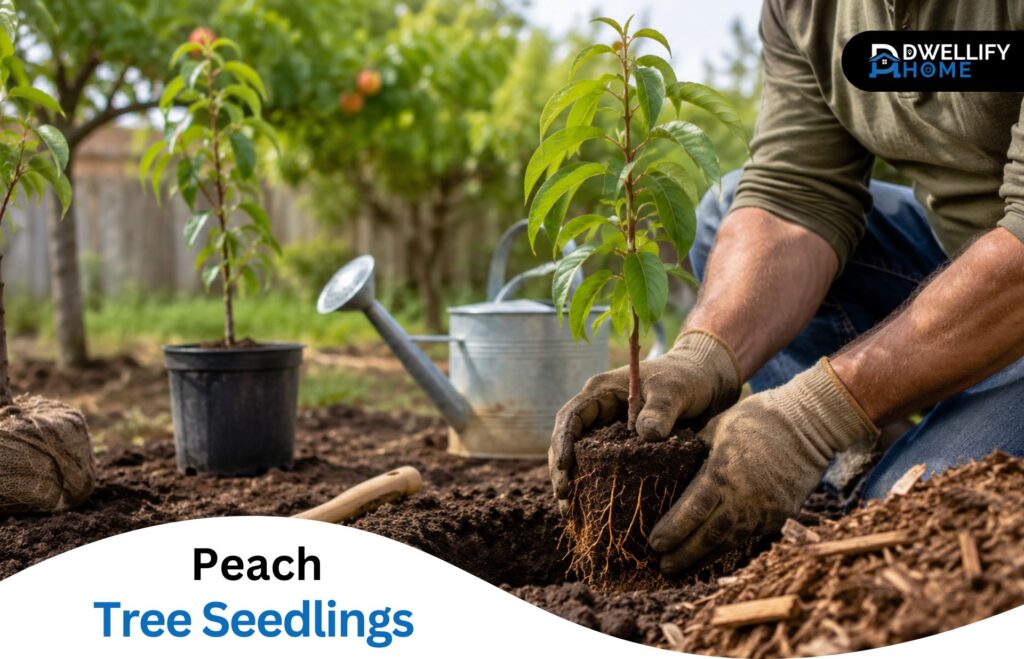
For a bare-root tree, remove packing material and inspect the roots. Trim only clearly broken or dead portions with clean tools. Keep the roots damp while working, but don’t leave them exposed to sun or drying wind.
For a container tree, slide off the pot and inspect the root ball. Gently loosen outward-growing roots. Circling roots may need to be teased apart or carefully cut so they don’t continue wrapping around the trunk area.
Dig the Planting Hole and Position the Roots
Dig a hole wider than the root system but no deeper than needed. The broad hole gives roots room to spread into loosened soil.
Set a bare-root tree on a small mound of soil if necessary, arranging the roots outward rather than bending them sharply downward. For a potted tree, don’t use the top of the nursery potting mix as the only depth reference; locate the uppermost structural roots and plant according to the tree’s actual root collar.
Keep the Graft Union Above the Soil
On a grafted peach tree, keep the graft union clearly above the final soil level. Planting it below ground can encourage unwanted rooting from the scion and can keep the lower trunk excessively damp.
The trunk should not disappear into a deep, bowl-shaped hole. Allow for some settling, especially in recently disturbed soil.
Backfill, Water, Mulch, and Stake Correctly
Backfill primarily with the soil removed from the hole, breaking up large clumps as you work. Heavy amendment of only the planting hole can create an abrupt soil boundary and may discourage roots from expanding into the surrounding ground.
Water thoroughly after planting to settle the soil around the roots. Add a broad layer of organic mulch over the root zone, but leave a clear gap around the trunk. Stake only when the tree can’t remain stable on its own, and remove or adjust ties before they constrict the bark.
First-Year Care After Planting
The first season is mainly about root establishment and balanced structural growth. A young peach tree doesn’t need to be pushed into rapid growth or an early, heavy crop.
How Often to Water a Newly Planted Peach Tree
Water deeply enough to moisten the developing root zone, then allow the soil to lose some surface moisture before watering again. The correct frequency depends on rainfall, temperature, wind, soil type, drainage, mulch, and whether the tree is in the ground or a container.
Check the soil rather than following a rigid calendar. Dry, sandy soil may need attention sooner than heavier soil, while clay that remains saturated can suffocate roots. Consistent moisture is helpful; constantly waterlogged soil is not.
Mulching Without Damaging the Trunk
Spread mulch in a wide, shallow ring that covers the root zone. Keep it several inches away from the trunk so the bark remains visible and dry.
A mound of mulch pressed against the trunk can hold moisture against the bark and hide damage from rodents or decay. Think “mulch ring,” not “mulch volcano.”
When Fertilizer Is—and Is Not—Needed
Don’t automatically add fertilizer at planting. The tree may already have adequate nutrients, and excessive feeding can promote soft growth before the root system is ready to support it.
A soil test offers better guidance than guessing. If fertilizer is recommended, follow locally appropriate extension advice and apply it according to the product label. Fertilizer can correct a real need, but it can’t repair poor drainage, deeply buried roots, or an unsuitable cultivar.
Protecting Young Trees From Heat, Wind, Wildlife, and Winter Damage
Young trunks and shoots can be damaged by deer, rabbits, rodents, lawn equipment, strong wind, and abrupt temperature changes.
Use guards or fencing that allow airflow and don’t rub the bark. Keep string trimmers and mower decks away from the trunk. Container-grown trees may need added root protection in winter because roots inside a pot are more exposed to temperature swings than roots in the ground.
How to Train and Prune a Young Peach Tree
Young peach trees are commonly trained to an open-center form, with several well-spaced scaffold branches surrounding an open middle. This shape improves light penetration, airflow, and access to fruiting wood.
Building an Open-Center Framework
Choose a small number of strong branches that point in different directions and have reasonably wide attachment angles. These become the main scaffold branches.
The goal isn’t to remove every shoot immediately. It’s to gradually create a balanced framework without allowing several narrow, competing trunks to crowd the center.
What to Remove During the First Pruning
Prioritize:
- Broken or dead shoots
- Branches that rub or cross
- Strong competing leaders
- Very low growth that interferes with the intended structure
- Inward-growing shoots that crowd the center
Make clean cuts and avoid leaving torn bark or long stubs.
Avoiding Heavy or Poorly Timed Pruning
Pruning recommendations vary with climate and tree condition. Removing too much growth from a weak or newly stressed tree can delay establishment, while allowing the canopy to become dense makes future correction harder.
For regional timing, especially in areas with severe winter cold or recurring disease pressure, follow local extension guidance. Peach pruning is best treated as an ongoing training process rather than a one-time attempt to create the finished tree.
How Fast Do Peach Tree Seedlings Grow and Bear Fruit?
Healthy peach trees can establish and grow quickly under favorable conditions, but fruiting time varies. Grafted nursery trees may produce a small crop within a few years, while seed-grown trees often require more time and remain less predictable.
Growth Expectations During the First Few Years
The first year may produce less visible growth than expected because the tree is rebuilding or expanding its root system. Weather stress, planting depth, root damage, poor drainage, and competition from grass can slow establishment.
Strong shoot growth doesn’t always indicate that every need is being met. Excessive nitrogen can produce long, soft shoots without improving structure or future fruiting.
Grafted Tree vs. Seed-Grown Tree Fruiting Time
A grafted tree already contains mature cultivar wood, so it generally offers a shorter and more predictable route to fruit than starting with a seed.
A seed-grown tree must pass through its juvenile stage before flowering. Its eventual fruit may also differ from the peach that supplied the pit. Treat published timelines as estimates rather than guarantees.
Why Early Blossoms Do Not Always Produce a Crop
Flowers can be damaged by a late frost, poor weather during bloom, tree stress, or inadequate chill. A young tree may also drop some flowers or fruit as it balances limited resources.
Even when a newly planted tree sets fruit, allowing it to carry a heavy crop can pull energy away from root and branch establishment. A modest early crop—or no crop at all—doesn’t necessarily mean the tree has failed.
Common Peach Seedling Problems and Planting Mistakes
Most early problems trace back to the roots, planting depth, water management, unsuitable stock, or environmental stress.
Planting Too Deep or Burying the Graft Union
A deeply planted tree may decline slowly rather than fail immediately. Watch for a trunk that enters the soil without a visible root flare or a graft union that has disappeared below grade.
Correcting the depth soon after planting is easier than trying to rescue an established tree later.
Letting Bare Roots Dry Out
Bare roots can lose moisture quickly during shipping, unpacking, and planting. Prepare the hole and tools before exposing them, and keep the roots protected while the tree is out of the ground.
Overwatering, Poor Drainage, and Root Stress
Wilting doesn’t always mean a tree needs more water. Damaged or oxygen-starved roots can’t supply the canopy properly, even in wet soil.
Check below the surface before watering. Persistent standing water, a sour smell, or continuously saturated soil points to a drainage problem rather than a need for additional irrigation.
Circling Roots in Container-Grown Trees
Roots that continue circling can restrict future growth. Inspect the entire root ball rather than placing it intact into the hole.
A few careful corrections at planting can help roots move into the surrounding soil. Severe root deformation may be a reason to choose another tree.
Mulch Against the Trunk and Excess Fertilizer
Too much mulch and fertilizer often come from good intentions. Keep mulch off the bark and avoid feeding a stressed tree simply because it isn’t growing quickly.
Correct light, drainage, planting depth, and watering before reaching for fertilizer.
Frost Injury, Peach Leaf Curl, and Unexplained Dieback
Frost-damaged shoots may blacken or collapse after a sudden cold event. Peach leaf curl commonly produces puckered, thickened, distorted leaves, often with reddish coloration. Cankers and spreading dieback can signal more serious disease or injury.
Don’t apply a pesticide or fungicide based only on a photograph or vague symptom description. Confirm the problem through a local extension service or qualified nursery, then follow region-specific recommendations and the product label.
When a Young Peach Tree Needs Expert Help
Contact a cooperative extension office, Master Gardener program, experienced fruit-tree nursery, or qualified tree professional when the cause of decline isn’t clear.
Persistent Standing Water or Site Drainage Problems
Repeated waterlogging may require grading, drainage work, or relocation of the tree. Adding gravel to the bottom of a planting hole generally doesn’t solve a wet site.
Cankers, Severe Dieback, or Repeated Tree Failure
Seek diagnosis when lesions expand, branches continue dying, the trunk oozes, or several peach trees have failed in the same location. The underlying issue may involve disease, soil conditions, cold injury, root damage, or a cultivar poorly suited to the site.
Unclear Variety, Rootstock, or Regional Suitability
A missing label makes long-term planning difficult. Local specialists may help identify likely growth characteristics, but a tree of unknown origin will always carry more uncertainty than properly labeled nursery stock.
Can Peach Tree Seedlings Grow in Containers?
Yes, peach trees can grow in containers, but compact or dwarf selections are the most practical. Container trees need generous root space, reliable drainage, closer moisture monitoring, and protection from temperature extremes.
Choosing Dwarf or Compact Peach Trees
Choose a cultivar sold specifically for restricted spaces and confirm its expected mature size. A generic young seedling may eventually become too vigorous for long-term container culture.
Container Size, Soil, and Drainage
Use a sturdy container with unobstructed drainage holes and a well-draining potting mix. Don’t fill a patio container with dense yard soil, which can compact and drain poorly.
Leave enough room at the top for watering, and position the graft union above the potting mix.
Repotting and Overwintering a Potted Peach Tree
Repot when roots become crowded, water runs through without wetting the mix evenly, or growth declines despite appropriate care.
In cold regions, protect the container and roots during winter. The tree may tolerate outdoor cold better than its exposed root ball, so a sheltered location or added insulation may be needed.
Frequently Asked Questions About Peach Tree Seedlings
Can You Grow a Peach Tree From a Store-Bought Peach Pit?
Yes, a peach pit can germinate after suitable preparation and cold stratification. However, germination isn’t guaranteed, and the resulting tree may not produce fruit identical to the store-bought peach. A locally adapted pit may also be more suitable than one from a fruit grown in an unknown climate.
Is a Grafted Peach Tree Better Than a Seed-Grown Tree?
A grafted tree is usually the better choice for predictable fruit, known cultivar characteristics, and a shorter path to production. A seed-grown tree is better suited to experimentation, propagation projects, or situations where variation isn’t a problem.
What Is the Best Time to Plant Peach Tree Seedlings?
Bare-root peach trees are generally planted while dormant, often in late winter or early spring when the soil is workable. Potted trees have more flexibility, but cool, moderate weather is preferable to extreme summer heat. Local climate should guide the exact timing.
How Deep Should a Peach Tree Be Planted?
Plant the tree so its upper structural roots sit near the natural soil level and the graft union remains clearly above ground. Don’t use the nursery pot’s rim or loose surface mix as the only depth guide.
How Often Should a Newly Planted Peach Tree Be Watered?
Water often enough to maintain even moisture around the developing roots, but let soil conditions determine the schedule. Check below the mulch before watering, and adjust for rainfall, temperature, wind, drainage, and soil type.
How Long Does a Peach Tree Seedling Take to Produce Fruit?
A grafted nursery tree may begin producing within a few years under suitable conditions. A tree grown from seed often takes longer, and its timeline is less predictable. Early flowers don’t guarantee a harvest because frost, stress, and tree age can affect fruit set.
Do You Need Two Peach Trees to Produce Peaches?
Most commonly grown peach cultivars are self-fertile, so one tree can produce fruit. Check the cultivar label, however, because pollination characteristics and local growing conditions can vary.
Give Your Peach Tree the Right Start
The best peach tree isn’t necessarily the largest one at the nursery. It’s the tree with healthy roots, a suitable cultivar, clear labeling, and a mature size that fits the planting site.
Choose the location before choosing the tree, keep the graft union above the soil, protect the roots from drying and waterlogging, and focus the first year on establishment rather than a heavy crop. Those basic decisions give peach tree seedlings a stronger foundation for healthy growth and future fruit.
Disclaimer
This content is for general informational purposes only. Homes, gardens, needs, budgets, preferences, and local conditions vary. Seek qualified professional advice for safety, installation, repair, legal, structural, electrical, plumbing, HVAC, or major property decisions.