A bare root tree shows up looking like a bundle of bare sticks with a tangle of roots and no soil in sight, which throws most people the first time they open the box. It isn’t dead and it isn’t a mistake — it’s simply dormant, and bought right, it’s the cheapest and often fastest way to get a strong tree established. This guide covers what a bare root tree actually is, how to pick a healthy one, when and how to plant it, and how to keep it alive through that crucial first year.
Snippet-Ready Definition
A bare root tree is a deciduous tree sold dormant with no soil on its roots. Gardeners choose it because it’s cheaper, lighter, and establishes faster, settling its roots directly into native ground.
Mission Statement:
Dwellify Home exists to help homeowners, renters, and property enthusiasts make confident, practical decisions about their space — including choices like planting a bare root tree, where clear guidance turns an unfamiliar task into a straightforward, rewarding one.
What Is a Bare Root Tree?
A bare root tree is a deciduous tree or shrub dug and sold while fully dormant, with all the soil washed or shaken off its roots. Because there’s no soil and no pot, it’s light, cheap to ship, and goes straight into your native ground — which is exactly why nurseries sell so many trees this way.
Dormant is the key word. Through winter the tree drops its leaves and slows right down, so it can sit out of the ground for a short while without harm. That same trait is why you’ll only find deciduous trees sold bare root. Evergreens don’t shut down the same way.
Bare Root vs. Dormant vs. Dead: How to Tell
Almost every worried message I get in late winter is from someone convinced their tree arrived dead. It usually hasn’t. Scratch a bit of bark with your thumbnail — green and slightly damp underneath means it’s alive. The buds should look plump rather than shrivelled, the twigs should bend instead of snapping, and the roots should feel firm and moist, not slimy or brittle.
Key Terms to Know (Root Flare, Graft Union, Rootstock)
Three words come up constantly, so it’s worth pinning them down. The root flare is where the trunk widens and the first roots spread out, and that’s your depth guide. The graft union, sometimes called the bud union, is the knuckle low on the trunk where the named variety (the scion) was joined to a separate root system (the rootstock). Mixing up the flare and the graft is the single most common reason people plant too deep.
Quick comparison: bare root vs. potted vs. balled-and-burlapped
| Factor | Bare root | Potted (container) | Balled-and-burlapped |
| Cost | Lowest | Higher | Highest |
| Root system | Most intact, no circling | Often root-bound | Many roots cut when dug |
| Planting window | Dormant season only | Almost any time | Spring or fall |
| Weight / handling | Very light | Moderate | Heavy, often needs help |
| Selection | Widest | Moderate | Limited |
Key benefits of bare root trees
- Costs a fraction of the same tree in a pot, ideal for planting in numbers
- Roots go straight into native soil and establish faster, with no circling
- Light and easy to carry, transport, and plant single-handed
- Widest variety selection, especially for fruit trees and hedging
What Types of Trees and Plants Are Sold Bare Root?
Far more than fruit trees. If it loses its leaves in winter, there’s a good chance you can buy it bare root.
Fruit is the obvious category — apple, pear, cherry, peach, and plum all sell well this way — along with nut trees like walnut, pecan, and hazelnut. But shade trees, flowering ornamentals, roses, and hedging plants such as beech, hornbeam, and hazel are sold the same way, often as small whips or seedlings. The common thread is deciduous and dormant. Broadleaf evergreens almost never make the list.
What Are the Advantages of Bare Root Trees?
Three things, mostly: price, establishment, and handling. A bare root tree typically costs a fraction of the same tree in a pot, it tends to settle in faster, and you can carry a dozen under one arm. For anyone planting in numbers, the savings alone change what’s possible.
The establishment part is the one people underrate. A bare root tree keeps far more of its actual root system than a containerized tree, whose roots get cut to fit the pot and often start circling. Those roots go straight into your native soil and never have to break out of a pot-shaped wad, so the tree spends its energy reaching outward instead of recovering. Within a couple of seasons, a well-planted bare root tree will often overtake a larger potted one bought the same year.
What Are the Disadvantages of Bare Root Trees?
The catch is timing and care. You can only plant a bare root tree while it’s dormant, the roots can’t be allowed to dry out, and it needs to go in the ground promptly. This isn’t a tree you buy on a whim in July.
You’re also mostly limited to deciduous trees, so no bare root pines or hollies. And what arrives looks modest — a thin whip with bare roots, not a leafy specimen — so fruit trees in particular ask for patience before they crop. None of that is a dealbreaker. It just means a bare root tree rewards a little planning rather than impulse.
Bare Root vs. Potted vs. Balled-and-Burlapped: Which Should You Choose?
Here’s how the three common ways of buying a tree stack up.
| Factor | Bare root | Potted (container) | Balled-and-burlapped |
| Cost | Lowest | Higher | Highest |
| Root system | Most intact, no circling | Often circling, root-bound | Many roots cut when dug |
| Planting window | Dormant season only | Almost any time | Spring or fall |
| Weight / handling | Very light | Moderate | Heavy, often needs help |
| Size at purchase | Smallest | Instant, fuller | Largest |
| Selection | Widest | Moderate | Limited |
Choose bare root when you want value, variety, and the strongest long-term root system, and you can plant in the dormant season. Choose potted when you need to plant in summer or want instant size and convenience. Choose balled-and-burlapped for large evergreens or sizeable shade trees where bare root isn’t offered — just be ready for the weight.
When Should You Plant Bare Root Trees?
Plant a bare root tree during dormancy — late fall through early spring, after the leaves drop and before the buds break, any time the soil is workable and not frozen or waterlogged. In milder areas (around USDA zone 7) that’s often late January into March; in colder regions, you’ll wait for spring.
The window matters more than the exact date. As long as the tree is still asleep and you can dig, you’re fine. Fall planting gives roots a head start in mild climates; in hard-winter areas, spring is safer so the roots aren’t sitting in frozen ground. Get it in before it tries to leaf out and you’ve done the most important part.
Where to Buy Bare Root Trees (Online, Local, and Wholesale)
Four main places, depending on scale: mail-order nurseries online, local nurseries and garden centers, conservation-district and Arbor Day community sales, and wholesale growers for big projects. Each suits a different need and budget.
For range, it’s hard to beat the specialist nurseries with bare root trees for sale online — they ship varieties no local store can stock, usually on a preorder basis. A local nursery lets you inspect before buying and skip the shipping. To find bare root trees near you on the cheap, your county conservation or soil and water district often runs low-priced spring sales, which is also where wholesale and bulk seedlings turn up for windbreaks and large plantings.
When Are Bare Root Trees Available to Buy?
Order early. Bare root season at retail runs roughly from fall preorders to shipping in late winter and early spring, often February through April depending on your region. Outside that window, listings usually sit as placeholders or sell-outs. Popular varieties and dwarf fruit rootstocks go first, so the gardener who orders in autumn gets the pick — not the one who remembers in April.
How Do You Choose a Healthy Bare Root Tree?
Look at the roots first. You want them firm, moist, and well spread, with plenty of fine fibrous roots and no mush, mold, or brittle snapping. Then check the top: a straight trunk, no major wounds, and reasonably balanced branches.
For fruit trees, two extra things matter — the rootstock, which controls final size, and, for many varieties, a compatible pollination partner and the right chill hours for your climate. When the box arrives, open it the same day. Unwrap the roots, look them over, and if you can’t plant straight away, get the roots into water or damp material immediately. A tree left bagged and dry on a porch for a week is the one that struggles.
How to Plant a Bare Root Tree Step by Step
None of this is hard, but the details decide whether the tree thrives or sulks. You’ll want a spade, a bucket of water, some mulch, and ideally a cool, overcast day so the roots aren’t baking while you work. Here’s the sequence I follow every time.
Step 1 — Soak the Roots Before Planting
Get the roots rehydrated before they go in. Stand them in a bucket of water for anywhere from half an hour up to a few hours, long enough to plump up but not so long that they drown. Don’t leave them soaking for days; past about 24 hours you start starving the roots of air. Keep them shaded and moist right up to the moment they hit the hole.
Step 2 — Dig a Wide, Shallow Hole (and Skip the Soil Amendments)
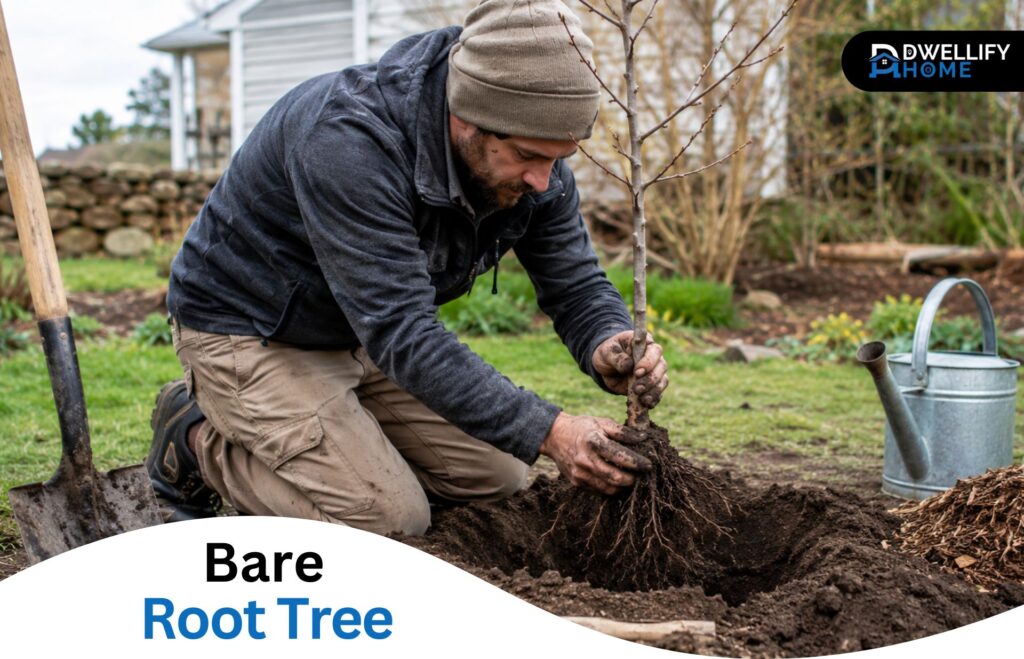
Dig wide and shallow. The hole wants to be two to three times the spread of the roots but only as deep as they are, with a firm cone of native soil left in the middle to drape the roots over. Resist the urge to dump compost or potting mix in the hole — rich backfill encourages roots to circle inside it like a pot and stops them venturing into the surrounding ground. Backfill with the soil you dug out. If your ground is heavy clay and water sits in the hole for hours, plant on a slight mound instead. Root dips and mycorrhizal powders are optional and the evidence is mixed; good soil contact and steady water matter far more.
Step 3 — Position the Tree at the Right Depth
Spread the roots over the cone and set the tree so the root flare sits at or just above the surrounding soil level. The graft union should stay a couple of inches clear of the ground — burying it invites rot and lets the variety root over its own rootstock. You’ll hear different advice on which way to face the graft; some point it north, some southwest, the idea being to shield that low bark from the harshest sun. In practice, depth matters far more than compass direction.
Step 4 — Backfill, Firm, and Water In
Backfill with native soil, working it in around the roots with your fingers so there are no air pockets. Firm it gently with your hands or a light press of the heel — settled, not stamped solid. Then water deeply to collapse any remaining gaps and bring soil into contact with every root. In dry regions, build a low rim of soil around the edge to hold water over the root zone.
Step 5 — Mulch, Stake, and Protect the Trunk
Spread two to four inches of mulch over the root zone, but keep it pulled back a few inches from the trunk; piled against the bark it traps moisture and invites rot. Most bare root trees don’t need staking — only stake if the tree won’t stand or the site is very windy, and leave a little sway. Add a trunk guard against rabbits and voles, and in sunny or borderline climates a coat of diluted white latex paint on the lower trunk helps prevent sunscald and borers. Skip fertilizer at planting; it does nothing for roots that aren’t growing yet. Some fruit whips benefit from being headed back to around knee height to balance the top with the roots, but check what your variety wants first.
How to Care for Your Bare Root Tree After Planting
The first year is the one that counts. Get the tree through its first growing season and into a second winter alive, and it’s usually away. Almost everything that goes wrong in year one comes down to water and patience.
Watering Through the First Season
Water is the single biggest factor. A freshly planted bare root tree has no established roots to draw on, so it depends entirely on you keeping the root zone moist. A good rule for the first few weeks is a deep soak — roughly ten to fifteen gallons — every couple of days, easing back to about once a week as it settles. Deep and infrequent beats a daily sprinkle that only wets the surface. Just don’t let it sit waterlogged. A slow-release watering bag is a tidy way to deliver that volume without runoff.
When Will Your Bare Root Tree Leaf Out?
Don’t worry if it’s slow to wake. A bare root tree pours its first spring into growing roots, so it often leafs out later than established trees nearby, sometimes not until May. That’s normal. If there’s still no sign of life by June, scratch the bark: green underneath means it’s alive and just taking its time; dry and brown all the way up is the point to be concerned.
Mulch, Weeds, and First-Winter Protection
Keep that mulch ring topped up through the season and the grass and weeds well back from the trunk, since they compete hard for water young trees can’t spare. As the first winter comes round, check the trunk guard is still in place and snug — hungry rabbits and voles do their worst under snow. A little attention here protects everything you did at planting.
Troubleshooting Common Bare Root Tree Problems
Most bare root failures trace back to one of four things. Here’s how to spot each and what to do.
Roots Dried Out in Transit
Symptom: shrivelled, papery roots and a trunk that’s started to wrinkle. Cause: the tree sat unwrapped and dry too long before planting. Fix: soak the whole root system for several hours, up to overnight, then plant immediately and keep it well watered. Mildly dried roots often recover; if they’ve gone crisp and snap like dry twigs, the odds are poor.
Planted Too Deep or Root Flare Buried
Symptom: a tree that leafs out weakly, stalls, or slowly declines over a season or two with no obvious pest. Cause: the root flare or graft got buried, the most common planting mistake there is. Fix: while it’s still dormant, lift the tree and replant it higher so the flare sits at the surface. It’s far easier to correct in year one than year three.
Delayed or No Leaf-Out (Transplant Shock)
Symptom: delayed, sparse, or no leaf-out in the first spring. Cause: roots that dried out, were planted too deep, or aren’t getting steady water. Fix: confirm it’s alive with the scratch test, check the planting depth, and keep moisture consistent. Prevention beats cure here — moist roots, correct depth, and regular water through summer head off most shock.
Animal Damage in the First Winter
Symptom: chewed bark low on the trunk, especially after winter. Cause: rabbits, voles, and deer stripping bark for food when little else is around. Fix and prevention: fit a trunk guard tall enough to clear expected snow depth — a foot or two of mesh or spiral wrap — and use repellents or fencing where deer are heavy. Bark chewed all the way around the trunk usually can’t be saved, so guard before damage, not after.
Planting Bare Root Trees in Cold Climates (Minnesota and Zone 3–4)
In hard-winter regions like Minnesota and other zone 3 and 4 areas, plant in spring rather than fall, as soon as the frost is out and the soil can be worked, often around April or May. Fall-planted roots can struggle before they’re anchored once the ground freezes deep and early.
Mulch is your insurance up north — a generous ring moderates soil temperature and holds moisture while roots establish over the short season. Choosing genuinely hardy stock matters just as much as timing.
Cold-Hardy and Drought-Tolerant Bare Root Trees
For tough sites and cold zones, lean on trees that shrug off both. Ginkgo, hackberry, Kentucky coffeetree, northern catalpa, honeylocust, serviceberry, hawthorn, and linden are durable, adaptable choices that handle cold and dry spells well. For fruit in the north, look specifically for cold-hardy apple, plum, and pear varieties bred for short seasons rather than whatever’s cheapest.
Community and Bulk Tree Sales
Some of the best value in cold regions comes from local programs. County conservation districts and soil and water districts run spring bare root sales at low per-tree prices, and many cities hold Arbor Day sales. Check your local district’s website in late winter — that’s where bulk seedlings for windbreaks, screens, and woodland plantings turn up cheapest.
Frequently Asked Questions
How long should I soak the roots before planting?
Stand the roots in water for about 30 minutes to a few hours before planting, enough to rehydrate them fully. Avoid going beyond 24 hours, since roots left underwater too long are starved of oxygen and can suffer.
How deep should I plant a bare root tree?
Plant so the root flare — where the trunk widens into roots — sits at or just above the surrounding soil. Keep the graft union a couple of inches above ground. Burying the flare too deep is the most common cause of slow decline.
Do bare root trees need staking?
Usually not. Most bare root trees stand fine on their own and build sturdier trunks without support. Stake only if the tree can’t stay upright or the site is very windy, leave some slack for movement, and remove it after the first year.
How long until a bare root tree leafs out?
Expect patience. Bare root trees focus first on roots, so they often leaf out later than nearby established trees, sometimes not until May. No leaves by June is a warning sign; scratch the bark to check for green, living tissue underneath.
Do bare root trees grow faster than potted ones?
Often, yes, once established. Because their roots go straight into native soil without circling in a pot, well-planted bare root trees frequently catch up to and overtake larger potted trees within a couple of seasons. Correct planting and steady water make the difference.
Should I fertilize when planting a bare root tree?
No. Dormant roots aren’t growing yet, so fertilizer at planting does nothing useful and can even burn tender new roots. Wait until the tree is actively growing, then feed lightly in its first or second season if the soil is poor.
How do I store a bare root tree if I can’t plant right away?
Keep the roots moist and cool. For a few days, wrap them in damp material in a cool, shaded spot. For a longer delay, heel the tree in — lay it in a shallow trench and cover the roots with soil until you’re ready to plant.
Why are bare root trees cheaper?
No pot, no potting soil, and far less weight to ship or handle. Nurseries grow them in open ground and lift them dormant, which cuts cost at every stage. Those savings get passed on, which is why bare root is the budget choice for planting in numbers.
Final Thoughts: Are Bare Root Trees Right for Your Garden?
A bare root tree asks for a little planning — the right season, moist roots, and the correct planting depth — and in return gives you an affordable, fast-establishing tree that often outperforms its potted equivalent. Get those few fundamentals right and the rest is mostly patience and water. For most gardeners willing to plant in the dormant window, it’s the smartest way to put a tree in the ground.
Disclaimer: This article is for general informational purposes only. Growing conditions, climate, soil, and individual circumstances vary, so your results and preferences may differ from the general guidance described here.