The Italian prune is one of those trees that quietly earns its place in a yard. It’s a small, oval, deep-blue European plum — Prunus domestica ‘Italian’ — sweet enough to eat off the branch in late summer and firm enough to dry into the dark, chewy prunes most of us grew up eating. That double life is the whole point. What follows covers all of it: what the fruit actually is, how to grow and harvest it, and the best ways to put it to use.
Snippet-Ready Definition
The Italian prune is a European plum (Prunus domestica ‘Italian’) with dark purple skin and firm, sweet flesh. Home gardeners choose it because one cold-hardy tree gives both fresh fruit for baking and the classic plum for drying into prunes.
Our Mission
Dwellify Home gives homeowners and property enthusiasts clear, practical guidance for the choices they actually face — including which fruit trees are worth planting and how to grow, harvest, and make the most of them season after season.
What exactly is an Italian prune plum?
An Italian prune plum is a European plum, Prunus domestica ‘Italian’, with an oval shape, dark purple-black skin, and firm golden flesh. It ripens in late summer and does double duty — good fresh for baking and excellent dried, since it’s the classic prune-making plum.
You’ll see it sold under several names: Italian plum, Italian prune, Italian prune plum, and sometimes Fellenberg. They’re all the same tree. The “prune” part causes the most confusion, so here’s the plain version — a prune is simply a plum that dries well whole, without spoiling around the pit, because it’s high in sugar and low in water. Every prune is a plum; not every plum makes a good prune.
Italian keeps good company among European plums. Stanley and Brooks are its common drying cousins, Damson is the small tart one for jams, and Green Gage is the sweet green dessert plum. One name worth flagging is Empress. You’ll find it listed as another word for Italian, but nurseries and researchers usually treat it as its own distinct cultivar — so if a tree is sold as Empress, ask before assuming it’s identical.
Key uses at a glance
- Fresh eating in late summer, sweet with a little tartness
- Baking — pies, tarts, crisps, and plum cakes (the flesh holds its shape)
- Savory pairings with pork, lamb, and duck, or on a cheese board
- Jams, chutneys, sauces, and plum butter
- Drying at home into prunes, plus freezing and canning
What does an Italian prune plum taste and look like?
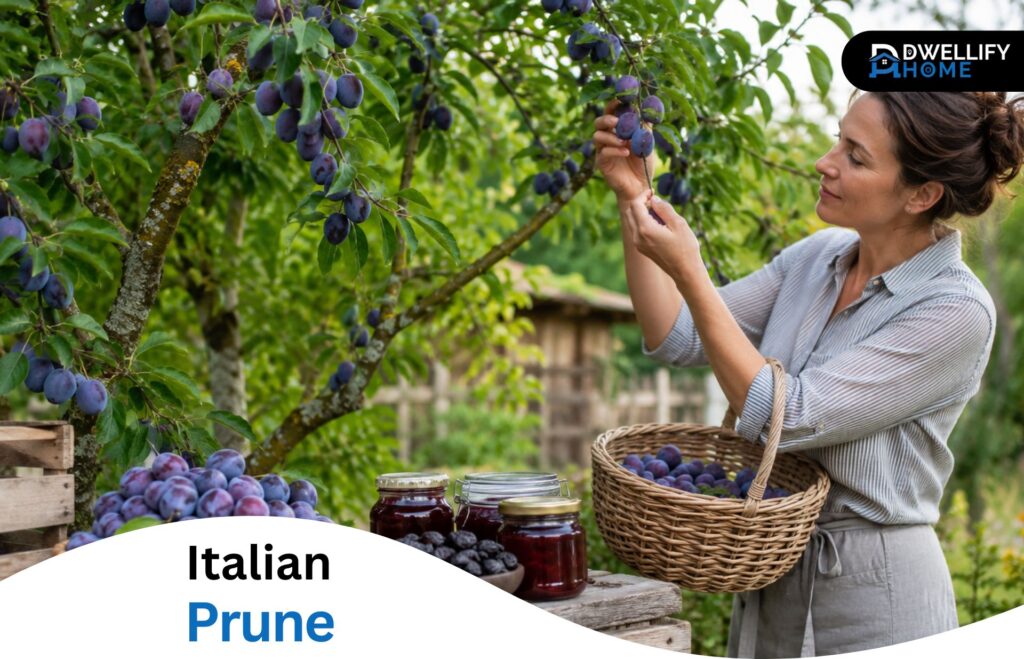
Picture a deep purple, almost black egg shape dusted with a pale, powdery bloom. The flesh is golden-green, firm, and dense rather than dripping with juice. Fresh, it’s sweet with a little tartness near the skin. Cooked, the flavor deepens and the color turns a striking fuchsia.
That dusty coating isn’t dirt — it’s a natural bloom that protects the fruit and signals freshness, so a plum that still wears it hasn’t been over-handled. The pit lifts out cleanly, and that freestone trait is a big reason this plum is so easy to work with. I’ll be honest about one thing, though: straight off the tree it’s pleasant rather than dazzling. Its real talent shows up with heat, when the amber-gold flesh cooks to deep fuchsia and the flavor concentrates into something far richer than the raw fruit.
As for whether they’re good for you: yes, in the ordinary way fruit is. Fresh, they’re mostly water and low in calories, with fiber, vitamin C, and potassium. Drying concentrates the sugars, fiber, and calories, so a few prunes are more filling than a fresh plum — and the sorbitol they contain explains their well-known effect on digestion.
Should you plant an Italian prune plum tree?
For a cold-tolerant gardener who wants a productive, low-fuss fruit tree, it’s one of the easier European plums to recommend. It performs reliably in roughly USDA Zones 5–8, though nurseries often list it as 4–9, and it shrugs off hard winters. The main catch is the wait before a real crop.
Cold is rarely the problem — these trees have come through around −25 °F without damage, with their outer limit colder still. Heat and mild winters are the bigger question. The tree needs somewhere around 700 to 1,000 chill hours, time spent below about 45 °F, to fruit reliably, so in a warm-winter climate it may bloom poorly or not at all.
Size comes down to rootstock more than the variety. On standard roots it reaches roughly 15 to 20 feet, but the same plum is sold on semi-dwarf or dwarf rootstocks for smaller yards. Rootstock also affects anchoring and disease resistance, so ask what yours is grown on. And set your expectations on timing: most Italian prunes take three to six years from planting to a worthwhile harvest, occasionally longer. The payoff is longevity — a healthy tree can bear for forty years or more.
How do you plant an Italian prune plum tree?
Plant a bare-root tree in late winter or early spring while it’s dormant. Choose a full-sun spot with well-drained, loamy soil around pH 6.0 to 7.0, and give a standard tree about 18 to 20 feet of room. Dig wide rather than deep, keep the graft union above the soil, water it in, and mulch.
Site matters more than people expect. Full sun gives you the sugar and the crop; a low, soggy spot or a frost pocket gives you disease and dropped blossoms. Good airflow helps too, since still, damp air is what fungal trouble loves. Most trees are sold bare-root in the dormant season, which is cheaper and gives the widest choice of variety and rootstock; container trees cost more but let you plant outside that window. Either way, ask the nursery three things — what rootstock it’s on, how old it is, and whether it’s certified disease-free.
The planting itself is simple. Dig a hole twice as wide as the roots but no deeper, so the tree sits at the level it grew at the nursery and the graft union stays above the soil line. Backfill with native soil, water well to settle out air pockets, and lay a ring of mulch kept a few inches off the trunk. Through that first year, water deeply and regularly — a tree barely pushing growth is usually telling you it’s too dry.
Does an Italian prune plum need a pollinator?
This is the question I’m asked most, and the honest answer is that it depends who you ask. Italian prune is widely sold as self-fertile, so a single tree will usually set some fruit alone. But most growers, and a good deal of extension research, find it crops noticeably heavier with a second European plum nearby.
The disagreement is real. Big nurseries tend to label it self-pollinating; some call it only partially self-fertile; a few insist it needs another European plum to fruit at all. University sources mostly land in the middle — European plums are generally self-fruitful but more productive with a partner. So one tree on its own isn’t a mistake; it just isn’t the heaviest-cropping setup.
Where you have room, plant a compatible European plum within about 50 feet. Stanley, Damson, Mount Royal, Green Gage, and President all work well. What won’t help is a Japanese or wild American plum — they’re different species that bloom on different schedules, so they can’t pollinate your Italian no matter how close you set them.
How do you care for an Italian prune plum tree through the year?
Care is light once the tree is established. Prune in late winter while it’s dormant, thin the fruit in early summer, feed modestly, and keep the water steady while the plums are sizing up. Do those four things and the tree largely looks after itself.
For shape, the modified central leader system suits these trees — a central trunk with tiered scaffold branches around it. Each dormant season, remove anything dead, crossing, or growing back toward the center, and keep the canopy open enough for light and air to reach the fruit. Thinning is the step new growers skip and later regret: when a branch sets a heavy cluster, pull off enough young fruit to leave a couple of inches between what stays. You’ll get larger plums, spare the limbs from snapping, and curb the tree’s habit of cropping hard one year and sulking the next.
Go easy on fertilizer. A modest feeding guided by a soil test is plenty; piling on nitrogen just buys a wall of leaves and fewer plums. Water is the bigger lever — keep it consistent while the fruit fills out, then ease off as harvest nears.
A simple season-by-season rhythm:
- Late winter — prune while dormant.
- Spring — watch for frost on the blossoms and early pests.
- Summer — thin the fruit and keep the water steady.
- Fall — harvest, then clear fallen fruit and leaves.
What problems should you watch for?
Most years bring nothing dramatic, but a few troubles are worth knowing. Black knot, brown rot, and bacterial spot are the common diseases; aphids, scale, and borers are the usual pests; and a late-spring frost or alkaline soil can quietly cost you a crop. None of these are reasons to skip the tree.
Black knot is the one to learn on sight, especially east of the Rockies — hard, black, crusty swellings on twigs and branches. Prune them out several inches below the gall in dry weather and carry the prunings away rather than leaving them nearby. Brown rot turns ripening fruit into fuzzy mummies, and bacterial spot freckles leaves and fruit; airflow and clean-up handle most of both. On the pest side, watch for aphids curling new leaves, scale on the bark, and borers near the base of the trunk. A yearly walk-around in spring usually shows you what needs attention, and the gentlest effective treatment beats a heavy spray after the fact.
A healthy-looking tree that won’t fruit is almost always one of these:
- Too young to bear yet.
- No compatible pollination partner nearby.
- Over-pruning, or wrong-timed pruning that removed fruiting wood.
- A late frost that killed the blossoms.
- Alkaline soil causing iron chlorosis — yellow leaves with green veins.
- Too much nitrogen, pushing leaves over fruit.
- Natural biennial bearing after a heavy year.
When and how do you harvest Italian prune plums?
Italian prunes ripen from late August into September across most of North America. They’re ready when the fruit gives slightly to gentle pressure, the stem releases with an easy twist, and the skin carries a full dusty bloom. In the coldest regions, growers often wait for a first light frost to deepen the sugars.
Color will fool you — these plums turn deep purple well before they’re at their sweetest, so don’t pick by looks alone. Wait until they give a little when squeezed and the stem comes away easily. For fresh eating that’s the moment; for drying, let them go a touch further to dead-ripe, when the sugar is highest.
For a few kitchen plums, hand-pick the ripe ones and leave the rest to finish. When you’re drying in quantity, an old orchard habit is to give the limbs a gentle shake every couple of days and gather what drops, since fully ripe fruit lets go on its own. A mature, well-pollinated tree can hand you more than you can use; in a marginal climate, expect a lighter, less predictable load. Ripe fruit doesn’t keep long — firm plums finish ripening on the counter, ripe ones hold a few days in the fridge, and the rest is best frozen, which leads straight to what to do with a glut.
How do you use fresh Italian prune plums in the kitchen?
Their low water, high sugar, and clean-release pit make these the baking plum. They hold their shape in pies and tarts, cook down to a glossy fuchsia in compotes and sauces, and pair as happily with pork and lamb as with vanilla, cinnamon, and almond.
Baking is where they shine. Because the pit lifts straight out and the flesh keeps its shape, they’re ideal for tarts, crisps, and the simple plum cake that turns up every September — the well-loved plum torte and the German Zwetschgenkuchen both rely on exactly this fruit. An italian prune pie holds together instead of collapsing into syrup, which is more than you can say for softer plums.
They’re just as good on the savory side. The sweet-tart flesh cuts through rich meat, so it works in a glaze or stuffing for pork, lamb, or duck, and a few slices lift a cheese board. Cooked down with sugar and spice, the same fruit becomes jam, chutney, sauce, or a thick plum butter, and that fuchsia color makes all of them look better than they have any right to. There’s a long tradition of preserving them in stronger stuff too — across Central Europe they’re distilled into spirits like slivovitz and quetsch, and a jar of prunes steeped in brandy is an old way to carry the harvest into winter.
How do you dry Italian prune plums into homemade prunes?
Wash and halve the plums, pop out the pits, and lay them skin-side down on the trays. Dry at about 135 to 140 °F for roughly 24 to 36 hours, until they’re pliable and leathery with no wet pockets, then condition them for several days before storing.
Step by step:
- Halve and pit the plums. For whole fruit, dip them in boiling water for a minute or two first to crack the skins so they’ll dry.
- Lay the halves skin-side down and gently turn them inside out — “popping the backs” exposes more flesh and speeds drying.
- Dry at 135 to 140 °F until pliable, with no bead of moisture when you press one, usually 24 to 36 hours.
- Condition for 4 to 10 days in a loosely covered jar, shaking daily so any leftover moisture spreads evenly.
- Store airtight in a cool, dark place, where they’ll keep 6 to 12 months.
A dehydrator is the easiest, most reliable tool — it holds a steady low temperature for as long as the fruit needs. An oven works if it’ll go low enough, but it ties up your kitchen and dries unevenly; sun-drying is traditional but really only practical in a hot, dry climate, with the fruit protected from insects. Conditioning matters more than it sounds: skip it and you risk case hardening, where the outside seals dry while the center stays damp and invites mold. When you’re ready to use them, a short soak in hot water plumps them back up for baking or cooking.
Can you freeze or can Italian prune plums?
Yes to both. For freezing, halve and pit the fruit and pack it in syrup, in sugar, or dry on a tray, where it keeps about six months. For canning, process halves or whole plums in a boiling-water bath. Use a tested recipe from a trusted source rather than improvising — this is one place where safety genuinely matters.
Freezing is the no-fuss option. Pack the pitted halves in a light syrup for the best texture, toss them with sugar, or freeze them loose on a tray if you want them to pour rather than clump. A pinch of ascorbic acid — plain vitamin C — keeps the color from browning, and frozen this way they slot straight into baking.
Canning takes more care. You can put up halved or whole plums hot-packed or raw-packed in a boiling-water bath, and the same fruit makes excellent plum sauce, spiced plums, and preserves. Because a wrong step in canning can actually make food unsafe, follow a tested method from the National Center for Home Food Preservation or your local extension service rather than guessing at times and ratios.
A short history: from Lombardy to your backyard
This plum carries its origin in its name. It traces to northern Italy and the wider Lombardy region, and the strain most American growers know descends from a line named for the Swiss town of Fellenberg, brought into wide cultivation in the early 1800s. It crossed the Atlantic and spread through California around the Gold Rush era, where it became a backbone of the American prune industry — California still grows the lion’s share of the country’s prunes. In Central Europe the same fruit anchors a whole baking tradition, from German Zwetschgenkuchen to dumplings and thick plum preserves. Plant one in your yard and you’re keeping a very old habit alive.
Is an Italian prune plum tree worth planting?
For most home growers in a cold-enough climate, yes — and the reason is that double harvest. A single Italian prune gives you a short, generous run of fresh fruit in late summer for baking and the table, then a pantry’s worth of homemade prunes to carry through the rest of the year. You’ll wait three to five years for the first real crop, but you’re planting a tree that can feed you for decades. Few fruit trees ask so little and give back so steadily.
Disclaimer: This article is for general informational purposes only. Growing conditions, climate, and individual results vary, so treat the guidance here as a starting point and adjust it to your own situation.