Streetlight Christmas decorations turn an ordinary lamp post into the warmest welcome on the street. You wrap your own residential lamp post, driveway light, or street-facing post in garland, add outdoor-rated lights and a big bow, and suddenly the whole front yard feels like Christmas. Start with the safety line first, though: you may decorate a lamp post you own on your own property, but a municipal streetlight or utility pole is not a homeowner project. You need permission from the city or utility for that pole, and you must never climb it or work near power lines.
Once you know which posts are yours, the rest is joyful and simple. Pick one look, gather outdoor-rated supplies, and wrap from the bottom up so gravity works with you instead of against you. Solar lights suit posts far from an outlet, while plug-in lights give you a steadier glow near the house. A timer does the nightly on-and-off work for you. This guide walks you through each choice, step by step, so your post looks polished by day and glows beautifully after dark.
First, Know Which Post Is Yours
Not every post on your street belongs to you, and that distinction matters more than any bow or bulb. A lamp post in your front yard, a driveway light, or a decorative post you bought and installed usually sits on your property, and you can decorate it. A tall streetlight at the curb, a pole with power lines, or a pole with a transformer belongs to the city or the utility company, even if it stands right in front of your house.
For a municipal streetlight, ask first and decorate only if the city or utility says yes in writing. Many cities treat attachments to streetlights as work that needs a permit, and they require a qualified contractor to install and remove the decoration. That rule exists for a good reason. Streetlights carry live power, sit over traffic, and must stay clear so drivers and walkers can see. A loose wreath or a sagging cord over a road can turn a pretty idea into a real hazard.
Never climb a municipal pole, and never lean a ladder against a utility pole. Never touch a power line, and never assume a wire is safe because it looks coated or old. Overhead lines can kill without warning, so treat every overhead wire as live. If a wire hangs low, looks damaged, or falls, stay away and call your utility company right away. Leave pole work to trained crews with the right gear.
Your homeowners association can add its own rules, too. Check its holiday policy before you buy anything. Some associations limit colors, brightness, or how long displays stay up. A quick check now saves you from taking everything down later.
Choose a Look That Fits Your Home
A lamp post looks best when it matches the rest of your yard. If your porch already glows warm white, a red-and-green post with warm white lights ties the whole front together. If your home leans modern, try cool white lights, silver ornaments, and a simple white bow. Pick one theme and repeat it, because one clear idea always beats five competing ones.
Here are four looks that work well on a residential post:
| Look | Colors and Materials | Best For |
|---|---|---|
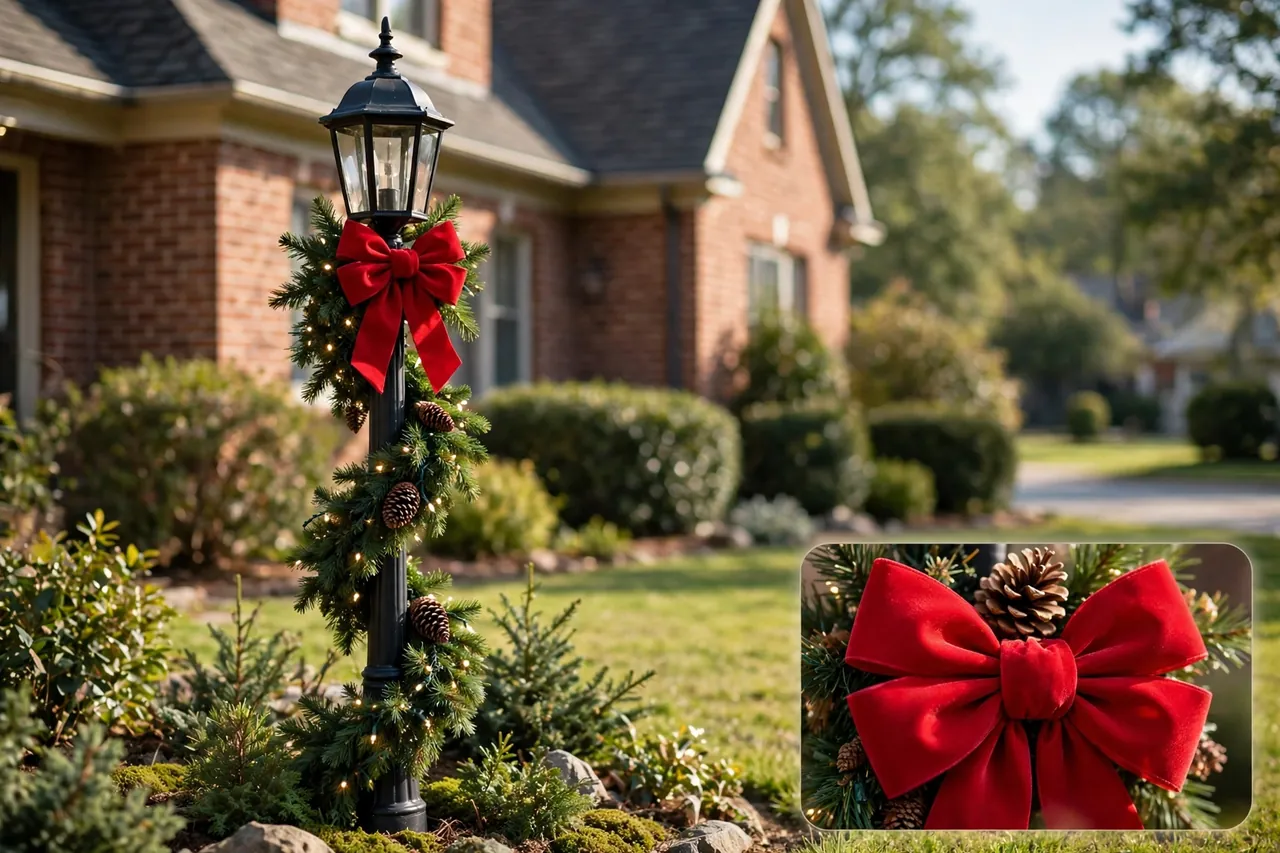
| Classic Christmas | Green garland, warm white lights, red velvet-style bow | Traditional homes and brick fronts |
| Winter Wonderland | Frosted garland, cool white lights, silver ornaments | Modern homes and snowy yards |
| Woodland Charm | Natural garland, pinecones, berries, warm lights | Cottages, cabins, and country yards |
| Candy Cane Cheer | Red and white ribbon wrap, bright lights, red bow | Family homes with playful displays |
Think about daytime, too. Lights steal the show at night, but garland, bows, and ornaments carry the look all day. A post wrapped in full, fluffy garland looks rich in daylight. A post with thin, bare lights looks sparse until dark. So build the daytime shape first, then add light on top of it.
What You Need Before You Start
Gather everything before you step outside. A mid-project trip to the store breaks your rhythm, and a half-wrapped post in a cold wind is no fun at all. Work on a dry, calm day if you can, and keep your feet firmly on the ground. You should reach every part of a residential lamp post from the ground or a short, stable step stool. If you need a tall ladder to reach it, stop and rethink the plan.
- Outdoor-rated garland, long enough to spiral the full post with some overlap
- Outdoor-rated LED light strings, solar or plug-in, to match your power plan
- Weatherproof zip ties or floral wire for fastening
- One large weatherproof bow, or wide wire-edged outdoor ribbon to make one
- A wreath or lantern topper for the lantern head, if your post has one
- Small ornaments, pinecones, or berry picks for texture
- An outdoor-rated extension cord and a weatherproof connection cover, for plug-in lights
- A timer, either plug-in, solar with a built-in timer, or smart
- Work gloves, scissors or wire cutters, and a small bag for trimmings
Measure your post before you shop. Wrap a piece of string around the post once, then measure the string. Multiply that by the number of spirals you want, and add a little extra for overlap at the top and bottom. A thin post needs less garland than a thick one, and a taller post needs more lights than you might guess. Buy one extra string of lights if you can, because a short string at the top looks unfinished.
Choose outdoor-rated gear every time. Indoor lights, indoor cords, and indoor ribbon do not belong outside in rain, snow, and cold. Check the label on each string. It should say it suits outdoor use, and it should carry the mark of a recognized testing lab. The U.S. Consumer Product Safety Commission (CPSC) advises shoppers to use only lights tested for safety by a recognized testing laboratory, and to throw out any set with cracked sockets, frayed wires, or loose connections.
How to Wrap Garland Around a Lamp Post
Garland gives your post its body. Lights alone look thin, but garland makes the post look full, soft, and finished. Start at the bottom and work upward in a gentle spiral. This order keeps each new wrap resting on the one below it, so the whole wrap stays put instead of sliding down.
- Clean the post first. Wipe off dirt, cobwebs, and loose rust so ties grip well and the garland sits cleanly.
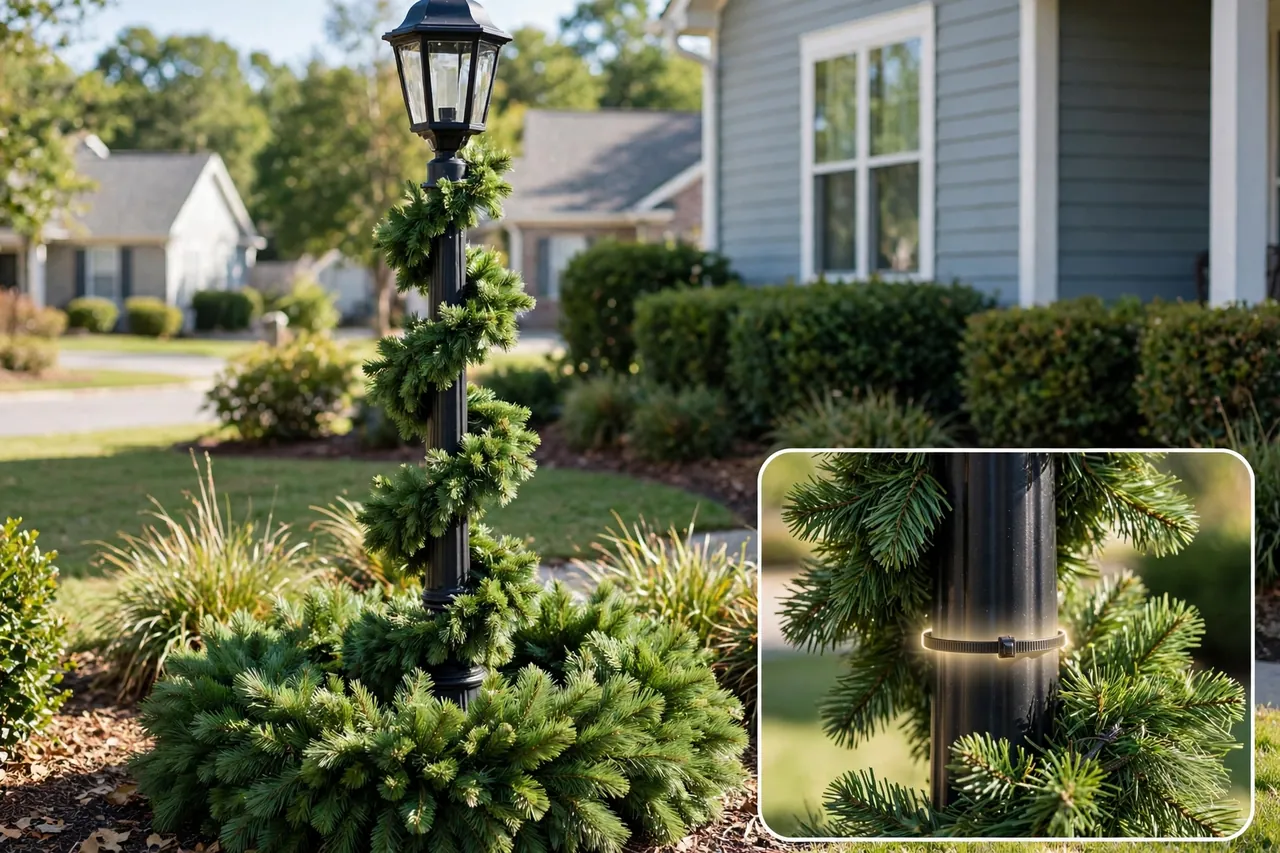
- Anchor the garland at the base. Loop the first end around the post and fasten it with two zip ties or a short piece of floral wire.
- Spiral upward with steady spacing. Keep each loop about the same distance from the last one, and pull the garland snug but not so tight that it flattens.
- Fasten as you go. Add a zip tie or wire every couple of feet, and add one more at any spot where the garland wants to slip.
- Fluff the garland as you climb the spiral. Pull small branches outward so the post looks full from every angle, not flat on one side.
- Anchor the top firmly. Wrap the last end around the post twice, fasten it well, and tuck the cut end inside the garland.
- Step back and check your work. Look from the street, not just from up close, and fix thin spots before you add lights.
Metal posts feel slick, so friction is your enemy here. If your garland keeps sliding, add more fastening points instead of pulling harder. A wrap that grips at many points stays neat through wind and rain. For a thick post, twist two garland strands together before you start, because one thin strand will look lost on a wide post.
Fresh greenery smells wonderful, but it dries out fast in winter wind, and dry greenery near warm bulbs can become a fire risk. Faux garland lasts the whole season, holds its shape, and shrugs off rain. If you love the scent of real pine, tuck a few fresh sprigs into the faux garland near the base, where you can check them often and swap them out when they dry.
Add Lights: Solar or Plug-In
Lights turn a pretty post into a glowing landmark. Wrap them over the garland in the same spiral pattern, so they sit on top of the greenery instead of hiding inside it. Keep the spacing even, and step back often to check the glow from the street. A string that bunches at the bottom and thins at the top looks lopsided after dark.
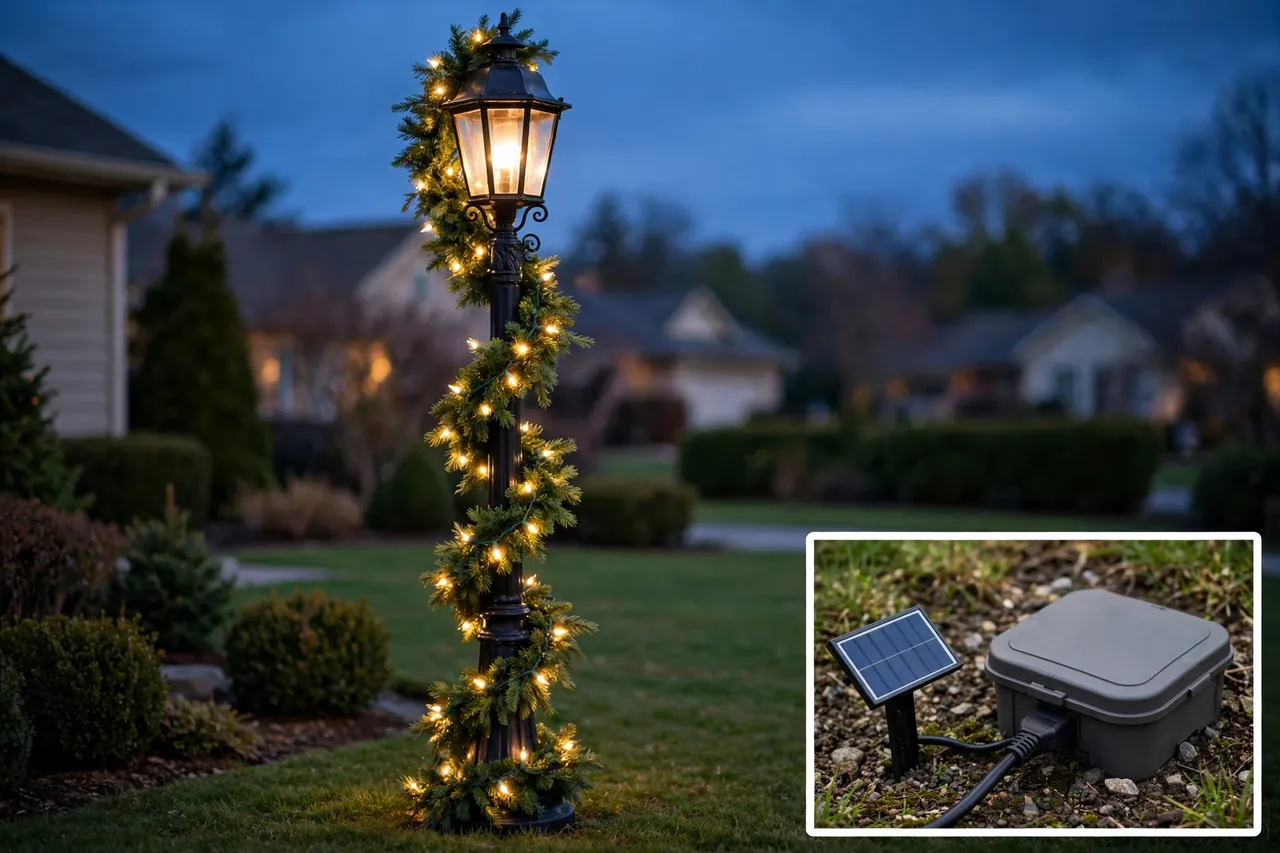
Solar lights win when your post stands far from the house. They charge by day and switch on at dusk, and you run no cord across the lawn. They also suit a post with no nearby outlet at all. Their weakness is winter: short days, cloudy skies, and snow on the solar panel all cut their glow time. Keep the panel facing the sun, brush snow off it, and trim any branch that shades it.
Plug-in lights win when your post sits near the house or a driveway outlet. They glow brighter, longer, and more steadily than solar lights, and they shine on cloudy nights just as well as clear ones. Their weakness is the cord. You must use an outdoor-rated cord, keep connections dry and off the ground, and never run a cord across a walkway where someone could trip. Plug outdoor lights into a ground-fault circuit interrupter (GFCI) outlet, because the U.S. Consumer Product Safety Commission (CPSC) recommends GFCI protection for outdoor electric lights and decorations.
| Feature | Solar Lights | Plug-In Lights |
|---|---|---|
| Best spot | Posts far from an outlet | Posts near the house or driveway |
| Brightness | Softer, varies with sunlight | Brighter and steady all night |
| Setup | No cord, quick to place | Needs an outdoor cord and GFCI outlet |
| Winter risk | Short days cut run time | Snow and ice on cords and plugs |
| Running cost | No power bill for the lights | Small, but steady, power use |
Battery lights offer a third path for a small post or a lantern head. They suit a wreath, a bow with lights, or a lantern insert where a cord would spoil the look. Check the batteries weekly, because cold drains them fast. For a full post wrap, though, solar or plug-in lights usually serve you better than batteries alone.
Whichever power source you pick, use LED strings. LEDs run cool, sip power, and last far longer than old incandescent bulbs. Cool bulbs also protect your garland, because a hot bulb resting against dry greenery is a risk you never need to take.
Finish With Bows, Wreaths, and a Lantern Glow
A big bow marks the spot where the eye should land. Place one large bow just under the lantern head, where the garland spiral ends. That single bow hides the join, frames the light, and gives the whole post a finished feel. Add smaller bows partway down only if the post is tall and the middle looks bare. Too many bows crowd the post and fight for attention.
Pick weatherproof ribbon. Velvet-style bows look rich indoors, but rain turns them limp and soggy outdoors. Wire-edged outdoor ribbon holds its loops through storms, and heavy polypropylene bows stay crisp all season. Tie the bow firmly to the post with wire, not tape, and angle the loops so they face the street.
If your post has a lantern head, dress it like a tiny room. Set a flameless LED candle inside for a warm glow, and tuck faux snow, pinecones, or small greenery around its base. Hang two or three small ornaments from the lantern frame, but keep them light so wind cannot swing them hard against the glass. Never put a real flame inside a lantern wrapped in garland. The risk is obvious, and the LED glow looks just as warm.
A wreath also works beautifully on a lamp post. Hang a small wreath on the street-facing side, just under the lantern, and fasten it with wire through the garland. Keep it modest in size. A huge wreath catches wind like a sail and strains its fastening. A wreath that suits the post looks intentional, while an oversized one looks like it might take flight in the next storm.
For a full yard display, let the lamp post lead the eye toward the house. Match its colors to your porch and walkway lights, and keep the path clear and bright. Our guide to outdoor Christmas displays shows how to tie posts, figures, and scenes into one layout that wows without looking cluttered.
Mount Everything Without Damaging the Post
A decorated post should come down in January looking just as good as it did in November. That means you fasten with care and never pierce, scratch, or stain the finish. Zip ties, floral wire, and soft clips hold well and remove cleanly. Nails, screws, and staples do not belong on a lamp post. They chip paint, invite rust, and can nick a wire hidden inside the post.
Wrap a soft layer under any wire that might rub. A short strip of cloth or felt between the wire and a painted post stops scuffs over a long season. Tighten ties enough to hold, but not so tight that they dent the post or crush the garland. Check the ties after the first storm, because wind loosens fastenings that felt firm on a calm day.
Keep decorations clear of moving parts. Do not block a lantern door, a photocell sensor, or an access panel on the post. A sensor covered in garland may leave the lamp burning all day or fail to switch on at night. If your lamp post has a dusk-to-dawn sensor, leave a clear gap around it, and test the lamp after you finish decorating.
Think about the neighbors who walk past, too. Keep every decoration above head height on any side that faces a sidewalk, and keep cords, ties, and loose ends tucked in. Nothing should dangle where a child, a dog, or a passerby could catch it. A tidy post is a safe post, and it looks better as well.
Timers, Power Safety, and Nightly Habits
A timer turns your post into a display that runs itself. Set it to switch on at dusk and off at bedtime, and you never need to trudge outside in the cold to plug and unplug lights. Plug-in timers cost little, and many solar lights include a built-in timer or dusk sensor. Smart plugs add phone control, so you can switch the post on early when guests arrive.
Follow a few power rules every night. Use only outdoor-rated cords outside, and keep every plug and connection inside a weatherproof cover, off the ground, and away from puddles. Do not overload one outlet or one extension cord with string after string. Read the label on each light set for its limit, and respect it. The U.S. Consumer Product Safety Commission (CPSC) also advises turning holiday lights off when you go to bed or leave the house, because a short can start a fire while no one watches.
Check the safety marks on your lights before you buy. Seasonal lights should meet the UL 588 standard for seasonal and holiday decorative products, and SGS, a global testing and inspection company, notes that conformity to UL 588 is the best way to confirm the three readily observable safety characteristics: minimum wire size, sufficient strain relief, and overcurrent protection. Look for a UL or ETL mark on the string itself, not just on the box. If the mark is missing, pick a different set.
Inspect your display once a week through the season. Walk around the post, look for sagging garland, loose ties, cracked sockets, and cords that have slipped into a puddle or walkway. Replace a damaged string instead of patching it with tape. A five-minute check keeps a small problem from becoming a dark post or a safety risk.

Survive Wind, Snow, and Ice
Winter weather tests every outdoor decoration, and a lamp post stands out in the open with nowhere to hide. Wind tugs at bows, snow loads garland, and ice adds weight to every loop. Build for the worst night, not the calm afternoon you decorated on.
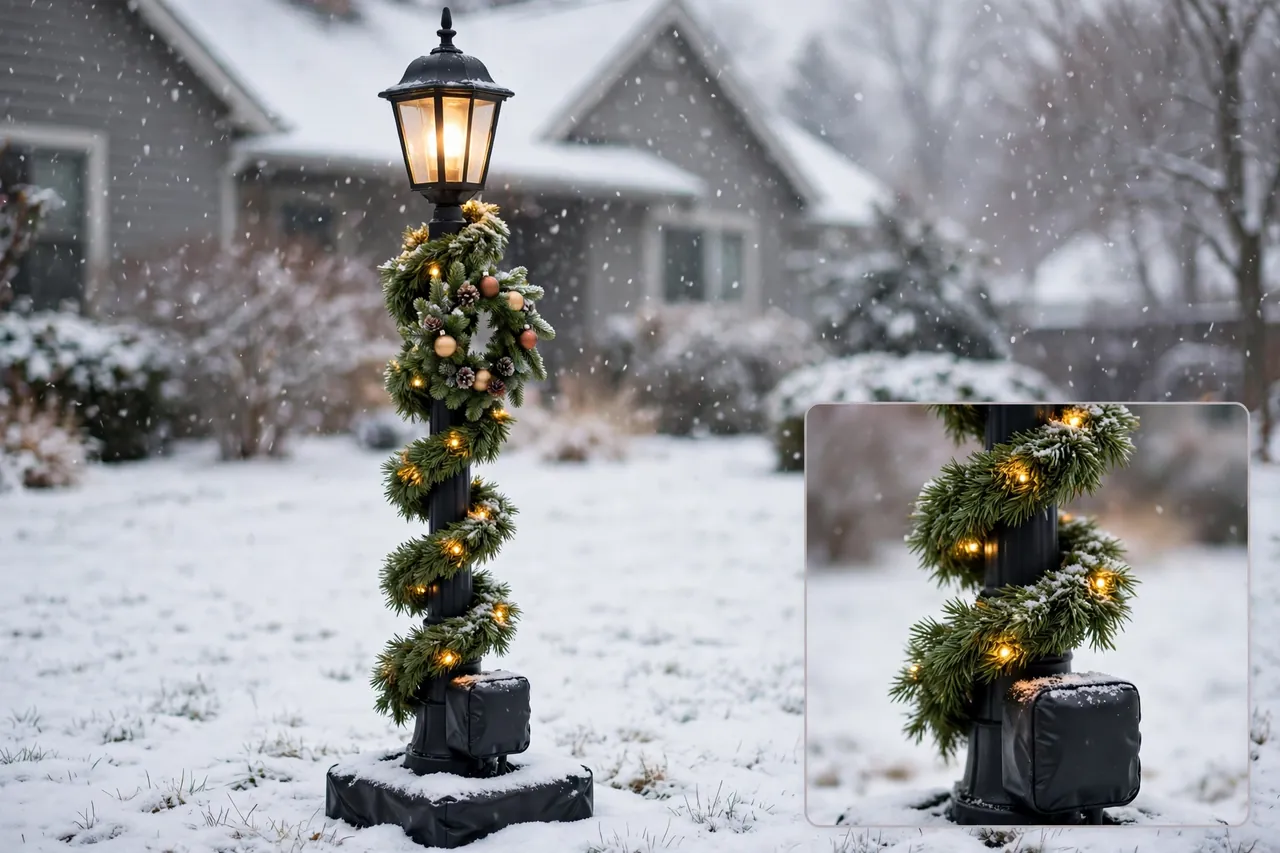
Shorten the sail. A tight spiral hugs the post and catches less wind than loose loops that flap. A small wreath strains less than a large one. Ornaments should hang close to the post, not dangle on long strings. After a storm, brush snow off the garland and lights so the weight does not drag the wrap downward.
Watch for ice on cords and plugs. Ice can crack a cord jacket and let water in, so keep connections covered and raised. If a plug freezes into a puddle, do not yank it free. Let it thaw, dry the connection, and check it before you plug it back in. If anything looks cracked or swollen, replace it.
Solar panels need care in snow, too. Brush snow off gently with a soft cloth, and do not scrape the panel with a hard tool. A scratched panel charges poorly for the rest of the season. If a heavy storm buries the base of the post, clear the snow so air can move around the garland and cords can dry.
Take It Down and Store It Well
Take decorations down soon after the season ends, before winter weather grinds them down further. Work in daylight, and remove lights first so you can see the garland ties clearly. Snip zip ties instead of pulling them, because pulling drags garland and scratches paint. Coil light strings loosely, and never wind them tight around a sharp edge.
Store garland in a large box or bag where it keeps its fluff. Crush it flat and it will look thin next year. Keep bows in their own box so their loops hold shape. Label each box with the post it belongs to, so next December you start decorating instead of sorting. Our guide to Christmas decor boxes covers storage that protects every piece through the year.
Before you pack lights away, test them once more and toss any damaged set. A string with a cracked socket will not heal in storage, and it will tempt you to reuse it next year. Note what worked this year, too: which garland length fit, which timer setting you liked, and which bow survived the storms. That short note turns next year into a quick job.
Please Read This Safety Disclaimer
This guide covers decoration of lamp posts you own on your own property, using ground-level work and outdoor-rated products. It does not cover work on municipal streetlights, utility poles, or any pole with power lines. For those poles, get permission from the city or utility first, and hire qualified professionals for installation and removal. Never climb a pole, never work near overhead power lines, and never touch a wire you suspect is live. If you feel unsure about any step, stop and ask a qualified electrician or your utility company for help. Your safety matters far more than any decoration.
Related Guides
Outdoor Christmas Decorations Wall · Best Christmas Light Clips · Commercial Outdoor Holiday Decorations
Frequently Asked Questions
How Do You Decorate a Lamp Post for Christmas?
Start with a clean post, then spiral outdoor-rated garland from the bottom up and fasten it every couple of feet. Wrap outdoor LED lights over the garland, add one large weatherproof bow under the lantern, and finish with a few ornaments. Step back often and check the look from the street.
How Do You Decorate a Lamp Post With Christmas Lights?
Wrap the lights in a spiral over garland so they sit on top of the greenery, not buried inside it. Anchor the string at the base, keep the spacing even, and fasten the top firmly so gravity cannot drag it down. Use solar lights far from an outlet, and plug-in lights near the house.
Can I Use Regular Christmas Lights on Lamp Posts?
Use only lights rated for outdoor use on an outdoor lamp post, even if regular indoor lights look the same. Outdoor-rated strings carry thicker insulation, weatherproof connections, and a recognized testing-lab mark. Indoor strings can crack, short, or fail in rain, snow, and cold, so they create a fire and shock risk outside.
How Do You Decorate an Outdoor Lamppost for the Holidays?
Pick one theme that matches your home, then build the daytime shape first with full garland, a bow, and a lantern glow. Add lights for the night, set a timer for dusk to bedtime, and keep every cord dry and out of walkways. Check the display weekly for sagging, loose ties, or damaged cords.
Your lamp post may be small, but it greets everyone who comes to your door. Wrap it with care, light it safely, and let it glow all season long. Start with the post you own, keep power lines and municipal poles out of the project, and enjoy the warm welcome you built with your own hands.