Commercial outdoor holiday decorations turn a storefront, restaurant, mall, hotel, or town square into a place people want to visit after dark. They use commercial-grade lights, oversized wreaths and garland, large trees, and sturdy frames that can handle wind, rain, snow, and weeks of nightly use. For a business, the goal is simple: draw eyes from the street, welcome guests at the door, and keep the whole property looking sharp from the first switch-on to the final takedown.
This guide walks you through the full commercial process. You will learn what makes decor truly commercial-grade, how to plan a display that fits your brand and your building, when permits and local rules come into play, how to choose between a professional crew and an in-house team, and how to budget, power, maintain, and store a display that earns its keep all season long.
What Makes Decor Commercial-Grade?
Commercial-grade decor is built for a harder job than a single evening of admiration. It must survive weather, crowds, and constant use, night after night, for six to eight weeks or more. That is why commercial pieces look bigger, feel heavier, and cost more up front than the light sets most people buy for one season at a time.
Three traits separate commercial pieces from ordinary decor. First, durability: thicker wire, sealed sockets, steel frames, and UV-stable greenery that does not fade or shed after a few storms. Second, scale: wreaths, garland, and trees sized for viewing from across a parking lot or a busy street, not just from a front porch. Third, safety ratings: lights and power gear tested by a recognized lab and rated for outdoor, wet-location use.
Here is the contrast in one line: a homeowner can swap a failed string in slippers on a Saturday morning, but a business cannot let a dark entrance or a sagging garland greet paying customers on a Saturday night in December.
Durability That Survives the Whole Season
Start with the parts that take the most punishment. Commercial light strings usually use heavier-gauge wire, molded plugs, and sockets that seal out moisture. Look for LED bulbs rather than old incandescent strings, because LEDs run cooler, draw far less power, and last far longer across a full season of nightly use.
Greenery matters just as much. Commercial garland and wreaths often use a steel hoop or rigid core instead of a thin wire ring, so they hold their shape in wind and under their own weight. Bows should use UV-stable ribbon that keeps its color in sun and snow. If a piece looks limp in the supplier photo, it will look worse after three weeks on a windy corner.
Check the frame before you check the sparkle. A large outdoor tree needs a weighted, anchored base and a frame rated for its height and wind load. A plaza display needs ground stakes, ballast, or bolt-down points that keep it upright when crowds bump it and storms push it. Ask the supplier, in writing, what wind rating the frame carries and how it anchors.
Scale That Reads From the Street
Scale is where many first-time commercial displays go wrong. A wreath that looks grand on a shop door can vanish on a hotel entrance or a mall facade. As a rule of thumb used by commercial installers, light-pole wreaths run about 24 inches, storefront door wreaths run 36 to 48 inches, and grand entries need 60 inches or larger to read from a distance.
Apply the same thinking to every element. Roofline lights should trace the full outline of the building, not stop halfway along the fascia. Tree wraps should climb high enough to catch the eye from the road, not just decorate the lowest branches. Ground displays should sit large enough that drivers can enjoy them without stopping traffic to squint.
Step back, literally, before you buy. Stand across the street or at the far end of the parking lot and look at your building the way a passing driver does. Mark the spots that already draw the eye: the entrance, the sign, the tallest tree, and the corners. Those are your anchor points, and your budget should go there first.
Safety Ratings You Must Not Skip
Safety ratings are not marketing words. For seasonal lighting used in a commercial setting, products should carry certification from a Nationally Recognized Testing Laboratory against UL 588, the safety standard for seasonal and decorative lighting products. SGS, a global testing and certification company, explains that lights used in a commercial setting must be certified by such a laboratory against UL 588, and that conformity to UL 588 is the best way to ensure the basic safety features are in place.
Read the label, not just the box. The tag should state outdoor or wet-location use, and it should name the testing lab, such as UL or ETL. Indoor-only lights have no place outside, no matter how good the price looks. Keep the packaging and spec sheets on file, because your insurer, your landlord, or a city inspector may ask to see them.

Planning a Commercial Display That Works for Business
A strong commercial display starts with a business goal, not a shopping list. Do you want more foot traffic past the door? Do you want guests to photograph your entrance and share it? Do you want a town square that anchors a whole shopping district? Each goal points to a different design, and naming it first keeps the budget focused.
Next, walk the property at night. Daylight hides the problems that darkness exposes: a dark corner by the parking lot, a sign that disappears after sunset, a walkway that feels unsafe, or an entrance that blends into the facade. Your display should fix those dark spots first, then add the festive layers on top.
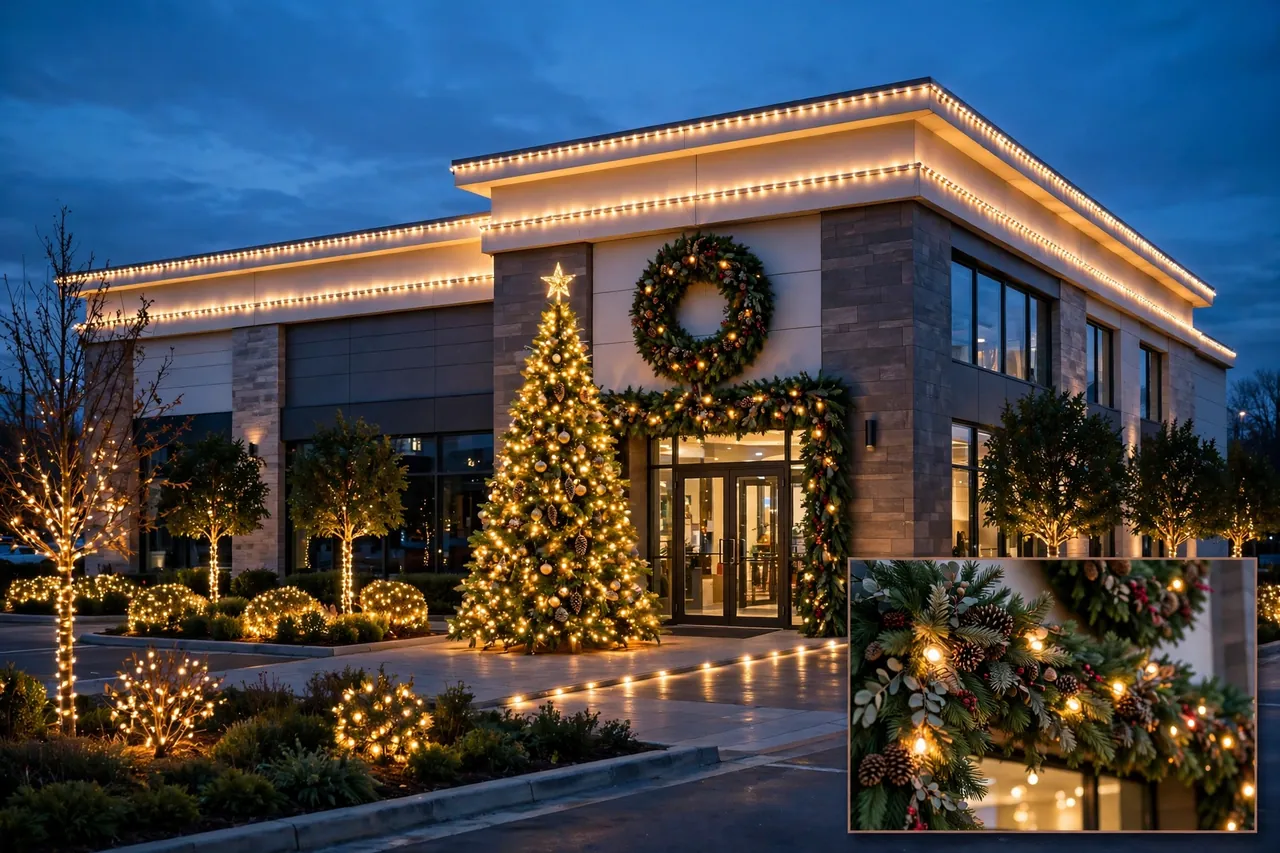
Build the design in layers. The roofline or facade outline gives the building its shape after dark. The entrance layer, with garland, wreaths, and warm light, welcomes people in. The landscape layer, with wrapped trees, lit shrubs, and ground figures, fills the space between the street and the door. The feature layer, often one large tree or one bold display, gives people a reason to stop, photograph, and remember your business.
Match the Display to Your Brand
Your holiday display is part of your brand for six weeks, so it should look like you. A fine-dining restaurant may suit warm white light, classic garland, and one elegant tree. A toy store or family attraction can carry bold color, playful figures, and a brighter, busier look. A corporate office park may want a clean, uniform outline with restrained color and no clutter.
Use your brand colors as accents, not as a takeover. A hotel with deep green branding can weave green into wreaths and bows while keeping the main light warm white. A retailer with a red logo can echo that red in bows and ornaments without turning the whole facade into a billboard. When the display matches the signage, customers connect the festive feeling to your business, not just to the season.
Keep the message simple from the road. Drivers get about three seconds to read your building, so one clear focal point beats five competing ones. Put the biggest, brightest moment at the entrance or the main sign, and let the rest of the property support it rather than fight it.
Design for Foot Traffic and Safety
A commercial display must guide people safely, not just impress them. Light the walkways, steps, ramps, and parking-lot crossings as brightly as the decorations themselves. Guests should never have to guess where the door is, where the curb drops, or where cars cross their path.
Keep displays out of the walking path. Ground figures, planters, and light poles belong beside the path, never in it, and cords must never cross a walkway where a guest can trip. Leave clear space around fire hydrants, exits, and emergency access routes, and never block an exit sign, a fire lane, or an accessible route with decor.
Think about the photo moment, because it is free marketing. A well-lit tree or entrance frame invites guests to stop and take a picture, and those pictures travel. Leave enough open space in front of the feature for a small group to stand, keep the background clean, and make sure the feature looks good from the front, not only from the installer’s ladder.
Permits and Local Rules: Check Before You Hang Anything
Permits surprise more commercial decorators than weather does. Rules vary by city, property type, and display size, and a display that needs no permit in one town may need one in the next. Check early, because a late permit can delay your whole install past the shopping season you wanted to capture.
Start with three calls or emails. First, your city or county permit office: ask whether temporary seasonal displays, large structures, banners, or signs need a permit, and whether there are rules on height, placement, or how long a display may stay up. Second, your property owner or landlord, if you lease: many leases require written approval for anything attached to the facade, roof, or signage. Third, your property manager or business district: malls, plazas, and downtown districts often run a shared theme or approval process.
Ask about the details that catch people out. Some cities limit how far a display may extend over a sidewalk or into the public right-of-way. Some restrict flashing or animated lights near roads, because they can distract drivers. Some require a licensed electrician for new circuits or hardwired work. Historic districts may add design rules on top of the standard ones. Get every answer in writing and keep it with your project file.
Do not forget the neighbors of your display: the fire code. Combustible decor near exits, in stairwells, or blocking egress routes can draw a violation even when the lights themselves are fine. If your display includes a large tree, draped fabric, or a covered walkway, ask your local fire authority or fire marshal’s office whether it needs flame-resistant materials or a separate review. A five-minute question in October beats a removal order in December.
Professional Installation vs an In-House Team
This is the decision that shapes your season. A professional crew brings design, equipment, insurance, and a maintenance promise. An in-house team brings local knowledge, lower labor cost, and direct control. Both can work, but they suit very different properties, and the wrong choice shows up fast when a storm hits or a section goes dark.
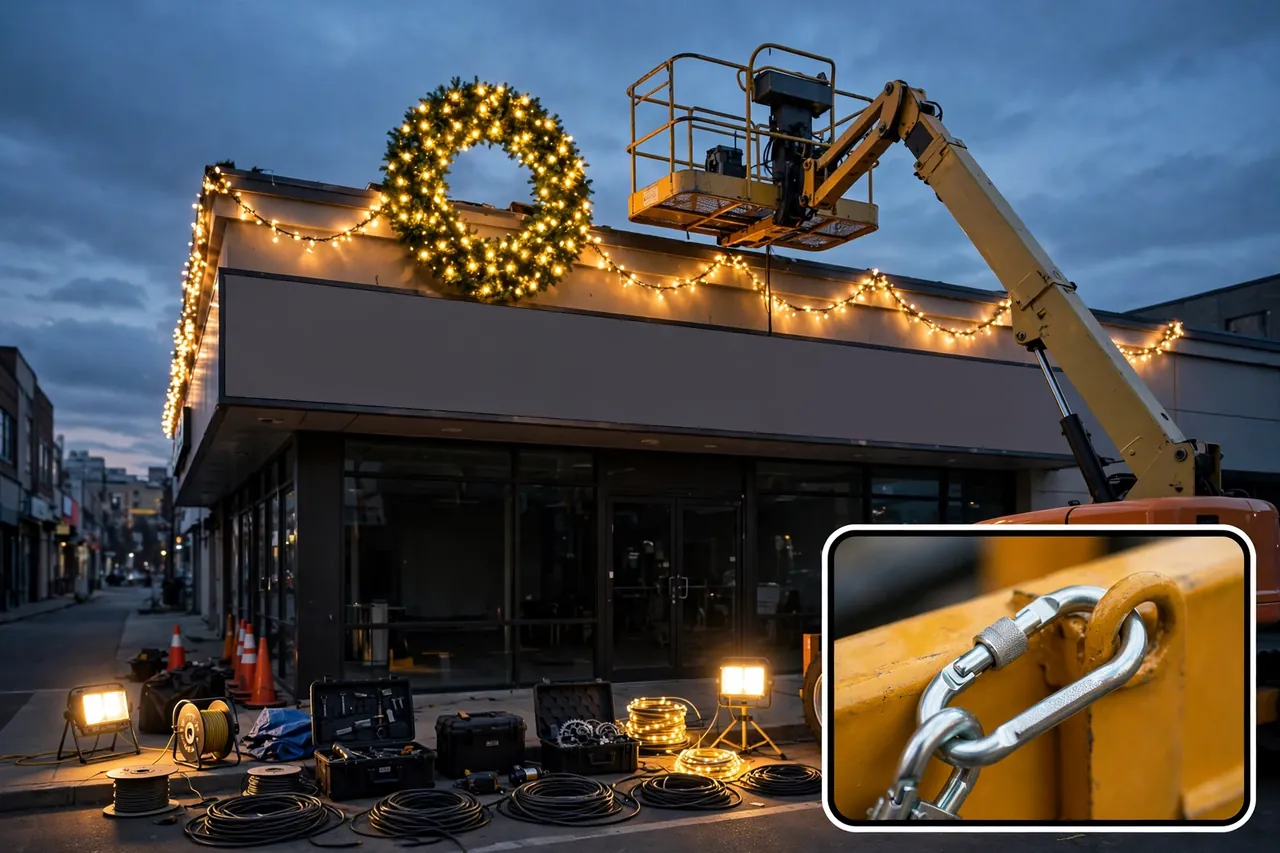
Choose a professional crew when the work involves height, roofs, large trees, bucket lifts, or new electrical circuits. Professional installers carry their own lifts, fall protection, and liability insurance, and they work after hours so your business keeps running. They also own the maintenance problem: when a section fails, they come back and fix it under the contract.
Choose an in-house team only when the display is low, simple, and fully within your staff’s safe reach. Ground-level planters, door wreaths at arm height, and window displays can suit a trained facilities team. Roof work, tall trees, and anything near power lines cannot. Never ask retail or restaurant staff to climb a roof or work from a tall ladder in winter weather to save a fee; the risk far outweighs the saving.
| Decision point | Professional crew | In-house team |
|---|---|---|
| Best for | Roofs, tall trees, malls, multi-site programs | Low, simple, ground-level displays |
| Equipment | Lifts, rigging, and safety gear included | You buy, store, and maintain it |
| Insurance and risk | Crew carries liability and workers cover | Your business carries the risk |
| Maintenance | Season-long service under contract | Your staff must find time to fix faults |
| Control | Less day-to-day control, more expertise | Full control, but limited skill and time |
Whichever route you pick, vet it like a business contract, not a favor. Ask for proof of insurance, references from similar properties, a written scope that names every element, a maintenance response time, and a takedown date. If a bidder cannot show insurance or will not put the scope in writing, walk away, no matter how low the quote looks.
Power and Safety Compliance: The Part Customers Never See
Power is the invisible backbone of a commercial display, and it is where shortcuts cause the most trouble. A beautiful display on an overloaded circuit will trip, flicker, or fail on your busiest night. Plan the power load before you buy a single string, and treat the electrical plan as part of the design, not an afterthought.
Start with a load count. Add up the wattage of every light string, figure, and powered element, then compare it with the capacity of each circuit you plan to use. LEDs help a lot here, because they draw far less power than old incandescent strings, but a large commercial display can still need several dedicated circuits. If the math does not fit, bring in a licensed electrician early to add circuits or upgrade capacity, rather than overloading what you have.
Protect every outdoor connection. The U.S. Consumer Product Safety Commission (CPSC) advises that outdoor lights should plug into a ground-fault circuit interrupter (GFCI) protected receptacle or a portable GFCI, and that users should check labels to confirm the lights are certified for outdoor use. Test each GFCI before the season starts, keep connections off the ground and out of standing water, and use only outdoor-rated extension cords, sized for the load and the distance.
Inspect before you energize. Check every string for cracked sockets, frayed wire, loose connections, and missing bulbs, and throw out damaged sets instead of patching them into a display. Fasten lights with insulated clips or hooks, never with nails or staples driven through a wire. Keep cords out of walkways, off hot surfaces, and away from sharp metal edges that can cut insulation over the season.
Set a nightly routine. Put the display on timers so it switches on at dusk and off at closing or at a set late hour, rather than running all night. Timers save power, extend bulb life, and reduce heat buildup. Assign one person to walk the display at opening each day during the season, so a failed section, a fallen garland, or a tripped breaker gets fixed before customers arrive, not after they complain.
A Short Safety Checklist for Opening Night
- Every string carries a recognized lab mark and an outdoor or wet-location rating.
- Every outdoor outlet sits on GFCI protection, and each GFCI has been tested.
- No circuit runs above its rated load, and no cord crosses a walkway.
- Exits, fire lanes, and accessible routes stay fully clear of decor.
- Timers are set, the nightly walk-through has a named owner, and the installer or electrician’s number is on file.
Budgeting and Timelines: What a Commercial Display Really Costs
Commercial pricing is almost always custom, because no two properties share the same footage, height, trees, and features. Installers quote after a site walk, and the honest ones will tell you that a small storefront accent and a multi-building retail center live in different worlds. Use published ranges to set expectations, then get your own written quote before you commit.
As a planning guide, Shine, a national commercial installer, states on its commercial holiday lighting page, checked November 2, 2026, that commercial holiday lighting for small to mid-size properties with straightforward roofline lighting typically starts around $1,500 to $3,000, with larger or more elaborate displays quoted individually. At the other end of the scale, Christmas Brothers, another professional installer, lists commercial and hospitality programs at $6,000 to $60,000 and above on its 2026 pricing page, checked November 2, 2026, covering multi-site programs, offices, hotels, retail, and venues. Your property will land somewhere in that wide span depending on size, height, and scope.
Budget for the whole season, not just install day. A complete commercial quote should cover design, materials or rental, installation, season-long maintenance, takedown, and storage. If a quote covers only installation, ask what maintenance visits, replacement bulbs, storm call-outs, takedown, and storage will cost on top. The cheapest install quote often becomes the most expensive season once those extras appear.
| Budget line | What it covers | Watch out for |
|---|---|---|
| Design and site walk | Measurements, night walk, concept, quote | A quote with no site visit is a guess |
| Materials or rental | Lights, garland, wreaths, trees, frames | Who owns the gear after the season |
| Installation labor | Crew, lifts, rigging, after-hours work | Height and access surcharges |
| Power work | New circuits, timers, GFCI upgrades | Unlicensed electrical work |
| Maintenance | Call-outs, bulb and section replacement | Response time not stated in writing |
| Takedown and storage | Removal, inspection, repair, storage | Storage fees or damage charges |
A Timeline That Protects Your Season
- September to early October: book the site walk, approve the design, and confirm permits, power, and insurance.
- October: order or reserve materials, confirm the install dates, and tell staff and tenants what to expect.
- November: install during off-hours, test every section at night, and fix faults before the grand switch-on.
- Late November to New Year: run the nightly walk-through, log faults, and call maintenance early.
- Early to mid-January: take the display down, inspect every piece, and store it labeled for next year.
Book early, because commercial crews fill their calendars first. Installers advise that most commercial properties book by late summer or early fall to secure design time and installation before Thanksgiving, and popular install windows fill quickly. If you wait until November to call, you may get a smaller crew, a rushed design, or no slot at all.

Maintenance Through the Season: Keep It Bright Every Night
A commercial display earns its money every night it looks perfect, and loses goodwill every night it looks tired. Plan maintenance into the contract from day one, with a named response time for outages. A section that stays dark for a week tells customers the business does not pay attention to detail, even when the rest of the display still shines.
Give the nightly walk a simple routine. The opener checks that every section lights, no garland sags, no wreath tilts, no cord lies in a walkway, and no timer drifted after a power cut. Log each fault with the date, the location, and a photo, so the installer can fix it fast and you can spot repeat problems, such as one circuit that keeps tripping or one corner that keeps catching wind.
Plan for weather, not just for opening night. Wind loosens clips, ice adds weight to garland, and heavy rain finds weak connections. After every storm, walk the display again before opening, even if nothing looks wrong from inside. Tighten clips, reseat plugs, and clear snow or ice from ground displays before guests arrive, and keep a small stock of spare bulbs, clips, and fuses on site for quick fixes.
Protect the brand moments most. If one section must wait for a repair, fix the entrance and the feature tree first, because those are the spots customers photograph and remember. A dark side wall can wait a day; a dark entrance cannot. Tell staff the priority order in advance, so nobody wastes a call-out on a low-impact fault while the entrance stays dark.
Teardown and Storage: Finish the Season Like a Professional
Teardown deserves the same care as installation. Rushed removal breaks bulbs, tangles strings, and damages greenery, and that damage becomes next year’s replacement bill. Schedule takedown for early to mid-January, after the holiday peak, and give the crew the same off-hours access they had for installation.
Inspect as you remove. Test each string, check each socket and frame, and set damaged pieces aside for repair or replacement instead of packing them away broken. Label every box and bag by location: entrance garland, north roofline, plaza tree, and so on. Next year’s crew will install twice as fast when every box tells them exactly where its contents belong.
Store the gear like an asset, because it is one. Keep lights coiled, not knotted, in dry, labeled bins away from heat and pests. Hang wreaths and garland rather than crushing them under heavier boxes. If your installer stores the display for you, ask whether storage is climate-controlled, how damage is handled, and when you can inspect the gear before next season. For ideas on packing that protects each piece, see our guide to Christmas decor boxes and safe storage.
Close the season with a short review while the details stay fresh. Note what drew the most attention, what failed most often, what cost more than expected, and what you would change next year. That one-page review becomes next September’s brief, and it turns a good display into a better one year after year.

Related Guides
For display ideas that scale from a single entrance to a full property, explore outdoor Christmas displays with lights, figures, and scenes. If your entrance needs the most work, our guide to Christmas decorating for the entrance way shows how to turn the walk to your door into a warm welcome. For the lighting itself, compare options in our best outdoor string lights guide, and for materials that hold up outdoors, see outdoor metal Christmas decorations and wood Christmas decorations outside. Finally, Christmas lantern decorations offer a warm, simple accent for paths, porches, and entry tables.
Frequently Asked Questions
How far in advance should a business book holiday lighting?
Book by late summer or early fall to secure design time and installation before Thanksgiving, because popular install windows fill quickly. That early start leaves room for a site walk, a custom design, permits, power checks, and material orders, instead of a rushed install in November.
How much does commercial holiday lighting cost?
It depends on property size, height, and design, from storefront accents to multi-building displays, so most installers give a custom quote after a site walk. As a planning guide, small to mid-size roofline work often starts around $1,500 to $3,000, while large commercial and hospitality programs can reach $6,000 to $60,000 and above.
Do commercial properties need permits for holiday lighting?
Permit needs vary by city and property type, so check with your local permit office before you install. Your installer, landlord, or business district can also advise during the design consultation, especially for large structures, banners, signs, or anything that extends over a sidewalk.
What types of businesses use commercial holiday lighting?
Malls, hotels, restaurants, car dealerships, retirement communities, and office parks all use commercial holiday lighting to boost seasonal visibility and foot traffic. Municipalities, medical offices, and shopping plazas use it too, because a lit, welcoming property stands out during the busiest shopping months.
What if the lights malfunction during the season?
Contact your installer as soon as a section goes dark or bulbs fail, because season-long maintenance is part of most commercial contracts. Most repairs fall under the maintenance guarantee at no extra cost, but check your contract for the promised response time and for any exclusions before the season starts.
How long does commercial holiday lighting installation take?
Most commercial installations take one to three days, depending on property size and design complexity. A simple roofline on a single-story building may take one day, while elaborate displays with trees, ground elements, and architectural lighting can take several, usually scheduled to minimize disruption to your business.
A Quick Safety Note
Commercial displays mix electricity, height, crowds, and winter weather, so treat safety as part of the design, not a footnote. Use only outdoor-rated, lab-certified lights on GFCI-protected circuits, keep exits and walkways clear, and hire licensed help for roof work, tall trees, and new electrical circuits. This guide shares general planning information and does not replace your local codes, your insurer’s requirements, or a licensed electrician’s advice for your specific property.
Start with one clear goal, one strong focal point, and one reliable crew, and your commercial outdoor holiday decorations will do what they should do all season: bring people to your door, keep them safe while they visit, and send them home remembering your business. Book the site walk early, and let this season’s display work as hard as your team does.