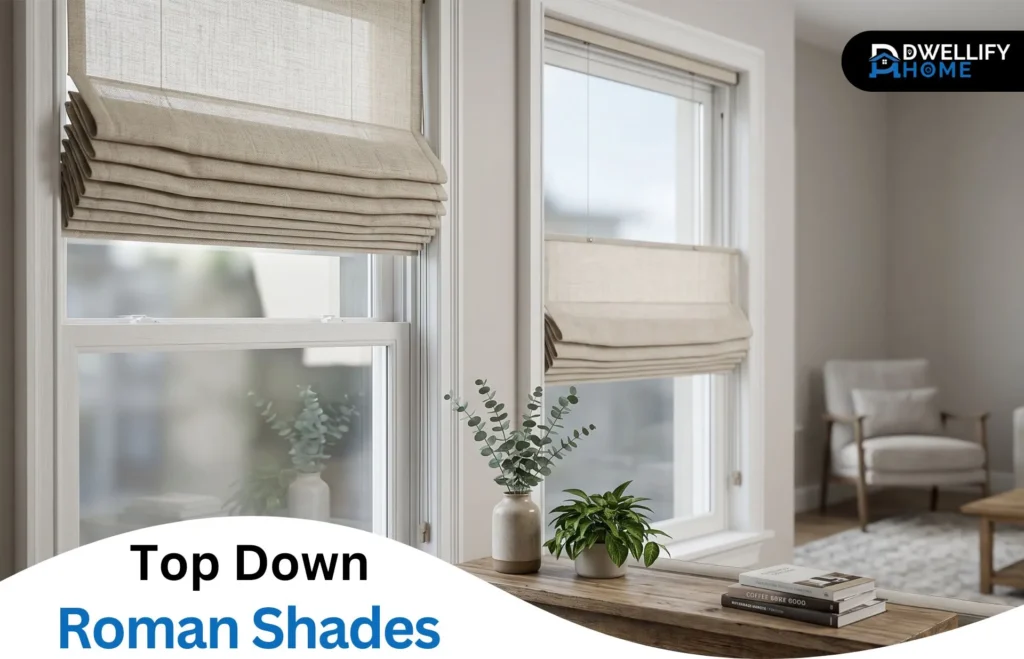
Most window treatments give you one choice — pull them up or leave them down. Top down roman shades break that rule, and once you’ve lived with a set, it’s hard to go back. They let you lower the shade from the top while keeping the bottom closed, so you get soft daylight streaming in without anyone on the sidewalk watching you fold laundry. That single detail changes how a room feels, especially on a ground floor or a window that faces the neighbors.
This guide walks you through everything that actually matters — how they work, the styles worth knowing, the fabrics that hold up, and the small decisions that make the difference between shades you love and shades you regret.
The Short Answer
Top down roman shades are fabric window treatments with a dual-rail system that lowers from the top while the bottom stays closed, giving you natural daylight and privacy at the same time.
Mission Statement
At Dwellify Home, we help homeowners make practical, stylish, and informed décor decisions. Our guides are built on real-world experience, not trends, so you can shape a home that feels right to live in and holds up over time.
Quick Decision Guide
| Your Priority | Best Choice |
| Modern look with patterned fabric | Flat fold |
| Soft, layered, traditional feel | Soft fold (hobbled) |
| Casual, relaxed style | Relaxed fold |
| Full darkness for bedrooms | Blackout liner + outside mount |
| Bright rooms with privacy | Sheer or light-filtering fabric |
| Kid or pet safety | Cordless operation |
| Hard-to-reach windows | Motorized lift |
Key Benefits at a Glance
- Privacy on the bottom while daylight flows in over the top
- UV protection for furniture and flooring without full darkness
- Soft, tailored look that pairs well with drapery
- Cordless and motorized options for modern, safer homes
- Works in bedrooms, bathrooms, kitchens, and street-facing living rooms
What Are Top Down Roman Shades and How Do They Work?
A roman shade is a fabric panel that folds upward in neat pleats when you lift it. A top down version adds a second control point at the top of the panel, so the shade can drop down from the headrail while the bottom stays anchored.
Under the hood, it’s a dual-rail system. Two independent rails — one at the top, one at the bottom — move along a track with cords, a cordless mechanism, or a motor. You can lower the top rail a few inches to let in light, raise the bottom rail for a full open view, or leave both in the middle for something in between.
That flexibility is the whole point. Standard roman shades give you one adjustment. These give you a sliding window of light and privacy you can tune throughout the day.
Top Down vs. Top Down Bottom Up: Clearing the Confusion
People use these two terms like they mean the same thing, and that causes real confusion when ordering. A true “top down only” shade drops from the top and that’s it — the bottom stays fixed. A top down bottom up shade does both: drops from the top and lifts from the bottom.
In the market today, nearly everything sold as “top down roman shades” is actually the top down bottom up version. So when you shop, check the spec sheet for “TDBU” or dual-rail operation. That’s the one you probably want.
Key Benefits of Top Down Roman Shades
The biggest win is privacy without darkness. You can keep the lower half of the window covered and still pull daylight in over the top — which is exactly what you need in a bathroom, a street-facing living room, or a bedroom where the morning sun is welcome but the view of your pajamas isn’t.
A few other things they do well:
- Let you protect furniture and flooring from direct UV without blacking out the room
- Soften the look of a window far more than blinds or roller shades
- Pair beautifully with drapery for a layered, finished look
- Give kids’ rooms usable daylight without compromising privacy
They also hold their shape and folds cleanly, which keeps a window looking intentional instead of cluttered.
Popular Fold Styles to Choose From
The fold style affects how the shade looks both raised and lowered. Most people focus only on how it looks when closed, then get surprised when they see it open. Here’s what each style actually gives you.
Flat Fold
Flat fold shades lie smooth against the window when down and stack into clean, tailored pleats when raised. They’re the most modern-looking option and they show off patterned fabrics well because there’s no extra drape to distort the print. If you’ve got a bold linen or a striped weave you love, flat fold is usually the right call.
The one thing to watch for: without hidden support rods, a flat fold can look a little limp when closed. A good manufacturer builds those in automatically. A cheap one doesn’t.
Soft Fold (Hobbled)
Soft fold, sometimes called hobbled, keeps permanent cascading folds even when the shade is fully lowered. It looks richer and softer — more like drapery than a blind. These work beautifully in traditional and transitional homes, and they add visual weight to a window that might otherwise feel bare.
The trade-off is fabric. Hobbled shades use noticeably more material, which pushes the price up and makes the stack taller when raised.
Relaxed Fold
Relaxed shades have a gentle curve at the bottom — a soft “smile” rather than a straight line. They feel casual and a little unstructured, which suits kitchens, breakfast nooks, and bedrooms with a softer look. Just know that on inside-mount installs, the curved bottom can leave the window corners slightly uncovered, so they’re not the best pick if you need full light blockage.
Fabric and Opacity Options
Fabric decides almost everything about how the shade performs. Two shades in the same style can look and function completely differently based on what they’re made from.
Natural fibers like linen and cotton breathe well and give you that soft, lived-in look. Polyester blends handle moisture better and resist fading, which matters in sunny rooms. Woven wood — bamboo, reeds, grasses — adds warmth and texture but lets more light through the weave, so plan for a liner if privacy matters.
Sheer and Light-Filtering Fabrics
Sheer top down roman shades are the right pick when you want daylight more than darkness. They diffuse the light instead of blocking it, so a room stays bright but glare drops and outside views get softened. Great for dining rooms, home offices, and any space where you’re chasing that warm, glowy feel during the day.
Light-filtering fabrics sit one step heavier — they still let light through but give you more privacy after dusk.
Blackout and Room-Darkening Options
For bedrooms, media rooms, and nurseries, a blackout liner changes the game. Top down bottom up roman shades blackout versions combine the flexibility of the dual-rail system with a lining that kills incoming light almost entirely. You still get the top-down feature during the day — and full darkness when you need to sleep.
One honest note: no roman shade achieves perfect blackout on an inside mount because light always sneaks around the edges. If total darkness matters, go with an outside mount or layer a blackout liner behind drapery.
Operation Types: Corded, Cordless, and Motorized
How you raise and lower the shade matters more than most people realize until they’ve used one every day.
Corded shades are the traditional setup — one cord raises the bottom, another lowers the top. They work reliably but they’re being phased out for safety reasons, and they’re not ideal in homes with kids or pets. Cordless top down roman shades use tabs or handles on each rail and stay where you leave them. They’re cleaner-looking and safer, and for most families they’re the right default.
Motorized top down roman shades are the upgrade worth thinking about for hard-to-reach windows, large openings, or anyone with a smart home setup. Most modern systems tie into app control, schedules, and voice assistants, so your shades can rise at sunrise and close when the sun hits the west-facing windows. For a tall stairwell window or a bank of shades in a great room, motorization stops being a luxury and starts being the only practical option.
Best Rooms for Top Down Roman Shades
These shades earn their keep in specific rooms more than others. Bedrooms are the obvious winner — morning light over the top, privacy on the bottom, and a soft look that doesn’t feel industrial. Bathrooms come next, especially with a moisture-resistant fabric, because you can light the room naturally without opening up the window to the whole block.
Living rooms with ground-floor or street-facing windows benefit the most visually. You keep the view dignified from outside while pulling in afternoon sun from above. Kitchens over the sink, home offices with screen glare issues, and nurseries where you need darkness for naps but light during playtime all make strong cases too.
Where they don’t shine: rooms where you just want the window fully open or fully closed. If you’re not going to use the top-down feature, the extra cost isn’t worth it.
How to Choose the Right Top Down Roman Shades for Your Home
Most regret comes from skipping the planning stage. A quick walk through these three decisions saves a lot of second-guessing later.
Match the Fabric to the Room
Think about what each room asks of a window. A bedroom needs darkness and privacy — so lean toward heavier fabrics with a blackout or room-darkening liner. A living room wants warmth and filtered light — linen or a light-filtering polyester blend does that well. Kitchens and bathrooms need fabric that can handle humidity without warping or growing mildew, so synthetic blends usually beat natural fibers there.
Inside Mount vs. Outside Mount
Inside mount sits the shade neatly inside the window frame. It looks clean and tailored, but it needs enough depth in the frame — usually around 2 to 3 inches minimum — and it can leave small light gaps at the edges. Outside mount sits above and around the window on the wall or trim. It blocks more light, makes a window look larger, and is the safer choice if your frame is shallow or out of square.
A trick most homeowners miss: measure window depth before falling in love with a specific style. Some mechanisms need more room than you’d think.
Picking the Right Lift System
Walk through your day with each window in mind. If you’ll adjust it constantly, motorized earns its cost quickly. If you set it and forget it, cordless is plenty. For wide or heavy shades over about 60 inches, a continuous cord loop or motor is often the only way to get smooth operation — plain cordless mechanisms can struggle with the weight.
Measuring and Installation Basics
Measuring is where most ordering mistakes happen. For inside mount, measure the exact width of the window opening at the top, middle, and bottom — then use the narrowest measurement. Do the same for height. The factory will apply a small deduction (usually around a quarter inch) so the shade operates without friction.
For outside mount, add 2 to 3 inches on each side of the window and 2 to 4 inches above it. That extra coverage is what blocks side light and makes the shade look intentional.
Installation itself is straightforward on standard windows — a drill, a level, and a helper for wider shades. If you’re working with deep trim, plaster walls, or a large opening, a professional installer is usually worth the hour or two of labor.
Top Down Roman Shades vs Other Window Treatments
Compared to bottom up roman shades, the top-down version costs a bit more and has a slightly more complex mechanism — but gives you a dramatically different privacy option. If you only ever plan to raise the shade from the bottom, skip the upgrade.
Against roller shades, roman shades win on texture, warmth, and how they finish a room. Roller shades win on cost, minimalism, and cleaning. Cellular shades beat both on insulation and they stack smaller, but they don’t come close to roman shades on style. The right answer depends on whether you want the window to disappear or become part of the decor.
Pros and Cons to Weigh Before Buying
The honest picture matters more than a sales pitch.
On the positive side, you get genuine flexibility in light and privacy, a soft and tailored look that suits almost any interior, and strong performance when paired with the right liner. With motorization and smart controls, they integrate cleanly into a modern home.
The trade-offs are real too. They cost more than standard roman shades or roller shades. The fabric folds stack at the top when fully raised, which covers a portion of the glass and blocks some view. Fabric requires more care than vinyl or polyester rollers. And on very wide windows, finding a smooth operation system can take extra planning.
None of these are dealbreakers — they’re just things worth knowing before you commit.
Styling Ideas for a Modern Home
A well-chosen shade disappears into the room in the best way. A few things that consistently look sharp:
- Layering the shade under full-length drapery panels for depth and insulation
- Sticking to neutral fabrics when you’ve already got bold furniture or art
- Using a textured weave (linen, subtle herringbone) when the rest of the room is simple
- Coordinating — not matching — shades across adjoining rooms for visual continuity
- Adding a thin trim or banding on the edge for a custom tailored detail
Avoid heavy patterns on a window that already has a strong view or architectural feature. The shade should support the room, not compete with it.
Care and Maintenance Tips
Most roman shades don’t need much, but they do need something. Once a week, run a vacuum over them with a soft brush attachment — that’s what keeps dust from settling into the folds and dulling the fabric.
Spot clean small stains with a mild soap and a damp cloth, and test on a hidden corner first. Avoid soaking the fabric, because water rings on roman shades almost never come out. For silk, linen, or any delicate weave, a professional cleaner is the safer bet every couple of years.
Check the lift mechanism once a year — a cord that sticks or a motor that lags usually points to dust in the track, not a broken part.
Common Mistakes Homeowners Make
After seeing the same regrets come up again and again, a few patterns stand out.
Picking fabric based only on color, without checking how much light it actually blocks, causes more disappointment than anything else. A beautiful cream linen might look perfect in the catalog and do almost nothing at 7 a.m. in an east-facing bedroom.
Skipping the mount depth check is the next big one. Homeowners fall for a style, order it, and then realize their window frame is too shallow for the hardware. Always measure depth first.
Going too heavy on fabric for a wide window is another — thick hobbled shades on a 72-inch opening can strain even a good cordless mechanism. And finally, ignoring sun exposure: a south-facing window will fade a delicate fabric faster than most people expect, so pick UV-resistant material for those spots.
Frequently Asked Questions
Are top down roman shades worth the extra cost?
For ground-floor windows, bedrooms, and bathrooms, yes — the privacy-plus-daylight combination is hard to get any other way. For upper floors with no privacy concerns, probably not.
Can top down roman shades be fully blackout?
Close to it, with a blackout liner and an outside mount. Some light will always bleed around the edges on an inside mount, so pair with drapery if total darkness matters.
Do they work on French doors or sliding glass doors?
Yes, but use an outside mount and add hold-down brackets so the shade doesn’t swing when the door moves.
Can I operate top down roman shades without cords?
Absolutely. Cordless and motorized versions are widely available and are now the recommended default for homes with children or pets.
How long do top down roman shades typically last?
A well-made shade should run 8 to 10 years or more with normal use. Fabric tends to outlast the lift mechanism, which is usually the first thing to wear.
Are they safe for children and pets?
Cordless and motorized versions are. Avoid corded operation in any room a child or pet uses regularly.
Final Thoughts
Top down roman shades solve a problem most window treatments ignore — how to let light in without giving up privacy. Once you know the styles, fabrics, and lift systems well enough to choose deliberately, picking the right set stops feeling overwhelming and starts feeling obvious. Take the time to measure carefully, match the fabric to the room, and think through how you’ll actually use the shade day to day. Get those three things right, and you’ll end up with window treatments that quietly make every room feel better.
Disclaimer
This article is for general informational purposes only. Product features, styles, and recommendations can vary by brand and region, and individual preferences, window conditions, and home needs differ from one household to another. Always check product specifications and, where needed, consult a qualified installer before making a final decision.