Green cabinets can make a kitchen feel calm, warm, and lived-in in the best way. But here’s the thing, green is also one of the easiest colors to get wrong if you skip the planning step. I’ve seen beautiful greens turn muddy under warm bulbs, and I’ve seen dark greens look stunning in the showroom but feel heavy at home.
In this guide, I’ll walk you through how I plan green cabinetry for real kitchens, with honest tips, practical examples, and the small details that make the finished space feel high-end and easy to live with.
Snippet-ready definition:
Green kitchen cabinets are cabinets finished in green tones, from soft sage to deep forest, used to add warmth and character while pairing well with neutral countertops, simple tile, and metal hardware.
Mission statement:
Dwellify Home helps homeowners create calm, functional interiors with practical, experience-based design guidance that feels easy to follow and realistic to use in everyday life.
Quick help first: how to choose green cabinets without regrets
If you’re stuck between five shades and everything looks “kind of nice,” you’re not alone. The fastest way to get unstuck is to start with what can’t easily change: your light and your fixed finishes.
First, look at your kitchen’s natural light. A north-facing kitchen or a space blocked by nearby buildings usually needs a softer, lighter green to avoid a shadowy look. Bright south-facing kitchens can handle deeper greens beautifully, as long as the counters and backsplash keep things balanced.
Next, check your countertop, flooring, and backsplash, even if you plan to update later. Those surfaces set the tone. If your countertop has warm beige or gold movement, a cool blue-green can feel off. If your floors are very warm, a green with a gray undertone often feels more natural and grown-up.
A quick decision path that works:
- Low light kitchen: lean toward sage, muted olive, or light green cabinet tones
- High light kitchen: dark green and richer tones can look incredible
- Warm counters or floors: choose a green that has warmth or soft gray in it
- Cool gray surfaces: lean into cooler greens, but test under your lighting
- Want low risk: start with a green island or green lower cabinets only
Quick guide table (fast comparison)
| Shade option | Best in this lighting | Pairs best with | Hardware that looks great | Watch out for |
| Light green kitchen cabinets | Low light, small kitchens | White tile, light quartz, pale wood | Chrome, brushed nickel | Can feel “minty” if undertone is too yellow |
| Sage green kitchen cabinets | Almost any light level | Warm woods, creamy whites, marble-look quartz | Brass, brushed nickel, matte black | Looks dull if lighting is very warm and dim |
| Dark green kitchen cabinets | Bright kitchens or strong lighting | White quartz, light stone, warm wood accents | Brass, matte black | Can feel heavy if counters and floors are also dark |
Step-by-step mini guide (easy and clean)
- Start with what can’t change
Countertops, floors, backsplash, and your kitchen’s natural light. - Pick a shade family first
Light green, sage, or dark green. Don’t jump into paint codes yet. - Check undertones at home
Tape 2–3 samples near the countertop and view them morning and night. - Choose your “supporting cast”
One countertop look, one backsplash style, one main hardware finish. - Decide paint vs buy
Painting saves money if cabinets are solid. Buying makes sense if layout or storage must change.
Why green kitchen cabinets work and when they don’t
Green works because it behaves like a nature-based neutral. It has color, but it doesn’t shout. In homes with wood floors, black accents, or warm metals, green can connect everything and make the kitchen feel intentional instead of pieced together.
On top of that, green plays nicely with the finishes kitchens already use. White countertops, natural wood, brass, matte black, even stainless, they can all work with the right shade of green. It’s flexible, and that’s why it keeps showing up in design projects year after year.
Where it fails is usually one of three things: wrong undertone, wrong depth for the light level, or too many competing finishes. I once walked into a kitchen where the cabinets were a pretty forest green, but the lighting was very warm, and the backsplash was creamy beige. The green looked dull and slightly brown. Nothing was “bad” on its own, but together it just didn’t sing.
Choose your shade family (this is the most important decision)
Before you think about brand names or paint codes, choose the shade family that fits your space and your lifestyle. This is the step that saves you from repainting later.
Light green kitchen cabinets
Light green kitchen cabinets can feel fresh and bright, especially in smaller kitchens or spaces with limited daylight. Think mint, pistachio, or a soft celery green. The best part is they can give you color without making the room feel heavier.
In practical terms, light greens work beautifully with simple white backsplashes, light quartz countertops, and chrome or brushed nickel hardware. If you want a clean look, keep the surrounding finishes quiet and let the cabinet color do the work.
A real-life tip: light greens show grime less than pure white, but they can show scuffs if the finish is too flat. I usually steer people toward a satin finish for daily life, especially if you have kids or a busy kitchen.
Sage green kitchen cabinets
Sage green kitchen cabinets are the safest “looks custom” choice I know. They sit right in the middle, not too bold, not too pale. Sage also handles different lighting better than many greens, which is why I use it often when a client wants color but doesn’t want drama.
Sage pairs well with warm wood, creamy whites, light stone, and most neutral tiles. It can feel modern with matte black hardware, or classic with brass. That flexibility is gold when you’re not replacing every finish in the room.
If you love the idea of green kitchen cabinets ideas but you’re nervous, sage is usually the best first step. It gives you a soft, designer look without locking you into one style.
Dark green kitchen cabinets
Dark green kitchen cabinets can look stunning, especially forest green, hunter green, or deep olive. Done right, they feel rich and grounded, like a high-end kitchen you’d see in a boutique hotel.
But here’s the truth: dark green demands balance. If your kitchen is already low light, or if you have dark floors and dark counters, the room can feel heavy. When I design with dark green, I almost always bring in a lighter countertop, a light backsplash, and good lighting so the space still feels open.
One more practical note: darker cabinets hide stains well, but dust can show if the finish is very matte. It’s not a deal-breaker, just something to know if you like a spotless look.
Undertones and LRV (the pro-level step most people skip)
This is the step that separates a “pretty color” from a kitchen that feels right. Two greens can look nearly identical on a screen, but one can read fresh and the other can read murky once it’s on cabinets.
Undertone is the hidden color inside the green. A green can lean blue, yellow, or gray. Blue-leaning greens feel cooler and crisp, yellow-leaning greens feel warmer and earthy, and gray-leaning greens feel muted and calm.
A simple test I use: put your sample next to a true white sheet of paper and a warm cream towel. If the green suddenly looks icy next to cream, it likely leans blue. If it looks slightly neon next to white, it may have a stronger yellow base.
LRV, which means Light Reflectance Value, is just a way of describing how much light a color reflects. Higher LRV looks lighter, lower LRV looks deeper. In real kitchens, LRV helps you predict whether a color will make the room feel brighter or more enclosed.
My quick sample routine:
- Test two or three greens, not ten
- View samples in morning light and evening light
- Check them under your actual bulbs and under-cabinet lights
- Look at the sample from across the room, not just up close
- Tape the sample near the countertop and backsplash if possible
Best green paint colors for kitchen cabinets (popular and trusted picks)
When clients ask for green kitchen cabinets Sherwin Williams options, I usually give them a small shortlist based on the home’s light, countertop tone, and vibe. The goal isn’t to chase the “trend color,” it’s to choose a green that stays attractive in real life.
For Sherwin-Williams, muted greens and green-grays tend to behave well on cabinetry. They don’t shift wildly, and they pair nicely with both warm and cool finishes. If you want a calm, timeless feel, look in that family first.
Benjamin Moore also has excellent greens that work in kitchens, especially those that sit in the sage and olive range. In my projects, these often feel “designed” without feeling forced, especially when paired with warm wood and soft whites.
A quick way to choose a paint family:
- Want cozy and earthy: olive, warm sage, softer yellow-leaning greens
- Want modern and crisp: cooler green-grays, slightly blue-leaning greens
- Want dramatic: forest, deep olive, emerald tones with lighter counters
Color pairings that make green cabinets look expensive
If you want green cabinets to look high-end, the pairing choices matter more than the shade itself. Countertops, backsplash, and hardware are the supporting cast, and they can make the cabinet color feel intentional.
For countertops, white quartz is the easiest partner, especially with dark green kitchen cabinets. Marble-look quartz also works beautifully because it adds movement and keeps the kitchen from feeling flat. Butcher block can look amazing with sage green kitchen cabinets, as long as you keep the backsplash simple.
Backsplashes are where many kitchens get too busy. If your cabinets are green, a quiet backsplash often looks more expensive than an overly patterned one. White subway tile, zellige-style tile in a soft white, or a simple slab backsplash can all work, depending on your style.
Hardware is the jewelry, and it’s fun, but keep it consistent. Brass or gold hardware warms up sage and olive greens. Matte black gives a modern contrast. Chrome and brushed nickel feel clean and classic, especially with light green kitchen cabinets.
Easy pairing wins:
- Dark green + white quartz + brass pulls
- Sage green + warm wood counters or accents + brushed nickel
- Light green + white backsplash + chrome for a fresh look
- Green lowers + white uppers + matte black hardware for contrast
Layout and coverage choices (how much green should you use?)
You don’t have to commit to a full green kitchen to get the benefit. In fact, many of my favorite results come from using green in a focused way.
A green island is a great option when you want color but you’re cautious. It creates a focal point, and you can keep the perimeter cabinets light for an airy feel. This works especially well in open-plan homes where the kitchen flows into living space.
Two-tone kitchens are another smart move. Green lower cabinets with white uppers are popular for a reason, they look fresh and they visually lift the room. This approach is also great when ceilings are low or the room is narrow.
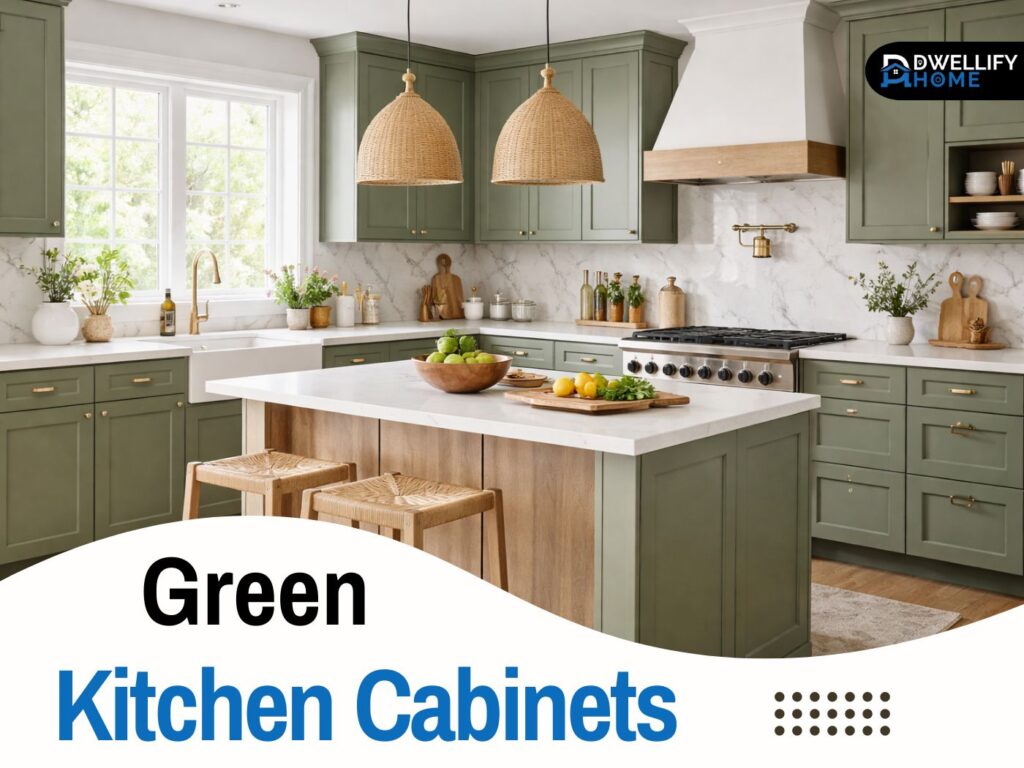
Full green cabinets can look stunning, but you’ll want to balance the room. Light counters, a light backsplash, and good lighting are the keys. If you love the full look, it can absolutely work, just plan the supporting finishes carefully.
Style playbook (pick your look, then copy the right details)
Green is flexible, but the styling details should match the overall vibe of your home. Otherwise, the kitchen can feel like it belongs in a different house.
For modern kitchens, look for cleaner door styles, simple pulls, and fewer decorative elements. A muted green-gray reads sleek, and matte black hardware usually fits naturally.
For farmhouse or rustic looks, warmer greens are your friend. Pair them with wood tones, textured tile, and warmer metals. I’ve used sage green kitchen cabinets with warm oak shelves and simple white tile, and the room instantly felt welcoming.
For Scandinavian-inspired spaces, softer greens with light counters and minimal hardware look calm and bright. And if you love a retro feel, light green kitchen cabinets in a minty shade can be charming, especially with playful details like rounded knobs or a classic checker floor.
Green kitchen cabinet recipes you can copy (fast inspiration)
Sometimes you just want a clear formula. Here are three combinations I’ve used, or helped clients build, that reliably look good.
Sage + white quartz + brass
This combo feels calm and classic. Brass adds warmth, and white counters keep it crisp. It works in both modern and traditional homes.
Dark green + warm wood + matte black
This one feels bold but grounded. The wood stops the green from feeling cold, and matte black adds a clean contrast. It’s great for kitchens with good lighting.
Light green + simple white backsplash + chrome
This feels fresh and bright. Chrome keeps it clean, and the white backsplash prevents the kitchen from looking busy. Perfect for smaller spaces.
Paint vs replace: what’s best for your budget and timeline?
If your cabinets are structurally solid, painting is often the smartest route. It’s cost-effective, and you can get a custom look with the right prep and products.
Refacing is a good middle option when the cabinet boxes are fine but the doors look dated. You get a big visual upgrade without full replacement.
Replacement makes sense when the layout doesn’t work, storage is lacking, or the cabinets are damaged. It’s the most expensive path, but it’s also the chance to fix function, not just color.
How to paint cabinets green so they look professionally done
Most “bad paint jobs” aren’t because of the color. They’re because of prep, and rushing cure time. Cabinets take more abuse than walls, so they need a tougher system.
Start with cleaning. Kitchens hold grease, and grease prevents paint from bonding. Degrease thoroughly, then scuff-sand so the primer can grip. Use a cabinet-appropriate primer, then a cabinet-grade paint or enamel designed for durability.
If you’re using a brush and roller, choose the right roller nap so the finish stays smooth. Sprayers can create a factory-like finish, but they also require good masking and patience. Either way, let the paint cure. Dry to the touch isn’t the same as fully cured.
A few pro tips that save headaches:
- Label doors and hinges so reassembly is painless
- Upgrade hinges if yours are old and squeaky
- Add felt bumpers to reduce sticking and chipping
- Don’t reinstall doors too early, give them time
Buying ready-made green cabinets (what to check before ordering)
Sometimes buying is easier, especially if you’re doing a full renovation. If you’re exploring green kitchen cabinets IKEA options, focus on system compatibility, door style, and how the finish holds up for daily cleaning. I always recommend checking samples in your lighting if that’s available, because greens shift more than people expect.
For green kitchen cabinets Lowe’s, pay attention to sizing, availability, and finish durability. Make sure the cabinet line offers the widths you actually need, and check lead times early, especially if your remodel schedule is tight.
No matter where you buy, don’t skip the basics. Check how drawers feel, whether the finish is easy to wipe, and what the warranty covers. Those details matter more than a pretty photo.
Maintenance and long-term care (keep the green looking new)
Green cabinets are easy to live with when you treat them gently. Use mild soap and water, skip harsh cleaners, and wipe spills sooner rather than later. Grease buildup near the stove is normal, but it’s easiest to manage with regular quick wipes.
For touch-ups, keep the original paint info and a small labeled container. The trick is to feather the edges lightly and touch up in good light. If the finish is very matte, touch-ups can show more, so a careful hand helps.
If you want fewer chips over time, choose good hardware and place it thoughtfully. People naturally grab corners when pulls aren’t comfortable, and that’s where paint wears fastest.
Common mistakes to avoid (the ones that hurt the final look)
The biggest mistake is choosing a green without testing it in your kitchen. Lighting changes everything. A soft sage can look perfect during the day and unexpectedly gray at night, depending on bulbs.
Another common one is going too dark in a low-light room. Dark green kitchen cabinets can be gorgeous, but they need support from light counters, reflective surfaces, and good lighting. Under-cabinet lighting can be a game changer here.
Also, don’t fight your fixed finishes. If your countertop is warm and busy, a simpler green and a calm backsplash usually look best. If your floors are orange-toned wood, cooler green can feel off unless you bridge it with warmer accents.
FAQs
Are green kitchen cabinets a good idea?
Yes, when you choose the right undertone and balance the room with counters, backsplash, and lighting. Green is forgiving day to day and can look both cozy and polished.
Are green kitchen cabinets in style in 2025?
Yes. Multiple design outlets highlighted green kitchens as a continuing trend through 2025, and 2026 trend coverage still mentions shades of green as popular choices.
What color of green is best for kitchen cabinets?
The “best” green depends on your light and fixed finishes. In most homes, sage and muted olive-green shades are the safest because they shift less and match more materials.
What color green did Joanna Gaines paint her kitchen cabinets?
She has used Cottage Grove Green from her Magnolia collection, described as a navy-green blend that can shift with the light, in her kitchen-related cabinetry spaces such as the butler’s pantry.
What countertops look best with dark green cabinets?
White quartz, marble-look surfaces, and light stones are the easiest match because they lift the room. Warm wood accents also work well to keep the space from feeling cold.
Conclusion
If you take one thing from this guide, let it be this: green cabinets look their best when you choose the shade family first, confirm undertones in your actual lighting, and then pair finishes that support the color.
A calm sage can feel like a neutral, a light green can brighten a tight space, and a deep forest green can look truly custom when it’s balanced with lighter surfaces. Keep your backsplash simple, choose hardware that matches your style, and don’t rush prep if you’re painting.
Guess what, once those pieces are in place, green doesn’t feel risky at all. It feels like the kitchen finally has a point of view, and it still works for everyday life.
Disclaimer:
This guide shares general design advice based on real-world kitchen planning. Always test paint samples in your own lighting, confirm product specs with the seller, and consult qualified pros for renovation or installation work. Brand names mentioned are examples, not endorsements.

I’m Bilal, the founder of Dwellify Home. With 6 years of practical experience in home remodeling, interior design, and décor consulting, I help people transform their spaces with simple, effective, and affordable ideas. I specialize in offering real-world tips, step-by-step guides, and product recommendations that make home improvement easier and more enjoyable. My mission is to empower homeowners and renters to create functional, beautiful spaces—one thoughtful update at a time.