Choosing a place to live sounds simple until you realize how much the building itself shapes the experience. Price and location get most of the attention during a search. The building type, its construction era, and how it’s managed? Those often get skipped entirely. That’s where most people go wrong — and why they end up regretting a lease within three months. This guide covers every major apartment building type, the unit layouts you’ll actually encounter, and the specific things worth checking before you commit to anything.
The Short Answer
An apartment building is a multi-unit residential structure where separate units are rented or owned within one shared building. It serves renters, buyers, and investors by offering varied housing options — from compact studios to spacious multi-bedroom units — under a single roof.
Dwellify Home
At Dwellify Home, our focus is simple: helping you make practical, well-informed decisions about the spaces you live in. Whether you’re choosing between building types, planning a renovation, or figuring out what actually matters before signing a lease, we aim to give you honest, experience-grounded guidance — without the noise.
What Is an Apartment Building?
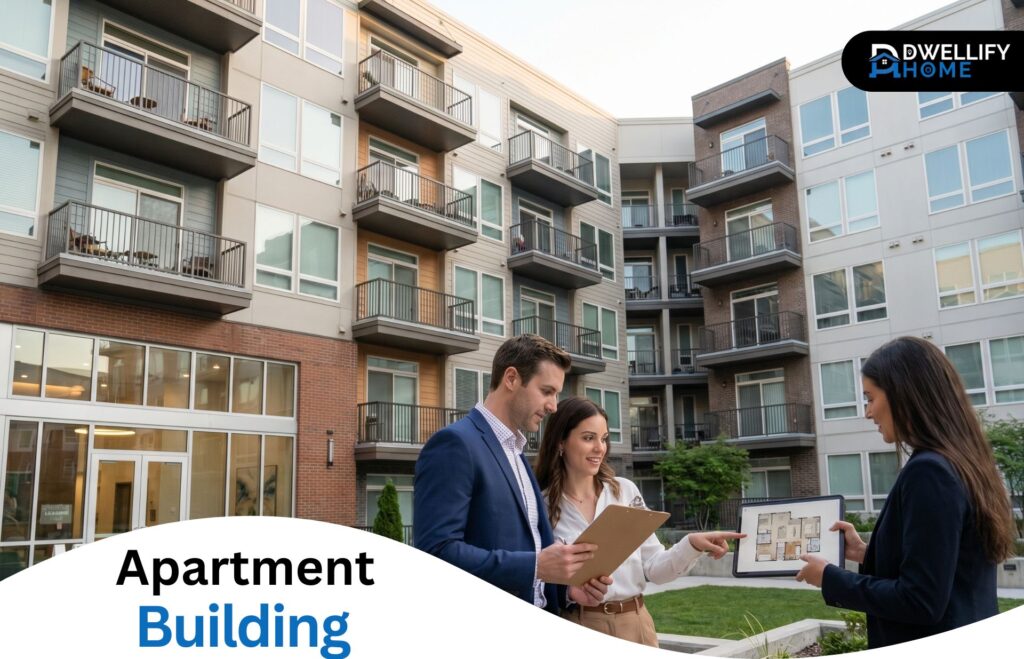
An apartment building is a multi-unit residential structure where individual units are either rented or owned separately within a single shared building. Multiple households occupy the same structure under one roof, sharing common infrastructure — entrances, hallways, stairwells, elevators, and often utility systems.
Apartment Building vs. Apartment Complex vs. Condo Building — What’s the Difference?
An apartment building is one structure containing multiple rental units, typically owned and managed by a single entity. An apartment complex is a group of multiple buildings on the same property managed as one community. A condo building looks similar from the outside but each unit inside is individually owned, with residents paying HOA fees and carrying more control over their own space.
The practical distinction matters: in a rental apartment building, one landlord sets uniform rules for every unit. In a condo building, each owner establishes their own lease terms, which creates variation in unit quality, pricing, and expectations across the same hallway.
How Many Units Does an Apartment Building Have?
Any residential structure with two or more separate units qualifies as a multifamily property. A two-unit duplex sits at one end of the range. A large urban high-rise can hold several hundred units. For zoning and investment purposes, five or more units typically pushes a building into commercial multifamily classification — a threshold that matters significantly when evaluating an apartment building for sale.
Quick Comparison: Apartment Building Types at a Glance
| Building Type | Height | Elevator | Best For | Typical Cost |
| Low-Rise | 2–4 floors | Rarely | Quiet, community-oriented living | Lower |
| Mid-Rise | 5–8 floors | Sometimes | Balance of access and scale | Moderate |
| High-Rise | 9+ floors | Always | Urban lifestyle, full amenities | Higher |
| Garden | 2–4 floors | Rarely | Outdoor access, quieter setting | Lower–Moderate |
| Walk-Up | 2–5 floors | Never | Budget-conscious renters | Lower |
| Luxury | Varies | Always | Full-service, premium finishes | Premium |
| Adaptive Reuse | Varies | Varies | Character-driven, unique layouts | Moderate–High |
Key Things to Know Before Choosing an Apartment Building
- Building type affects daily noise, community feel, amenity access, and rent — not just aesthetics
- Pre-war buildings offer character; new construction offers efficiency; both come with real trade-offs
- “Utilities included” rarely means all utilities — always confirm in writing what is actually covered
- Management quality shapes the lived experience more than any building feature or amenity
- Hidden monthly costs (parking, pet rent, amenity fees) frequently add $150–$400 beyond base rent
- Unit layout — open-concept vs. compartmentalized — should match how you actually live, not how a photo looks
- A proper walkthrough covering plumbing, electrical, insulation, and pest history takes 30 minutes and prevents significant problems
A Brief History of Apartment Buildings (And Why It Still Matters Today)
The era in which a building was constructed shapes everything you encounter inside it — the wall thickness, the ceiling height, the heating system, and the floor plan logic. Understanding a building’s history helps you anticipate what you’re actually getting into.
How Urban Growth and Transit Changed the Way We Build and Live
In cities like Washington DC, early apartment buildings weren’t placed at random. They followed streetcar lines, clustering along major thoroughfares that gave residents direct commute access to downtown workplaces. These became what historians call “apartment corridors” — dense stretches of residential buildings shaped by transit infrastructure. Many of those corridors remain the most desirable rental locations in the city today. That connection between transit access and building location hasn’t changed — it’s just expressed differently now with metro lines and bus rapid transit routes.
Pre-War, Post-War, and New Construction Apartment Buildings — What Each Era Means for You
Pre-war buildings constructed before the 1940s are known for thick plaster walls, ornate lobbies, generously sized rooms, and real architectural character — but they often come with smaller kitchens, older plumbing, and limited electrical capacity. Post-war buildings from the 1950s through the 1970s prioritize practicality: uniform layouts, thinner walls, reliable elevators, and central heating. New construction delivers modern finishes, smart home integration, and energy-efficient systems — at a noticeably higher rent and with considerably less architectural soul.
Knowing which era you’re walking into sets the right expectations. A pre-war apartment building requires different tolerance and different questions than a building completed last year.
Types of Apartment Buildings — A Clear Breakdown
Apartment buildings fall into two broad classification systems: by height and scale, and by architectural style or structural type. Understanding both categories helps you match a building to your actual lifestyle rather than just reacting to listing photos.
Low-Rise Apartment Buildings (2–4 Stories)
Low-rise buildings have two to four floors and typically no elevator. They tend to feel quieter, more intimate, and more community-oriented than larger structures. Many garden-style and walk-up buildings fall into this category. For renters who prefer knowing their neighbors and want to avoid high-density hallway traffic, low-rise buildings are consistently worth prioritizing.
Mid-Rise Apartment Buildings (5–8 Stories)
Mid-rise buildings offer a practical middle ground — more amenity access than a low-rise, without the full cost and scale of a high-rise. They may or may not have elevators depending on their age, and they appear in both urban and suburban settings. For most renters, this range represents the most common apartment building type on the market.
High-Rise Apartment Buildings (9+ Stories)
High-rise buildings are found almost exclusively in urban cores. They require at least one elevator by code, and they typically deliver rooftop amenities, concierge services, package management systems, and stronger building security. The trade-off is higher rent, more residents sharing common spaces, and a less personal community feel.
Garden Apartment Buildings
A garden apartment building is a low-rise structure built with landscape integration as a design priority. Lower-level units — sometimes partially below street grade — often have direct access to a courtyard, garden, or private patio. Natural light can be a limitation on the lowest floors depending on how the building faces neighboring structures, so confirming unit orientation is worth doing before signing.
Walk-Up Apartment Buildings
Walk-up buildings have no elevator at all. Access to every floor is by stairs only. They’re typically low-rise, often older, and usually priced lower than comparable elevator buildings. For renters on a tighter budget who are physically comfortable with stairs, a walk-up can represent genuine value. The honest caveat: think carefully about furniture moves, grocery runs, and how that calculation changes several years in.
Rowhouse-Type and Mansion-Type Apartment Buildings
These buildings carry an exterior that doesn’t match their interior reality. A rowhouse-type apartment building looks like a row of attached homes from the street but conceals multiple separate units across three to five floors with several entrances. Mansion-type buildings appear to be freestanding historic residences but internally hold five or more distinct units. Both building styles offer the kind of architectural character that purpose-built new construction rarely replicates.
Mixed-Use (Commercial-Residential) Apartment Buildings
Mixed-use buildings stack residential floors above ground-floor commercial space — a restaurant, pharmacy, or retail shop. The benefit is genuine walkability and urban convenience. The reality is additional noise and foot traffic, particularly on evenings and weekends. Before committing to a unit in a mixed-use building, spend 15 minutes standing outside at peak hours and listen. The listing won’t tell you what that Friday evening sounds like from the second floor.
Luxury Apartment Houses
Luxury apartment buildings are defined by architectural quality and service level, not just a price tag. They typically feature grand public lobbies, full-service concierge, curated building amenities, and noticeably higher-quality unit finishes throughout. Before paying the premium, compare what’s actually included against what you’ll realistically use. A lap pool and a rooftop lounge sound appealing — how often you’d genuinely access them is the relevant question.
Adaptive Reuse and Historic Apartment Buildings
Some of the most distinctive buildings available today started as something entirely different — a warehouse, a school building, a factory, or a government office converted into residential units. The appeal is real: exposed brick, original beams, high industrial ceilings, and layouts that don’t look like every other apartment. What to watch for: older infrastructure that predates modern insulation standards, inconsistent heating and cooling between units, and renovation restrictions tied to historic preservation designation.
High-Rise vs. Low-Rise Living — Which One Actually Fits You?
High-rise living offers amenities, city views, and urban convenience. Low-rise living offers quiet, community, and usually lower rent. Neither choice is inherently better — the real question is whether you value scale and access, or calm and character. Most people who’ve genuinely lived in both for extended periods will say the building type matters far less than who manages it and who lives in it.
Apartment Unit Types and Floor Plan Layouts — What You Need to Know
The building type describes the structure you’re entering. The unit type describes what you’ll actually live in day to day. These are two separate decisions, and treating them as one is one of the most consistent mistakes renters make during a search.
Studio, Efficiency, and Micro Apartments
A studio apartment combines the bedroom, living area, and kitchen into one room, with only the bathroom separated. An efficiency apartment functions similarly but always includes a kitchenette rather than a full kitchen — a smaller refrigerator, limited burners, and minimal counter space. A micro apartment is the smallest category, typically between 200 and 400 square feet total. All three work well for people who spend limited time at home and prioritize location over space, but organization becomes non-negotiable at these sizes.
Alcove and Convertible Apartments — When a Studio Isn’t Quite a Studio
An alcove studio has a recessed nook large enough for a bed, creating some visual separation from the main living area without an actual wall. A convertible apartment has a flexible space — usually off the main room — that can be divided with a bookshelf, curtain, or partition wall to function as a sleeping area or home office. Both sit between studio pricing and genuine one-bedroom function, and in competitive rental markets they represent some of the better value you can find.
One-Bedroom Apartments
A one-bedroom apartment has an enclosed bedroom with a door that closes — which changes the daily experience more than most renters anticipate until they’ve lived without one. Privacy for sleeping, the ability to separate work from rest, and a cleaner division between zones all follow from that single wall. For singles and couples, it’s the most practical and livable starting point across most markets.
Two-Bedroom and Three-Bedroom Apartments
Two-bedroom units serve roommates, small families, and remote workers who need a dedicated office space without paying for a larger unit. Three-bedroom units add flexibility but typically come at a higher price per square foot than comparable two-bedroom layouts. One thing worth confirming in any multi-bedroom unit: whether every bedroom has a window. In some older buildings, interior rooms were designed without exterior exposure.
Loft Apartments
Loft apartments are most commonly found in converted industrial buildings — warehouses, factories, and printing houses repurposed into residential use. The defining features are high ceilings, an open floor plan, oversized windows, and original structural elements like exposed brick or concrete. The trade-off is sound: without interior walls to absorb it, noise carries freely throughout the space. They suit people comfortable with creative partitioning and minimal room separation.
Duplex and Triplex Apartments
A duplex apartment spans two floors connected by an internal staircase — typically the living and kitchen area on one level, bedrooms on another. A triplex distributes the same logic across three floors. The appeal is a house-like vertical layout within a larger building. The honest consideration: internal stairs become part of every single day, and that either feels natural or slowly tiring depending on the person.
Penthouse and Floor-Through Apartments
A penthouse is the top-floor unit of a mid-rise or high-rise — larger, more private, and almost always more expensive than lower floors in the same building. A floor-through apartment occupies an entire floor, which means no shared walls on either side. Both are genuinely rare at accessible price points. If you find one worth considering, always check how the top floor handles temperature — in buildings without adequate roof insulation, upper units can run significantly hotter in summer.
Railroad Apartments — What They Are and Whether They Work for You
A railroad apartment arranges rooms in a straight line, one after another, with no central hallway connecting them. To reach the back room, you walk through every room in front of it. For one person living alone, this is manageable. For two or more people sharing the space, someone will walk through another person’s bedroom every single morning. They’re common in older urban buildings and priced accordingly — but the layout is worth thinking through honestly before signing.
Open-Concept vs. Compartmentalized Floor Plans — Pros, Cons, and How to Decide
Open-concept apartment floor plans connect the kitchen, dining area, and living space in one continuous zone. They feel larger, support social living, and work well for people who entertain or prefer visual openness at home. Compartmentalized plans separate those same spaces with walls and doors — offering more acoustic separation, clearer boundaries between rooms, and better sleep quality for households with different schedules. Neither is universally the right choice. The question to answer honestly is how you actually use your space on an ordinary Tuesday.
Apartment Building Amenities — What’s Worth Paying For and What Isn’t
The honest framing here isn’t which amenities are impressive — it’s which ones you’ll actually use. Buildings price their amenities into rent whether or not residents take advantage of them. Evaluating amenities through the lens of your realistic daily habits changes the calculus considerably.
In-Unit Features That Make a Real Difference Day-to-Day
In-unit washer and dryer access is consistently the feature renters most regret not prioritizing — the inconvenience of a shared laundry room compounds quickly over months. After that, in order of daily impact: central air conditioning you control independently, a full-sized kitchen with a working oven, adequate closet and storage space, and flooring that’s easy to clean. These aren’t upgrades. They’re the baseline that shapes your quality of life at home.
Building-Wide Amenities — When They’re Worth the Premium
A well-maintained fitness center, rooftop terrace, or coworking lounge adds genuine value when the building is managed well enough to keep them clean and accessible. A gym with broken equipment and a rooftop that’s locked in cold weather isn’t worth what it costs you in elevated rent. During your building tour, ask specifically how often amenity spaces are serviced, whether access requires advance booking, and whether any shared spaces are currently closed for maintenance or renovation.
Utilities-Included Apartment Buildings — What’s Actually Covered
In utilities-included apartment buildings, water and trash collection are the most commonly covered services. Heat is included in some buildings; electricity is included far less frequently. Internet is almost never part of a standard utilities-included package. Always request a specific written list of what the rent covers before signing — the phrase “utilities included” is applied inconsistently across listings and markets, and assumptions here can add $150 to $300 per month to your actual housing cost.
Pet-Friendly Apartment Buildings — What the Policy Really Means
A “pet-friendly” designation doesn’t mean a building accepts all pets without conditions. Most buildings with pet policies carry weight limits (commonly 25 to 50 pounds), breed-specific restrictions for dogs, and a combined structure of a one-time pet deposit plus ongoing monthly pet rent. Before submitting an application with a pet, ask for the complete written policy — including designated outdoor relief areas and any floor restrictions on pet ownership.
Building Security and Smart Access Systems
Solid apartment building security includes key fob or app-controlled entry, a functioning intercom or video doorbell system at the main entrance, secured package storage, adequate hallway and parking lighting, and some form of CCTV coverage in common areas. During your tour, test whether the entrance door closes completely behind a visitor without being held. Check whether the mailroom is accessible to non-residents. Notice whether the building’s common areas feel actively maintained or quietly neglected.
Sustainable and LEED-Certified Apartment Buildings — What It Means for Residents
LEED (Leadership in Energy and Environmental Design) certification is a third-party verified standard applied to buildings that meet measurable criteria in energy efficiency, water conservation, indoor air quality, and use of sustainable materials. For residents, LEED-certified buildings typically mean lower monthly utility costs, better ventilation and air filtration, and a reduced environmental footprint. The certification isn’t self-assigned — it requires independent assessment, which makes it a meaningful signal rather than a marketing label.
What to Check Before You Commit to an Apartment Building
The most common mistake renters make is deciding too fast. A 30-minute tour on a quiet Tuesday afternoon won’t reveal the Friday night noise level, the slow hot water, or the week-long wait for a maintenance response. Adding even a few deliberate evaluation steps changes what you walk into on move-in day.
Set a Realistic Budget First — and Understand the 30% Rule
The 30% rule holds that monthly rent should not exceed 30% of gross monthly income. It’s a reasonable starting point, but in high-cost urban markets it’s regularly stretched by necessity. A more practical calculation: add up your full monthly housing cost — base rent, parking, utilities not included in rent, pet fees, and internet — and compare that total against your actual take-home pay. That number tells you more than the gross income percentage does.
Evaluating the Neighborhood — Beyond Just the Zip Code
The neighborhood on a map and the neighborhood in practice are two different things. Visit the area at different times: a weekday morning, a weekend evening. Walk two blocks in every direction from the building entrance. Locate the nearest grocery store and time the walk honestly. Check your actual daily commute route — not just the nearest transit stop in a map screenshot — and run it at the time you’d actually be traveling.
How to Read a Lease Agreement Before You Sign
Most renters skim lease agreements and pay for it later. The sections worth reading carefully: the rent increase policy at renewal, the notice period required from both sides before vacating, early termination terms and the exact fees attached, what maintenance responsibilities fall to you versus the building, and whether subletting is permitted under any circumstances. These aren’t standard across buildings. The document you’re signing is the one that governs what happens next.
What to Check During Your Apartment Building Walkthrough
Work through this on every tour before making a decision:
- Test every light switch and electrical outlet in the unit
- Run the sink and shower — check water pressure and the time it takes to reach hot water
- Open and close every window and exterior door — note any sticking, gaps in seals, or visible damage
- Check every wall and ceiling for water stains, cracks, or uneven paint
- Open all cabinets and closets — check for moisture, mold signs, or pest activity
- Walk the common hallways, stairwells, laundry room, and building entrance — their condition reflects how the property is managed
- Check the building exterior for visible deferred maintenance
Take photos of anything that concerns you before signing.
Noise Levels, Insulation, and What Other Residents Can Tell You
Noise is one of the hardest variables to assess on a standard tour. Ask about wall and ceiling construction material — concrete and plaster absorb sound measurably better than drywall. Visit the unit on a different day and time if possible. Most importantly: if there’s any way to speak briefly with a current resident, do it. Their unfiltered account of what the building sounds like on a typical night is more useful than any listing description or leasing agent reassurance.
Natural Light and Unit Orientation — Why It Matters More Than You Think
South-facing units in the northern hemisphere receive consistent natural light through most of the day. North-facing units are often dim by early afternoon. East-facing units are bright in the morning; west-facing ones warm in the evening. Lower floors in dense urban environments are frequently shaded by adjacent buildings regardless of orientation. Tour the unit at the time of day you’d most regularly be home — not during the brief window when every apartment looks its best.
Checking Plumbing, HVAC, and Electrical During Your Visit
Turn on every faucet in the unit and flush the toilet to check water pressure and drainage. Time how long the shower takes to produce hot water. Count the number of electrical outlets in each room — too few is a daily frustration that doesn’t improve. Find out whether you control the thermostat in your unit independently or whether heating and cooling is managed centrally by the building. In older buildings, ask specifically about the heating system type — radiator heat operates on a different logic than forced-air, and it matters especially in climates with cold winters.
Pest History and Maintenance Response Time — Ask Before You Move In
Ask the landlord or property manager directly: “Has there been any pest activity in this unit or anywhere in the building in the past 12 months?” Then listen to how the answer is delivered, not just what it says. Landlords who’ve dealt with an issue honestly and professionally will tell you what it was and what was done. Evasive answers, vague reassurances, or immediate topic changes are a signal worth taking seriously. Ask the same directness about maintenance response time — how requests are submitted and what the typical turnaround looks like. A property that can’t answer that clearly will demonstrate the answer after you’ve moved in.
The Hidden Costs of Apartment Building Living Nobody Talks About
The rent figure in a listing is rarely your actual monthly housing cost. Common charges that catch renters off-guard include: monthly parking fees that can range from $75 to $300 depending on the market, separate amenity charges for gym or pool access billed outside the rent, monthly pet rent charged on top of a one-time pet deposit, package room or storage locker fees in newer buildings, elevator reservation charges on move-in day, and utility add-ons for water and trash in buildings that advertise “utilities included” for everything else. Before signing, ask for a written summary of all monthly charges associated with the unit. The honest total is what matters.
How to Recognize a Rental Scam Before It Costs You
The clearest warning signs: rent priced significantly below comparable units in the same area, a landlord who won’t arrange an in-person showing, any request for a deposit or first month’s rent before a lease has been signed and identity verified, and pressure to commit within 24 to 48 hours. Legitimate landlords with legitimate properties don’t need to rush you. Always verify the person you’re dealing with has the legal right to rent the unit before any money moves.
Building Management Quality — The Factor Most Renters Underestimate
Of everything covered in this guide, management quality has the most consistent impact on day-to-day experience — and it’s the factor that gets the least attention during a rental search.
Good management responds to maintenance requests within a reasonable timeframe, communicates proactively about building issues, applies lease policies consistently, and treats residents like adults with legitimate concerns. Poor management delays repairs without explanation, withholds security deposits on questionable grounds, goes unreachable between lease signing and move-in, and handles disputes by ignoring them.
The good news: management quality is assessable before you commit. Read Google and Yelp reviews specifically filtering for mentions of maintenance response, deposit handling, and how management communicates. Pay attention to how the leasing office responds to your questions during the application process — that responsiveness is a real preview of what comes after you sign. Buildings with high turnover relative to their size are also worth flagging.
Renting vs. Buying in an Apartment Building — Which Makes More Sense Right Now?
Renting a unit keeps your options open — you can move when circumstances change without the financial and logistical weight of a property sale. Buying a unit in the same building builds equity and offers more control over your space, but it ties capital to one location and adds HOA obligations to the equation. The right answer depends on your timeline, income stability, and how the local market is currently moving.
Condo Apartments vs. Rental Apartment Buildings — Key Differences
In a condo building, each unit is individually owned. Buyers pay HOA fees covering shared building maintenance and typically have more freedom to renovate. In a standard rental apartment building, one company or landlord owns all units and sets consistent policies across the property. Condos offer ownership and customization; rental buildings offer flexibility and fewer financial obligations beyond the monthly rent.
What to Know If You’re Looking at an Apartment Building for Sale
For investors evaluating a multifamily property, the primary metrics are: cap rate (net operating income divided by purchase price), current occupancy rate, per-unit rental income relative to market, and the deferred maintenance backlog. A building with below-market rents and strong occupancy in an appreciating neighborhood often represents a stronger opportunity than one with maximized rents and rising tenant turnover. Before any purchase, commission a full professional inspection — every unit and all shared systems.
How to Read an Apartment Building Floor Plan
Unit labels use a standard notation: 1BR/1BA indicates one bedroom and one bathroom; studio units are typically marked as 0BR. On full building plans, the variables worth examining are corridor width (affects move-in logistics and daily traffic), elevator shaft placement relative to your unit (proximity to mechanical systems creates ambient noise), and which walls are load-bearing versus partition walls. In condo units being considered for renovation, the structural wall designation determines what changes are actually possible.
How Apartment Building Design Is Changing — What to Expect in 2025 and Beyond
The most significant shifts in apartment building design right now aren’t cosmetic — they reflect how people actually live and work. Remote work has pushed developers to incorporate dedicated coworking lounges and sound-isolated work pods directly into residential buildings. EV charging stations are being built into parking structures as a baseline expectation rather than a premium feature. Biophilic design — natural materials, improved ventilation systems, indoor greenery, and better access to natural light — is being prioritized as evidence linking indoor environment quality to resident well-being accumulates. Unit footprints are trending smaller in urban markets, but storage design is becoming more intentional: built-in cabinetry, concealed Murphy beds, and modular furniture-compatible layouts are appearing consistently in new builds where raw square footage is limited.
Questions to Ask a Property Manager Before You Sign Anything
These questions surface the information no listing page will give you:
- What does the monthly rent include, and what is billed separately?
- How are maintenance requests submitted, and what is the typical response time?
- Has there been any pest activity in this unit or building in the past 12 months?
- What is the complete pet policy, including all deposits and monthly fees?
- Is subletting permitted under any lease terms?
- What is the lease renewal process, and how much advance notice is required from each side?
- Has rent in this unit increased over the past two years, and by how much?
- What is the average monthly utility cost for this unit size?
- What is the security deposit amount, and what conditions determine whether it is returned in full?
Frequently Asked Questions About Apartment Buildings
What is the difference between a low-rise and high-rise apartment building?
A low-rise apartment building has two to four floors and typically no elevator. A high-rise has nine or more stories, always includes at least one elevator, and is found almost exclusively in dense urban environments. Mid-rise buildings fall between five and eight floors. The classification affects rent level, community scale, amenity access, and the type of daily experience a building provides.
Are utilities usually included in apartment building rent?
Not consistently. Water and trash collection are the most commonly included utilities in apartment building rent. Heat is covered in some buildings; electricity is included far less often. Internet is almost never part of a standard package. Always request a written list of what the rent specifically covers before signing — the term “utilities included” is applied loosely and varies significantly between buildings and markets.
What should I check during an apartment building walkthrough?
Test all light switches and outlets. Run the sink and shower to check water pressure and hot water speed. Open every window and door. Inspect walls and ceilings for stains or cracks. Open cabinets and closets to check for moisture or pests. Walk the common areas and note their condition. Document any existing issues with photos before signing. A careful walkthrough takes 20 to 30 minutes and prevents the most common move-out disputes.
How many stories is considered a high-rise apartment building?
A residential building is generally classified as high-rise at nine or more stories, though some markets use a threshold of seven floors. Buildings under five stories are typically low-rise. High-rise buildings are required to have elevators, face stricter fire safety codes, and are almost exclusively built in dense urban cores — factors that directly affect both the cost of living there and the day-to-day experience.
What is a garden apartment building?
A garden apartment building is a low-rise residential structure — typically two to four stories — built with landscape integration as a design priority. Units on the lower levels often have direct access to a courtyard, garden, or patio area. The design emphasizes outdoor connection and a quieter residential character. Natural light on the lowest floors can be limited depending on the building’s orientation and neighboring structures.
Is renting or buying in an apartment building the better option?
Renting offers flexibility and lower upfront commitment — better suited to people whose plans or location may change within a few years. Buying a unit builds equity and allows customization but comes with HOA fees, maintenance obligations, and reduced mobility. For investment purposes, purchasing a full apartment building for sale offers rental income potential but requires substantial capital, thorough due diligence, and ongoing management commitment.
What does a LEED-certified apartment building mean for residents?
LEED certification confirms the building was independently verified to meet sustainability benchmarks — energy-efficient systems, improved indoor air quality, water-saving fixtures, and responsible use of building materials. For residents, this typically means lower monthly utility costs, better air circulation and filtration inside the building, and a smaller environmental footprint. The certification is granted by an independent body, making it a verifiable standard rather than a self-applied label.
Conclusion
The right apartment building isn’t the one with the most impressive lobby photos — it’s the one that fits how you actually live, serves your real priorities, and is backed by management that takes its responsibilities seriously. Take the time to evaluate carefully. Understanding building types, unit layouts, what amenities genuinely matter, and what to inspect before committing are the same factors that make the difference between a place you settle into comfortably and one you’re counting the months to leave.
Disclaimer
The content on Dwellify Home is provided for general informational purposes only. While we aim to keep all information accurate and up to date, individual circumstances, local markets, and personal preferences vary. Nothing on this site should be taken as professional legal, financial, or real estate advice. We recommend consulting qualified professionals for decisions specific to your situation.