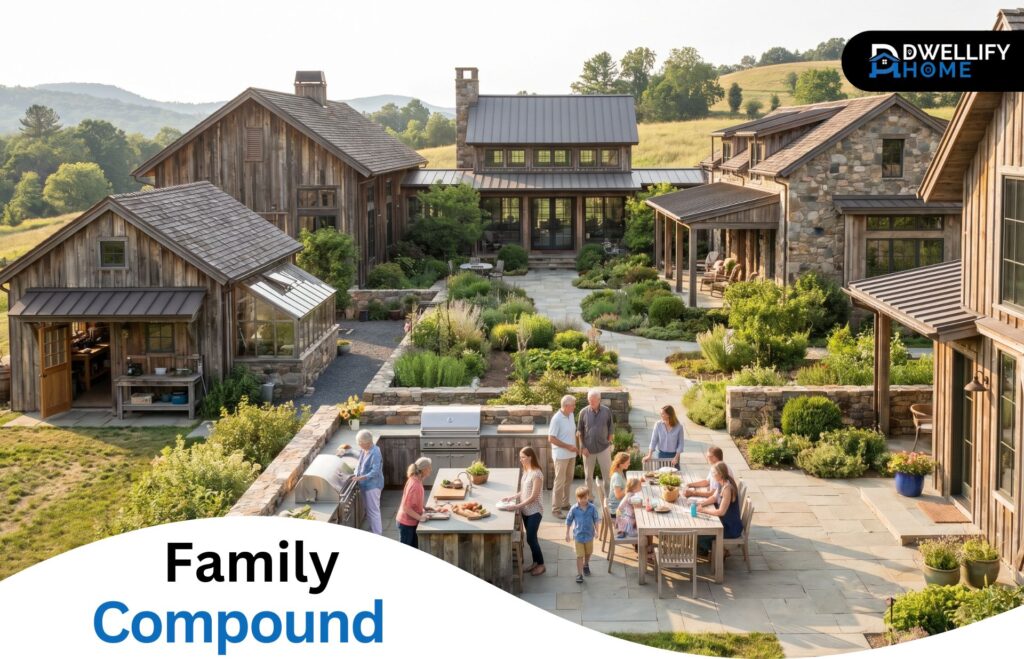
Building a family compound is one of the most deliberate property decisions a family can make. It is not an impulse buy or a trend you follow because someone on social media made it look effortless. The families who do it well spend months, sometimes years, planning every detail before a single permit gets filed.
This guide covers everything that planning actually involves. From understanding what a family compound really is, to choosing land, navigating zoning, structuring ownership legally, and designing spaces people genuinely want to live in. Whether you are just starting to explore the idea or you are already comparing properties, this is the honest, practical breakdown you need.
The Short Answer
A family compound is a private multi-home property where two or more related households each live in a separate dwelling on shared land. Families choose it to balance close proximity with genuine independence while sharing costs and caring for multiple generations.
Mission Statement
At Dwellify Home, we help homeowners make practical, well-informed decisions about their living spaces — from everyday home improvements to larger property choices. Our goal is to give you clear, honest guidance that reflects how real homes actually work, not just how they look in photos.
What Is a Family Compound, Really?
A family compound is a private multi-home property where two or more related households live on the same parcel of land, each in a separate dwelling, with shared outdoor space and often shared infrastructure. It is not a single house divided between relatives. Every household has its own front door, its own living space, and its own daily rhythm.
More Than Just Living Close — Here’s What Makes It a True Compound
The defining feature of a family compound is independent living within a shared property framework. Each unit functions as a complete home. What ties the compound together is the land, the shared amenities, and the legal structure underneath it all.
A true compound is planned. It has deliberate design decisions about where the homes sit relative to each other, how much visual and acoustic privacy each household gets, and how communal spaces are laid out. Families who skip that planning and simply build two houses next to each other often end up with conflict, not community.
Family Compound vs. ADU vs. Multi-Family Home — Key Differences Explained
These three arrangements are frequently confused, and the distinction matters practically and legally.
- A family compound typically involves multiple full-sized homes on one larger parcel, each with complete living amenities and meaningful separation between households.
- An accessory dwelling unit (ADU), sometimes called a granny flat or in-law suite, is a secondary dwelling added to an existing residential property. It is smaller by design and usually meant for one or two people.
- A multi-family home such as a duplex or triplex puts multiple households under one roof or in one building. Privacy is more limited, and the structure is treated differently under zoning and financing rules.
On a compound, the separation between homes is intentional and meaningful. That physical and psychological distance is a big part of why compound living works for so many extended families.
Who Is a Family Compound Actually Right For?
A compound works best for families where multiple generations genuinely want proximity but not constant togetherness. Parents who want their adult children nearby without sharing a kitchen. Siblings who want their kids growing up around each other without giving up their own space. Grandparents who want to age in place close to family rather than in a facility.
It also works well when the financial case makes sense. Pooling resources for a larger property purchase, sharing infrastructure costs, and splitting expenses over time can make a compound more affordable than each household buying separately in the same area.
Quick Comparison: Family Compound vs. Similar Arrangements
| Feature | Family Compound | ADU / Granny Flat | Multi-Family Home |
| Separate full homes | Yes | Partial | No |
| Independent entrances | Yes | Usually | No |
| Shared land ownership | Yes | Yes | Yes |
| Best for | Extended family, 2+ households | 1 extra household | Investors / close-knit families |
| Zoning flexibility | Moderate–High | High (most states) | Moderate |
| Privacy level | High | Moderate | Low–Moderate |
Key Benefits of a Family Compound
- Each household keeps a fully private, independent living space
- Shared land and infrastructure costs reduce per-household expenses
- Provides a practical care structure for aging parents and young children
- Builds multi-generational family wealth within a single property asset
- Offers more space and flexibility than any single-household purchase could achieve alone
Why More Families Are Building Compounds Right Now
The shift toward compound living is not a passing trend. Several real pressures have been building for years, and more families are concluding that a shared property structure simply makes more sense than the traditional separate-homes model.
Rising Housing Costs Are Changing How Families Think About Property
In many markets, the cost of buying a standalone home has made it genuinely difficult for multiple generations to live near each other at all. When you factor in what three or four separate households would spend on individual properties in the same region, a compound often delivers more value per dollar spent, even when the upfront cost is higher.
Shared land acquisition, split infrastructure costs, and the ability to build in phases all help make the numbers work. A family that pools resources can often access better land and better locations than any one household could manage on their own.
The Multi-Generational Factor: Aging Parents, Adult Children, and the Middle Generation
The middle generation, typically people in their 40s and 50s, often carries the most pressure. They are managing their own household, raising children, and increasingly responsible for aging parents who can no longer fully manage alone.
A compound does not eliminate that pressure, but it changes the logistics entirely. When a grandparent is a two-minute walk away instead of a forty-minute drive, daily caregiving becomes sustainable rather than exhausting. Adult children have easy access to support. Grandchildren grow up with extended family genuinely present in their lives, not just at holidays.
What Real Families Say After Making the Move
The consistent theme among families who have done this well is that they underestimated the importance of the planning phase and overestimated how smoothly things would run without clear boundaries.
Families who put real work into the governance side, who talked through expectations before anyone moved in, who set clear rules about shared spaces and private time, consistently report that compound living exceeded what they hoped for. Families who skipped those conversations often found that proximity amplified existing tensions rather than resolved them.
The Real Benefits of a Family Compound (Beyond Staying Close)
Shared Costs, Bigger Property — The Financial Case
When multiple households share the cost of land, infrastructure, and ongoing maintenance, each family unit typically gets access to more property than they could afford independently. A shared driveway, a shared well or septic system, and split utility infrastructure all reduce per-household costs over time.
This is especially relevant for rural land purchases, where infrastructure development is often the biggest cost driver. Spreading that cost across three or four households makes projects financially viable that would otherwise be out of reach for any single family.
A Built-In Care Network for Kids and Aging Parents
Child care costs and elder care costs are two of the largest financial pressures modern families face. A compound does not eliminate either, but it changes the structure significantly.
When grandparents are nearby, informal child care becomes possible in ways it simply is not when the nearest family member lives across town. Similarly, aging parents who need daily check-ins, help with groceries, or assistance after a medical event can receive that care from family without requiring professional services for every need.
The Privacy That a Standard Multi-Gen Home Simply Can’t Offer
Sharing a house with extended family, even in the most thoughtfully designed multi-generational home, means sharing walls, noise, schedules, and kitchen routines. That works for some families and creates friction for many others.
On a compound, each household has genuine separation. Different front doors, different sight lines, different daily rhythms. The communal areas exist when you want them. The private space is reliably private. That distinction is why compound living tends to be more sustainable long-term than in-home multi-generational arrangements.
Long-Term Wealth Building and Property Value
A well-planned compound on quality land tends to appreciate meaningfully over time. Multiple dwelling units on a single parcel add value beyond the raw land price. For families thinking about generational wealth transfer, a compound held in a family trust or structured LLC provides a mechanism for keeping the asset in the family across generations without the complications of standard inheritance.
Types of Family Compound Layouts — And How to Choose the Right One
Family compound layouts generally fall into a few core configurations: a main house with one or more accessory dwellings, multiple fully separate homes on a single parcel, or a clustered arrangement of smaller structures around shared amenity spaces. The right choice depends on lot size, budget, privacy needs, and how much communal interaction the family actually wants day to day.
Main House + ADU or Guest Cottage (Best for Smaller Lots)
This is the most accessible entry point for compound living. A primary home exists on the property, and one or more accessory dwelling units are added, either attached or detached. This works well on properties of one to three acres and in areas where full subdivision is not permitted.
The tradeoff is scale. ADUs are limited in size by local regulations in most jurisdictions, which means this configuration works best for one additional household, such as an aging parent or a young adult child, rather than multiple independent families.
Multiple Separate Homes on One Parcel — The Classic Setup
This is what most people picture when they think of a family compound. Two, three, or more full-sized homes sit on a single large parcel, each with its own footprint, yard space, and complete living amenities. The land is shared but not subdivided.
This configuration offers the best balance of independence and proximity. Each family unit has a real home, not a secondary structure. The shared land creates a natural buffer between households, and communal spaces can be positioned centrally or at the perimeter depending on the family’s preferences.
Clustered vs. Spread Layout: Choosing Between Privacy and Community Feel
On a clustered layout, homes are positioned close together, often facing a central shared space such as a courtyard, garden, or gathering area. This maximizes the community feel and makes spontaneous interaction easy.
A spread layout positions homes with more distance between them, maximizing visual and acoustic privacy while still keeping everyone on the same land. Families where privacy is the top priority tend to prefer this. Families who want the compound to feel like a small village tend to prefer clustering.
The honest answer is that most compounds end up somewhere in between, with homes close enough for easy connection but with enough visual separation that no household feels like they are being watched from their neighbor’s window.
3-Home, 4-Home, and Larger Compound Configurations — What Works at Each Scale
A three-home compound is the most common starting point. It is manageable from a governance perspective, infrastructure costs are shared meaningfully across three households, and the social dynamics are straightforward.
Four and five-home compounds introduce more complexity. Decision-making requires more deliberate structure. Infrastructure like shared driveways, septic systems, and utilities needs to be sized appropriately from the start. Governance agreements become more important, not less.
Compounds larger than five homes start to look more like intentional communities than family estates, and they carry different legal, financial, and social dynamics that require specialist guidance.
Real Family Compound Layout Examples and What They Look Like
A practical three-home layout on five acres might position the main house near the entrance, with two additional homes set further back and angled slightly away from each other to reduce sightlines. A shared outdoor kitchen or fire pit sits between them, accessible from all three homes without any household having to walk through another’s yard.
A four-home layout on twelve acres might spread homes across different elevation points on the land, using natural terrain to create visual separation. Shared infrastructure runs along a central corridor, and a larger communal space with a pool or garden occupies the geographic center of the property.
How Much Does It Cost to Build a Family Compound?
The cost to build a family compound typically ranges from $300,000 to well over $2 million, depending on location, number of homes, land cost, and infrastructure needs. Modest rural compounds with two or three smaller homes can come in at the lower end. Well-appointed compounds with multiple full-sized homes in desirable areas easily exceed $1.5 million in total development cost.
The Honest Cost Range — And Why It Varies So Much
The spread in cost comes down to four main variables: where the land is, how many homes you are building, what the homes are built to, and how much infrastructure the land requires. Two of those variables are entirely within your control. The other two are not.
Location is the single biggest cost driver most families underestimate. Rural land in the Midwest costs a fraction of comparable acreage in the Pacific Northwest or the Northeast. Building costs vary similarly by region. A three-home compound that costs $600,000 to develop in one state might cost $1.4 million in another for virtually identical square footage.
Land Is Your Biggest Variable: What to Expect
Raw land for a family compound typically runs between $50,000 and $500,000 or more depending on location, acreage, and whether utilities are already accessible. Rural land is dramatically cheaper but often requires more infrastructure investment. Suburban or semi-rural land with existing utility access is more expensive upfront but reduces development cost.
Construction Costs Per Dwelling Unit
Standard construction costs in most US markets currently run between $150 and $350 per square foot for residential builds, with significant variation by region, finish level, and building method. A modular or prefab approach can reduce costs by 20 to 30 percent compared to traditional stick-frame construction, which is why many families building compounds use modular homes for secondary dwellings.
Infrastructure Costs Most Families Forget (Roads, Utilities, Septic, Power)
This is the category that most surprises first-time compound builders. A private road to access multiple homes, a shared septic system sized for multiple households, electrical infrastructure, and water access can add $100,000 to $400,000 to a project before a single home is built.
These costs are not optional. They are the foundation that everything else runs on, and getting professional estimates before you commit to land is essential. An attractive piece of land with poor infrastructure access can quickly become an expensive mistake.
Building in Phases: How to Keep Costs Manageable Over Time
Most successful compounds are not built all at once. A common approach is to build the first home and core infrastructure in phase one, add a second home two to four years later, and continue from there. This spreads cost across time, reduces financing pressure, and gives the family time to learn what actually works on the property before committing to every design decision upfront.
Can You Start a Family Compound With Little or No Money?
Starting a family compound with minimal capital is genuinely possible, though it requires creativity and patience. The most practical approach is to start with land that already has one livable home, use the existing dwelling while building equity, and add additional units incrementally using a combination of construction loans, shared family investment, and phased development.
Some families start with manufactured or modular homes specifically because the upfront cost is lower. Others begin with an RV or temporary structure on land they own while they plan the permanent build. The key constraint is not just money but local zoning, which in many rural areas is flexible enough to allow exactly this kind of incremental approach.
How to Find the Right Land for Your Family Compound
Finding the right land starts with understanding what the compound actually needs, not just what looks appealing on a listing site. Acreage, zoning, utility access, soil conditions, road infrastructure, and proximity to services all matter more than scenery when you are building a place people will live in permanently.
How Many Acres Do You Actually Need?
A practical rule of thumb is one to three acres per household for a well-functioning compound. A three-home compound generally needs a minimum of three to five acres to give each household meaningful space and privacy. More acreage is rarely a disadvantage if the budget supports it, but you do not need fifty acres to build a functional compound.
What matters more than raw acreage is the usable land within the parcel. Steep slopes, wetlands, floodplains, and heavily forested areas all reduce what is practically buildable. Always look at topographic maps and soil surveys alongside standard listing information.
Rural vs. Suburban Land — What Each Really Offers
Rural land gives you more acreage for less money, more flexibility with zoning, and more distance from neighbors. The tradeoffs are longer commutes to services, more infrastructure investment required, and in some cases, limited broadband access that has become a real practical issue for remote-working households.
Suburban or semi-rural land near small towns gives you better infrastructure access and easier daily logistics. The tradeoffs are higher land cost, stricter zoning that may limit what you can build, and less privacy from surrounding properties.
How to Search for Family Compound Properties (Including Zillow and Listing Sites)
Standard residential listing sites like Zillow, Realtor.com, and Redfin are useful starting points but were not designed for compound searches. Searching for terms like family compound homes for sale, multi-home properties, or land with multiple dwellings will surface relevant listings, but you will need to filter carefully.
More productive approaches include working with rural real estate agents who specialize in land and multi-structure properties, checking land-specific sites like LandWatch and Land and Farm, and reaching out to county planning departments who sometimes know of off-market properties that suit this use.
Red Flags to Watch for Before You Commit to a Property
- Zoning that only permits one dwelling per parcel with no ADU exception
- No existing road access or right-of-way to the back portion of the land
- Percolation test failures or existing septic system sized for one home only
- Flood zone designation covering a significant portion of buildable area
- Deed restrictions or HOA covenants that limit multi-home development
Any of these issues can be worked around, but each adds cost, time, and complexity. Some are dealbreakers. Know which before you make an offer.
Zoning Laws and Permits — What You Must Know Before You Build
Zoning is the single most important variable in whether a family compound is feasible on a given piece of land. It determines how many dwellings can be built, what types of structures are permitted, minimum lot size requirements, and setback rules. No other planning factor deserves more attention before you buy land.
How Zoning Classifications Affect What You Can Actually Build
Single-family residential zones, typically designated R-1 or similar, often restrict land to one primary dwelling. This is the most restrictive category and the one that eliminates a lot of otherwise appealing parcels for compound use.
Agricultural zones, rural residential zones, and estate zones tend to be far more permissive. Multiple dwellings, accessory structures, and multi-generational housing arrangements are often explicitly permitted or can be approved through a variance process.
ADUs, Lot Splits, and Conditional Use Permits — Simply Explained
An ADU pathway allows you to add a secondary dwelling to an existing single-family parcel. This is legal in most states now, though size and placement restrictions vary significantly by county and municipality.
A lot split divides a larger parcel into multiple legally separate parcels, each with its own ownership and permitted development rights. This is useful for larger compounds where individual households want to hold title to their own home and land independently.
A Conditional Use Permit (CUP) is approval granted for a specific use that is not outright permitted in the zone but is considered acceptable under defined conditions. If the zoning does not clearly permit a multi-home arrangement, a CUP is often the pathway to making it legal.
Which States and Counties Tend to Be More Compound-Friendly?
Rural counties in states like Texas, Tennessee, North Carolina, Missouri, and the Mountain West tend to have the most flexible zoning for multi-home family properties. Agricultural zoning in these areas often allows multiple dwellings for extended family by right, without special permits.
States with strong ADU legislation like California, Oregon, and Washington have made it significantly easier to add secondary dwellings to existing properties, though the rules vary by municipality and the focus is on urban infill rather than rural compound development specifically.
Why You Should Speak With a Land Planner Before Buying Anything
A land planner or rural real estate attorney who knows local zoning can tell you within a day whether a specific parcel supports the compound you are envisioning. That conversation costs very little relative to the cost of buying land that turns out to be unusable for your purpose.
Many families skip this step and regret it. Zoning research is not something you want to do after you have already fallen in love with a property and made an offer.
How to Structure Ownership Before Anyone Breaks Ground
The ownership structure is the legal backbone of the compound. Getting it right protects every family member’s investment, clarifies what happens when circumstances change, and prevents the kind of disputes that can permanently fracture family relationships. There are three main approaches, each with different implications.
Tenancy in Common (TIC) — The Most Common Starting Point
In a Tenancy in Common arrangement, multiple parties each hold a fractional interest in the same property. Each owner’s share can be proportional to their financial contribution, and each share can be passed to heirs independently. TIC is the simplest structure and the easiest to set up.
The limitation of TIC is that it does not provide liability protection and it does not automatically prevent a co-owner from selling their interest to a third party. For family compounds, this usually means adding a separate co-ownership agreement that spells out buyout rights and restrictions on transfers.
LLC vs. Family Trust — Which Gives You Better Protection?
Placing compound ownership in a Limited Liability Company (LLC) provides a layer of liability protection. If something happens on the property and a lawsuit follows, individual family members’ personal assets are shielded from the property-level liability. An LLC also provides a formal structure for making decisions and documenting agreements between members.
A family trust, particularly an irrevocable land trust, is often the preferred structure for families focused on multi-generational wealth transfer. The trust owns the property, and beneficiaries are designated according to the family’s wishes. This can significantly simplify inheritance, reduce estate taxes, and ensure the compound stays in the family across generations.
Many families use a combination: an LLC for operational and liability purposes, with the LLC interests held within a family trust for estate planning purposes. This is where a real estate attorney with estate planning experience becomes genuinely essential.
How to Handle Shared Expenses, Exits, and Inheritance
The co-ownership agreement needs to address three scenarios that make families uncomfortable to discuss but that will absolutely arise eventually: how shared expenses are split and what happens when someone does not pay, what the process is when a family member wants to leave the compound and sell their interest, and how ownership transfers to the next generation.
The families who handle these conversations before they matter are the ones who stay intact when they do matter. The families who avoid them often find that a single financial disagreement or life event unravels years of planning.
Why a Real Estate Attorney Is Non-Negotiable Here
This is not a DIY area. The legal framework for co-owned multi-home properties involves real estate law, contract law, estate planning, and potentially tax considerations that require specialist knowledge. A real estate attorney who has structured family compound or multi-party ownership agreements will ask questions and identify scenarios that most families would never think to address on their own.
The cost of proper legal setup is a small fraction of the total compound investment. The cost of not doing it properly can be the compound itself.
How to Build a Family Compound — Step by Step
Step 1 — Define the Vision and Get Everyone Genuinely Aligned
Before anything else, the people who will live on this compound need to have an honest conversation about what they actually want. How much daily interaction do they envision? Who will manage shared maintenance? How will decisions get made? What happens if someone’s circumstances change?
This is not a conversation to rush. Families who come into compound planning with assumed alignment and unspoken expectations consistently run into conflict during development and after move-in. Getting genuinely aligned upfront is the highest-value thing you can do at this stage.
Step 2 — Set a Realistic Budget and Pool Your Resources
Map out what each household can contribute to land acquisition, development, and ongoing costs. Be honest about both the total budget and the financial flexibility each household has. Build contingency into the numbers; compound projects almost always encounter unexpected costs.
Decide how shared costs will be divided and document it. Equal splits are simple but not always fair if households have different incomes or different stakes in the property. Proportional contributions tied to a formal ownership structure tend to create fewer disputes.
Step 3 — Find and Secure the Right Piece of Land
Use the vision and budget you have established to set clear land criteria. Minimum acreage, zoning requirements, distance from work and services, infrastructure access, and soil suitability are all search filters, not afterthoughts.
When you find a serious candidate, commission a zoning review, perc test, and infrastructure assessment before going under contract. These due diligence steps are not optional on a compound project.
Step 4 — Work Through Zoning, Permits, and Legal Setup
With land secured, work through the regulatory and legal layer. Engage a land planner or attorney to confirm permitted uses and identify any permits needed. Set up the ownership structure, whether TIC with a co-ownership agreement, LLC, or trust, before any money moves.
Step 5 — Design the Layout With Both Privacy and Community in Mind
Work with an architect or land planner who has experience with multi-home properties. The layout decisions made at this stage, where each home sits, how sight lines work, where shared spaces land, and how infrastructure runs, are very difficult to change later.
Step 6 — Build in Phases, Starting With What Matters Most
Unless the budget supports full simultaneous development, build the primary home and core infrastructure first. Get one household living on the property. This grounds the project in reality, surfaces practical issues early, and avoids the cash flow strain of trying to complete everything at once.
Step 7 — Establish Ground Rules and Boundaries Before Move-In
Before anyone moves in, document the rules that will govern daily compound life. Quiet hours, guest policies, shared space maintenance responsibilities, and expectations around shared outdoor areas all need to be stated clearly. These are not exciting conversations, but families who have them reliably say they are worth every minute they take.
Designing a Family Compound People Actually Want to Live In
Getting the Balance Right Between Shared Space and Private Space
The design goal is not maximum community or maximum privacy. It is the right ratio of each for the specific family using the compound. That ratio varies significantly from family to family, and the design should reflect actual preferences rather than what looks good on a floor plan.
Communal Areas That Encourage Connection Without Forcing It
The best communal spaces on a compound are ones that people gravitate toward naturally rather than spaces they feel obligated to use. An outdoor kitchen or covered dining area at a central point on the property tends to work well. A fire pit, a shared garden, or a recreational area like a pool or sports court also creates consistent points of natural gathering.
The key design principle is that communal areas should be easy to reach from every household but not so close to any individual home that their presence feels intrusive. No one wants their breakfast table overlooking the shared picnic area.
Private Retreats — Separate Entrances, Soundproofing, and Visual Boundaries
Each household needs to feel genuinely private within their own space. Separate entrances matter more than they might seem on paper. When the only way into your home is through a shared foyer or common area, privacy erodes quickly.
Visual separation between homes is equally important. Landscaping, fencing, grade changes, and strategic building orientation all contribute to the sense that each household’s outdoor space belongs to them. Acoustic separation in construction, particularly if any dwellings share a wall, should not be treated as optional.
Outdoor Areas: Gardens, Courtyards, and Shared Recreation Spaces
Outdoor spaces are often what compound residents use most and value most. A shared vegetable garden, fruit trees, or working garden gives the compound a productive communal identity that many families find deeply satisfying. Courtyards work particularly well in clustered layouts, creating a natural gathering space that feels enclosed and intentional.
Designing for the Long Game — Aging-in-Place and Universal Design
Many compounds are built with multi-generational living as a core purpose, which means designing for the full life span of the people who will live there. Homes intended for elderly residents should have no-step entries, wide doorways, single-floor living options, and accessible bathrooms from the start. Retrofitting these features later is significantly more expensive than building them in.
Universal design principles applied across all homes on the compound future-proof the property for whoever lives there across decades. It also makes the compound more valuable as real estate.
Should You Build or Buy an Existing Family Compound?
Building from scratch gives you full control over design, layout, and quality. Buying an existing compound is faster and eliminates the construction process entirely. The right choice depends on how closely you need the compound to match your specific vision, how quickly you need it to be ready, and whether the existing market has properties that genuinely fit what your family needs.
The Case for Building From Scratch — Full Control, Higher Cost
When you build, every design decision reflects your family’s actual preferences and practical needs. Layout, privacy ratios, communal space design, and infrastructure sizing are all calibrated for the specific households moving in. The tradeoff is time, complexity, and cost. A full compound build from land acquisition to occupancy typically takes two to four years.
The Case for Buying an Existing Compound — Faster, But Compromises
Existing multi-home properties eliminate the construction process and let you move in on a conventional timeline. The tradeoffs are real: the layout may not suit your family’s privacy needs, infrastructure may be sized incorrectly, and existing homes may need significant renovation.
The market for family compound homes for sale is smaller than standard residential real estate, which means options are limited and properties that meet specific criteria can be hard to find. Patience and a well-defined set of search criteria are essential.
What to Look for When Evaluating a Family Compound for Sale
- Number and size of existing dwellings versus how many households need to be accommodated
- Condition of shared infrastructure, particularly septic systems and access roads
- Zoning that supports the intended use without requiring additional permits
- Layout quality, specifically whether privacy between households is genuinely achievable
- Expansion potential if additional dwellings will be needed in the future
The Part Most Guides Skip — Making the Compound Work Long-Term
Setting Ground Rules Before You Need Them (Not After a Problem Arises)
Every compound eventually encounters friction. Someone has a guest who stays too long. Maintenance responsibilities get ignored. One household uses shared spaces in a way that bothers another. These situations are not failures of the compound concept. They are normal byproducts of people living in close proximity.
What determines whether those frictions become minor inconveniences or major conflicts is whether there is an agreed framework for addressing them. Shared living agreements that cover maintenance, guests, noise, and decision-making are not excessive formality. They are the infrastructure of a functional compound, just as essential as the septic system.
Shared Responsibilities, Shared Decisions, and Clear Boundaries
Decide before move-in who is responsible for shared maintenance tasks and how costs are split when repairs are needed. Define how major decisions about the property, such as improvements, new construction, or changes to shared spaces, will be made and by whom.
The clearer these frameworks are documented, the less likely they are to generate disagreement. Many families find it helpful to designate one person or one household as the point of contact for property management decisions, with a defined process for when full family input is required.
What Happens When a Family Member Wants to Leave
People’s circumstances change. A family member who was excited about compound living may, five years later, want to sell their interest and move elsewhere. This is not a betrayal of the family vision. It is a normal life event that the compound’s legal and governance structure needs to accommodate.
The co-ownership agreement should include a right of first refusal that gives remaining compound members the opportunity to buy out a departing member’s interest before it can be sold externally. It should also define a valuation method so that a buyout price can be determined without requiring an adversarial negotiation.
Keeping Family Relationships Intact Through Conflict and Change
The families who do compound living well are not the ones who never have disagreements. They are the ones who have built enough structure into the arrangement that disagreements can be resolved without threatening the underlying relationships.
When serious conflicts arise, a neutral third party such as a mediator familiar with shared property situations can help families work through disputes without the situation escalating to legal action. Building a relationship with a mediator before you need one is not pessimistic. It is practical.
Insurance, Financing, and Ongoing Costs to Plan For
Getting the Right Insurance for a Multi-Home Property
Standard homeowner’s insurance policies are not designed for multi-home compound arrangements. You will need coverage that accounts for multiple dwellings, shared infrastructure, and liability across a property used by multiple households.
Work with an insurance broker experienced in rural or multi-structure properties. Separate policies for each dwelling combined with an umbrella liability policy covering the full property is a common approach, but the right structure depends on how ownership is arranged.
Financing Options: Construction Loans, Land Loans, and Joint Mortgages
Land loans, which fund raw land purchases, carry higher interest rates and shorter terms than standard mortgages. Construction loans cover the build phase and typically convert to a permanent mortgage on completion. Both require more documentation and more detailed project plans than standard home loans.
When multiple households are financing jointly, the lending structure needs to align with the ownership structure. An LLC-owned compound, for example, requires commercial or investment property financing rather than residential mortgages. A real estate attorney and a lender experienced with multi-party properties should both be involved before you commit to a financing structure.
How to Split Shared Expenses Fairly and Sustainably
The most straightforward approach is a monthly shared expense fund that each household contributes to proportionally. This fund covers shared maintenance, infrastructure upkeep, insurance, property taxes on common areas, and any capital reserves for future repairs.
Making contributions automatic and tracking expenses transparently, through a shared spreadsheet or property management app, removes the awkwardness of asking family members for money and reduces the chance of contributions becoming a source of friction.
Frequently Asked Questions About Family Compounds
How many acres do you need for a family compound?
Most functional family compounds require between three and ten acres, with one to three acres per household as a practical rule of thumb. The actual acreage needed depends on how much privacy each household wants, whether the land will be used for farming or recreation, and local zoning requirements for minimum lot size per dwelling.
Is a family compound a good long-term investment?
A well-planned compound on quality land in a desirable rural or semi-rural area generally appreciates over time. Multiple dwellings on a single parcel add to property value, and the shared cost structure means each household builds equity more efficiently than they might in separate properties. The investment case is strongest when the family intends to hold the property across generations.
Can you legally build a family compound anywhere?
No. Zoning laws vary significantly by state, county, and municipality. Some jurisdictions allow multiple dwellings on a single parcel by right, while others restrict land to a single primary home with limited accessory structures. Researching zoning before purchasing land is essential. A land planner or real estate attorney can quickly determine what is and is not permitted on a specific parcel.
What’s the difference between a family compound and a co-housing community?
A family compound is privately owned and occupied exclusively by one family or a small group of related households. A co-housing community is a broader intentional living arrangement where unrelated households collectively own and manage a shared property, typically with more formal governance structures and communal living philosophy. Family compounds prioritize family cohesion and private ownership. Co-housing prioritizes community across a wider group.
How do you start a family compound with no money?
Starting with very limited capital requires a phased and creative approach. Begin with land that already has one livable structure, build equity over time, and add dwellings incrementally using construction loans and family contributions. Modular and manufactured homes significantly reduce upfront construction costs. Rural land with flexible zoning makes this kind of gradual development most practical.
How do you keep family relationships healthy on a compound?
Clear boundaries, documented agreements, and regular honest communication are the foundations. Respect for each household’s private time and space is non-negotiable. Having a defined process for raising and resolving concerns before they become entrenched grievances matters more than most families expect. The compounds that stay healthy long-term are the ones where proximity is balanced by genuine privacy and respected boundaries.
Final Thoughts
A family compound done well is not the result of enthusiasm alone. It is the result of careful, realistic planning that addresses both the practical details and the human dynamics before anything is built.
The families who make it work are the ones who had honest conversations early, put proper legal structures in place, chose land that actually supported their vision, and designed for real daily life rather than an idealized version of it. The technical steps matter. So does the foundation of trust and clear communication that holds everything together.
Done right, a family compound creates something genuinely valuable: not just a property, but a place where multiple generations of a family can live well, support each other, and build something that lasts.
Disclaimer
The content published on Dwellify Home is intended for general informational purposes only. It does not constitute legal, financial, or professional advice. Costs, zoning rules, and property regulations vary by location and change over time. Always consult qualified professionals before making property or financial decisions. Individual situations and results will vary.