Put a smoke detector inside every bedroom, outside each sleeping area, and on every level of your home, including the basement. The National Fire Protection Association (NFPA) sets that as the minimum, and it adds that larger homes may need extra alarms. Mount each alarm on the ceiling or high on a wall, keep it at least 10 feet from the stove, and connect your alarms so when one sounds, they all sound. A detector in the wrong room is a decoration; a detector in the right room is the difference between waking up and not waking up.
Smoke detector placement is the part of fire safety most homes get wrong without knowing it. Three out of five home fire deaths happen in homes with no working smoke alarms, according to the NFPA — and many of the rest happen in homes where the alarms existed but sat in the wrong place, too far from the bedrooms, or too close to the kitchen to stay working. This guide gives you the room-by-room map, the exact distances, and the spots to avoid, all from NFPA guidance.
The Short Answer: How Many Smoke Detectors Do You Need?

Count three places and you have your minimum: one alarm inside every bedroom, one outside each separate sleeping area, and one on every level, including the basement. A two-story, three-bedroom home needs at least five alarms by that count — three bedrooms, one hallway, and one more level — and a home with a finished basement or a long hallway needs more. Larger homes may require additional smoke alarms to provide minimum protection, the NFPA says, so treat its list as a floor, not a target.
The reason for the bedroom rule is simple and frightening: a closed bedroom door can cut the sound of a hallway alarm nearly in half, from 85 decibels to about 46 decibels, according to the U.S. Consumer Product Safety Commission. A sleeper behind a closed door may never hear the hallway alarm at all. That is why the alarm belongs inside the room where people sleep, not just near it. The room-by-room map below starts where you sleep and works outward, and one room on it surprises most people — the living room, where a surprising share of deadly fires start.
Smoke Detector Placement Room by Room
Caption: Smoke detector placement by room — the NFPA minimum for every home.
| Room | Where to Put It | Why It Matters |
|---|---|---|
| Every bedroom | Ceiling, near the center | Closed doors block hallway alarms |
| Hallway outside bedrooms | Ceiling in the sleeping-area hallway | Covers the escape path |
| Every level | Ceiling near the stairs | Smoke rises to the top first |
| Basement | Ceiling at the bottom of the stairs | Catches smoke before it climbs |
| Living room | Ceiling or high wall | Many deadly fires start here |
| Near the kitchen | At least 10 ft from the stove | Close enough to warn, far enough to avoid false alarms |
About 65 percent of home fire deaths are caused by fires in just three rooms — living rooms, bedrooms, and kitchens — according to the NFPA. That is why those three rooms lead the map. If you can only add one alarm this week, put it inside the bedroom of the person who sleeps with the door closed. If you are choosing which sensor goes where, our photoelectric vs ionization smoke detector guide explains which type belongs near the kitchen and which belongs in bedrooms.
Bedrooms: Inside Every Room Where Someone Sleeps
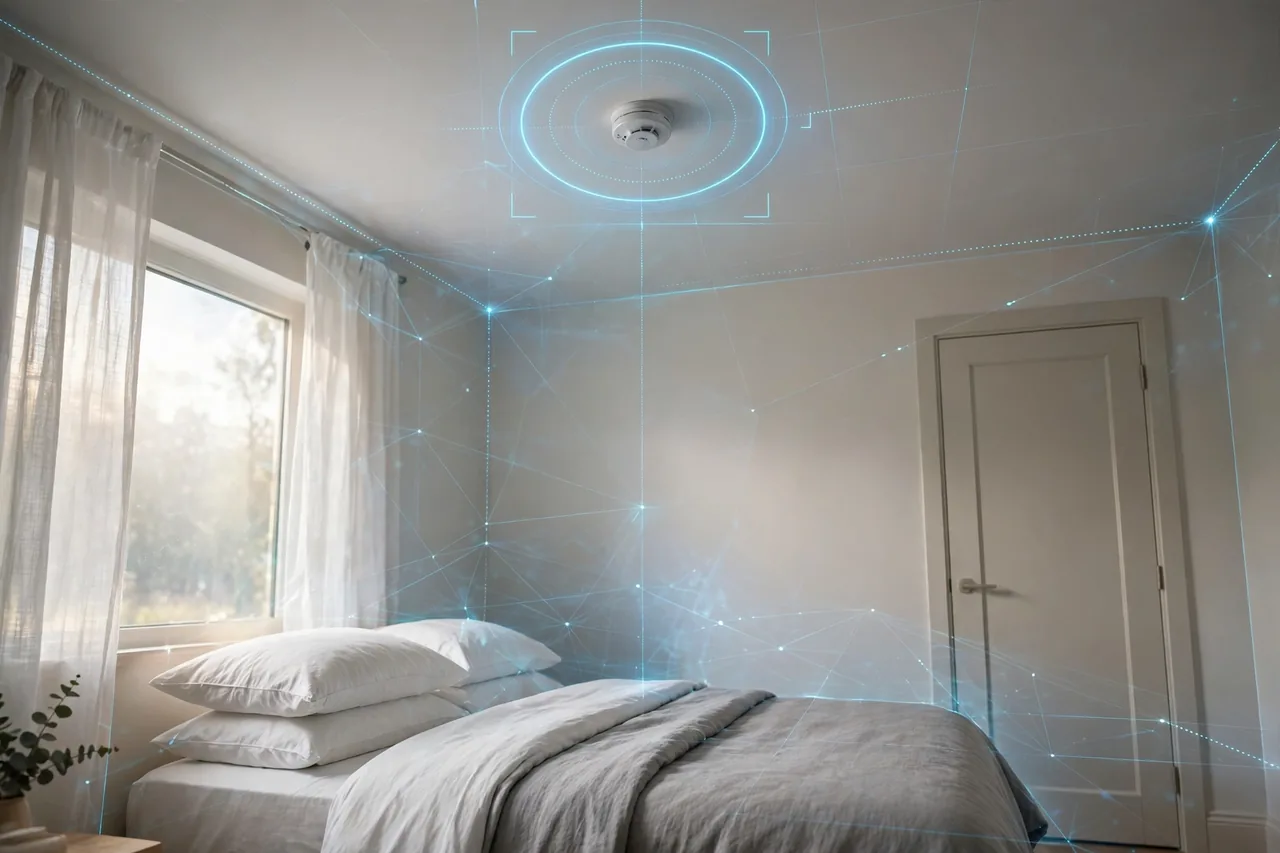
Install a smoke alarm inside every bedroom, on the ceiling near the center of the room. This is the single most important placement rule in the house, because people die in their sleep when smoke reaches them before sound does. The NFPA’s guidance is explicit: install smoke alarms in every sleeping room. If someone sleeps with the door partly or completely closed, the alarm inside the room is the only one guaranteed to wake them — the hallway alarm’s sound drops sharply through a closed door, from 85 decibels to about 46 decibels, according to the fire service guidance the IAFC publishes.
Put the alarm on the ceiling, at least 4 inches from any wall, and away from the corner where air can stall. If the bedroom has a ceiling fan or a supply vent, keep the alarm at least 3 feet from it so moving air does not push smoke away from the sensor. One alarm inside each bedroom is the rule that saves the most lives, and it is the one most homes skip. In a child’s room, mount the alarm where an adult can reach it for testing from a step stool — you will test it monthly, and an alarm you cannot reach is an alarm you will not test. Our guide to testing a smoke detector shows the thirty-second check to run on each one.
Hallways, Stairs, and Every Level
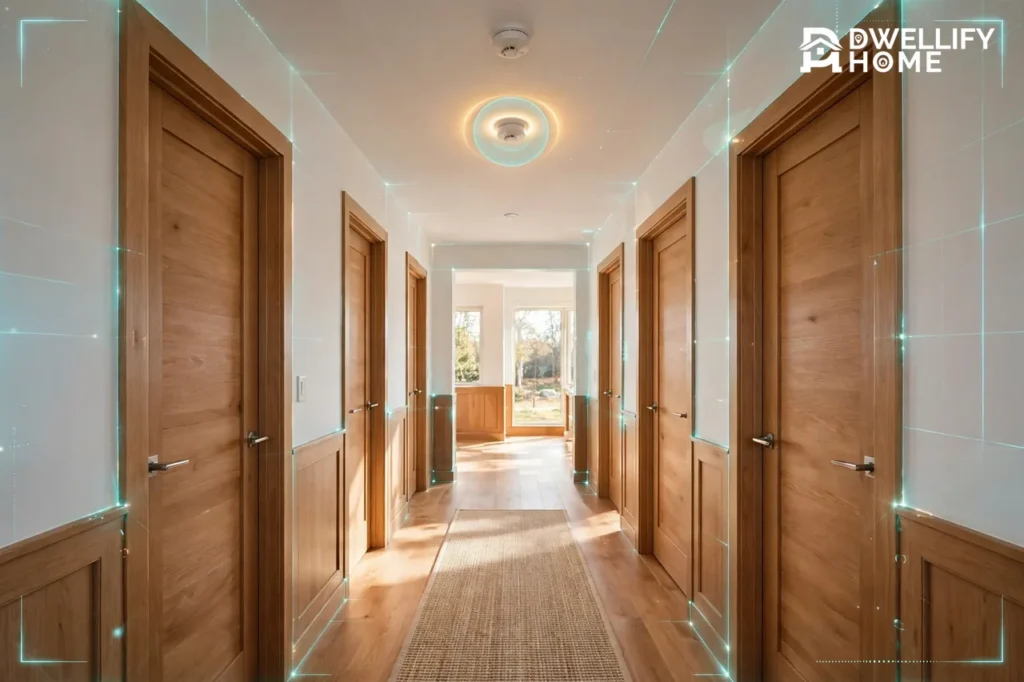
Put an alarm on the ceiling of the hallway outside the bedrooms, and put one on every level of the home, including the basement. Hallways are smoke highways: they connect the bedrooms to the exits, and smoke moves through them fast. If a hallway is longer than 30 to 40 feet, put an alarm at each end so no bedroom sits beyond the reach of a warning. On levels without bedrooms, install the alarm in the living room or near the stairway to the upper level.
At stairwells, mount the alarm at the top, because smoke rises and gathers there before it spreads to the upper floor — never mount it inside the stairwell itself, where drafts confuse it. In the basement, mount the alarm on the ceiling at the bottom of the stairs, so it catches smoke before it climbs into the living areas. Smoke rises, so the highest alarm in the house is the one that sounds first — protect the top of the stairs and the bottom of the basement stairs. For the full picture of what to do when an alarm sounds, read our fire escape plan guide and make sure every bedroom has two ways out.
Ceiling or Wall: The Exact Mounting Rules
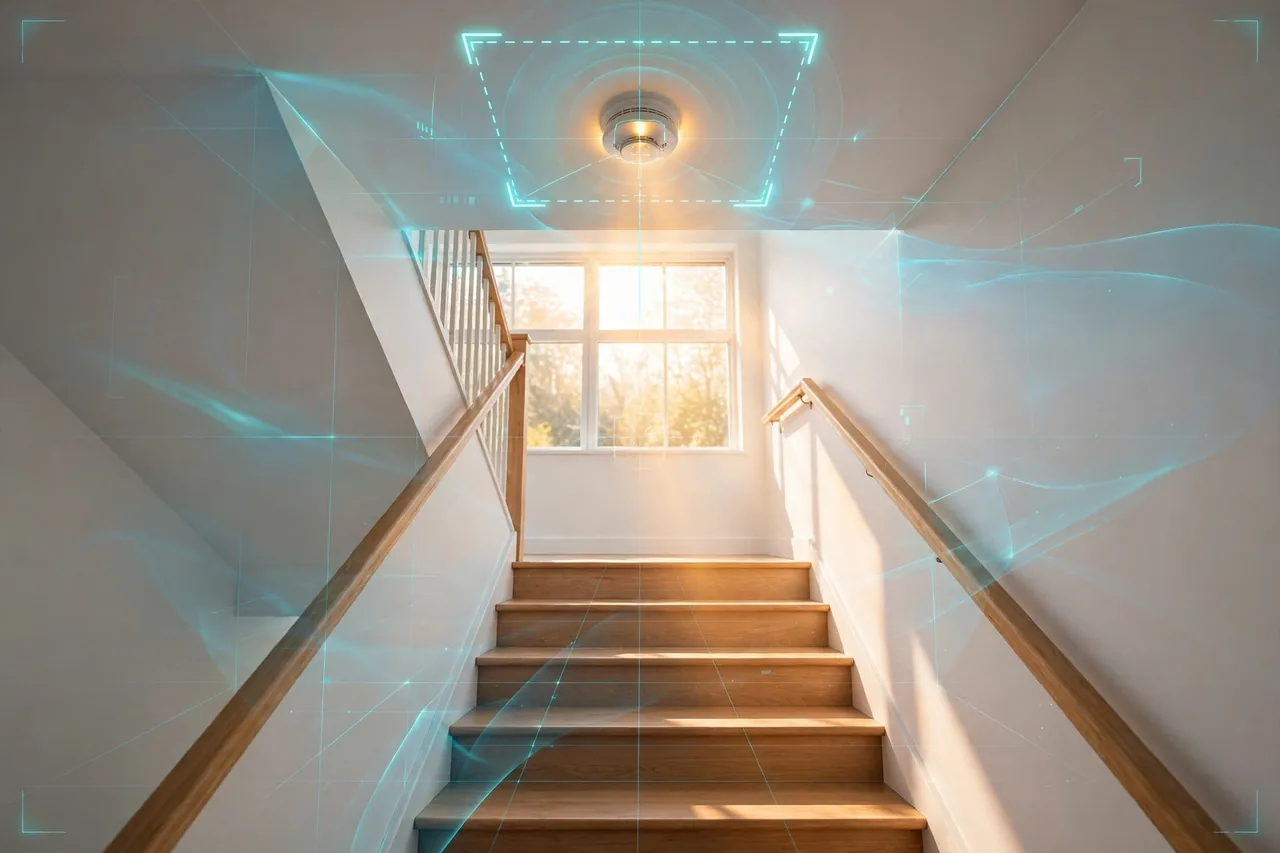
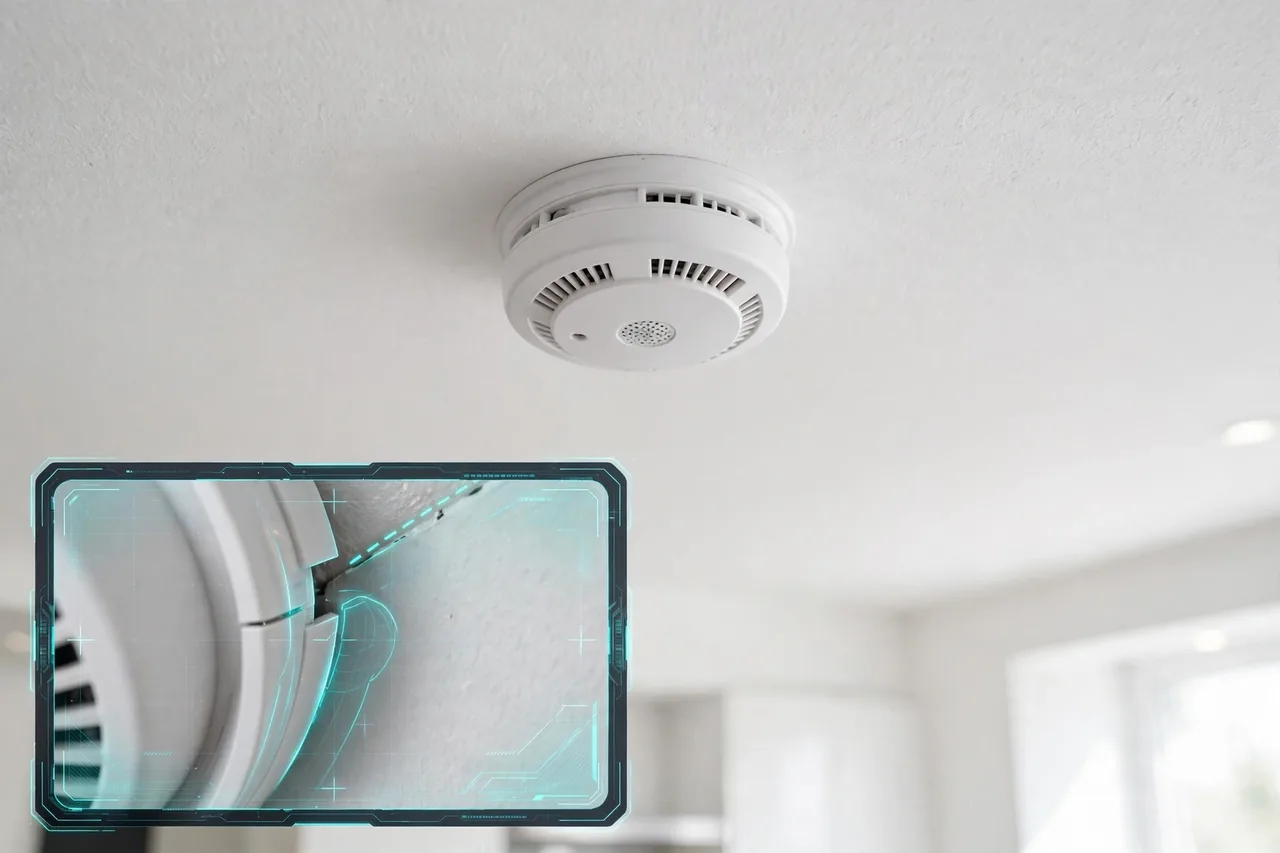
Ceiling mounting is always the first choice, because smoke rises. Mount the alarm on the ceiling as close to the center of the room as you can, and keep it at least 4 inches away from the wall. If wall mounting is your only option, mount it high on the wall with the top of the alarm 4 to 12 inches below the ceiling — never lower, because smoke hugs the ceiling and a low alarm may never see it.
For sloped or pitched ceilings, install the alarm within 3 feet of the highest point, but not in the very peak itself, where air stalls in a dead pocket. Keep every alarm at least 3 feet from any supply vent or ceiling fan, and away from windows, doors, and ducts where drafts can push smoke away from the sensor. Four inches from the wall on the ceiling, or 4 to 12 inches below the ceiling on a wall — those two numbers cover almost every room in the house. Do not mount an alarm in a corner or within 4 inches of where the wall meets the ceiling: that dead-air pocket is the one place smoke does not go. If your alarm keeps chirping or sounding for no reason, our guide to alarms that go off randomly covers the causes before you move it.
The Kitchen: Close Enough to Warn, Far Enough to Stay Quiet
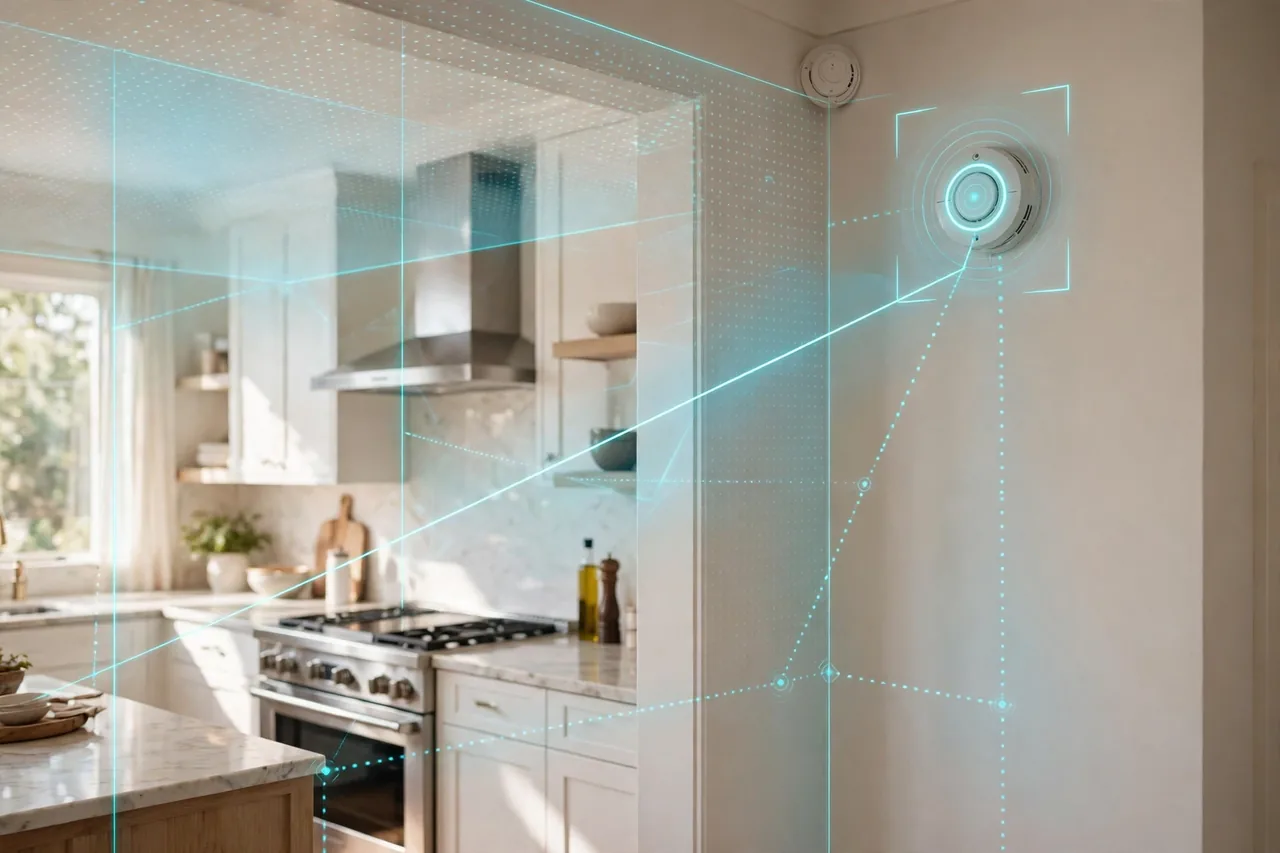
The kitchen is the trickiest room in the house. Cooking causes about 49 percent of reported home fires, according to the NFPA, yet the kitchen is also where false alarms are born. The NFPA’s rule is to install smoke alarms at least 10 feet (3 meters) from a cooking appliance to reduce false alarms — and near the kitchen, use a photoelectric alarm, which tolerates cooking smoke and steam better than an ionization alarm. The City of Lawrence fire prevention FAQs, which restate the NFPA rules, give the same answers: how many alarms, where to mount them, and when to change batteries. In a small kitchen where 10 feet is impossible, a photoelectric alarm is the right call, because it is less reactive to cooking particles.
If your kitchen flows into an open living area, put the alarm on the living-room side of the boundary, where it still watches the kitchen without sitting in the cooking smoke. Never put a smoke alarm inside the kitchen itself if you can avoid it — use the living area or hallway instead. Ten feet from the stove is the number that keeps the alarm working instead of silenced, and a silenced alarm protects nobody. The worst habit in home fire safety is pulling the battery to stop a cooking alarm, and it starts with an alarm mounted too close to the stove. If yours already goes off over toast, our guide to stopping a smoke alarm from beeping shows the fix, and our smoke alarm false alarm guide explains why it happens.
Where NOT to Put a Smoke Detector
Placement is as much about avoiding the wrong spots as finding the right ones. Do not install a smoke alarm in a bathroom or within 10 feet of one — steam sets it off again and again. Do not install one in a garage, where car exhaust and dust cause constant false alarms; use a heat detector in the garage instead. Do not install one near a window, door, or duct where drafts push smoke away, and never in a spot where the temperature drops below 40 degrees or rises above 100 degrees Fahrenheit, such as an unfinished attic.
Do not put an alarm in a dusty workshop, a laundry room full of lint, or right above a furnace or water heater — combustion particles from those appliances cause nuisance alarms, and the NFPA says to keep alarms at least 10 feet from sources of combustion particles. Every alarm in a wrong spot trains the house to ignore alarms, and an ignored alarm is as dangerous as a missing one. If an alarm in your home sounds constantly and you cannot find the cause, move it before you disable it — and read our guide to how often to check your smoke alarm so the new spot stays clean and working.
What Most People Get Wrong About Smoke Detector Placement
Most people believe one alarm in the hallway covers the bedrooms. It does not, because a closed door cuts the sound nearly in half and blocks smoke for critical minutes. The second wrong belief is that the kitchen needs an alarm right over the stove. It needs the opposite — an alarm 10 feet away, on the living-room side, so it warns about a real fire without crying wolf over dinner. The third wrong belief is that the basement does not need an alarm because nobody sleeps there. It needs one at the bottom of the stairs, because a basement fire climbs the stairwell and fills the house above before anyone smells smoke.
The fourth wrong belief is that a high ceiling means a high alarm anywhere near the peak is fine. The very peak is a dead-air pocket — mount within 3 feet of the peak, not in it. The fifth is that more alarms always means more safety. More alarms in wrong spots means more false alarms, more disabled alarms, and less safety. Right rooms, right heights, right distances — placement is a short list of numbers, and every one of them is in this guide. If your home has a monitored alarm system, our monitored fire alarm guide explains how placement changes when a monitoring center is listening.
Interconnected Alarms, Testing, and the 10-Year Rule
Interconnect your alarms so when one sounds, they all sound. The NFPA calls interconnected alarms the best protection, and model code NFPA 72 requires newly built homes to have hardwired, interconnected smoke alarms on each floor, in hallways, and inside all sleeping areas. You can interconnect with hardwired alarms installed by a qualified electrician, or with wireless alarms that listen to each other — when one sounds, the rest sound too, so a basement fire wakes the second floor.
Test every alarm at least once a month with the test button, and replace all smoke alarms when they are 10 years old — the manufacture date is printed on the back. Interconnected, tested monthly, replaced at 10 years: three habits that turn good placement into real protection. Clean each alarm once or twice a year with a soft brush or vacuum so dust does not dull the sensor, and replace batteries at least once a year or the moment an alarm chirps. The NFPA’s own fire-safety guidance states the same three rules — alarms in every sleeping room, outside each sleeping area, and on every level; interconnected for the best protection; tested monthly and replaced at 10 years. For a closer look at sensor types for each room, our photoelectric vs ionization smoke detector guide covers the choice room by room.
A Safety Note Before You Mount Anything
Smoke detector placement follows the NFPA’s guidance, but your local building code may require more alarms or different spots — check your city or county rules, especially if you are building, remodeling, or selling a home. Battery alarms are a safe do-it-yourself job, but hardwired alarms connect to your home wiring: turn off the breaker, test that the power is truly off, and hire a licensed electrician if you feel unsure. If an alarm sounds and you smell smoke or see fire, leave the house and call 911 from outside. This guide is general information, not a substitute for local code or professional advice.
Related Guides
Placement and sensor type work together, so read our photoelectric vs ionization smoke detector guide after this one. For the monthly routine, see our guide to testing a smoke detector and our guide to how often to check your smoke alarm. If an alarm misbehaves, our guide to stopping a smoke alarm from beeping, our smoke alarm false alarm guide, and our guide to alarms that go off randomly cover the fixes. For the way out, read our fire escape plan guide.
Frequently Asked Questions
How many smoke detectors do I need in my home?
The NFPA recommends smoke alarms inside every bedroom, outside each sleeping area, and on every level of the home, including the basement. A two-story, three-bedroom home needs at least five alarms, and larger homes need more, so count your bedrooms, sleeping areas, and levels before you shop.
Where should I mount my smoke detectors on the wall or on the ceiling?
Mount them on the ceiling when you can, at least 4 inches from the wall. If you mount one on a wall, put the top of the alarm 4 to 12 inches below the ceiling. Keep alarms away from drafts, vents, and corners where air stalls.
What type of smoke alarm should I install?
Install photoelectric alarms near the kitchen and bathrooms, where they cause fewer false alarms, and ionization or dual-sensor alarms in bedrooms and living areas. The NFPA recommends both types, or combination alarms, for the best protection, and look for the UL or ETL mark on the box.
How often should I change the batteries in my smoke alarm?
Change batteries at least once a year, or right away when the alarm chirps. Alarms with sealed 10-year batteries need no battery changes — replace the whole alarm when it chirps or reaches 10 years from its manufacture date.
Where should smoke detectors be installed for best protection?
Inside every bedroom, outside each sleeping area, and on every level including the basement, mounted on the ceiling or high on a wall. Keep them at least 10 feet from cooking appliances and 3 feet from vents, fans, and bathroom steam.
Should I put a smoke detector in the kitchen?
Not inside the kitchen if you can avoid it. Put the alarm in the living area or hallway at least 10 feet from the stove, and use a photoelectric alarm there. An alarm too close to the stove causes false alarms that lead people to disable it.
Walk your house tonight with this list: inside every bedroom, outside each sleeping area, every level including the basement. Every gap you find is a ten-minute fix — a screw, a test button, and a house that can wake you up.