The right type of fire extinguisher for most homes is a multipurpose dry chemical extinguisher rated A:B:C. Kidde lists dry chemical ABC units as the type that puts out ordinary combustibles, flammable liquids, and electrical fires, so one unit covers the three fires a home is most likely to face. A 5-pound 2A:10B:C unit by the kitchen exit and another in the garage covers most houses, with a Class K unit added only if you deep-fry.
A fire grows fast, and the wrong extinguisher can make it worse instead of stopping it. Water on a grease fire throws burning oil across the room, and water on a live electrical fire can shock you. That is why the letters on the label matter more than the size of the can. This guide explains the five fire classes, the six extinguisher types, and exactly which one belongs in each room of your home. One thing on this list surprises most people: the extinguisher most homes already own is the wrong one for the kitchen fire they fear most.
The Short Answer: Which Type of Fire Extinguisher Should You Buy for Home?
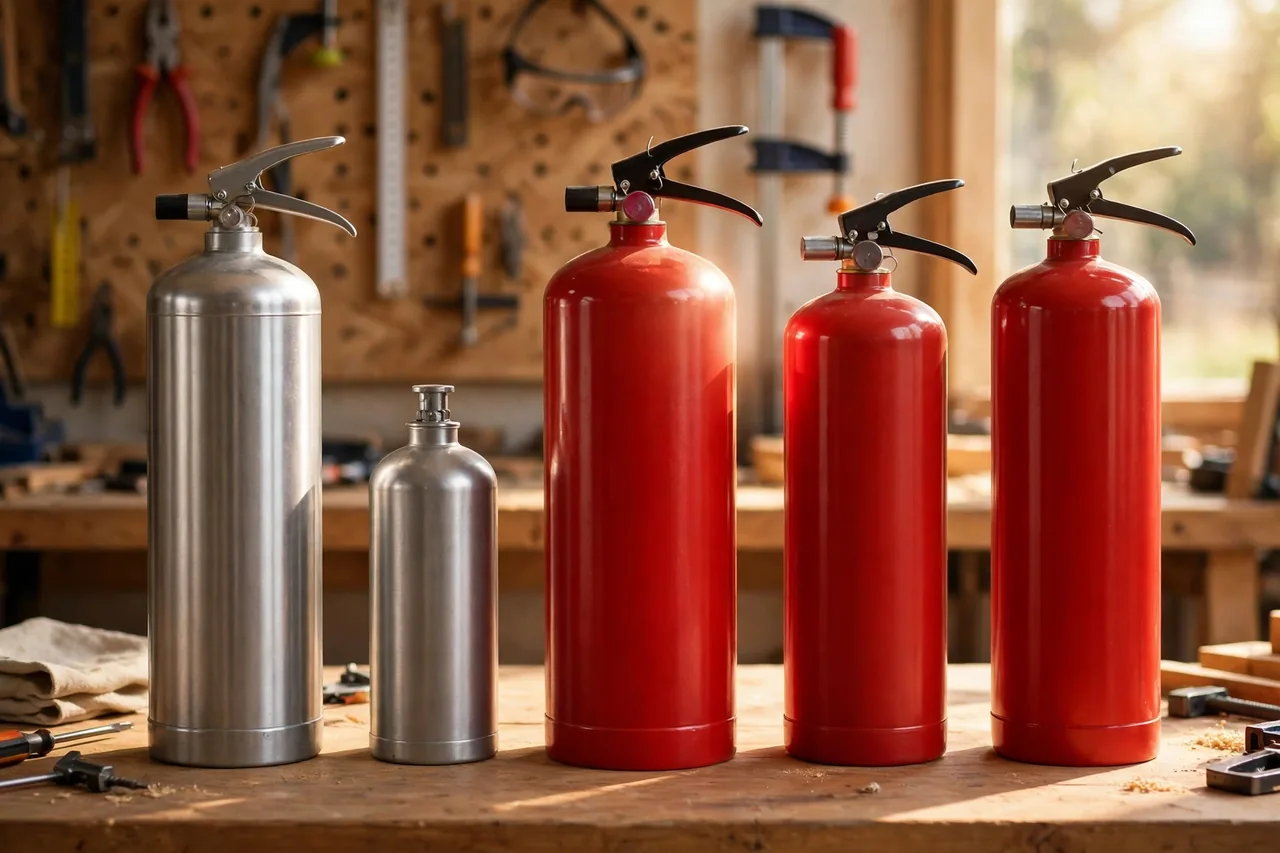
Buy a multipurpose dry chemical extinguisher rated A:B:C for your home, in a 5-pound 2A:10B:C size for the kitchen and garage. It handles wood, paper, and cloth fires, flammable-liquid fires, and live electrical fires, so you do not have to classify the fire in a panic. Add a smaller 1A:10B:C unit for the car, and a dedicated Class K wet chemical unit only if you deep-fry or cook with large amounts of oil.
That single recommendation comes from the same logic every fire-safety source repeats: in an emergency you get one decision, not five. The Boston Fire Training Academy’s drill master told This Old House that a B,C-rated extinguisher is “good for electrical” but “not good for, say, a paper fire,” and recommended the multipurpose A,B,C unit precisely so you never have to make a split-second classification while your house is burning. The A:B:C unit is the only one that covers all three common home fire classes, and it costs about the same as a single-class unit.
One warning before you shop: a dry chemical extinguisher leaves a corrosive yellow powder that damages electronics, so it is the wrong first choice beside a computer or TV. A small CO2 unit belongs there instead. The sections below show you where each type earns its place, and the kitchen section holds the surprise.
The 5 Fire Classes, Plainly Explained
Fire extinguishers are labeled by class, and each class names what is burning. Class A covers ordinary combustibles like wood, paper, cloth, rubber, and many plastics. Class B covers flammable liquids like gasoline, oil, grease, and oil-based paint. Class C covers energized electrical equipment like appliances, tools, and panels. Class D covers combustible metals like magnesium and titanium, found in factories, not homes. Class K covers cooking oils and fats in commercial and home kitchens.
Caption: The five US fire classes and what burns in each one.
| Class | What Burns | Where It Happens at Home |
|---|---|---|
| A | Wood, paper, cloth, trash, most plastics | Living room, bedroom, workshop |
| B | Gasoline, oil, grease, solvents, paint | Garage, shed, workbench |
| C | Energized electrical equipment | Kitchen appliances, outlets, panel |
| D | Combustible metals | Almost never in a home |
| K | Cooking oils and animal fats | Kitchen, deep fryer, range |
The letters on an extinguisher label tell you exactly which classes it can fight, and Kidde explains that the letters A, B, and C refer to the classes established by UL and the NFPA. A label that reads A:B:C means the unit is rated for all three. A label that reads B:C only skips ordinary combustibles, which is why it fails on a paper fire. The class system is the whole game: match the letter to the fuel, and you are safe. Match it wrong, and you can spread the fire or shock yourself. But the letters are only half the label, and the numbers in front of them decide how big a fire the unit can handle.
The 6 Types of Fire Extinguishers and How Each Works

Kidde lists six common types of fire extinguishers, and each one fights fire a different way. Dry chemical extinguishers spray a fine powder that interrupts the fire’s chemical reaction and smothers the flames. Water extinguishers cool the burning material below its ignition point. Foam extinguishers lay a film over the fuel that cuts off oxygen. Carbon dioxide (CO2) extinguishers displace oxygen with cold gas and leave no residue. Wet chemical extinguishers cool hot oil and form a soapy layer that stops re-ignition. Clean agent extinguishers, like Halotron, release a fast-evaporating liquid that interrupts the reaction and leaves nothing behind.
Caption: Six extinguisher types — how each one puts out a fire.
| Type | How It Works | Classes | Best At Home For |
|---|---|---|---|
| Dry chemical (ABC) | Powder interrupts the chemical reaction | A, B, C | Kitchen, garage, general use |
| Water | Cools the fuel | A | Wood and paper fires only |
| Foam (AFFF) | Film smothers and cools | A, B | Garage liquid fires |
| CO2 | Displaces oxygen, cools | B, C | Electronics, appliances |
| Wet chemical | Soapy layer cools oil, stops re-ignition | K (and A) | Deep fryers, serious cooking |
| Clean agent | Evaporating liquid, no residue | B, C (some A:B:C) | Computers, server gear |
For most homes the dry chemical ABC unit wins because it is the only common type rated for A, B, and C at once, and it is the cheapest and most widely available. Its weakness is the mess: the monoammonium phosphate powder is corrosive, coats everything it touches, and can ruin electronics, so clean it up right after any discharge. CO2 is the clean alternative for electrical fires, but it has a short discharge range of 3 to 10 feet and can re-ignite deep-seated Class A fires. Water is the simplest type and the most dangerous to misuse: never aim it at a liquid, grease, or electrical fire. The type you buy matters less than the type you reach for, and that is decided by where you hang it.
What Type of Fire Extinguisher for Electrical Fires?
For an electrical fire, use an ABC dry chemical extinguisher or a CO2 extinguisher, because both use non-conductive agents that will not carry current back to you. This Old House explains that Class C extinguishers are specifically for fires involving energized electrical equipment and use non-conductive agents like carbon dioxide or dry chemicals to put the fire out without risking shock. Never use a water extinguisher on an electrical fire, and never use water from a tap or a hose on one either.
The first move in an electrical fire is not the extinguisher at all: cut the power if you can do it safely, at the breaker or by unplugging the appliance. Once the power is off, the fire stops being Class C and becomes an ordinary Class A fire, which any ABC unit handles. If you cannot cut the power safely, stand back, aim an ABC or CO2 unit at the base of the flames, and keep your exit behind you.
CO2 earns its place beside the TV, the computer desk, and the home office because it leaves no residue and will not destroy the electronics it saves. The trade-off is range and cold: a CO2 horn gets freezing cold during discharge, so hold it by the handle only, and its short range means you must get closer than you would with a dry chemical unit. If you own one extinguisher for the whole house, make it ABC. If you own two, make the second one CO2 for the electronics corner. The kitchen, though, plays by different rules, and most people get it wrong.
What Type of Fire Extinguisher for Grease Fires?
For a grease fire, the right tool is a Class K wet chemical extinguisher, which sprays a fine mist of potassium compounds that cools the oil and forms a soapy foam layer that stops it from re-igniting. Class K units are the standard in commercial kitchens, and they are now sold for home kitchens too. An ABC dry chemical unit works on a small grease fire in a pinch, because it is rated for Class B flammable liquids, but it cannot cool the oil the way wet chemical does, so re-ignition is more likely.
The one rule that matters more than the extinguisher type is this: never put water on a grease fire. Water flashes to steam instantly in hot oil, throws burning oil across the room, and turns a pan fire into a room fire. A lid, a cookie sheet, or a damp towel smothers a small pan fire faster than any extinguisher, and a fire blanket does the same job with no mess. Reach for the extinguisher only when the lid does not work and the fire is still small and contained.
Here is the surprise from the intro: the ABC extinguisher most homes already own is rated for grease, but it is not the best tool for it, and the powder it sprays makes a kitchen cleanup miserable. If you deep-fry, pan-fry with large amounts of oil, or cook on a serious range, a small Class K unit by the kitchen exit is the one upgrade worth buying. It costs more than an ABC unit and handles nothing but cooking oil, which is why it is a second extinguisher, never the only one. And if the fire has already spread past the pan, no extinguisher is the right answer.
What Most People Get Wrong About Fire Extinguishers
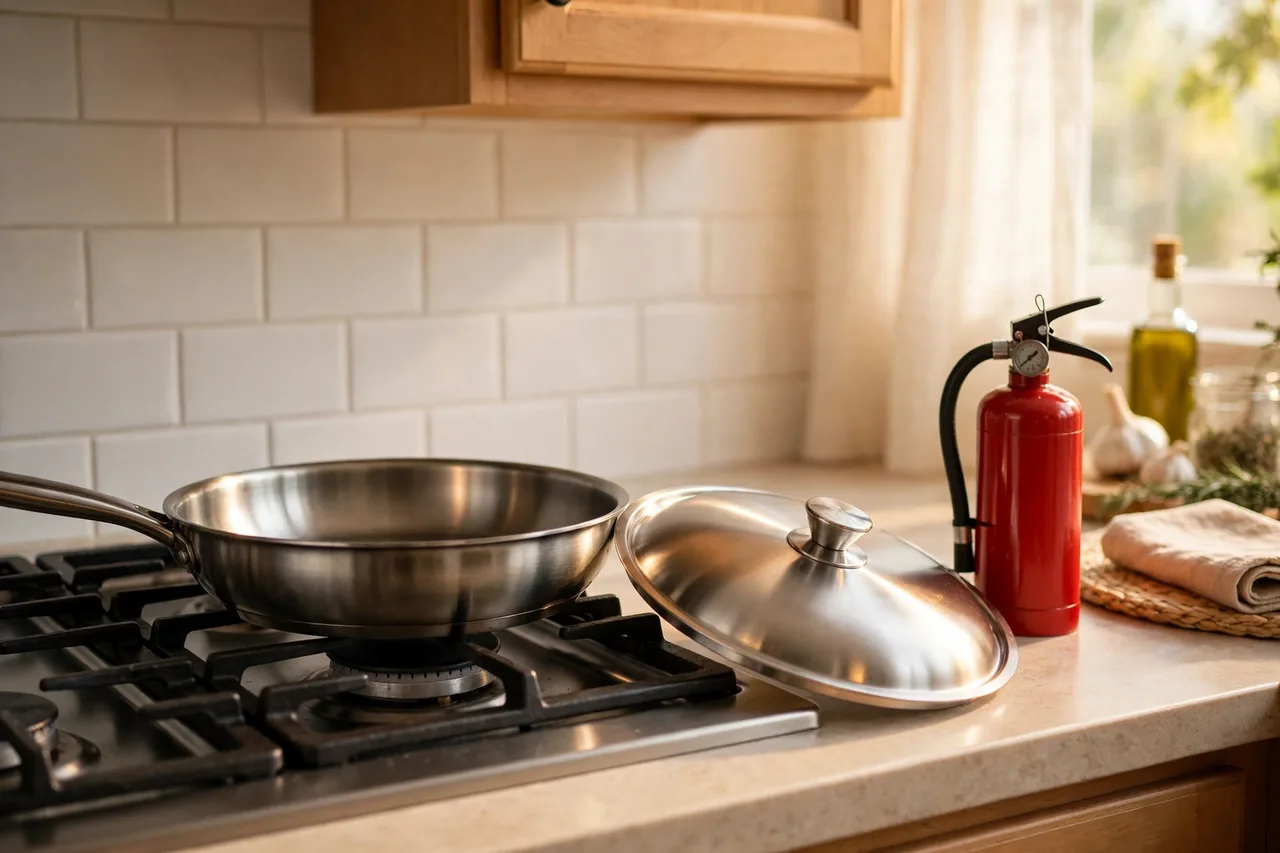
The most common mistake is buying one extinguisher and hiding it. People tuck it in a closet, behind the cleaning supplies, or on top of a high shelf, and then cannot reach it when seconds matter. An extinguisher belongs mounted on the wall by the exit of the room it protects, with its handle at a height any adult can grab without a step stool. The second mistake is never checking it: a gauge that has drifted into the red, a missing pull pin, or a cracked hose turns the unit into a paperweight, and none of those failures announce themselves.
The third mistake is treating the extinguisher as a firefighting tool instead of an escape tool. A home extinguisher is meant for a small, contained fire only — a wastebasket, a pan, a single appliance. This Old House puts it plainly: a home extinguisher is meant for small, contained fires only, and if the fire is beyond your control, get out and call 911. If smoke fills the room, if the fire blocks your exit, or if the extinguisher does not knock the fire down in seconds, leave. Your house is insured. You are not replaceable. That judgment call is the real skill, and the next section shows you how to use the tool when the fire is still small enough to fight.
How to Use a Fire Extinguisher: PASS in 4 Steps
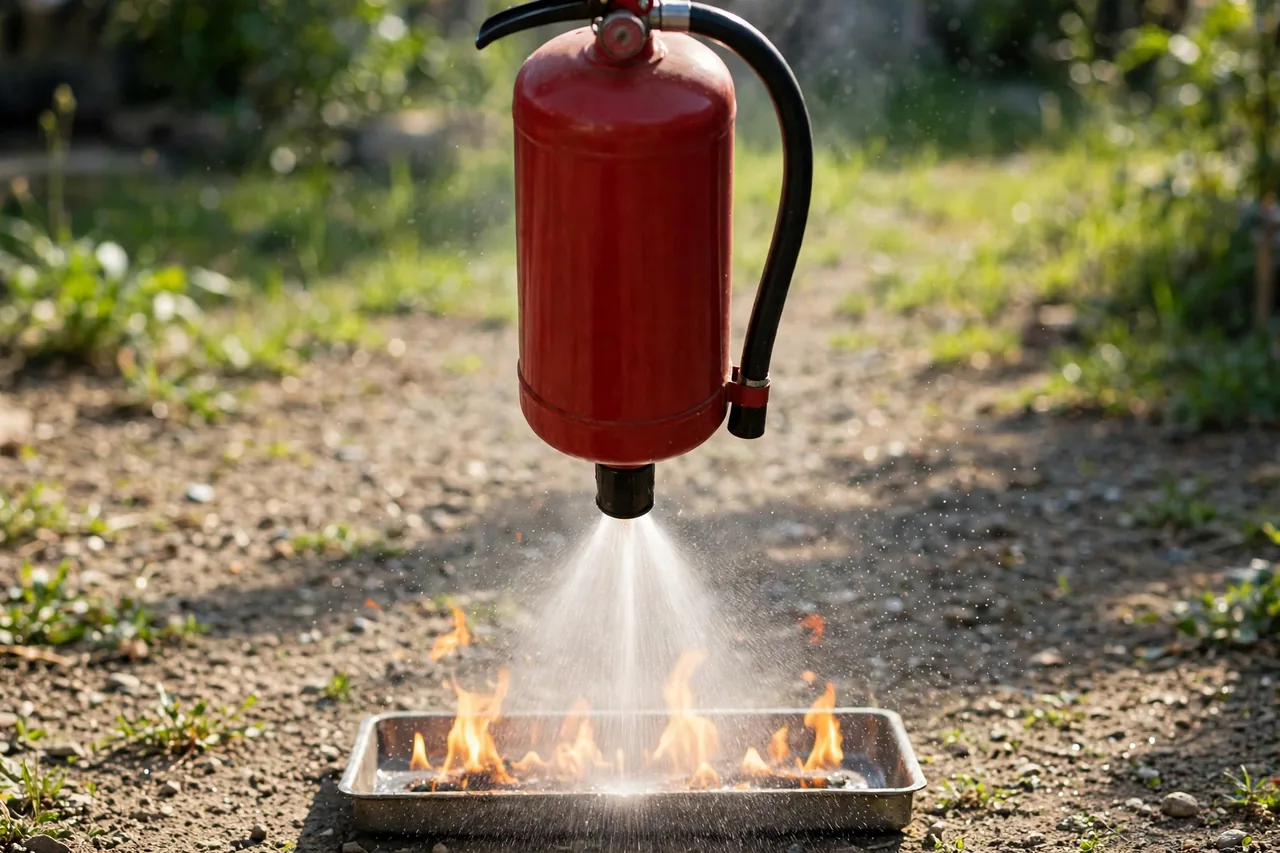
Every extinguisher in the US uses the same four-step method, remembered as PASS. Pull the pin at the top of the handle, breaking the tamper seal. Aim the nozzle low, at the base of the fire, not at the flames. Squeeze the handle slowly and evenly. Sweep the nozzle from side to side across the base of the fire until it is out. The whole discharge lasts only about 10 to 20 seconds on a typical 5-pound home unit, so aim carefully and do not waste the first burst on the flames.
Before you pull the pin, do three things. First, make sure someone has called 911 or is calling. Second, check that your back is to an exit and the fire is between you and nothing you need. Third, read the gauge: if the needle sits in the green, the unit is charged. Then fight the fire in short bursts, watching for re-ignition, and back out the moment the fire grows or the smoke thickens. After any discharge, even a short one, the extinguisher needs recharging or replacement — a partly used unit may not work the next time. Our fire escape plan guide shows how to plan the exit you will use if the extinguisher does not finish the job, and that plan matters more than the tool itself.
How to Read the Label: Ratings Like 2A:10B:C
The numbers in front of the letters measure capacity, not size. Kidde explains that the numbers before the letter A represent the rating for that capability, and the numbers before the letter B do the same for flammable-liquid fires. The A number roughly equals gallons of water equivalent: a 2A unit puts out about twice the ordinary-combustible fire a 1A unit does. The B number is roughly the square footage of flammable-liquid fire the unit can cover: a 10B unit handles about 10 square feet. The letter C carries no number, because it only confirms the agent is safe on live electrical equipment.
For a home, the ratings to shop for are simple. A 2A:10B:C unit, usually about 5 pounds, is the right size for the kitchen and the garage: big enough to matter, light enough for any adult to lift and aim. A 1A:10B:C unit, usually about 2.5 pounds, fits a car, a boat, or a small apartment. Bigger numbers look better on the shelf, but a 10-pound unit that nobody in the house can lift with one hand is worse than a 5-pound unit everyone can use. Buy the rating your household can actually handle, then mount it where hands can reach it. Where exactly to hang each one is the next decision, and most homes get it half right.
Where to Put Fire Extinguishers in Your Home
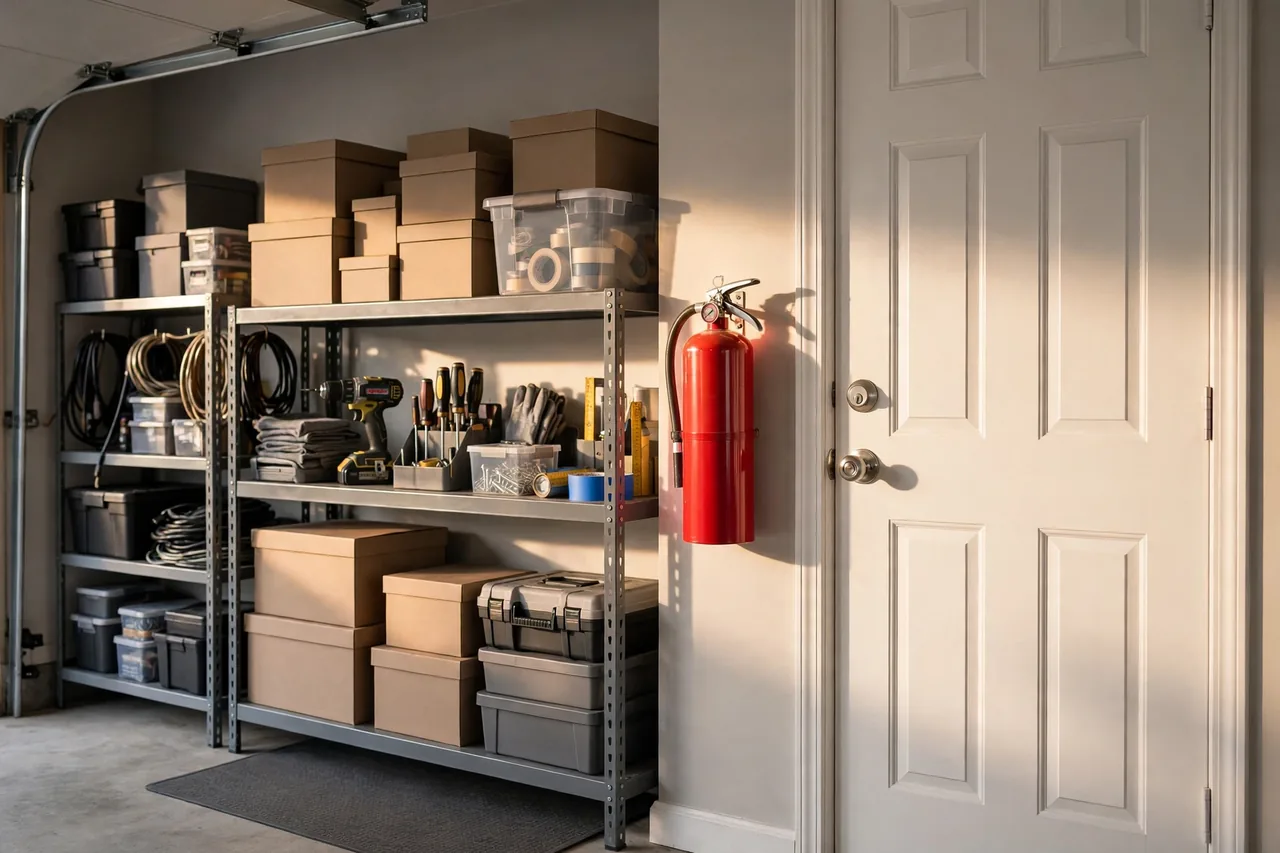
Put an extinguisher by the exit of every room where a fire is likely to start, never beside the hazard itself. In the kitchen, mount the ABC unit near the door, not beside the stove, so a stove fire never sits between you and the extinguisher. In the garage, mount a 5-pound 2A:10B:C unit by the door into the house, where gasoline, oil, and paint live. In the bedroom hallway, a small unit covers a bedroom fire and lights the way out. In the car, a compact 1A:10B:C unit with a solid metal bracket rides where the driver can reach it.
Mount the unit on a wall bracket with the handle about waist to chest high, where the gauge is visible at a glance. Keep it out of damp spots and away from heat sources, and never bury it behind coats, boxes, or cleaning supplies. A monthly glance at the gauge is the whole maintenance program for most units: green means charged, red means replace or recharge. If your home has a monitored alarm, our monitored fire alarm guide explains how detection and suppression work together, and our smoke detector testing guide covers the monthly test that should happen on the same day you check the gauge. The extinguisher puts out the fire; the detector tells you the fire exists. You need both, and the detector goes off first.
Maintenance: The 30-Second Monthly Check
Once a month, spend thirty seconds on each extinguisher. Check that the pressure gauge needle sits in the green. Check that the pull pin is in place and the tamper seal is unbroken. Check that the hose is not cracked or blocked and the nozzle is clear. Turn a dry chemical unit upside down and tap the bottom firmly a few times, because the powder can settle and pack down over months of sitting still, and a packed unit may discharge weakly or not at all.
After any use, recharge a rechargeable unit or replace a disposable one, even if you only fired a short burst. Check the manufacture date stamped on the label, and follow the maker’s replacement guidance: many disposable home units are rated for about 12 years, but the gauge is the real authority — a unit in the red is done regardless of its age. If the gauge reads low, the pin is gone, or the body is dented or corroded, replace the unit and do not keep it as a backup. A dead extinguisher on the wall is worse than none, because it invites you to stay and fight a fire you cannot win. Our smoke alarm check guide pairs this monthly routine with your detector test, and our fire alarm installation cost guide covers the bigger system that backs up these small tools.
When NOT to Fight a Fire — and a Safety Note
Do not fight a fire that is bigger than a wastebasket, a fire that has spread to the walls or ceiling, a fire filling the room with smoke, or any fire when your exit is blocked. Get out, close the door behind you to slow the spread, and call 911 from outside. If the extinguisher does not knock the fire down within a few seconds, it will not knock it down at all — leave. Never go back inside for pets, photos, or valuables; firefighters will tell you the same.
This guide is general information, not fire-safety advice for your specific home. Fire codes and extinguisher rules vary by state and by building type, and commercial kitchens, rentals, and multi-family buildings have requirements a single-family home does not. If you are unsure what your home needs, ask your local fire department — most offer free home safety visits and will check your extinguisher placement in person. That visit costs nothing and can catch the one mistake this guide cannot see.
Related Guides
If you are building a full home fire-safety setup, start with our fire escape plan guide, then read our smoke detector testing guide and our monitored fire alarm guide. For costs, our fire alarm installation cost guide breaks down what a full system runs.
Frequently Asked Questions
How many types of fire extinguishers are there?
There are five fire classes in the US — A, B, C, D, and K — and six common extinguisher types: dry chemical, water, foam, CO2, wet chemical, and clean agent, per Kidde. Most homes need only one type: a multipurpose dry chemical ABC unit.
What type of fire extinguisher is used for electrical fires?
Use an ABC dry chemical extinguisher or a CO2 extinguisher on an electrical fire. Both use non-conductive agents, so they will not shock you. Cut the power first if you can do it safely, and never use water on a live electrical fire.
What type of fire extinguisher is used for grease fires?
A Class K wet chemical extinguisher is the right tool for a grease fire, because it cools the oil and forms a soapy layer that stops re-ignition. An ABC unit works on a small grease fire, but never use water — it throws burning oil across the room.
What type of fire extinguisher for home?
A multipurpose dry chemical extinguisher rated 2A:10B:C, about 5 pounds, is the best home extinguisher. Put one by the kitchen exit and one in the garage. Add a Class K unit only if you deep-fry, and a small CO2 unit near electronics.
Can you use a fire extinguisher on a grease fire?
Yes, an ABC dry chemical extinguisher can put out a small grease fire, and a Class K wet chemical extinguisher does it better. A lid or fire blanket smothers a pan fire even faster. Never use water on any grease fire, in any amount.
How long does a fire extinguisher last?
Check the gauge monthly: green means charged, red means replace or recharge. Replace any extinguisher after any use, even a short burst. Many disposable home units are rated for about 12 years, but the gauge, not the date, is the real authority.
Buy the ABC unit first, mount it by the kitchen exit, and check the gauge on the first of every month. Then add the Class K unit if you fry, the CO2 unit if you have expensive electronics, and the escape plan that makes all of them a backup instead of a gamble. Start with our fire escape plan guide tonight — it takes twenty minutes and it is the part of fire safety that actually saves lives.