
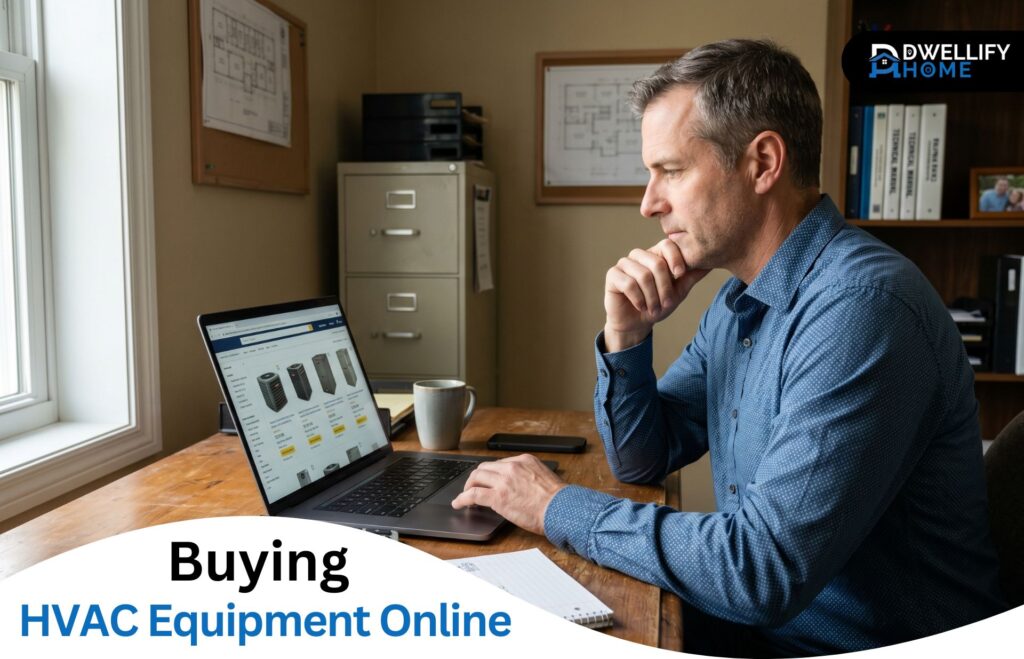
For landlords and small business owners, the decision to buy HVAC equipment online is rarely about preference. It is about controlling costs on a recurring expense that can quietly drain profitability. A single rooftop unit replacement on a small commercial space can run $8,000 to $15,000 through a traditional contractor, while a duplex with two failing furnaces can demand $10,000 in a single quarter. Multiply that across a portfolio of rentals or a chain of small business locations, and the case for online purchasing becomes obvious.
The challenge is that rental properties and small businesses introduce wrinkles that homeowners do not face. Tenant comfort, code compliance, business interruption, tax treatment, and long-term portfolio strategy all factor into the buying decision. This playbook walks through how to approach online HVAC purchases when the unit is not for your own home.
Start With a Replacement Strategy, Not a Single Purchase
Owners with multiple properties or locations should think in terms of fleet management rather than one-off replacements. Standardizing on one or two equipment brands and capacity ranges produces meaningful operational benefits. Maintenance contractors can stock common parts, technicians become familiar with specific models, and bulk purchasing leverage emerges over time.
Look at your portfolio and group properties by similar characteristics: square footage ranges, climate zone, fuel type, and age. Identify the two or three system configurations that cover the majority of your locations. When equipment fails, you already know what to order, which compresses the painful window between failure and restoration.
Build a Relationship With an Installer Who Welcomes Online Equipment
The single biggest practical obstacle to online HVAC purchasing for landlords and small business owners is finding installers willing to work with owner-supplied equipment. Many contractors refuse outright, and others charge labor premiums that erode the savings. Before you make a single online purchase, identify and cultivate relationships with local installers who specialize in this arrangement.
Independent contractors, smaller mechanical shops, and contractors who serve property management companies are typically more receptive than large branded service companies. Get written labor pricing for standard installations: residential furnace replacement, residential condenser replacement, package unit swap, and mini-split installation. With pricing locked in across your typical configurations, you can quickly calculate total project costs whenever a unit fails.
Some owners formalize this with a service agreement that gives the contractor first call on installation work in exchange for guaranteed labor rates. This arrangement benefits both parties and removes friction from emergency replacements.
Match Equipment Quality to Property Strategy
Not every rental property or business location justifies premium equipment. A property you plan to sell within three years has different needs than a property you intend to hold for two decades. A high-rent unit in a competitive market needs better comfort performance than a value-tier unit where tenants prioritize price.
For short-hold properties, baseline efficiency equipment that meets minimum federal standards usually makes financial sense. The energy savings from premium equipment accrue over years, and you will not own the property long enough to capture them. Focus instead on reliability, parts availability, and the lowest credible total cost.
For long-hold properties, the math shifts. Higher SEER2 and HSPF2 ratings produce energy savings that translate to higher net operating income over a fifteen to twenty year holding period. If you pay utilities directly, the savings are immediate. If tenants pay utilities, the equipment still helps with retention and rent positioning in markets where energy costs influence tenant decisions.
For commercial spaces, factor in operating hours. A retail space open seventy hours a week consumes far more energy than a residential rental, which makes efficiency upgrades pay back faster.
Take Advantage of Tax Treatment
Equipment purchases for rental properties and businesses receive significantly better tax treatment than personal residential purchases. Section 179 of the tax code allows businesses to deduct the full cost of qualifying HVAC equipment in the year it is placed in service, up to annual limits. Bonus depreciation rules may permit additional first-year deductions depending on the current year’s provisions.
For residential rental property, HVAC replacement is typically depreciated over 27.5 years as part of the building, though specific components may qualify for shorter recovery periods under cost segregation studies. The Inflation Reduction Act introduced additional incentives for heat pumps and high-efficiency equipment that property owners can stack with traditional depreciation.
Talk with your accountant before placing significant orders. The difference between immediate expensing and 27.5-year depreciation affects your cash position, and the choice of equipment type can shift the answer.
Plan Around Tenant and Business Interruption
Equipment failures rarely happen at convenient times. A furnace that fails on a Friday evening in January creates immediate habitability obligations for landlords and immediate revenue loss for businesses that cannot operate without climate control. The traditional contractor model handles this through rapid response, often at premium pricing. The online equipment model requires you to build that response capacity yourself.
Stock common replacement parts in advance for your fleet’s most failure-prone components: capacitors, contactors, ignitors, blower motors, and condensate pumps. For high-stakes locations, consider keeping a complete spare unit on hand if your portfolio is large enough to justify it. Establish backup HVAC arrangements for emergencies: portable units for short-term tenant comfort, or relationships with contractors who can provide rental equipment during extended replacement projects.
Pre-negotiate emergency response terms with your installer. Knowing your contractor’s after-hours rate and response window helps you make better decisions when failures occur.
Manage the Documentation Carefully
Online HVAC purchases for rental property or business use generate paperwork that matters more than it does for owner-occupied homes. Keep complete records of every purchase: invoices, model and serial numbers, installation dates, contractor invoices, permit documentation, warranty registrations, and any correspondence with manufacturers about authorized dealer status.
This documentation supports tax positions, warranty claims, insurance claims, and eventual property sale due diligence. Buyers of investment properties increasingly request mechanical system documentation, and well-organized records can support higher sale prices.
For warranty registration specifically, register every unit immediately after installation and confirm the registration in writing. Manufacturers sometimes require professional installation documentation including refrigerant pressure readings and startup checklists. Make sure your installer provides these and store them with the equipment records.
A Practical Sequence for Each Replacement
Once you have the foundation in place, individual replacements become routine. The sequence works like this. Confirm equipment specifications using your standardized configurations. Buy HVAC equipment online from your verified retailer. Coordinate delivery with your installer’s schedule. Pull permits in your name or your installer’s name as appropriate. Complete installation, registration, and documentation. File the records into your property or location file.
The savings compound over time. A landlord with ten units who saves $2,000 per HVAC replacement captures $20,000 across a single replacement cycle, with the benefits flowing directly to the bottom line. The discipline required to capture those savings is real, but for owners willing to build the system, the returns are difficult to match through any other operational improvement.
Thanks for being here! Don’t miss out on our other articles before you leave. As a heads-up, some of the links in this post may be affiliate or sponsored links. If you make a purchase through them, we may earn a small commission, which directly supports the growth of Dwellifyhome.com. All views and opinions in this article are solely those of the author and do not necessarily represent the official position of Dwellifyhome.com.